Claude Opus 4.8 landed on May 28, 2026, and within hours the same question started showing up everywhere: okay, but should I switch? The launch benchmarks look strong, GPT-5.5 is still the coding favorite for a lot of people, and Gemini 3.5 Flash keeps winning on price and speed. Three flagship-ish models, three different sales pitches.
The honest answer is that there’s no single winner in June 2026 — there’s a winner per job. Here’s the comparison framed the way you’d actually decide, using Anthropic’s own launch numbers and the current public pricing for all three.
What the benchmarks actually say
Anthropic published a head-to-head table at launch. It’s worth looking at before anyone tells you who “won,” because the table itself shows the answer is split.
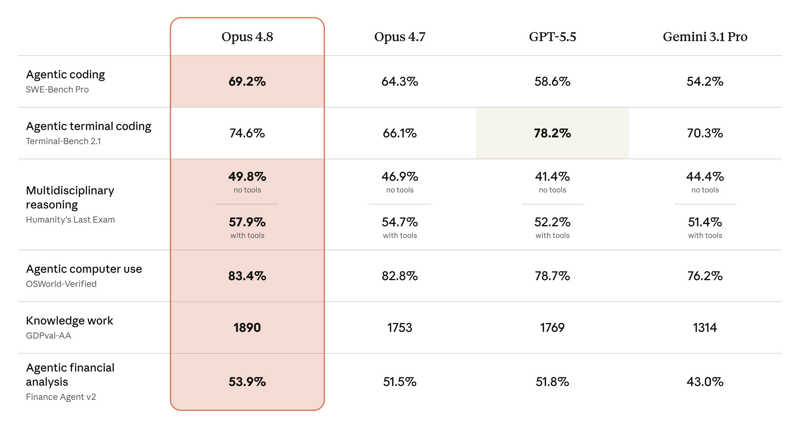
Read across the rows and a pattern jumps out:
- Agentic coding (SWE-Bench Pro): Opus 4.8 69.2% vs GPT-5.5 58.6% vs Gemini 3.1 Pro 54.2%. Clear Claude lead.
- Agentic terminal coding (Terminal-Bench 2.1): GPT-5.5 78.2% vs Opus 4.8 74.6%. GPT-5.5 wins this one — the one row Anthropic didn’t highlight in pink.
- Agentic computer use (OSWorld-Verified): Opus 4.8 83.4% vs GPT-5.5 78.7%.
- Knowledge work (GDPval-AA): Opus 4.8 1890 Elo vs GPT-5.5 1769 vs Gemini 3.1 Pro 1314.
- Multidisciplinary reasoning (Humanity’s Last Exam): Opus 4.8 leads both with and without tools.
- Financial analysis (Finance Agent v2): Opus 4.8 53.9% edges GPT-5.5’s 51.8%.
So Opus 4.8 takes most of the agentic categories, and Anthropic separately calls its 84% on Online-Mind2Web “a meaningful jump over both Opus 4.7 and GPT-5.5” for web agents. But notice GPT-5.5 still owns the terminal-coding row — and that’s the workflow a huge number of developers live in all day. One skeptic on X put the cynical version bluntly: “Is Claude Opus 4.8 actually better than GPT-5.5, or just better enterprise sales?” Fair question. The benchmarks say “better at agentic depth, not at everything.”
The “Gemini” you mean matters
Quick but important: “Gemini” isn’t one model. There are two you might be comparing against, and they play completely different games.
- Gemini 3.1 Pro is Google’s flagship reasoning model — the one in Anthropic’s benchmark table, where it trails both Opus 4.8 and GPT-5.5 on most agentic rows.
- Gemini 3.5 Flash is the speed-and-cost play. It runs at over 280 output tokens per second — roughly 4× faster than comparable frontier models, and scores about 55 on the independent Artificial Analysis Intelligence Index, within two points of Claude Opus 4.7 — at a fraction of the price.
If your comparison is “best raw answer,” it’s Opus 4.8 or GPT-5.5. If it’s “good-enough answer, fast and cheap, at scale,” that’s where Gemini 3.5 Flash gets interesting.
Pick by job, not by leaderboard
Here’s the decision frame that actually holds up:
- Reach for Opus 4.8 when the task is long, multi-step, and agentic — refactors across a codebase, research that runs for a while, analysis where you need it to catch its own mistakes. Anthropic leaned hard into “honesty” this release (the model is ~4× less likely to let flaws in its own code pass unremarked), and early users keep repeating the same line: it “stops saying ‘done’ when it’s half done.” That reliability is the real differentiator, more than any single benchmark point.
- Reach for GPT-5.5 when you live in the terminal and the Codex CLI workflow. It still leads Terminal-Bench, and if your muscle memory is built around it, the gap to Opus on that specific harness isn’t worth switching for.
- Reach for Gemini 3.1 Pro when you’re already inside Google Workspace and want reasoning that’s one click from Gmail, Docs, and Drive.
- Reach for Gemini 3.5 Flash when volume and latency dominate — classification at scale, chat features in a product, anything where you’d run thousands of calls and a two-point intelligence gap is invisible but a 3× cost gap is not.
The price reality
Cost flips the picture for high-volume work. Per million tokens (input / output):
| Model | Input | Output | Best at |
|---|---|---|---|
| Claude Opus 4.8 | $5.00 | $25.00 | agentic depth, autonomy |
| GPT-5.5 | $5.00 | $30.00 | terminal coding |
| Gemini 3.1 Pro | ~$2–18* | — | Google-native reasoning |
| Gemini 3.5 Flash | $1.50 | $9.00 | speed + scale |
Gemini 3.1 Pro pricing varies by context length. Sources: Anthropic, LLM-Stats, Artificial Analysis.
Opus 4.8 and GPT-5.5 sit at premium parity. Gemini 3.5 Flash is roughly a third of GPT-5.5’s price — which is exactly why it’s the default for cost-sensitive production, even when it isn’t the smartest model in the room. (And if you want Opus-level intelligence cheaper, Opus 4.8’s own Fast Mode is a separate lever worth knowing about.)
What this means for you
If you’re a solo developer or indie hacker: Use what’s already in your subscription. If you’re on Claude Max, Opus 4.8 for agentic work is a real upgrade and costs you nothing extra. If you’re deep in Codex, GPT-5.5 is fine — don’t switch on a benchmark you don’t run.
If you’re building a product feature on an API: Route by task. Opus 4.8 for the hard, agentic calls; Gemini 3.5 Flash for the high-volume, low-stakes ones. Paying Opus rates for a classification endpoint is the most common money leak we see.
If you’re a non-technical professional (writer, analyst, marketer): Honestly, any of the three writes a great email. Pick based on where your other work lives — Workspace → Gemini, everything-app → ChatGPT, deep-work-and-honesty → Claude. The differences that matter to you are integration and habit, not SWE-Bench.
If you’re choosing one tool for a small team: Opus 4.8’s reliability-on-long-tasks is the safest single bet for mixed work, with Gemini 3.5 Flash as the cheap second model for bulk jobs. Two models, routed by job, beats forcing everything through one.
What a benchmark can’t tell you
- Your workflow isn’t a benchmark. SWE-Bench Pro is not your codebase. The model that tops the chart can still lose on your repo with your conventions. Trial it on a real ticket before you commit.
- Harnesses change the numbers. Anthropic noted GPT-5.5’s terminal score depends on the harness (its Codex CLI run scored higher than the public Terminus-2 harness used in the table). Comparison numbers assume a setup that may not be yours.
- “Honesty” and “taste” don’t have a column. The qualities early Opus 4.8 users rave about — pushing back on a bad plan, not over-claiming — barely show up in a percentage. They show up after a week of real use.
- Prices move monthly. Every vendor repriced newer models up in 2026. Today’s table is a snapshot, not a contract.
- A two-point intelligence gap can be irrelevant — or decisive. For a chatbot, invisible. For autonomous code that ships to production, that gap is the bug you didn’t catch. Match the model to the stakes.
The bottom line
In June 2026, stop asking “which model is best” and start asking “best at what.” Opus 4.8 for agentic depth and long autonomous work. GPT-5.5 for the terminal. Gemini 3.1 Pro if you live in Workspace. Gemini 3.5 Flash when speed and cost beat the last two points of intelligence. Most serious setups use at least two of them, routed by job — and that routing decision saves more money than picking the “winner” ever will.
Want to actually feel the difference instead of reading benchmark tables? Our ChatGPT vs Claude course runs the same real tasks through each so you can pick by experience, and AI Fundamentals covers the routing mindset — matching the model to the job — that turns a tool list into a workflow.
Sources
- Introducing Claude Opus 4.8 — Anthropic
- Gemini 3.5 Flash: Benchmarks, Pricing, and Complete Specs — LLM-Stats
- Gemini 3.5 Flash — Intelligence, Performance & Price Analysis — Artificial Analysis
- Gemini 3.5 Flash vs GPT-5.5: Benchmarks, Features, Use Cases — DataCamp
- Google’s Gemini 3.5 Flash follows Anthropic and OpenAI in making newer models pricier — The Decoder
