It’s a heat wave, every fridge and freezer in town is picking the worst week to die, and your inbox is full of messages like “hey my fridge is making a weird noise and kinda warm, can someone come???” No brand. No model. No idea how urgent. So you play twenty questions over text, half the details arrive after you’ve already loaded the truck, and you show up without the part you needed.
There’s a faster front door, and it’s not an AI receptionist replacing your phone. It’s using ChatGPT to do the boring middle bit — turn a customer’s vague, panicky message into a clean, structured repair ticket, and write the professional arrival-window text that makes you look like the organized shop in town. That’s a real time-saver. But appliance repair is also a trade where AI can get someone hurt, so the safety line here is the most important paragraph on the page. Let’s do both.
Why this matters right now
Homeowners expect speed. One 2026 appliance-repair lead study found 56% of customers want 24/7 scheduling or after-hours communication, and responding within minutes — not hours — is the single biggest thing separating the shop that gets the job from the one that gets voicemail. When a freezer’s defrosting onto the kitchen floor, the first clear, calm, professional reply usually wins.
The problem is that “fast and professional” is hard when you’re under a dishwasher. That’s exactly the gap ChatGPT fills — not by talking to your customer, but by helping you turn their mess of a message into something you can dispatch on, and reply to, in seconds.
Step 1: Turn the messy message into a clean ticket
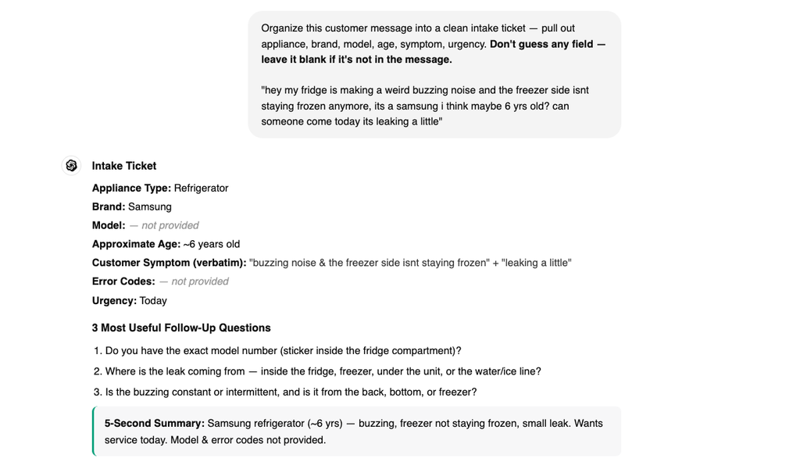
Paste the customer’s actual text into ChatGPT with this:
You’re helping me, an appliance repair tech, organize an incoming customer message into a clean intake ticket. Pull out: appliance type, brand, model number (if mentioned), approximate age, the symptom in the customer’s own words, any error codes, and urgency (today / this week / flexible). Do not guess or invent any field — if it’s not in the message, leave it blank. Then list the 3 most useful follow-up questions I should ask to fill the blanks. Give me the ticket as a short summary I can read in 5 seconds.
What you get back is a tidy ticket — Refrigerator · brand unknown · symptom: “buzzing + not cold” · urgency: today · missing: model, age — plus the exact three questions to text back. The “do not guess” instruction is doing real work: you never want the bot inventing a model number that sends you out with the wrong compressor.
This is the difference between arriving prepared and arriving twice. Fewer wasted trips, the right parts on the truck, and a customer who already feels handled.
Step 2: The arrival-window text that builds trust
Now the reply. Customers don’t just want a time — they want to feel like a real business is coming. Ask once, save the templates:
Write a concise, professional SMS confirming an appliance repair appointment. Include: the date, a 2-hour arrival window, one line of prep (“please clear access to the appliance and secure any pets”), and how to reschedule. Warm but professional. Then write 3 variants: same-day emergency, next-day standard, and a “running late, new window” message.
Five seconds, and you’ve got the canned texts that used to be either rushed and curt or never sent at all. The client communication template and service agreement writer skills keep these — plus your quote-confirms, parts-delay notices, and review replies — organized and in your voice.
ChatGPT is just as good for the marketing side — Google Business Profile posts, service-page copy, the polite review request after a clean job. Same rule applies: it writes the words, you own the facts.
The line you don’t cross — read this twice
This is the part that matters more in appliance repair than almost any trade, because the failure mode isn’t an awkward email. It’s a fire or a shock.
ChatGPT organizes the customer’s words and writes your comms. It never diagnoses the fault, and it never tells anyone to touch a gas line or a powered appliance.
- Never the diagnosis. “Buzzing fridge” is not “bad compressor relay.” AI pattern-matches confidently and wrongly; the actual fault is found by you, on site, with a meter. Don’t let it guess the problem and don’t repeat its guess to the customer.
- Never a DIY safety instruction. It must never tell a customer to bypass a gas valve, open a powered appliance, reset a breaker repeatedly, or “just check the heating element.” That’s how people get hurt. The intake captures the symptom; the fix is a trained tech’s job.
- Never a firm quote sight-unseen. AI can write the wording around pricing. The number comes after you see the unit.
Here’s the part worth knowing: your customers are already doing the dangerous version. Techs all over the trade forums report the same headache — someone runs their symptom through an AI, gets a confident wrong answer, and argues “but my AI said it’s just the thermostat.” Your edge is being the calm professional who says “let’s have a tech confirm that safely” — and never being the shop whose own chatbot handed out the bad advice. (The pest-control trade learned the same lesson: AI writes the customer text, never the thing that’s regulated and dangerous.)
What this means for you
If you’re a solo tech: this is your dispatcher. Clean tickets and instant professional replies, without hiring anyone — so you arrive prepared and look twice your size.
If you run a small shop: standardize the intake prompt and the text templates across everyone who answers messages. Consistent, fast, professional replies are a competitive moat when the other shop sends “k we’ll come by sometime.”
If you’re swamped in peak season: the time saved isn’t in the texting — it’s in the trips you don’t repeat because the ticket was complete before you left. That’s real money in a heat wave.
If you do your own marketing: lean on AI for the Google posts, service pages, and review replies too. Just keep every technical claim and price under your control.
What this won’t do for you
- It won’t diagnose the appliance. Ever. Symptom in, ticket out — the fault is yours to find on site.
- It won’t give safe repair advice. It must never coach a customer near gas, power, or water. That’s a liability you don’t want and a danger they don’t deserve.
- It won’t quote a real job. The wording, yes. The number, only after you see it.
- It won’t replace your phone. A clear text wins the lead; the relationship and the repair are still yours.
- It won’t know a model it wasn’t told. No guessing parts. Blank stays blank until the customer confirms.
The bottom line
The appliance shops that win the heat-wave rush aren’t the ones with the slickest tech — they’re the ones who reply first, arrive prepared, and sound like a real business doing it. ChatGPT gets you there by turning a panicked one-liner into a clean ticket and a professional text in seconds. It just never crosses into the diagnosis or the safety call — because in this trade, that line is where someone gets hurt.
Want the whole front-office workflow — intake, arrival texts, quote confirms, review replies, Google posts — in one place built for non-technical owners? Our AI for Business course walks you through it, and Getting Found by AI covers showing up when someone asks ChatGPT “who fixes fridges near me?”
Organize the words. Send the fast text. Leave the diagnosis to the meter.
Sources
- Appliance Repair Lead Generation 2026 (56% want 24/7 scheduling; respond in minutes) — LeadTruffle
- Using AI Tools for Appliance Repair Marketing — Appliance Marketing Pros
- Appliance Repair Marketing: 14 Strategies to Grow in 2026 — Comrade Digital Marketing
- How ChatGPT Is Changing Appliance Repair (intake & comms, not diagnosis) — Fluid Services
- ChatGPT Local Search reality for contractors 2026 — MarketingCode
