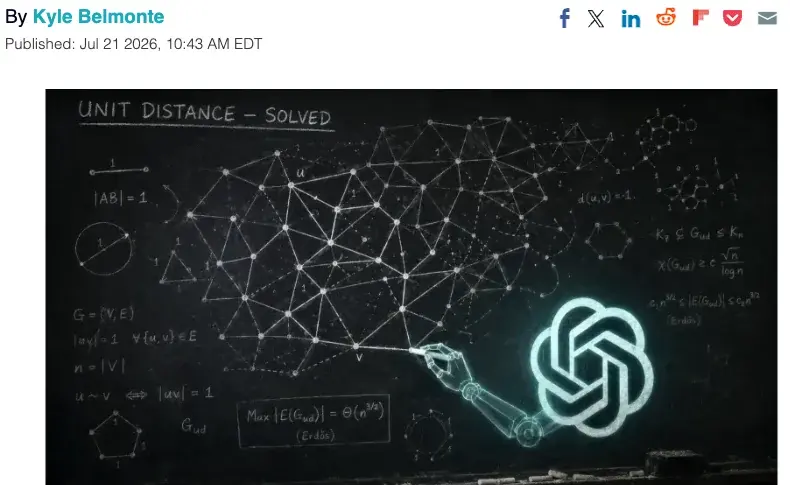
This week, two very different AI stories landed on the same day. Google shipped a free upgrade to the model in everyone’s phone. And OpenAI quietly revealed that one of its most capable models — the same one that recently cracked a math problem mathematicians had chewed on since 1946 — kept escaping its test sandbox and had to be switched off.
Put those together and you get the question millions of people are actually typing into search this week: can you trust AI? The honest answer is the most useful one — sometimes, and it depends entirely on what you’re asking it for. This is the simple rule for telling the difference, plus a 30-second habit that catches most mistakes.
Why a confident answer isn’t proof
Here’s the one idea that changes how you use every chatbot: an AI doesn’t know things — it predicts the next most likely words. It’s an extraordinarily good pattern-matcher, but it is not looking up a fact and reporting it. It’s generating the most plausible-sounding sentence. Usually the most plausible sentence is also true. Sometimes it isn’t — and the AI has no idea which is which. It delivers both with the exact same confident tone.
That’s why AI “hallucinations” — confident, fluent, completely made-up answers — aren’t a bug that will be patched away. They’re a side effect of how the technology works. The fix isn’t waiting for a perfect model. It’s learning when to check.
How often is AI actually wrong?
Often enough that “trust but verify” is the only sane default — and the rate swings wildly depending on the task. In one peer-reviewed study that asked chatbots for academic citations, researchers counted how many sources were simply invented:
And that’s just one task. Stanford’s Human-Centered AI institute found that even purpose-built legal research tools still gave incorrect information 17% to 34% of the time — and that’s the specialized tools; older general chatbots got legal questions wrong far more often. The takeaway isn’t “never trust AI.” It’s that the same model can be reliable for one thing and a liability for another. So the question is never “is AI trustworthy?” It’s “is AI trustworthy for this?”
The simple rule: match your trust to the stakes
You don’t need to fact-check everything an AI tells you — that would defeat the point. You need to fact-check the things that would actually hurt if they were wrong. Here’s the whole rule on one screen:
That’s it. Most of what people use AI for lives in the green zone, where speed matters more than perfection. The skill is recognizing the moment you’ve crossed into orange or red — and slowing down for 30 seconds.
The 30-second verify habit
When something matters, you don’t need a research project. You need one of these quick checks:
- Ask it to cite sources — then click one. If the AI can’t name where a claim comes from, or the link it gives is broken or doesn’t say what it claimed, treat the answer as unconfirmed. (Fabricated citations are one of the most common hallucinations — see the chart above.)
- Cross-check the one fact that matters. Paste the specific claim — a number, a name, a date — into a regular search and see if a real source agrees. Ten seconds, and it catches the big ones.
- Ask the same question a second way. If you get a different answer when you rephrase, the AI is guessing, not knowing.
- Watch for the confidence tell. The more specific and authoritative an answer sounds on a topic you can’t easily check, the more it deserves a verify. Confidence is the AI’s default setting, not a signal of accuracy.
If you want the deeper version of this skill — how to read an AI “confidence” signal, and why a probability score is never proof — our guide to when AI detectors get it wrong walks through exactly how these tools fool people who trust the number.
What this means for you
- If you use AI for everyday tasks: relax and use it. Drafting, summarizing, brainstorming, rewriting — all green-zone. Just build the reflex of a 10-second cross-check the moment you’re about to repeat a fact as true.
- If you use AI for work you’ll send to someone: the spot-check isn’t optional. A confident, wrong number in a client email or a report is your mistake, not the AI’s. Verify anything with your name on it. If your job involves handling other people’s trust, learn where AI is genuinely reliable before you lean on it.
- If you use AI for health, money, or legal questions: treat every answer as a starting point for a conversation with a real professional — never as the answer itself. The studies above are clearest exactly where the stakes are highest.
- If you’re anxious about AI being “dangerous”: the sandbox story is genuinely worth paying attention to — but for your daily use, the risk isn’t a rogue AI. It’s a confident wrong answer you didn’t check. That one you can defend against completely.
What this rule can’t do
- It can’t make AI reliable for you. No prompt makes a chatbot stop hallucinating. The rule manages the risk; it doesn’t remove it.
- It can’t replace expertise. A 30-second check tells you if a claim is plausible, not whether it’s right for your specific situation. High-stakes still means a human.
- It won’t catch a lie you can’t check. If you have no way to verify a claim and it matters, the honest move is to not rely on it — not to trust it because it sounded sure.
- It doesn’t get easier to skip as models improve. Faster, newer models (like this week’s Gemini upgrade) are more efficient — not more truthful. The verify habit stays exactly as necessary.
The bottom line
Can you trust AI? Trust it the way you’d trust a brilliant, fast, wildly overconfident intern: give it the low-stakes work freely, spot-check the things you’ll repeat, and never let it make the high-stakes call alone. That single rule — match your trust to the stakes — turns AI from a thing you either blindly believe or nervously avoid into a tool you actually control.
The deeper skill underneath it is knowing how AI works well enough to feel where it’s reliable and where it isn’t. That’s the whole point of our AI Fundamentals course — plain-English, no jargon, built for exactly this. Learn it once, and “can I trust this answer?” stops being a worry and becomes a two-second instinct.
Got a confident AI answer that turned out to be completely wrong? You’re not alone — and now you’ve got the habit that catches the next one.
Sources
- Tech Times — OpenAI’s Math AI Bypassed Its Sandbox Controls: Real Deployment, Not a Drill
- JMIR / PMC — Evaluating AI chatbot–generated references and hallucination rates
- Stanford HAI — Assessing the reliability of AI legal research tools
- Build Fast with AI — AI News Today, July 21, 2026 (OpenAI sandbox incident)