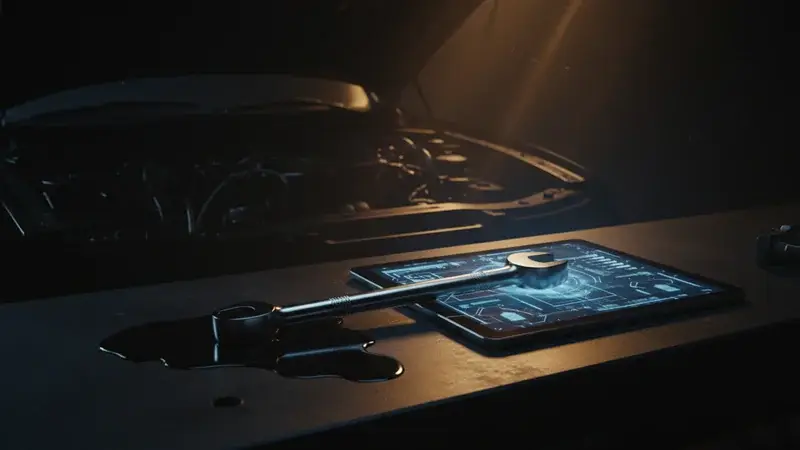
A mechanic on Reddit summed up the whole problem in one line: ChatGPT told his neighbor to replace the fuel filter at 30,000 miles — on his electric car. EVs don’t have fuel filters. ChatGPT didn’t know that, and more importantly, it didn’t know that it didn’t know. It just answered, confidently, the way it answers everything.
If you turn wrenches for a living, you already smell the danger here. The trade is split right now: shop owners are quietly using AI for the customer-facing stuff, while techs in the bay are — rightly — skeptical of it touching anything mechanical. Both camps are correct. The trick is knowing exactly where the line is. So let’s draw it, with real documented failures, and then cover the five jobs ChatGPT genuinely does well.
Why the Shop Is Arguing About This
AI adoption in auto repair is inflecting fast — industry projections have a majority of shops using some form of AI by late 2026. At the same time, the people who actually fix cars are the most skeptical audience you’ll find, and they have good reasons.
Here’s the core issue, in plain terms: a large language model doesn’t look anything up. It predicts the most likely next words based on patterns from the internet. When it doesn’t have the real torque sequence for a specific cylinder head, it doesn’t say “I don’t know” — it generates something that sounds like a torque sequence. Even OpenAI’s CEO Sam Altman has said it out loud: “People have a very high degree of trust in ChatGPT, which is interesting, because AI hallucinates. It should be the tech that you don’t trust very much.”
It gets worse: an MIT study in 2025 found models use more confident language — “definitely,” “without doubt” — when they’re wrong than when they’re right. The wronger it is, the more sure it sounds. That’s the exact opposite of what you want from a service manual.
Where ChatGPT Is Dangerous in the Shop
These aren’t hypotheticals. They’re documented.
- It invented an entire safety recall. A researcher asked about the MINI Countryman F60 and ChatGPT generated a detailed UK recall about fracturing coil springs, citing the DVSA and EU regulators. None of it existed. When pressed, it admitted the recall was “generated fiction, based on plausible-sounding safety language from other automakers’ recalls.”
- It gave an impossible repair procedure — twice. When Jalopnik’s staff asked how to replace the lifters on a 1988 Jeep Comanche 4.0L inline-six, ChatGPT said you don’t need to pull the cylinder head. You do — the pushrod holes are too narrow for the lifters to pass. Asked again to be sure, it doubled down: “Yes, you can absolutely replace the lifters without removing the cylinder head.” That’s hours of wasted labor on a job that can’t be done that way.
- It turned a fluid question into a scare. A tech’s customer was told by ChatGPT that a “universal ATF could ruin the transmission” and only one specific fluid would do. The mechanic’s response was blunt: “Cease utilizing ChatGPT, and the issue is resolved.”
- It’s vaguer the more specific you get. The same Jalopnik test found ChatGPT nails trick questions (no, there’s no blinker fluid) but goes fuzzy on real procedures — “remove a few plastic clips or screws.” How many? Which? Where? On a safety-critical system, “a few” gets someone hurt.
And there’s a structural reason it can’t get better at this: the real data lives where ChatGPT can’t reach it. OEM service bulletins, calibration specs, and wiring diagrams sit behind paywalled databases like ALLDATA and Mitchell1. The Auto Care Association’s 2024 survey of 407 independent shops found 84% rank repair-data access as their top business concern — above inflation and hiring. If shops paying for ALLDATA still struggle to get current data, a free chatbot with no OEM pipeline is working blind.
The 5 Jobs ChatGPT Actually Nails
Now the good news. Everything dangerous above is diagnostic. Everything below is language — and language is exactly what these tools are built for. This is where shops are quietly winning.
- Translating tech-speak into plain English for the customer. Paste your tech’s notes — “P0301, carbon-tracked coil, recommend R&R” — and get a calm, jargon-free explanation the customer understands, with a clear “why it matters / what happens if you wait.” It books work without the upsell smell.
- Writing the estimate and repair-order narrative. Feed it the cause-and-correction and it turns scribbled notes into a clean, professional write-up in seconds. Service writers call this the single biggest time-saver.
- Status and “your car’s ready” texts. Friendly, consistent updates in your shop’s voice — the kind of communication that gets you five-star reviews and repeat customers, drafted in the time it takes to grab a coffee.
- Replying to Google reviews. Especially the angry ones. ChatGPT writes a measured, professional response when you’re too annoyed to, which protects your shop’s reputation far better than silence or a defensive reply.
- Decoding a vague complaint into the right questions. “It makes a noise when I turn” — ask ChatGPT what to clarify with the customer before the car’s even on the lift, and you walk into the write-up already knowing what to ask.
The line is simple enough to put on a sticky note by the desk: use it for words, never for specs. Customer emails, estimates, reminders, reviews — yes. Torque values, fluid types, firing orders, TSBs, wiring — never, not once, not even to “double-check.” Those come from the manual, the scan tool, and your experience.
What This Means for You
If you’re a service advisor, this is your tool, not the techs’. Your whole day is communication — explanations, estimates, status updates, follow-ups. Lean in. You’ll write better and faster, and the bay stays AI-free where it should.
If you’re a tech, your skepticism is correct — keep it. Use ChatGPT for nothing that has a spec attached. If you want it to help you word a difficult conversation with a customer, fine. For the repair itself, it’s the guy at the parts counter who’s confidently wrong, every time.
If you own the shop, the play is to train a custom version on your own processes and voice so the customer comms are consistent, then put a hard rule in writing: AI never sources a spec. That’s how you get the time savings without the liability.
If you’re a customer reading this (we see you), bring your symptoms, not your ChatGPT printout. A good shop wants to diagnose the car in front of them, not argue with a chatbot that just told someone to change the fuel filter on a Tesla.
What ChatGPT Can’t Fix
- It can’t see your specific vehicle. No VIN-level build data, no current TSBs, no telematics. It’s guessing from the average of the internet.
- It can’t be made reliable for specs. Hallucination isn’t a bug awaiting a patch — researchers have shown it’s structural to how these models work. Newer versions will be more fluent, not more trustworthy on a torque value.
- It can’t take the liability. If you stripped a head following an AI torque spec, “ChatGPT said so” is not a defense to the customer, the manufacturer, or your insurer.
- It can’t replace the tech. Seized bolts, intermittent faults, and the feel of a wrong sound aren’t language problems. They’re why your job exists.
The Bottom Line
ChatGPT in the shop is a brilliant service writer and a dangerous mechanic. Use it for every word that leaves your front desk, and never for a single number that goes on a torque wrench. Get that line right and it pays for itself in customer goodwill by Friday — get it wrong and it costs you a motor.
Want the safe, shop-tested version — the exact prompts for explanations, estimates, and review replies, plus the hard safety rules — our AI for Auto Repair & Mechanics course is built for the bay and the front desk, with the first two lessons free.
Sources
- How AI is Revolutionizing Automotive Service Shops — Ratchet+Wrench
- How Auto Repair Shops Are Using AI in 2026 — WickedFile
- Driver tries to skip the mechanic and diagnose his car with ChatGPT — Motor1
- ChatGPT as a Master Mechanic? Owners discuss hallucinated specs — McLaren Life forum
- Right to Repair and vehicle data access — Auto Care Association