
There’s a quiet pattern in foundation-review meetings right now. A panel reviewer on r/nonprofit who reads grants for a living put it bluntly a few weeks ago: “Last year, most applications were written by humans. This year, ~100% are AI-supported.” The reviewer wasn’t complaining. They were observing — and they noted that the success rate still depends on the strength of the underlying program, not the polish of the prose.
That’s the opening for any nonprofit executive director or grant writer reading this. AI doesn’t write a winning grant. It writes a fast first draft that you and your board chair can then make winning. The catch: federal funders now require you to disclose that you used it, and the way you disclose matters as much as the way you write.
This piece walks through four ChatGPT prompts that produce a fundable first draft of a federal grant in about 45 minutes, plus the NSF-PAPPG-compliant disclosure paragraph to paste into the relevant proposal section. You can run all of it on free ChatGPT, the $8/month OpenAI for Nonprofits ChatGPT Team plan via Goodstack, or Claude / Gemini — the prompts are model-agnostic.
What just changed: the federal AI-disclosure rule that’s now real
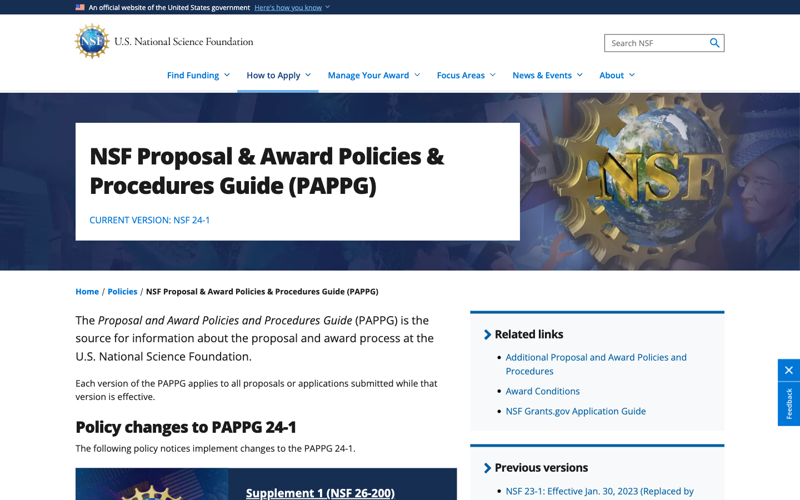
NSF’s current PAPPG (Proposal & Award Policies & Procedures Guide, version 25-1) — in force through 2026 — permits AI use in proposal preparation but requires disclosure of the extent and manner of that use in the relevant proposal section. NSF has not mandated a single boilerplate paragraph; what they’ve signaled, through review panels and program-officer guidance, is that an adequate disclosure names (1) which AI tool, (2) what it was used for, and (3) confirms a qualified human verified the output.
NIH is stricter. NIH wants disclosure in the cover letter or acknowledgments, treats AI-hallucinated citations as researcher misconduct, and has explicitly warned against using AI to generate Specific Aims, biosketches, or budget justifications. Get a citation wrong because ChatGPT hallucinated it and you risk more than a rejection.
SBIR (Small Business Innovation Research) tracks under both — the agency-specific rules apply (DOE has additional language about accessing ChatGPT on a government computer needing business justification). The thread that runs through all of it: the principal investigator is fully accountable. AI cannot be listed as an author. You are responsible for every claim, every number, and every citation in the document.
That’s the legal floor. The 4-prompt workflow below sits on top of it.
The 4-prompt workflow (about 45 minutes end-to-end)
Open ChatGPT. Have ready: the RFP PDF, your organization’s most recent 990, your most recent annual report, your service-population data (counts + 3 facts), your budget table, and any letters of support already secured. Paste those as attachments or excerpts as each prompt requests.
Prompt 1 — Problem statement (10 minutes)
“Using these 3 facts about my service population — [PASTE: 3 facts, e.g., median income, % insurance-uninsured, count served annually] — plus the relevant excerpt of our most recent 990 — [PASTE] — plus this paragraph from our last annual report — [PASTE] — draft a 200-word problem statement for an NSF / NIH / [agency] proposal. The statement should commit to a clear point of view about why current approaches in our service area fall short. Avoid generic phrases like ’leveraging partnerships’ or ‘sustainable impact.’ Lead with the specific gap the proposal will address, then quantify the unmet need using the facts I provided. Write in active voice. Do not invent statistics; if a number isn’t in what I gave you, use a placeholder I can fill in.”
What good output looks like: a 200-word paragraph that names a specific gap (not “underserved community”), uses your 3 facts in-line, and ends with a sentence that previews the proposed approach without yet describing it.
Prompt 2 — Project narrative (15 minutes)
“Using the attached LOI (letter of intent) — [PASTE] — and this RFP scoring rubric — [PASTE the 5 review criteria] — draft a 1,000-word project narrative. The narrative must explicitly address each of the 5 rubric criteria, with the criterion name appearing as a sub-heading. Use specific language from the rubric where the rubric uses specific language. Where the rubric asks for ’evidence of community engagement,’ tell the reviewer what we have done already (cite our actual programs from the LOI), not what we will do. Where the rubric asks for ‘measurable outcomes,’ propose 3 quantitative metrics with baselines and 12-month targets. Write at an 8th-grade reading level for the introduction; technical sections can be more advanced. Do not invent prior outcomes; if a number isn’t in the LOI, flag it for me.”
What good output looks like: a 1,000-word draft with 5 clear sub-headings matching the rubric, real language pulled from your LOI, and 3 named outcome metrics. The “flag it for me” instruction surfaces every place ChatGPT would otherwise hallucinate a number.
Prompt 3 — Budget justification (10 minutes)
“Given this budget table — [PASTE: line items with dollar amounts] — and these federal allowable-cost categories — [list the categories the RFP names: personnel, fringe, travel, equipment, supplies, contractual, other, indirect] — write a 400-word budget justification. For each line item, write 1-2 sentences answering the implicit reviewer question ‘is this reasonable for the work proposed?’ Where indirect-cost recovery applies, name our federally negotiated indirect rate if I told you it. Where match or cost-share is required by this funder, identify which line items count toward match. Do not propose reallocations; my CFO has signed off on the table as-is.”
What good output looks like: a clean per-line-item paragraph that pre-empts the reviewer’s question. The “do not propose reallocations” line saves you the half-hour you’d otherwise spend defending why the table is what it is.
Prompt 4 — Sustainability plan (10 minutes)
“Using our 3-year revenue trend — [PASTE: total revenue and 3 largest line items per year for FY23, FY24, FY25] — plus these 2 letters of support — [PASTE] — write a 250-word sustainability plan that is honest about our funding gaps. The plan should identify (a) which programs the requested grant funds, (b) what continuing-funding sources will cover those programs after the grant period ends, and (c) the realistic gap that remains. Do not promise ‘diversified revenue streams’ or other unfalsifiable language. If the math shows we cannot fully sustain the program post-grant, propose 1 specific mitigation (e.g., absorbing 50% of staff cost into general operating, partnership with [named partner]) and acknowledge the residual risk.”
What good output looks like: a paragraph that names real numbers from your revenue history, identifies a concrete continuing-funding source (not “we will pursue additional grants”), and admits the gap. Funder review panels read hundreds of sustainability plans that all sound the same; an honest plan with a real mitigation stands out.
The NSF-PAPPG-compliant disclosure paragraph (copy-paste)
After you’ve drafted with the four prompts above, paste this paragraph into the relevant proposal section. NSF has not mandated a single boilerplate — this version satisfies the “extent and manner” standard plus the NIH-equivalent expectations. Edit the brackets to fit your situation.
Portions of this proposal’s narrative were drafted with the assistance of generative AI writing tools (specifically [tool name, e.g., ChatGPT-4o via OpenAI for Nonprofits]). These tools were used to support initial drafting, structural organization, and plain-language editing of the [Project Description / Problem Statement / Budget Justification]. All content was substantially reviewed, revised, and verified by the PI and co-investigators named herein. The project team takes full responsibility for the accuracy, originality, and integrity of all proposal content. No AI tool was used to generate citations, data, or claims of prior art without independent verification.
Three notes on the paragraph.
On the tool-name line. Be specific about which tool. “Generative AI” alone is no longer adequate disclosure under most agency interpretations. If you used multiple tools (ChatGPT for draft, Grammarly for editing, Claude for a second-opinion review), list all of them.
On the “substantially reviewed” line. This is the language that activates PI accountability. The reviewer needs to see that you read every sentence and stand behind it. If a panel later asks you to elaborate on a paragraph that’s actually 80% ChatGPT-as-pasted, you will not be able to — and that’s the failure mode r/nonprofit panel reviewers describe most: applicants who can’t speak to their own application because they didn’t really write or read it.
On the citation-and-data line. This is the NIH-level protection. Hallucinated citations are the single most common reason an AI-drafted grant gets rejected for cause rather than for merit. If ChatGPT cites a paper, look it up before you submit. If it cites a statistic, find the source before you submit. The disclosure line does not protect you if a citation turns out to be invented.
The “would I actually say this?” review pass (5 minutes)
Before you send the draft to your board chair, run one pass with this filter on every paragraph: would I — as the ED, as the PI, as the development director — actually say this sentence in a room with the program officer?
ChatGPT writes in a tone that reviewers have learned to recognize. The patterns to watch for and rewrite:
- Em-dashes connecting two clauses that don’t need connection. Cut the em-dash. Use a period.
- “Leveraging” anything. Replace with “using.”
- “Robust.” Replace with the actual mechanism (a 4-person team, a quarterly review cycle, a specific tool).
- “Strategic.” Replace with the actual strategy (a 12-month phased rollout, a partnership with [named partner], a pivot from individual to corporate giving).
- “Diversified revenue streams.” Replace with the actual line items.
- “Equity-centered” / “community-driven” / “stakeholder engagement” if you don’t follow them with specifics.
The same r/nonprofit reviewer who said “100% AI-supported” also described a case where two applicants from the same region submitted “suspiciously uniform” applications — identical phrasings, identical structural choices. When the foundation called them, neither could elaborate on the proposal. One was disqualified; the other was given 48 hours to submit a human-rewritten version. The review-pass filter is what prevents you from being either of those applicants.
What this means for you
If you run a small nonprofit (under $1M budget) and write your own grants
The 4-prompt workflow is for you. It compresses what used to take 3-4 hours into about 45 minutes plus your own review-and-rewrite time. Use free ChatGPT to start; consider OpenAI for Nonprofits via Goodstack at $8/month once you’ve drafted 3 grants and want admin controls, longer context, and the ability to keep prior proposals in a project workspace for tone-matching.
If you’re the executive director of a mid-size nonprofit ($1-5M budget) with a development director
Hand this piece to your dev director. The right division of labor: ChatGPT drafts; dev director reviews, rewrites, fact-checks; you provide the final pass on tone and political nuance. Set a written policy this quarter on which prompts your team is authorized to use, what data they may paste in (no donor PII; no client identifying information from program records), and what the disclosure paragraph will say in every federal proposal you submit.
If you’re a freelance grant writer working with multiple clients
You’re already doing this. The piece worth taking from the workflow above: build a per-client prompt library that bakes in the client’s voice, mission statement, and historical outcome metrics, so each new RFP can be drafted in 30 minutes rather than 90. One r/nonprofit user described doing exactly this with custom LLMs and moving from 3-4 hours to 30 minutes per draft. The win for you is throughput — but document for your client which tool you used and supply them the disclosure-paragraph language.
If you’re an SBIR PI or a faculty grant writer at a small college
The same workflow applies with two adjustments. First, the disclosure paragraph belongs in the cover letter as well as in the relevant proposal section for NIH submissions. Second, the citation-verification rule is non-negotiable — academic peer review is unforgiving on hallucinated references, and the institutional consequence for a fabricated citation is real. Run every citation through your library’s database before you submit.
If you’re a faith-based or 501(c)(3) leader unsure whether OpenAI for Nonprofits applies
Check eligibility. OpenAI for Nonprofits via Goodstack covers most 501(c)(3) organizations but excludes political, religious, and governmental organizations from the discounted ChatGPT Team plan. If your org is excluded, the same prompts work on standard ChatGPT Plus ($20/month) or Claude Pro ($20/month) — the pricing model differs but the workflow doesn’t.
What this workflow can’t fix
It can’t fix a weak underlying program. The foundation-panel-reviewer quote — “success still depends on the program, not the writing” — is the constant. AI compresses your drafting time so you can spend more time on the underlying logic model, the partnership work, and the outcome design. If the program isn’t fundable, faster drafts won’t change that.
It can’t pass a non-disclosed AI review. Some funders now use AI-detection tools (GPTZero, Turnitin AI) on submissions. The 4-prompt workflow above produces text that those tools will flag — and that’s the whole point of the disclosure paragraph. Trying to hide AI use by paraphrasing through three rounds is both unethical and ineffective; tools catch up faster than rephrasing does.
It can’t write your biosketches or your specific aims. NIH explicitly prohibits both. Use AI for outlining, editing, and plain-language rewrites of biosketches and specific aims; do not use it to generate the underlying technical content. If your CV needs polishing, do it by hand.
It can’t replace your prospect research. Every grant writer reading this has felt the temptation to ask ChatGPT “which foundations should I apply to for [program]?” The answer is wrong about half the time — foundations change priorities, sunset programs, and consolidate without ChatGPT’s training-data window updating. Use Foundation Directory Online, Candid, or Instrumentl for prospect research; use ChatGPT to draft your LOI once the prospect list is real.
The bottom line
Federal grant writing changed in the last twelve months. The funders now expect you to use AI. They also expect you to disclose it, to verify it, and to take responsibility for every sentence. The 4-prompt workflow above gives you the writing-time compression; the NSF-PAPPG disclosure paragraph gives you the compliance language; the “would I actually say this?” pass gives you the polish that turns a generic AI draft into something that reads like your organization wrote it.
If you want the longer-form version of this for your team — including a complete prompt library, a per-funder disclosure template (NSF, NIH, SBIR, DOE, state funders, private foundations), the prospect-research workflow we mentioned briefly above, and a downloadable XLSX checklist tying every prompt to the relevant PAPPG / NIH AI section — our Grant Writing course covers the end-to-end workflow.
Sources
- NSF Proposal & Award Policies & Procedures Guide (PAPPG)
- Notice to research community: Use of generative AI in NSF merit review process (NSF)
- Introducing OpenAI for Nonprofits (OpenAI)
- Goodstack — OpenAI for Nonprofits eligibility & $8/mo ChatGPT Team (Goodstack)
- AI for Grant Writing in 2026: A Practical Playbook (OpenGrants)
- 7 AI Grant Writing Tools Tested on Real NIH, NSF, SBIR Proposals (GrantedAI)
- Can I Use ChatGPT for SBIR Grants? NIH’s AI Rules (Akela Consultants)
- Using ChatGPT for grant writing: FAQ guide for nonprofits (FreeWill)
- Using ChatGPT for nonprofits? — r/nonprofit (40 comments)
- PMC: AI use in federal grant proposals (NIH NCBI)