TL;DR — Which plan should I pick?
| You are… | Pick this | Why |
|---|---|---|
| Solo dev, light/daily use | Pro — $20/mo ($17/mo annual) | 5-hour rolling quota fits most workdays |
| Solo dev, full-time on Claude Code | Max 5x — $100/mo | 5× Pro’s quota; hits limits much less often |
| Pair-programming all day | Max 20x — $200/mo | 20× Pro’s quota; for users who never want to think about limits |
| Team of 5+ devs | Team Premium — $100/seat (annual) | Max 5x quota + SSO, SCIM, shared projects, central billing |
| Building an app or integration | API (pay-per-token) | Subscriptions aren’t designed for programmatic use |
| Just curious / kicking tires | Free, then upgrade | Free gives you Claude on web only — Claude Code requires Pro+ |
The honest catch (updated May 11, 2026): Claude Code v2.1.100+ silently inflates token consumption by ~40%. Anthropic shipped six more releases through v2.1.133 (May 8) — adding the --plugin-url flag, working skillOverrides, a 10GB MCP stdio memory leak fix, and sub-agents that finally discover project/user/plugin skills — but none of them publicly patch the underlying token-inflation bug introduced in v2.1.100. The root cause is now believed to be broken prompt caching forcing full re-processing of conversation history on every turn. July 2026 status: later releases shipped partial cache fixes, but community reports still dispute whether the inflation is fully gone — watch Settings → Usage rather than assuming. The old npm-downgrade workaround is obsolete (npm installs are deprecated in favor of the native installer). Historical detail below.
Update, July 10, 2026 — the June 15 billing split is live. Programmatic usage (Agent SDK,
claude -p, third-party agents authenticating through your subscription) now draws from a separate monthly credit pool at API rates: Pro gets $20 of credit, Max 5x $100, Max 20x $200. Interactive Claude Code sessions are unaffected. If that split is your deciding factor, our decision table covers who pays more and who should switch. And if you haven’t set up Claude Code yet, the one-command install guide takes five minutes.
Claude Code doesn’t have one price. It has six.
Between Pro at $20/month, Max at $100 or $200, Team tiers, Enterprise, and pay-as-you-go API billing, figuring out what Claude Code actually costs you is genuinely confusing. And Anthropic hasn’t made it easier — the company admitted on March 31 that quotas were “running out too fast” for paying subscribers, shipped Opus 4.7 on April 16 with the same API prices but a new tokenizer that can bill up to 35% more tokens for the same text, quietly added Claude Code to the Team Standard tier in late April, then on April 21 briefly stripped Claude Code from the Pro tier on the pricing page entirely before reversing the change inside a few hours. (Yes, that one rattled people.)
Here’s the full breakdown, the real math on break-even points, and the honest answer to “is $200/month worth it?”
What Is Claude Code?
Before pricing makes sense, you need to know what you’re paying for.
Claude Code is Anthropic’s agentic coding tool. It lives in your terminal — the text-based command window developers use — and writes, tests, and debugs code alongside you. Think of it as a senior engineer you can chat with, except this one has read your entire codebase and never sleeps.
It’s become Anthropic’s fastest-growing product. In March 2026, “claude code” hit 1 million searches, up 20x from the year before. At the HumanX AI conference this month, Glean’s CEO called it “a religion” among developers. Claude Code now generates an estimated $2.5 billion in annualized revenue.
So yes — the pricing questions matter. A lot of people are trying to figure this out.
The Full Plan Lineup
Here’s what Anthropic sells, ranked cheapest to most expensive:
| Plan | Price | Claude Code? | Rate Limits (~5hr window) | Best For |
|---|---|---|---|---|
| Free | $0 | No | Limited Claude.ai web only | Testing Claude web, not Claude Code |
| Pro | $20/mo ($17/mo annual) | Yes | ~44K tokens, ~45 messages | Solo developers, light-to-medium daily use |
| Max 5x | $100/mo | Yes | ~88K tokens, ~225 messages | Power users, full-day coding sessions |
| Max 20x | $200/mo | Yes | ~220K tokens, ~900 messages | Heavy users, pair-programming all day |
| Team Standard | $20/seat (annual), $25 (monthly) | Yes (added late April 2026) | Pro-level per seat | Small dev teams on a budget |
| Team Premium | $100/seat (annual), $125 (monthly) | Yes | Max 5x-level per seat | Dev teams needing higher quota + SSO |
| Enterprise | Custom (from ~$50K/yr) | Yes | Negotiated + compliance API | Orgs needing RBAC, SCIM, data residency |
| API | Pay-per-token | Yes (via API key) | Soft-capped, usage-based | Apps, integrations, <1,480 msgs/mo |
Only the Free tier excludes Claude Code now. (As of late April 2026, Team Standard quietly gained Claude Code access — older guides still list it as Premium-only, so double-check the live pricing page before quoting anyone.)
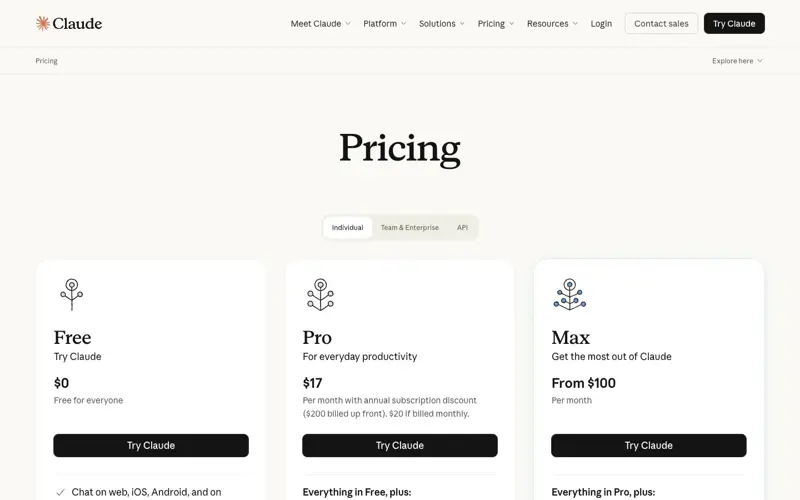
Source: claude.com/pricing — captured May 4, 2026. Re-verified unchanged May 11.
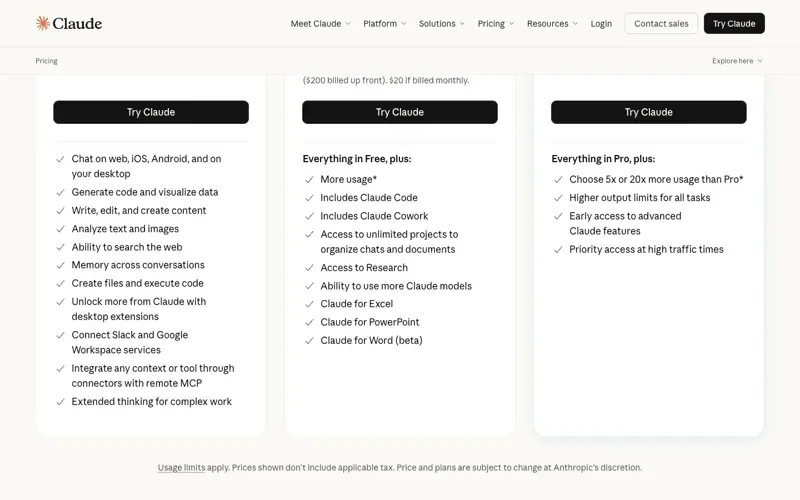
The Pro plan checklist explicitly includes both Claude Code and Claude Cowork — confirming the $17/$20 tier is the entry point for both products.
Pro Plan ($20/mo): The Default Choice
Pro is where most individual developers start. For $20 a month (or $17 if you pay $200 annually — save $36 a year), you get Claude Code in your terminal plus Claude on the web and desktop.
What you can do:
- Claude Code in terminal with Sonnet 4.6, Haiku 4.5, and Opus 4.7 (launched April 16, 2026)
- Claude Cowork (the visual canvas-based workspace; bundled into Pro since the GA rollout)
- File creation and code execution
- Unlimited projects
- Google Workspace integration
- Remote MCP connectors
- Extended reasoning on web Claude
What you can’t do:
- Hit ~45 messages every 5 hours without getting rate-limited
- Run Opus 4.7 heavily (it burns tokens fast — more on that below)
- Use this for 8 hours of straight coding (you’ll hit limits)
The 5-hour rolling window is the catch. Unlike monthly quotas, Pro uses rolling 5-hour windows. Hit your limit at 2pm, you’re waiting until 7pm. Then your next 5-hour window starts.
Anthropic tracks by tokens, not just messages. Each prompt, file attachment, tool definition, and conversation history all count. A “message” with a large file attached can eat 10x more quota than a simple question.
Max Plans ($100 or $200/mo): The Power User Tiers
Max has two flavors — 5x and 20x — referring to multiples of Pro’s usage allowance.
Max 5x ($100/mo):
- 5x the tokens of Pro
- Priority access to new features
- Enough for most full-time devs using Claude Code daily
Max 20x ($200/mo):
- 20x the tokens of Pro
- First in line for new models
- For people who basically never want to think about rate limits
Here’s the honest truth on Max 20x: the value is extraordinary if you actually use it. One developer ran the numbers and estimated a $200 Claude Code plan equals around $5,000 worth of API compute at pay-per-token rates. That’s 25x value.
But there’s a catch nobody advertises. Claude Code v2.1.100 silently added around 20,000 invisible tokens to every request — confirmed via proxy logs, server-side, burning quotas ~40% faster than users expect. Six more releases have shipped since — through v2.1.133 on May 8 — bringing the --plugin-url flag for session-scoped plugins, working skillOverrides, a 10GB MCP stdio memory leak fix, and sub-agents that finally discover project/user/plugin skills. But none of them publicly patch the v2.1.100 token-inflation bug. The current best theory, based on independent proxy-log reverse-engineering, is broken prompt caching that forces full re-processing of conversation history on every turn. Workarounds: downgrade to v2.1.34, or reinstall via npm instead of the native binary (the native binary is the one carrying the TTL/cache regression that silently shrinks prompt-cache TTL from 60 minutes to 5).
This is why some heavy users have actually downgraded from Max back to Pro — Max burns tokens faster, and if you’re not careful, you hit limits just as fast as on Pro.
Team Plans ($20-$125/seat/mo)
Teams start at 5 seats minimum. There are two tiers:
| Plan | Annual/seat/mo | Monthly/seat/mo | Claude Code | Best For |
|---|---|---|---|---|
| Team Standard | $20 | $25 | ❌ | Non-technical teams (marketing, ops) |
| Team Premium | $100 | $125 | ✅ | Dev teams |
Heads up: some third-party articles still list Team Premium at $150/seat — that was the 2025 price. Anthropic dropped it to $100/seat annual in January 2026. Always check claude.com/pricing for the current rate.
Team Premium at $100/seat/mo (annual) is equivalent to individual Max 5x ($100/mo) but adds team management features: SSO, SCIM, shared projects, usage analytics, centralized billing, Microsoft 365 and Slack integrations. If you have 5+ developers, Team Premium is a straight upgrade over individual Max subscriptions — same price per seat, more control.
Annual billing saves $60/seat/year on Team Standard and $300/seat/year on Team Premium. For a 10-developer team, that’s $3,000/year in savings versus monthly billing.
Enterprise: When You Stop Asking About Price
Enterprise pricing is custom. Anthropic doesn’t publish it because it varies by:
- Number of users
- Data residency requirements (US, EU, etc.)
- Compliance needs (SOC 2, HIPAA, GDPR)
- Negotiated rate limits
- RBAC, SCIM, OpenTelemetry requirements
Expect to pay significantly more per user than Team Premium. In exchange, you get enterprise-grade security, dedicated support, and negotiable terms.
API Pricing: The Pay-As-You-Go Route
If your usage is spiky or you’re building an app, API billing can beat subscriptions. Here are the rates per million tokens:
| Model | Input | Output | Cache Write | Cache Read | Batch |
|---|---|---|---|---|---|
| Opus 4.7 | $5 | $25 | $6.25 | $0.50 | 50% off |
| Opus 4.6 | $5 | $25 | $6.25 | $0.50 | 50% off |
| Sonnet 4.6 | $3 | $15 | $3.75 | $0.30 | 50% off |
| Haiku 4.5 | $1 | $5 | $1.25 | $0.10 | 50% off |
Cache reads at 0.1x input price are the killer feature. If you’re sending the same system prompt repeatedly, prompt caching can cut input costs by up to 90%.
A catch with Opus 4.7: list price is identical to 4.6, but Anthropic shipped a new 2026 tokenizer that can generate up to ~35% more tokens for the same raw text. Your effective bill can go up even though the sticker price didn’t move. Worth knowing before you switch your default model.
When Does API Beat Subscription?
Break-even math, roughly:
API wins over Pro ($20/mo) if:
- You use Claude Code fewer than 50 sessions per month
- Your monthly API spend would be under $20
- You’re building an app where usage is unpredictable
Max 5x ($100/mo) wins over API if:
- Your monthly API equivalent spend exceeds $100
- You’re a daily Claude Code user doing real work
Max 20x ($200/mo) wins over API if:
- Your monthly API equivalent spend exceeds $200
- You’re pair-programming with Claude most of your workday
For most full-time developers using Claude Code daily, subscription wins. API pricing only makes sense for sporadic users or app builders.
The Rate Limit Crisis (March-May 2026): A Timeline
Here’s what Anthropic doesn’t advertise: rate limits have been tightening, and several things converged in late March to make it much worse. The story has now stretched across eight weeks — here’s the full sequence.
What actually happened, in detail:
On March 31, 2026, Anthropic officially acknowledged: “People are hitting usage limits in Claude Code way faster than expected. We’re actively investigating… it’s the top priority for the team.”
Three things caused the crisis:
Peak-hour throttling (March 28): Anthropic engineer Thariq Shihipar announced that 5-hour session limits would be reduced during peak hours — weekdays from 5 AM to 11 AM Pacific Time (1 PM-7 PM GMT). This affects roughly 7% of users.
End of the double-limit promo: From March 13-27, Anthropic ran a promotion doubling off-peak usage limits. When it ended March 28, users perceived it as a sudden limit cut.
Suspected Claude Code bug: A developer who reverse-engineered the Claude Code binary found two independent bugs that broke prompt cache, silently inflating token consumption by 10-20x. Users confirmed that downgrading to version 2.1.34 significantly reduced usage.
Real user complaints shared on GitHub and Discord:
- A Pro subscriber: “It’s maxed out every Monday and resets on Saturday… out of 30 days I get to use Claude 12.”
- A Max 5x user: “I used up Max 5 in 1 hour of working, before I could work 8 hours.”
On April 4, Anthropic added another wrinkle: Claude Code subscription credits no longer cover third-party tools like OpenClaw. Those now require separate pay-as-you-go API billing. TechCrunch reported the email triggered refund requests, and community roundups documented a reported 1,000% spike in “how to cancel Claude subscription” searches inside 48 hours.
Update (May 11): Anthropic still has not publicly declared the March 31 crisis resolved. Lydia Hallie (Anthropic technical staff) confirmed in early April that the team had “shipped some fixes on the Claude Code side,” and Claude Code has shipped seven more releases since (v2.1.126 through v2.1.133, May 1-8) — but technical write-ups tracking the underlying token-inflation issue (dubbed “Tokenocalypse” in the community) still say “no public fix date.” The leading independent theory: broken prompt caching that forces full re-processing of conversation history on every turn. CEO Dario Amodei has separately said publicly that Anthropic is compute-constrained and data-center buildouts take 18-24 months — so the rationing is structural, not just a bug.
What this means in practice: if you’re evaluating Claude Code, check which version you’re running with claude --version. v2.1.133 (May 8) is the latest, but the token-inflation bug introduced in v2.1.100 still isn’t publicly patched — downgrade to v2.1.34 or reinstall via npm as a workaround. And budget for the possibility that even $200/month Max 20x can hit limits on peak-hour heavy days through 2026.
Update (May 15, four days later): Still no public v2.1.100 fix from Anthropic. Code with Claude SF (May 6-7) shipped Managed Agents “Dreaming” mode and Outcomes for asynchronous agent work — but those are feature launches, not pricing or quota changes. Pro at $20/mo, Max at $100/$200, Team Premium at $100/seat, and Enterprise tier all unchanged from the May 11 lineup above. The downgrade-to-v2.1.34 workaround remains the recommended path for heavy users. We’ll re-update this page the moment Anthropic ships a public fix or revises the plan structure.
Cost Optimization: How to Actually Save Money
If you’re on API billing, these tricks compound:
1. Prompt caching (up to 90% savings) Cache your system prompt. If you send the same 2,000-token system prompt every request, caching cuts those tokens to 10% of input price. For high-volume usage, this is the biggest lever.
2. Batch processing (50% off) For non-urgent work, batch processing cuts costs in half. Not usable for interactive Claude Code, but great for scripted bulk operations.
3. Use Haiku for simple tasks Haiku 4.5 is 5x cheaper than Sonnet and 25x cheaper than Opus. If you’re classifying text, extracting data, or generating short summaries, Haiku is plenty.
4. Annual billing on Pro ($36/yr savings) Pro is $20/mo billed monthly or $200 billed annually ($17/mo effective). Save $36 a year if you’re committing.
5. Don’t default to Opus (especially 4.7) Opus is brilliant for hard reasoning but overkill for most coding. Sonnet 4.6 handles 90% of what Opus does at roughly 1/5th the cost — and with Opus 4.7’s new tokenizer inflating token counts by up to 35% over 4.6, that gap has effectively widened. Set Opus as an on-demand escalation, not your default.
6. Turn off features you don’t use Extended reasoning, web search, and certain MCP connectors eat tokens. If you don’t need them, disable them per session.
Combined: prompt caching + batch + Haiku can cut your bill by up to 95% versus naive API usage.
What It Can’t Do (Be Honest With Yourself)
No granular billing control. You can’t set “spend $50/month and stop” on individual subscriptions. API has budget alerts but subscriptions just rate-limit you when you hit caps.
No rollover. Unused messages from this 5-hour window don’t carry to the next. Use it or lose it.
Rate limits are a black box. Anthropic doesn’t publish exact token caps per tier. The “45 messages / 5 hours” figure is an approximation. Your actual mileage varies based on message size.
Max 20x isn’t infinite. Some power users hit Max 20x limits too. If you truly need unlimited access for heavy agentic workloads, you may need Enterprise.
Claude Code Pricing vs Competitors
The competitive landscape just got more interesting. Here’s the May 11, 2026 snapshot — Copilot is the one to watch.
| Tool | Price | What You Get | The Catch |
|---|---|---|---|
| Claude Code Pro | $20/mo | Claude Code + web/desktop Claude | 5-hour rolling quota; v2.1.100 token bug |
| GitHub Copilot Pro | $10/mo | Autocomplete + chat, agent mode | Switches to usage-based billing June 1, 2026 — $10 of AI Credits included, overage paid |
| GitHub Copilot Pro+ | $39/mo | Higher model access + agent | Same June 1 transition; $39 in credits |
| Cursor Pro | $20/mo | Cursor editor + ~$20 API usage included | API usage caps; jumps to Pro+ at heavy use |
| Cursor Pro+ | $60/mo | ~$70 API usage included | Better than Claude Pro for Cursor users |
| Cursor Ultra | $200/mo | ~$400 API usage included | Direct Max 20x competitor — 2x compute value |
| Windsurf | $15/mo | Editor + 500 credits/mo | Credits run out fast on agentic tasks |
| Cline / Aider | Free (BYOK) | Open-source CLI agents, your API key | You pay token costs directly; no quota games |
| GPT Pro + Codex | $200/mo | Advanced GPT + coding agent | OpenAI’s direct Max 20x answer |
The June 1 Copilot shake-up matters. On April 26, GitHub announced that every Copilot tier transitions to usage-based billing on June 1, 2026. Headline prices don’t change — but each tier now includes AI Credits equal to its subscription price, and overage is metered. A developer who runs Copilot’s agent mode all day will burn through $10 of credits inside a workweek. That’s actually closer to Claude Code’s model than the old “flat-rate autocomplete” pitch — and it makes the $10 sticker price misleading for heavy users.
Cline and Aider deserve a separate mention. Both are completely free, open-source CLI coding agents. You bring your own API key (Anthropic, OpenAI, Groq, OpenRouter, anything) and pay only for tokens. No quota games, no surprise throttling. If you’re already comfortable with API-side prompt caching and don’t need the Claude.ai web UI, BYOK + Cline can beat any subscription on cost. The trade-off: less polished UX, no shared sessions, and you eat the model-routing logic yourself.
Claude Code Pro at $20 is still the cheapest way to get an all-inclusive agentic CLI from a frontier lab. Cursor Pro is closer than ever at $20 (model-agnostic). Copilot is no longer reliably cheaper after June 1.
What This Means for You
Before you spend more, work the decision tree. Most “I’m hitting limits” cases are fixable without upgrading.
If you’re a developer just starting with Claude Code: Start with Pro at $20/month. See if you hit rate limits consistently. If you do, jump to Max 5x at $100. Don’t start at $200 — you might not need it.
If you’re already on Pro and hitting limits: Before upgrading to Max, walk the diagram above. v2.1.133 (May 8) is the latest release, but the v2.1.100 token-inflation bug is still unpatched — downgrade to v2.1.34 or reinstall via npm before you pay for more quota you may be burning through a bug.
If you’re a team lead evaluating tools: For 5+ developers, Team Premium at $100/seat (annual) is the no-brainer. Do the math: 5 developers × $100 Max 5x = $500/mo at the same token budget, but Team Premium adds SSO, SCIM, Slack/Microsoft 365 integrations, shared projects, and centralized billing for the same per-seat price. No reason to buy individual Max subscriptions for a team.
If you’re building an app or integration: Use API pricing with prompt caching and batch processing. Skip subscriptions entirely — they’re not designed for programmatic use.
If you’ve never used AI coding tools: Claude Code has a learning curve, not just a pricing question. Before buying a subscription, watch tutorials on what it actually does. Our Claude Code Mastery course walks you from installation to advanced workflows.
The Bottom Line
Pro at $20 is the right starting point for almost everyone. Upgrade to Max 5x ($100) only when you’re consistently hitting rate limits. Jump to Max 20x ($200) only when Max 5x doesn’t cut it.
API is rarely the right answer for daily individual use — it’s built for apps and integrations.
And factor in the rate limit reality: even $200/month doesn’t guarantee unlimited use. Anthropic is rationing capacity because demand has exploded. Budget accordingly.
The honest math: for most full-time developers, Pro at $17-20/month returns more value per dollar than any other AI tool you can buy. The problem isn’t that Claude Code is overpriced — it’s that you might want MORE than what any tier currently offers.
Want to level up? Our Claude Code Mastery course teaches the full workflow — installation, prompting, skills, hooks, MCP integrations, and cost optimization. Pair it with AI Agents Deep Dive to see how Claude Code fits into the broader agentic ecosystem.
Sources (last verified May 11, 2026):
- Claude Plans & Pricing — Official
- What is the Pro plan? — Claude Help Center
- What is the Max plan? — Claude Help Center
- Using Claude Code with Pro or Max — Claude Help Center
- What is the Enterprise plan? — Claude Help Center
- Claude API Pricing — Official Docs
- Claude Code Changelog — Official
- Claude Code v2.1.126–v2.1.133 release notes — May 1–8, 2026
- GitHub Copilot announces usage-based billing — April 26, 2026
- Cursor pricing tiers — March 2026 reference
- Windsurf pricing — Morphllm comparison
- Claude Code: Rate Limits, Pricing, and Alternatives — Northflank
- Anthropic admits Claude Code quotas running out too fast — The Register
- Claude Code Pricing: Every Plan Explained — SSD Nodes
- Claude Pricing in 2026 — Finout
- Claude Code Pricing 2026: Plans, Token Costs — Verdent
- AI Usage Limits Are Becoming the New Reality — PYMNTS
