A claim gets denied. Now someone at the front desk has to write a pre-authorization or appeal letter that cites clinical necessity, references the right codes, and actually persuades an insurer to say yes. It’s tedious, it’s high-stakes, and it eats an hour you don’t have between patients.
This is one of the tasks dental teams are quietly handing to ChatGPT — and it works well. About a third of dental practices now use AI in some form, and front-desk staff and billers report drafting in minutes what used to take most of an afternoon.
But dentistry has a trap that, say, a photographer’s caption doesn’t: patient privacy law. Do this the wrong way and you’ve turned a time-saver into a HIPAA violation. So before anything else, let’s get the safe method straight — because it’s simple, and it’s the whole ballgame.
The one rule that keeps you out of trouble
Never paste a patient’s private information into the free, public version of ChatGPT.
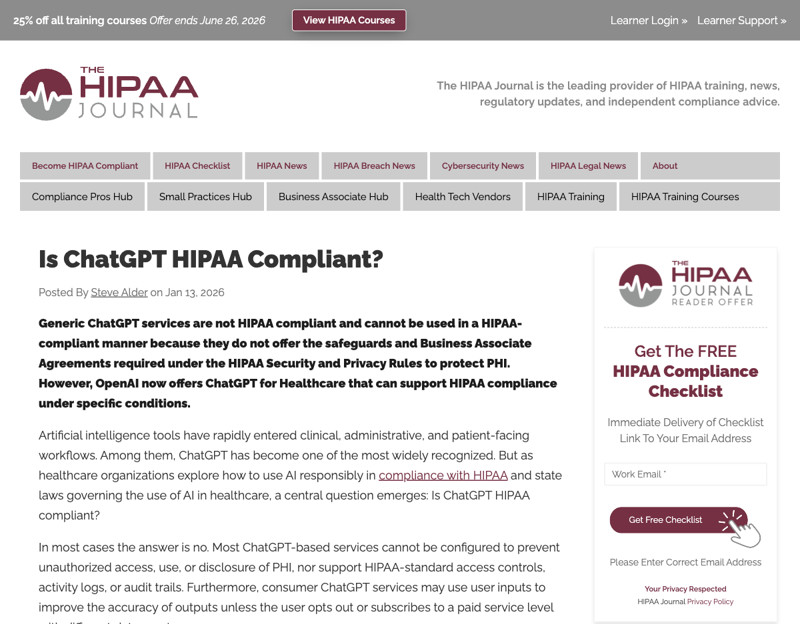
Here’s why, in plain English. Health-privacy law (HIPAA) says that any company handling your patients’ protected health information — names, birth dates, ID numbers, even a specific combination of dates and treatment details — has to sign a formal agreement (a “Business Associate Agreement,” or BAA) promising to protect it. The free, consumer version of ChatGPT does not sign that agreement with dental practices, and it may use what you type to train its models. So pasting real patient details into it isn’t HIPAA-compliant — full stop. The California Dental Association says this directly: don’t use the free, public ChatGPT with patient data.
The good news is you don’t need to. The trick the careful practices use is de-identification — you ask ChatGPT to write the letter using generic, anonymous details, then you fill in the real patient information yourself, locally, in your own document.
In practice that means: instead of “Jane Smith, DOB 4/12/1979, member ID 88421, needs a crown,” you write “a patient needs a crown on tooth #19 due to recurrent decay under an existing restoration.” No name, no birth date, no ID. ChatGPT writes a clean letter around the clinical facts; you drop the real identifiers into the blanks afterward. Same finished letter, zero privacy risk.
Know the three words (so you ask for the right thing)
Front desks mix these up constantly, and insurers don’t:
- Predetermination (a “pretreatment estimate”): you ask the insurer ahead of time roughly what they’ll cover. Helpful for showing the patient their likely cost — but it’s an estimate, not a promise to pay.
- Pre-authorization (or “prior authorization”): advance written approval an insurer requires before certain procedures. It’s a prerequisite for coverage, and it’s usually time-limited (often valid about 60 days). Crowns, implants, oral surgery, perio surgery, and some orthodontics commonly need it.
- Appeal: what you send after a denial, arguing the decision was wrong. Most plans give you 30–60 days from the denial to file.
Knowing which one you’re writing changes the letter — so name it before you start.
The 10-minute workflow
Step 1 — Gather your “starter pack” (de-identified). Pull together three things, stripped of patient identifiers: the clinical facts (tooth number, procedure, CDT code, the diagnosis), the exact denial reason from the EOB if you’re appealing, and the payer’s stated criteria for that procedure if you have them.
Step 2 — Prompt ChatGPT with generics. Use a template like this:
“Write a professional dental insurance [pre-authorization / appeal] letter. Use placeholders like [PATIENT NAME], [DOB], [MEMBER ID] — do not invent these. Clinical facts: crown on tooth #19, CDT code D2740, due to recurrent decay under a failing existing restoration with a cracked cusp. [If appealing:] The claim was denied for ‘insufficient documentation of necessity.’ Make the case for medical/dental necessity, reference the attached radiograph and intraoral photos, keep it concise and evidence-based, and end with a clear request to approve/reprocess.”
Step 3 — Review it against the chart. Read every line. Does the narrative match what’s actually in the record? Are the codes right? AI will confidently write a plausible sentence that isn’t true — your job is to catch it.
Step 4 — Fill in the real details locally. In your own word processor or practice-management system, replace the placeholders with the patient’s actual information. The identifiers never touched ChatGPT.
Step 5 — Attach and log. Add the radiographs, perio charts, photos, and notes the letter references, then record the submission date and a follow-up reminder in your system. (Don’t rely on the AI to “remember” anything.)
What a strong letter actually includes
When you review the draft, check that it has all of these:
- Patient and provider identifiers (added in your final version)
- Claim details: dates of service, CDT codes, and tooth numbers
- A clear statement of what you’re requesting (approve, or reprocess the denied claim)
- The denial reason restated word-for-word from the EOB (for appeals)
- Each code tied to a specific clinical finding — why it’s necessary
- A list of attachments: radiographs, perio charting, photos, progress notes
- A professional, concise tone aligned with the insurer’s own published clinical guidelines
What this means for you
If you’re the front desk or office manager: This is your time-back machine. Build one de-identified template for pre-auths and one for appeals, and you’ll turn an afternoon’s task into a 10-minute one — without ever putting patient data at risk.
If you’re a biller or RCM specialist: Lean on it for the EOB-denial rebuttals. The structure (restate the denial, tie codes to findings, list evidence) is exactly where ChatGPT shines. You stay the expert; it does the typing.
If you’re the dentist or practice owner: Set the rule for your team in writing — de-identified prompts only, no patient data in free ChatGPT — and you get the efficiency without the compliance exposure. It’s also a great use for turning your chairside notes into patient-friendly treatment explanations.
If you’re a solo or small practice: This levels the playing field with big groups that have dedicated billing departments. One well-built template set does a lot of that work.
What it can’t do (the honest limits)
- It is not HIPAA-compliant with patient data. This is the big one. The free, public version has no BAA — keep real identifiers out of it, every single time. No exceptions, no “just this once.”
- It invents things. It will produce a confident, wrong CDT code or a clinical detail that isn’t in the chart. Every line needs a human check against the record.
- It does not guarantee approval. A better-written letter improves your odds; it doesn’t bind the insurer. Pre-auth and appeal outcomes still depend on the plan and the evidence.
- The narrative must match the chart. Never let a persuasive sentence drift from what actually happened clinically — that’s a documentation and liability problem, not just a wording one.
- It’s not legal or clinical advice. For genuinely contested denials or anything with legal weight, involve the dentist and, if needed, professional guidance.
The bottom line
AI can take the dread out of pre-authorization and appeal letters — drafting in ten minutes what used to swallow an afternoon — as long as you follow the one rule: write with de-identified, generic details, and add the real patient information yourself. Do that, and you get the speed without the risk.
If you want your whole team working from the same safe, repeatable playbook — patient letters, pre-auths, treatment-plan narratives, and the privacy guardrails to go with them — our AI for Dentists & Dental Clinics course walks through it lesson by lesson. AI for Dental Practice Growth goes further into the operational side once your front desk has the basics down.
Sources
- Is ChatGPT HIPAA Compliant? (Updated 2026) — HIPAA Journal
- AI in dentistry: What are the HIPAA violation risks? — California Dental Association
- Pre-Authorization vs. Predetermination for Insurance — OMSP
- Dental Insurance Pre-Authorization in 2026 — Dental Area
- AI for Dental Practices: prompts dentists can use — BastionGPT
