

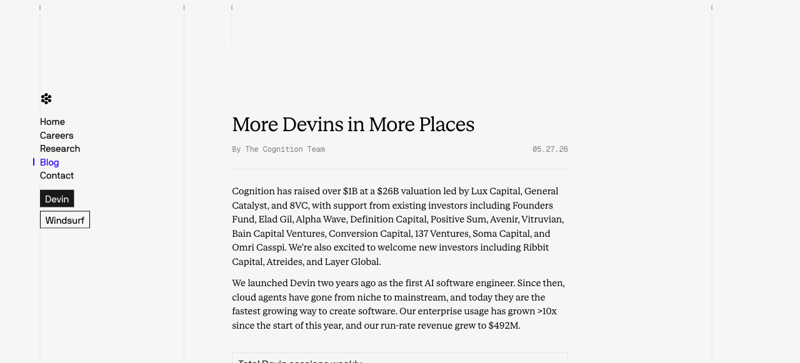
On May 27, 2026, Cognition AI closed a Series D of more than $1 billion at a $26 billion valuation, more than doubling the $10.2 billion mark it hit nine months earlier. Lux Capital and General Catalyst led; 8VC co-led; Founders Fund, Ribbit, and Atreides participated. Cognition’s own claim — “89% of the PRs written at Cognition are now opened by Devin” — landed about ten hours later in the company’s announcement post. Run-rate revenue: $492M. Customers named in the press release: Citi, Goldman Sachs, Mercedes-Benz, Dell, Santander, the US Army, and the US Navy.
If you run a ten-engineer team and your weekly AI bill is starting to look like a junior engineer’s salary, the question is no longer “should we use AI.” The question is “on which tickets does Devin earn its keep — and on which tickets does Claude Code with the team’s existing Max subscription do the same job for one-tenth the cost?”
This post answers that.
What just changed
Three things landed in the last six weeks that change the comparison:
Devin 2.0 (April 2026) — Cognition dropped the entry tier from $500/month to $20/month + $2.25 per Agent Compute Unit (ACU), where one ACU equals roughly 15 minutes of active Devin work. A typical bug fix runs 2-3 ACU. A multi-file migration runs 30+. WeavAI’s benchmark review put the practical math at $4.50-6.75 for a routine fix, $67.50+ for a serious refactor.
Claude Code Remote Tasks — Anthropic’s most recent Claude Code update brought the SWE-Bench Verified score to 87.6%, the highest published number on the standard benchmark as of May 2026. Pricing didn’t move: Pro at $20/mo, Max 5x at $100/mo, Max 20x at $200/mo. Heavy real-world users land at $100-200/mo.
The OpenHands counter — @iam_elias1’s May 23 X post (84 likes, 29 reposts, 33 replies) framed the budget alternative: OpenHands (formerly OpenDevin) combined with Claude Sonnet 4.5’s extended-thinking mode achieves 72% on SWE-Bench Verified at roughly $6/day in API costs on heavy use. Open-source. Docker-sandboxed. No vendor lock-in. The whole frame of the post: “Six dollars per day on heavy use. Versus $500 per month for Devin.”
The valuation news is the headline. The pricing news is the actual story.
The 4 ticket types — and which agent wins each
The way to think about this is by ticket shape, not by tool brand. Devin’s pitch is autonomy: you hand it a GitHub issue, it disappears for hours, it opens a PR. Claude Code’s pitch is in-loop pair programming: you sit at the terminal, it does the work, you sign off line by line. The right answer per ticket depends on whether you’d rather wait or sit.
Ticket 1 — Flaky test fix
The classic “this test failed three times this week, we don’t know why” ticket.
- Claude Code (in-loop): Open the failing file. Tell Claude what’s flaky. It traces the race condition or timing dependency in front of you. Cost: maybe $0.50 of your Max 5x subscription. Wall-clock: 15-30 minutes.
- Devin (autonomous): Assign the GitHub issue to a Devin session. Walk away. It runs the test suite, instruments the test, finds the flake source, opens a PR. ACU burn: 2-3. Cost: $4.50-6.75. Wall-clock: ~45 minutes from your perspective, but you weren’t in the room.
Winner: Claude Code, by cost and by judgment. You learn what was flaky. Next time the suite flakes you spot it faster.
Ticket 2 — Dependency upgrade across 30 files
The “we need to bump React/Next/Express to vN+1” ticket. Mostly mechanical. Lots of files. Tedious.
- Claude Code: Run the upgrade command. Hand-fix the breakages. Claude Code can batch-edit but you’re still babysitting. Cost: a few dollars on subscription. Wall-clock: 2-3 hours.
- Devin: Hand off the issue with the upgrade target. It runs the upgrade, fixes the breakages, runs the full test suite, opens a PR. ACU burn: 15-25. Cost: ~$50. Wall-clock: 2-4 hours of Devin time. You did something else.
Winner: Devin, clearly. This is the canonical “you’d rather wait than sit” job. $50 to get three hours of your week back is a good trade.
Ticket 3 — Build a new endpoint with 4 callers
The “we need a new POST /api/v2/foo and four services need to call it” ticket.
- Claude Code: You probably want to sit with this one. Designing the endpoint shape, the auth surface, the error handling, the four caller integrations — that’s architecture-shaped work, not mechanical. Claude Code is great here because it co-designs with you. Cost: a few dollars. Wall-clock: 2-3 hours.
- Devin: Devin will design it. The output will probably work. It might not match your service conventions. @morganlinton on X: “They both tend to think they are done building a plan, but there are still either unbuilt portions, or real bugs that need to be fixed.” ACU burn: 20-30. Cost: $50-70.
Winner: Claude Code, with a caveat. Devin wins if your codebase is uniform enough that an outside agent’s conventions land within tolerance. For most ten-engineer teams that’s not yet true.
Ticket 4 — Multi-file refactor (rename + signature change across 80 call-sites)
The “we’re changing the function signature and there are 80 call-sites” ticket.
- Claude Code: Painful. You’ll either babysit the rename or use a deterministic refactoring tool first and have Claude clean up the edge cases. Cost: a few dollars subscription. Wall-clock: half a day.
- Devin: Hand off. ACU burn: 30-50. Cost: $70-115. Wall-clock: half a day of Devin time. You did something else, again.
Winner: Devin, if your test coverage is honest. The risk is silent regressions on call-sites whose tests don’t cover the changed behavior — and that risk is the same with any tool, you just can’t watch the agent miss them. Pair Devin with a strict CI gate.
The honest cost table for a ten-engineer team
Take a typical week — 4 flaky tests, 2 dependency upgrades, 3 new endpoints, 1 large refactor:
| Approach | Devin spend | Claude Code spend | Combined monthly | Note |
|---|---|---|---|---|
| All Devin | — | ~$8,200 | The official-press-release option | |
| All Claude Code | — | $200/mo × 10 = $2,000 | $2,000 | Subscription, no ticket overage |
| Hybrid (Devin for #2, #4; Claude Code for #1, #3) | ~$300/mo per dev × 10 = $3,000 | $200/mo × 10 = $2,000 | $5,000 | The @ryancarson actual stack — Devin for backend/cloud agents, Claude Code or Codex for frontend/local |
| OpenHands + Claude Sonnet 4.5 API | — | ~$6/day × 22 work days × 10 devs = $1,320 | $1,320 | The budget-floor option per @iam_elias1 |
The numbers are illustrative. The math is real. Hybrid lands at $5,000/mo for the team — vs $8,200 if you go all-Devin, vs $1,320 if you go all-open-source. The post-raise question every engineering manager should ask is: “on which tickets does the extra $3,200/mo of Devin actually buy me three hours of senior-engineer time?” The answer is mostly #2 and #4. Mostly.
What this means for you
- If you run a 5-15 engineer team: Hybrid. Use Devin for #2 and #4-shaped tickets (mechanical, multi-file, “you’d rather wait than sit”). Use Claude Code on Max 5x or Max 20x for #1 and #3 (judgment-heavy, architecture-shaped, “you should sit”). Budget about $4-5K/mo for the team.
- If you run a 50+ engineer team: Devin’s per-seat math gets better at scale because the autonomous tickets dominate. Talk to Cognition about enterprise pricing — the $20 floor was the consumer move; serious customers negotiate.
- If you’re a solo dev or 2-3 person team: Claude Code Pro or Max 5x covers 80% of what you need. Devin’s ACU pricing is structured for tickets that take hours; solo devs rarely have those.
- If you’re at a company that requires open-source / no-vendor-lock-in: OpenHands + Sonnet 4.5 API. The 72% SWE-Bench number is real, the Docker sandbox is real, and the $6/day on heavy use is genuinely cheaper than any subscription path. The cost is your weekend, because nothing is set up for you.
- If you’re at a regulated industry (finance, healthcare, defense): Devin won the Citi / Goldman Sachs / US Army / US Navy deals for a reason — their compliance posture is built for that buyer. Claude Code on enterprise-tier with Anthropic’s enterprise contract gets you to a similar place. OpenHands does not.
What this can’t fix
The honest limits, before you swap your stack:
- No agent removes the need for review. Devin opening 89% of PRs at Cognition does not mean the company reviewed 11% of them carefully. It means a human still sat with each one. You will too.
- The “tried Devin once a year ago and it sucked” thing is real. @nityasnotes (Exa): “If you tried Devin when it first came out, know it is a completely different product today.” The 2024 reputation does not match the 2026 product. Retest before deciding.
- ACU burn is unpredictable until you’ve watched it for two weeks. A “simple bug fix” can turn into 12 ACU because the test suite is slow. Track per-ticket cost for the first 10 tickets before you trust the budget projection.
- OpenHands is not zero-effort. The “$6/day” number assumes Docker is up, the runtime is configured, the Claude Sonnet 4.5 API key is set, and the prompts are tuned. You will spend a weekend on setup.
- Devin is not yet a frontend agent. The high-engagement practitioner stacks (@ryancarson shipped Devin for backend, Codex for frontend, Claude Design for design surfaces) treat it as a backend / cloud-task agent. Don’t ask it to ship pixel-perfect UI.
The bottom line
The raise valuation is the news. The actual story is the four tickets above — what’s mechanical, what’s judgment, what’s “I’d rather wait” and what’s “I should sit.” For a typical 10-engineer team, hybrid wins on cost and on outcome. Pure Devin is the press-release move. Pure Claude Code leaves the dependency-upgrade and multi-file-refactor pain on the senior engineers’ plate. OpenHands is a real option only if you can absorb the setup cost.
If you want a guided walkthrough of how to wire Claude Code into a daily team workflow — Sessions, hooks, agents, the patterns that survive a real codebase — our Claude Code Mastery course is the structured version of the in-loop side of this stack.
Which of the 4 ticket types ate the most senior-engineer hours on your team last week — and what is the cheapest stack that actually solves that one ticket?
Sources
- Cognition — More Devins in More Places (Series D announcement)
- Bloomberg — Cognition raises $1B at $26B value (May 27)
- TechCrunch — AI coding startup Cognition raises $1B at $25B pre-money valuation
- The Decoder — AI coding agent Devin maker Cognition more than doubles its valuation to $26 billion in under nine months
- PYMNTS — Cognition Raises $1 Billion to Expand AI-Powered Software Engineer
- TheNextWeb — 90% of Cognition’s own code is written by Devin
- WeavAI — Devin 2.0 Review: AI Engineer Price Drops to $20 (May 13, 2026)
- Claude Code Documentation
- IBM Think — Meet Devin the AI Software Engineer, Employee #1 in Goldman Sachs
- Yahoo Finance — Cognition AI raises $1B at $25B pre-money valuation