Festival season just landed, and the math is brutal in your favor. A single good festival day can gross you $3,000 to $8,000 — versus the $800 to $1,500 you’d fight for at a regular weekday lunch stop. The events filling their summer vendor slots right now are the difference between a decent year and a great one.
Here’s the part nobody warns you about when you buy the truck: the cooking isn’t the hard part. The application is. Organizers for a curated festival might get 200 applications for a few dozen spots, and they’re reading every one for menu uniqueness, professionalism, and whether you actually filled out the form. If you’re one of the roughly 91% of food trucks that’s owner-operated — prepping, driving, serving, and doing the books, all you — the marketing and the paperwork are the things that quietly get skipped because the day ran out.
That’s exactly the gap ChatGPT closes. Not the food. The words around the food — the vendor application, the pitch email, the week of “where we’ll be” posts. This is a walkthrough you can run from your phone in about ten minutes. But first, the line you do not cross, because it’s the whole reason this works.
The line: AI for the words, your phone for the food
Go on X right now and search for AI food photos. The mood is ugly. One post roasting a truck for posting AI-generated pictures of its menu pulled over a thousand likes, ending with “I kinda be hoping they fail.” Another: “what does your actual food look like??” There’s a real, growing instinct among customers that if you faked the photos, you probably cut corners on the cooking too. It’s not paranoia — Zomato banned AI-generated food images across its whole platform back in 2024 after they tanked customer trust and drove up refunds.
So the rule for everything below is simple and non-negotiable: use AI for the marketing and admin words — captions, schedules, application narratives, pitch emails, review replies. Never for your food. Real photos from your actual phone, of your actual food. And never let AI assert an allergen or food-safety claim — “gluten-free,” “nut-free,” “vegan” — that you haven’t verified yourself against your real prep. AI doesn’t know what’s in your fryer. You do.
Handled that way, the guardrail isn’t a disclaimer. It’s your edge. While other trucks get roasted for fake photos, you’re the one with honest pictures and a sharp, professional application.
What a festival application actually asks for
Before you let ChatGPT help, it helps to know what you’re filling out. Most big festivals run applications through a portal — EventHub, Eventeny, or the organizer’s own form — and they almost all ask for the same handful of things:
- A short business bio (who you are, your story)
- Your concept and what makes you different (the part everyone writes badly)
- Your full menu with prices
- Power and space specs (amperage, generator, footprint in feet)
- Insurance and permits (typically a $1M-per-occurrence liability policy naming the organizer as additionally insured)
- Sometimes a social following minimum (some events want 500+ followers as proof you’ll help promote)
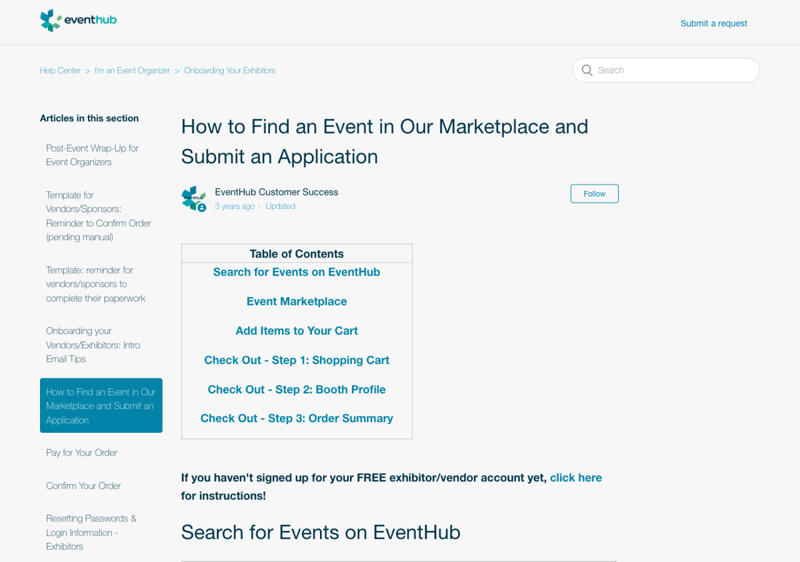
The insurance and the permits are on you — that’s real paperwork, not writing. But the bio, the concept, the menu descriptions, and the pitch? That’s where a good draft separates a “maybe” from a “yes,” and it’s exactly what ChatGPT is good at.
The 10-minute application workflow
Open ChatGPT. Paste the festival’s actual application questions in, then your truck’s real details, and ask for a draft. Here’s a prompt that works — change the details to yours:
I run a food truck called [name] that serves [cuisine / signature items]. I’m applying to [festival name] on [dates]. Here are their application questions: [paste the form fields]. Here are my facts: [years operating, signature dish, what makes us different, menu with prices, power needs, follow count]. Write a complete, professional application. Make the “what makes you different” answer specific and confident, not generic. Keep the tone warm but not gimmicky. Do not invent any facts I didn’t give you.
That last line matters. ChatGPT will happily make up an award you never won if you let it — so you give it the facts and tell it to stick to them. Read every line of what comes back before it goes anywhere near “submit.”
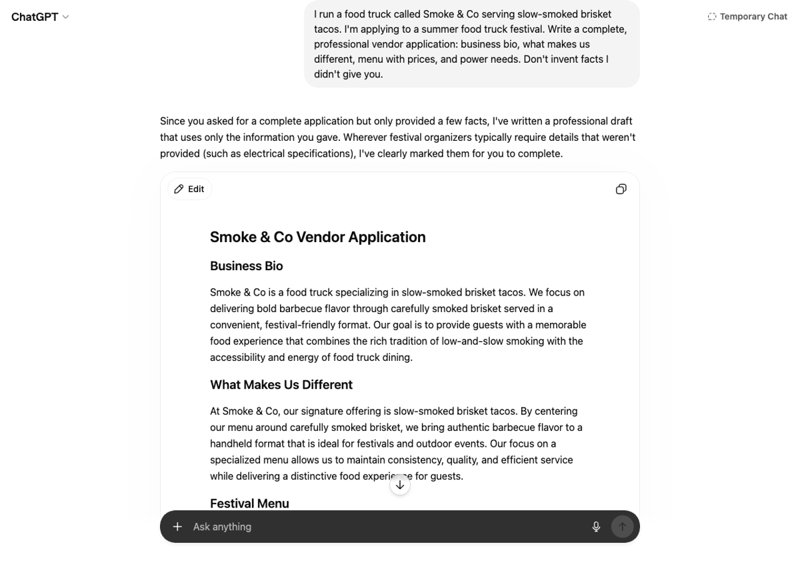
The two answers organizers actually judge you on are the concept (“what makes you different”) and menu fit for their crowd. If your first draft feels flat, push back: “Make the concept answer focus on the fact that we smoke everything in-house overnight — lean into that.” You’re not asking AI to be creative for you; you’re handing it your real differentiator and asking it to say it well.
Then there’s the follow-up. Most owners apply and go silent. A short, polite check-in email a week later — “applied on the 3rd, wanted to flag we can bring a second window for high-volume slots” — keeps you on the radar. One more prompt: “Write a brief, friendly follow-up email to the organizer.” Done.
A realistic expectation: you’ll apply to five to ten events to land two or three good spots, and the big festivals open applications months ahead — often November through January for the following summer. Start early, apply wide, and let the workflow make each application take ten minutes instead of an hour.
The bonus: a week of “where we’ll be” posts in one sitting
Festival booking is half the battle. The other half is people knowing where to find you — and attendees genuinely hate vague schedule posts (“private event,” “private event,” “closed”). One owner’s whole feed being unreadable is a real complaint people make out loud.
Feed ChatGPT your week: “I’m at [location] Tuesday 11–2, [festival] Saturday all day, the brewery Friday night. My specials are [X]. Write me 7 short, upbeat social posts with the times and a ’today only’ line for the specials.” You get a week of captions in fifteen minutes, you edit them to sound like you, you schedule them. Pair real photos with them and you’ve got a feed that books tables instead of confusing people. (Our social media content calendar skill is built for exactly this rhythm.)
What this means for you
If you’re applying to your first festival: this is the highest-leverage thing you can do this week. You don’t have a track record to lean on, so the quality of your application is most of what the organizer has to go on. A specific, professional, complete application punches above a new truck’s weight.
If you’re an established truck going after a bigger event: your edge is the concept answer. You know what makes you different — you just don’t always write it down well. Use the workflow to turn “we’re pretty good” into a confident, specific pitch, and use the follow-up email you’d normally skip.
If you hate social media: the week-of-posts workflow is for you specifically. You’re not becoming a content creator. You’re spending fifteen minutes once a week so customers can actually find you, then closing the app.
If you’re juggling five events and the books: the whole point is reclaiming hours. Owners report saving two to four hours per application cycle on the writing alone, plus a few more on captions. That’s time back for prep, or sleep.
What this won’t do for you
Be clear-eyed about the limits, because pretending otherwise is how trucks get burned:
- It won’t make food-safety or allergen claims you can trust. AI doesn’t know your kitchen. Every “gluten-free” or “vegan” label is yours to verify, every time.
- It can’t generate your food photos. It shouldn’t, and customers will punish you if it does. Phone camera, real food, good light.
- It won’t get your insurance or permits. That’s real paperwork with real deadlines. AI can remind you what’s required; it can’t file it.
- It can’t set your prices or pay your fees. Booth fees run from a couple hundred dollars at a community event to a few thousand at a major festival, sometimes plus a cut of your sales. Those numbers are business decisions you make, not prompts.
- It won’t guarantee you a spot. A great application improves your odds at a curated festival; it doesn’t override a full vendor list or a menu category they’ve already filled.
The bottom line
The trucks that win festival season aren’t the ones with the fanciest tools. They’re the ones that actually apply — to enough events, early enough, with applications good enough to get read. ChatGPT removes the excuse that the admin ate your day. Ten minutes per application, fifteen for a week of posts, and the part that matters — the food, the photos, the craft — stays entirely yours.
That’s the whole philosophy of doing this well: AI for the words, you for everything that goes in the window. If you want the full festival-season workflow built into one place — the application, the pitch, the posts, the calm reply to a tough review — our AI for Small Business course walks a non-technical owner through it step by step, and the winning-bid workflow is the same paste-the-form-get-a-draft move that powers vendor applications.
Book the spots. Keep the food yours.
Sources
- America’s food trucks are nearing a $3 billion business — CNBC
- Food Trucks in the US — Number of Businesses — IBISWorld
- Food Truck Income Survey — Food Truck Empire
- How to Submit a Vendor Application — EventHub
- Become a Vendor (application requirements) — Reno Street Food
- AI usage in small food & beverage businesses — VistaPrint
- How to get booked at food festivals — StreetFoodHub
