There’s a quiet backlash building, and if you run a funeral home, you need to know about it. Families are starting to recognize AI-written obituaries — and they’re hurt by them. Garbled names. An invented hobby. A survivor listed who isn’t real. A life flattened into the same gentle, generic phrases that could describe anyone.
One person who proofreads funeral programs for a living said they now get an AI-generated obituary on their desk “at least once a day,” sometimes with a name mangled into nonsense. The reactions online are raw: our dead deserve better. A young woman wrote that a relative used AI to write a eulogy for her grandfather and it made her feel physically ill.
This is the opposite of what a good obituary is for. So let me be clear about what this post is and isn’t. It is not “how to crank out obituaries faster.” It’s how to use AI as a careful drafting aid — for accuracy and dignity — without ever becoming the cautionary tale a family remembers for the wrong reasons.
Why this is different from every other AI use case
In most jobs, an AI mistake is an annoyance. Here, an AI mistake lands on the worst week of someone’s life, gets printed, read aloud, and kept forever. An obituary isn’t content. It’s the last public record of a person, written for people in grief. The stakes aren’t “is this efficient.” The stakes are “did we honor them, and did we get it right.”
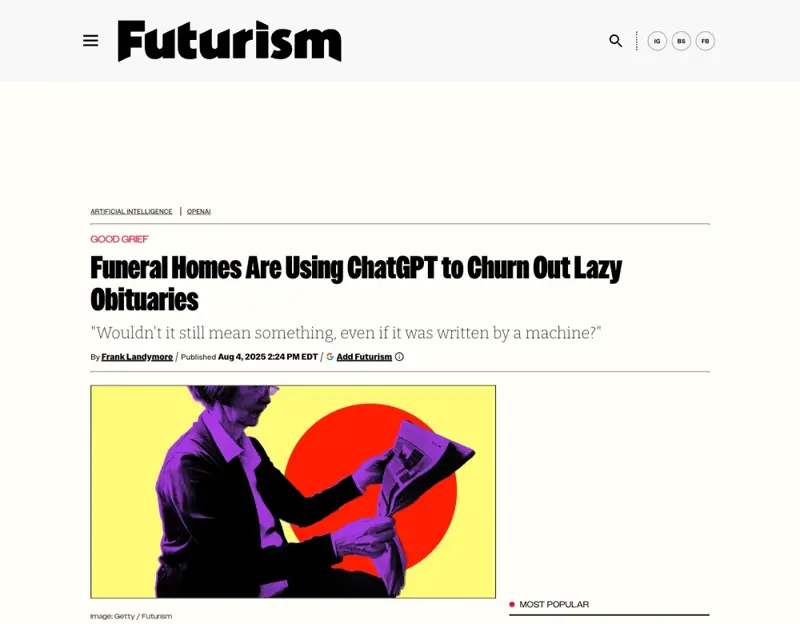
That’s exactly where today’s AI tools are weakest. Reporting on AI obituary services found they have a habit of making things up — inventing anecdotes, misattributing hobbies, dressing everything in the same flowery filler. As one writer who reads obituaries for a living put it, the best ones get to “the imperfect heart of who that person was” — and what AI does is airbrush all of that away.
So the goal isn’t to let AI write the obituary. The goal is to let AI help you arrange what the family told you, while you guard every fact and all of the humanity.
The one rule that changes everything
If you remember nothing else, remember this:
AI may only arrange the facts the family gave you. It may never add one.
Every disaster — the invented survivor, the wrong middle name, the accomplishment that never happened — comes from the AI filling a gap with a guess. The fix is to never let it fill a gap. No detail goes into an obituary that didn’t come from the family. If the AI produces a line you can’t trace back to the intake notes, that line is wrong until proven otherwise, and it comes out.
Hold that line and AI becomes a safe tool. Break it and you’re rolling dice with a grieving family’s memory.
The accuracy-first workflow
Here’s a way to use ChatGPT that keeps you firmly in control.
Step 1: Gather the facts the way you always have. The conversation with the family doesn’t change — that’s the irreplaceable part. Names (spelled out, double-checked), dates, relationships, the church, the team they loved, the story they want told. Write it all down.
Step 2: Constrain the AI to those facts only. Paste your notes into ChatGPT with a prompt that boxes it in:
Write a warm, dignified obituary draft using ONLY the facts below.
Do not add, infer, or invent anything — no hobbies, accomplishments,
survivors, dates, or details I haven't given you. If something is
missing, leave a clearly marked [GAP: ___] note instead of guessing.
Plain, sincere tone. No clichés, no flowery filler. About 250 words.

Facts from the family:
- Full name (verified spelling): ...
- Born / died: ...
- Survived by (exactly as given): ...
- What the family wants remembered: ...
- Service details: ...
The [GAP] instruction is the safety valve. Instead of the AI quietly inventing a detail to smooth over a hole, it flags the hole so you can go back to the family and ask.
Step 3: Do the read-back fact-check. Read the draft line by line against your intake notes. Every single fact must trace to something the family told you. Names, dates, and relationships get checked twice — those are the errors families notice instantly and never forget. Delete anything that doesn’t trace, and cut any phrase that sounds like it could describe a stranger.
Step 4: The family approves every fact. Before anything is published, the family reads it and confirms the details. This isn’t just safe — it’s part of the care. It also catches the one thing AI can never supply: whether the obituary actually sounds like them.
Done this way, AI saves you the blank-page struggle and the structural busywork — not the judgment, not the relationship, not the truth.
What this means for you
If you’re a solo funeral director. AI can take the pressure off writing under exhaustion at the end of a long day — but only as a drafting assistant working from facts you verified. The conversation with the family and the final read-back stay yours, every time. Used this way, it gives you more time with families, not less care for them.
If you run a larger funeral home with staff. Make the rule explicit and trainable: intake facts only, the [GAP] flag, the line-by-line check, family sign-off. The risk isn’t one careful director using AI well — it’s a rushed staffer pasting a name into a chatbot and printing whatever comes out. A simple written checklist prevents the headline.
If a family wants to write their own. You can gently guide them to the same method — write down the real details first, let the tool arrange only those, and read it back together. It protects them from the same mistakes, and it’s a kind thing to offer.
On transparency. Families increasingly sense when something was machine-written. You don’t have to make a speech about it, but you should be comfortable telling a family how the draft was made if they ask. Honesty here is part of the trust your whole business runs on.
What it can’t do
Four honest limits, because this is the one topic where getting it wrong really wounds people:
- It can’t know the person. It only knows what you type. The warmth that makes an obituary true comes from the family’s words and your care — never from the model.
- It can’t be trusted not to embellish. Left unconstrained, it will add a touching detail that never happened. The rules above exist precisely because this is its default behavior.
- It can’t replace the conversation. The sacred part of this work — sitting with a grieving family — is the part no tool touches. AI can only help with what comes after.
- It can’t carry the responsibility. If a wrong fact gets printed, “the AI wrote it” is no comfort to a family and no defense for your home. The accountability is, and stays, human.
The bottom line
The funeral homes getting roasted online aren’t in trouble because they used AI. They’re in trouble because they let AI invent — and a grieving family noticed. The lesson isn’t “never touch these tools.” It’s that an obituary has zero room for a confident guess.
Use AI to arrange the truth the family trusted you with, check every word against it, and let the family have the final say. Do that, and the tool quietly helps while the dignity stays exactly where it belongs — with you, and with them.
If you want to get fluent at this kind of careful, fact-anchored writing with AI, our Professional Writing with AI course covers how to draft sensitive communications without losing the human touch, and AI for Business shows small businesses how to use these tools responsibly.
Some things you don’t rush, and you don’t outsource. The family’s trust is one of them.
Sources
- Funeral Homes Are Secretly Using ChatGPT to Churn Out Lazy Obituaries — Futurism
- AI Is Now Writing Obituaries — and Business Is (Unfortunately) Good — Vice
- AI-Crafted Obituaries Spark Debate Over Authenticity, Efficiency, and Grief — Complete AI Training
- Leveraging ChatGPT to Write Obituaries: A Guide for Funeral Homes — Parting Pro
