

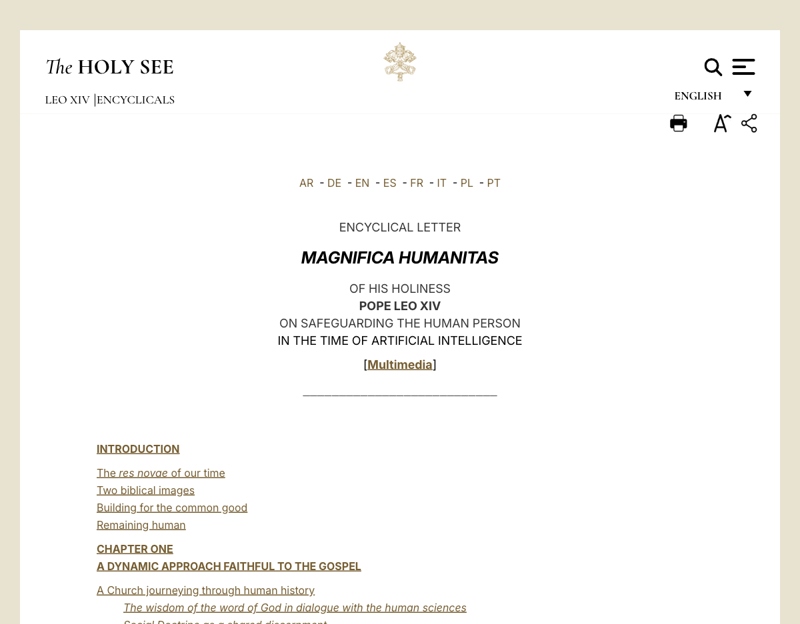
On Monday afternoon, May 25, Pope Leo XIV walked into the Vatican’s Synod Hall and presented the first papal encyclical ever written about artificial intelligence. Magnifica Humanitas — “Magnificent Humanity,” subtitled “On Safeguarding the Human Person in the Time of Artificial Intelligence” — was signed exactly ten days earlier, on May 15, on the 135th anniversary of Rerum Novarum, Pope Leo XIII’s 1891 encyclical on workers and the Industrial Revolution. That date choice is not a coincidence.
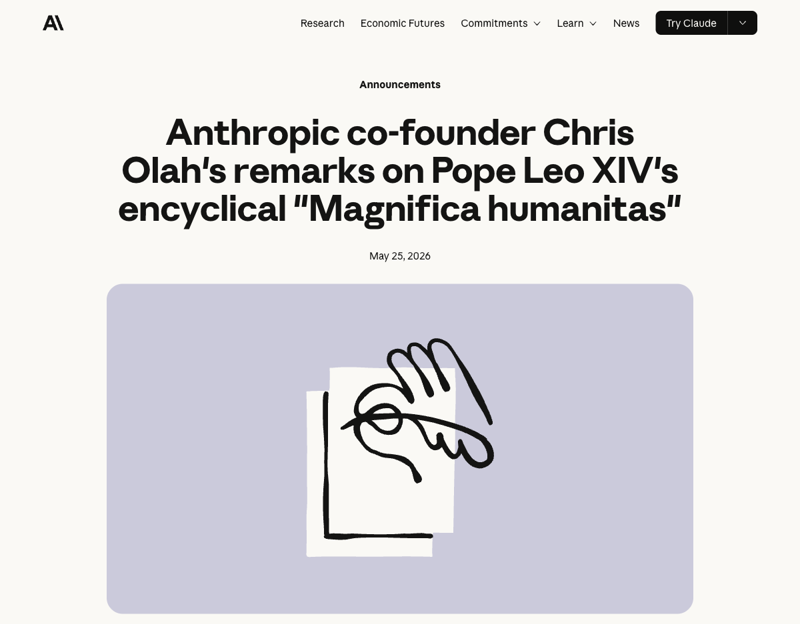
What surprised everyone in the room: the second speaker on the panel was Christopher Olah, the 33-year-old co-founder of Anthropic. Not the head of the Vatican’s tech ethics dicastery. Not a Cardinal. Olah, an atheist, was personally invited by the Pope’s office.
If you’re not Catholic, you might be wondering why this matters to you and what to take from an 83-page theological document while you’re trying to figure out how to use ChatGPT at your job. Here’s the honest, work-focused read — without theology degree required, without telling you what to believe.
What is an encyclical, and why is this one different
An encyclical is the highest form of teaching document a Pope writes. Not a tweet, not a sermon, not a press release — it’s the equivalent of a CEO publishing a 2026-and-beyond strategic vision, except the company has 1.4 billion members and a 2,000-year backlog of prior strategic memos that the new one has to engage with.
What makes Magnifica Humanitas different is its placement in history. The Pope signed it on the 135th anniversary of the foundational 1891 document on workers’ rights — the encyclical that gave us the language of “the dignity of labor,” shaped a century of union law in Europe and Latin America, and was directly referenced by Franklin D. Roosevelt in framing the New Deal. By choosing that anniversary, Leo XIV is explicitly telling the world: AI is the new factory floor. The questions are the same; the technology is different.
If you’re a knowledge worker, that framing alone is the most important takeaway. The Church is not arguing about whether AI is good or bad. It’s arguing that the rules of the workplace are going to need to be rewritten — and that the workers should be in the room when that happens.
The five things the document actually says about your work
The encyclical is organized into five chapters, but the parts that directly touch the working day of someone using AI on the job — your day — concentrate in Chapter 4. The five claims worth knowing:
1. “Design for the human person, not for performance”
This is paragraph 150 of the document, and it’s the most-quoted line in any Catholic outlet covering the release. Pope Leo writes:
“While AI promises to boost productivity by taking over mundane tasks, it frequently forces workers to adapt to the speed and demands of machines, rather than machines being designed to support those who work. As a result, contrary to the advertised benefits of AI, current approaches to technology can paradoxically de-skill workers, subject them to automated surveillance and relegate them to rigid and repetitive tasks. The need to keep up with the pace of technology can erode workers’ sense of agency and stifle the innovative abilities they are expected to bring to their work.”
In English: if your manager rolls out a new AI tool next quarter, the question isn’t “does it work?” — it’s “does it leave you smarter and more in control, or dumber and more monitored?” The Vatican’s position is that the second outcome is a moral failure, not just a UX problem.
2. “An algorithm cannot bear responsibility — a person must”
In paragraphs 103–106, Leo XIV addresses what he calls “the simulation of objectivity” in automated decision systems. The most concrete passage:
“Entrusting an algorithm in practice with the power to select who is worthy or not, without anyone bearing responsibility for that judgment, is to hand over the task of redefining the boundaries of human possibilities.”
This is a direct shot at how a lot of HR, lending, and benefits-eligibility software is currently being deployed. The Vatican is not saying “don’t use AI to triage résumés” — it’s saying somebody human has to be accountable for the call, by name, and the person on the receiving end has to be able to appeal. If your company has rolled out an algorithm that makes a hire/no-hire decision and there’s no named human appeal path, the Vatican just put that practice on the wrong side of a moral line.
3. “AI is never morally neutral”
Paragraph 104 is short and sharp: “we cannot consider AI to be morally neutral. In reality, every technical tool embodies choices and priorities through what it measures, ignores and optimizes, and how it classifies people and situations.”
Translated to your Monday: when your team picks an AI tool, “we’re just trying it out” isn’t a values-neutral statement. The system you adopt comes with a built-in answer to questions like what counts as a productive employee?, whose work is visible?, and which kinds of mistakes are forgivable and which aren’t? The encyclical is asking knowledge workers to start treating tool-selection as a values decision, not just a procurement one.
4. “Job protection cannot be sacrificed to profit”
Paragraph 152 is the bluntest in the document on layoffs:
“The pursuit of greater profits cannot justify choices that systematically sacrifice jobs, because the human person is an end, not a means, and the economic order must remain subordinate to human dignity and the common good.”
This is the line you can quote to your senior leadership if your company is using AI savings as the cover story for layoffs. The Pope is not saying employment must be guaranteed forever — paragraph 153 explicitly acknowledges that real transitions are “uneven, fragmented and sometimes conflictual.” He’s saying systematic layoffs justified by cost-cutting alone fail the test.
5. “AI must be disarmed”
The single most-quoted line on social media this week — circulating in English, Italian, Spanish, and German posts — comes from paragraph 110: “AI now demands to be disarmed, freed from logics that turn it into an instrument of domination, exclusion, and death.”
“Disarm” is the verb Leo XIV deliberately repeats throughout the document. It originally refers to literal weapons (the encyclical has a full chapter on AI in warfare), but he extends it to economic and workplace contexts: AI shouldn’t be used to defeat the other side of a transaction, whether that side is a worker, a job applicant, or a customer.
Why Anthropic’s co-founder was on that stage
This is the angle that has confused both the tech press and Catholic commentators. Anthropic is not the Vatican’s AI vendor. Olah was not announced as a partner. The Pope’s office invited him because he occupies a specific niche in AI: the leading published voice on interpretability — the field that asks, “if a model gave us this answer, can we look inside and see why?”
Anthropic published Olah’s full remarks the same afternoon. Three lines are worth highlighting because they reframe how Anthropic — one of the four big frontier labs — is positioning itself relative to its own industry.
“Every frontier AI lab — including Anthropic — operates inside a set of incentives and constraints that can sometimes conflict with doing the right thing… we will always be influenced by those incentives.”
That is, by the standards of corporate communications from any AI lab in 2026, a remarkable admission. It’s the CEO of a major lab telling the Pope, in front of an audience of cardinals and theologians, that his company’s stated values cannot be fully trusted because of the market it operates in.
“AI systems are not engineered the way a bridge or an airplane is engineered… They are grown, on a structure roughly modeled after the brain, on an enormous inheritance of human thought and speech.”
This is Olah laundering one of the central insights of interpretability research into a register the Vatican can carry. It also tracks what the encyclical itself says — that AI systems “remain in important ways mysterious even to those of us who train them.”
“There is a real possibility that AI will displace human labor at very large scale. If that happens, supporting those displaced will be a moral imperative of historic proportions.”
That’s not a footnote. That’s the co-founder of an AI lab telling the Catholic Church, on the Church’s biggest stage of the year, that mass labor displacement is on the table — and that he agrees with the Pope that the response is a moral obligation, not a market outcome.
What this means for you
The encyclical itself is a moral document, not an operational one. But the implications for how you should think about AI at work are sharper than they look at first read.
If you’re an individual contributor at a desk job: When your employer rolls out a new AI tool, start asking the encyclical’s question: does this leave me smarter or dumber, more in control or more monitored? Write the answer down. Bring it to your one-on-one. The document just gave you a moral vocabulary your manager has to take seriously, even if your manager isn’t religious.
If you manage a team: The two questions Leo XIV is implicitly asking you are: who in this workflow is the named human accountable for AI-driven decisions, and how does the person on the receiving end appeal? If you can’t answer those questions for any AI tool you’ve deployed, that’s the work to do this quarter. Don’t wait for legal — this is a leadership move.
If you work in HR, lending, education, or healthcare: Paragraphs 103–106 are directly about you. The encyclical is explicit that algorithms doing eligibility, scoring, or triage have to be appealable by name. If your vendor can’t tell you exactly which human is on the hook for a decision and how a denied applicant can challenge it, the Pope just put your stack on the wrong side of a moral line. That’s not a theological observation — it’s now in plain text, on the Vatican’s website, in eight languages.
If you’re a small-business owner: The encyclical’s framework treats AI adoption as a values decision, not just a productivity one. The question to put in front of yourself before signing the next subscription: does this tool let me serve my customers better, or does it let me serve fewer of them at the same revenue? Both can be legitimate, but the document is saying you owe yourself the honest answer.
If you’re skeptical of religious framing in business contexts: Fair. You don’t have to share Leo XIV’s metaphysics to take seriously that the largest non-state institution on earth, with 2,000 years of moral-doctrine experience, just published an 83-page document on AI ethics. The Vatican was the institution that condemned interest-bearing loans in the 1200s, helped legitimize the cooperative movement in the 1800s, and turned the language of “the dignity of labor” into modern labor law. You don’t have to believe in the theology to notice when an institution like that decides a technology has crossed a threshold.
What the document doesn’t do
Three things worth being clear about so you don’t read more into the encyclical than what’s there.
1. It doesn’t ban or condemn any specific AI product. No mention of ChatGPT, Claude, Gemini, or Copilot by name. No mention of any specific company except in the warfare chapter (which targets categories of weapon, not vendors). The encyclical operates at the level of principles, not product reviews.
2. It doesn’t tell employers what wages or hours to pay. Rerum Novarum in 1891 was famous in part because it gave specific, concrete labor recommendations — a living wage, the right to form unions, limits on child labor, Sunday rest. Magnifica Humanitas is more abstract on this front. It calls for “new collaborative efforts” among governments, labor organizations, the business world, and the scientific community, but it doesn’t say “AI users should be paid X” or “workers monitored by algorithms should get Y.” Those debates are for the labor councils, regulators, and bargaining tables the encyclical is asking to be revived.
3. It doesn’t endorse Anthropic over OpenAI or any other lab. The fact that Anthropic’s co-founder was on the stage is meaningful, but the document itself is silent on company comparisons. Anthropic was invited because of Olah’s interpretability work, not because the Vatican endorsed Anthropic’s products. If you see headlines claiming “the Pope chose Anthropic,” that’s a marketing-driven misreading of the event.
The bottom line
You don’t need to read all 83 pages. You need to know that the most senior moral authority outside the legal system just told 1.4 billion people that the AI rollout happening at their jobs in 2026 has a values dimension — and that workers, not just executives and engineers, get a seat at that table.
For most knowledge workers, that’s the actionable read. The next time someone in your organization frames a new AI tool as a pure efficiency play, you have a globally credible counter-frame to push back with: who’s accountable, what’s getting measured, and does this leave the people doing the work in a better or worse place than before?
If you want a longer take on the work-side of how AI is reshaping employment — without the theology — our Workplace Survival in the AI Era course walks through the practical version of these questions for individual contributors and managers. And if you want the foundational tour of where AI ethics actually lands in 2026, AI Ethics for Professionals is built for exactly this audience: people who want to use these tools well without becoming AI doomers or AI cheerleaders.
Sources
- Vatican.va — Magnifica Humanitas (full English text, May 15, 2026)
- Vatican News — Pope Leo’s ‘Magnifica humanitas’: AI must serve humanity not concentrate power
- Anthropic — Chris Olah’s remarks on Pope Leo XIV’s encyclical
- National Catholic Reporter — Pope Leo, Anthropic co-founder call for church-tech ethics partnership
- The Washington Post — Pope elevates AI ethics to a religious imperative with first encyclical
- TIME — Pope Leo Uses First Major Papal Text to Warn About Dangers of AI
- Religion News Service — In his first encyclical, Pope Leo XIV says AI must serve humanity
- Fox News — Pope Leo warns AI risks becoming tool of ‘domination, exclusion and death’
- CNN — Pope Leo warns of AI fueling warfare in first major theological document
- Angelus News — Pope Leo unveils his encyclical, thanks Anthropic’s Christopher Olah
- USCCB Welcomes Pope Leo XIV’s Encyclical, Magnifica Humanitas
- U.S. Catholic — 10 quotes from Pope Leo XIV’s first encyclical, ‘Magnifica Humanitas’
- Vatican — Encyclical of Pope Leo XIII, Rerum Novarum (1891, for parallel context)