

Your blood test results are in. Most rows look fine. Then there’s one, bolded in red, with three letters you’ve never seen: RDW — High. No appointment for two weeks, and a search bar right in front of you.
Before you open fourteen tabs and diagnose yourself with three diseases: a high RDW, by itself, is one of the least alarming flags on the whole panel. Here’s what it actually means in plain English — and, at the end, a safe way to ask AI to explain any line on your results without sending yourself into a spiral.
What RDW actually measures
RDW stands for red cell distribution width. Strip the jargon and it’s simply this: how much your red blood cells vary in size.
Your blood is full of red cells carrying oxygen. Ideally they’re all about the same size. RDW is the number that says how mixed the sizes are. A low or normal RDW means they’re fairly uniform. A high RDW means there’s more variety — some bigger, some smaller than the rest. That’s the whole concept. It’s a measure of variation, not of anything being broken.
Most labs report it as RDW-CV, a percentage. A typical normal range is roughly 11.5% to 14.5%, though — and this matters — every lab sets its own range. Always read the “reference range” column printed next to your own result, not a number from the internet. A “14.9” on one lab’s report might be flagged high and sit perfectly normal on another’s.
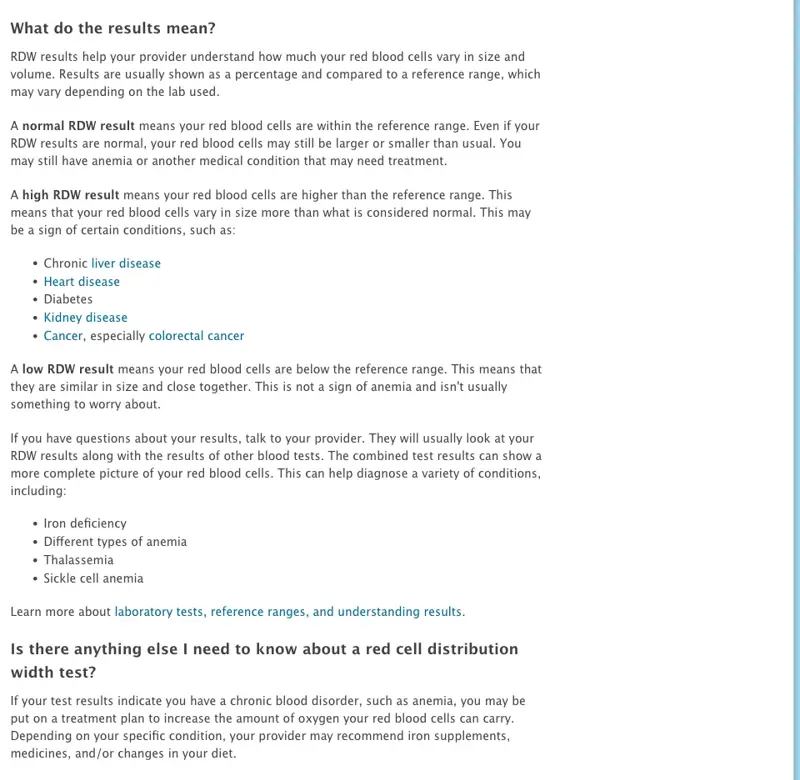
What a high RDW can mean (and why it’s rarely scary on its own)
A high RDW tells you there’s a mix of red-cell sizes. That can happen for reasons ranging from completely benign to worth-checking:
- Iron deficiency — the most common cause, especially when RDW is high and the cells are running small.
- A vitamin B12 or folate shortfall — often when RDW is high and the cells are running large.
- Recovery — after blood loss, or once you’ve started an iron supplement, fresh new cells of a different size enter circulation and widen the spread. Here, a high RDW is a sign of things getting better.
- Simply having a mixed picture the day of the draw — recent changes, timing, and normal variation all play in.
Notice what’s not on that list: a single high RDW does not, by itself, point to anything serious. Hematologists call RDW an “ancillary index” — a supporting clue, never a diagnosis on its own. Using a lone high RDW to conclude you’re sick is, in their words, poor practice.
The one rule that makes RDW make sense: never read it alone
This is the part the scary search results skip. RDW only means something in combination with two other numbers on the same panel: your MCV (average red-cell size) and your hemoglobin (how much oxygen-carrying protein you have). The pattern is the message:
The takeaway isn’t to memorize these combinations. It’s to understand why a chatbot — or a panicked midnight search — gets RDW so wrong: it reads the one red number in isolation, which is the exact thing you’re not supposed to do.
The safe way to ask AI about RDW — or any result
AI is genuinely useful here, but only inside guardrails. Studies of chatbots reading lab results found they’re clear and even empathetic — and also that they over-alarm in 22% to 33% of cases, over-read single values, and miss the context a doctor would catch. A general chatbot has no rules unless you give it some. So give it some.
Here’s a prompt that keeps AI in its lane — explaining, not diagnosing — and works for any marker on your report, not just RDW:
Act as a health educator, not a doctor. I'll paste one line from my blood
test. In plain language:
1. Explain what this test measures.
2. Tell me what "high" or "low" generally means for it.
3. List the most common, harmless reasons it can be off.
4. Tell me which OTHER numbers on a blood panel it should be read
   alongside.
Do not diagnose me and do not tell me what to do about medication.
End with 2-3 questions I should ask my doctor.

Here is the result: RDW-CV 15.2% (reference range 11.5-14.5%)
Three things make that prompt safe. It names a role (“health educator”), which measurably improves answers. It forbids diagnosis and medication advice, the two places AI does the most harm. And it ends with questions for your doctor — turning a scary PDF into an agenda for your appointment instead of a verdict you deliver to yourself at 1 a.m.
Two hard rules before you paste anything:
- Strip your identity first. Delete your name, date of birth, and any patient ID — or crop them out of a screenshot. A consumer chatbot is not covered by medical-privacy law; anything you paste may be logged and used to train the model. Paste the numbers, not the person.
- Never act on the answer. Not a supplement, not a dose, not “skipping the follow-up because the AI said it’s fine.” False reassurance is quieter than a false alarm — and more dangerous.
What this means for you
- If you just saw “RDW High” and nothing else is flagged: breathe. On its own it’s a weak signal. Note it, and ask your doctor to read it alongside your MCV and hemoglobin at your next visit.
- If several red-cell numbers are off together (RDW, MCV, hemoglobin): that’s a pattern worth a conversation sooner rather than later — not an emergency, but a real “call the office this week” item.
- If you’re using AI to understand results: use the prompt above, strip your identity, and treat the output as questions for your doctor — never as answers.
- If you’re a caregiver helping an older parent make sense of a report: the same routine works, and preparing questions together beats handing them a diagnosis.
What AI can’t do with your blood work
- It can’t diagnose you, and it’s least reliable exactly where it sounds most confident.
- It can’t see your context — your age, medications, pregnancy, or history all change what a number means, and the chatbot only sees the printout.
- It can’t judge urgency well. Studies found models mis-timing in both directions: “mention it someday” for things that warrant a call this week, and vice versa.
- It doesn’t replace the reference range on your own report. Your lab’s numbers are the ones that count.
The bottom line
RDW is just “how varied your red blood cells are in size.” A high value on its own is one of the mildest flags on a blood panel — its meaning comes entirely from the company it keeps (MCV and hemoglobin) and from your own history, which only your clinician has. AI can absolutely help you understand the words and walk into your appointment with sharper questions. It cannot tell you what your results mean for you — and the moment it tries, that’s your cue to close the tab and ask a human.
Want to use AI safely for more than lab results? Our AI Fundamentals course covers the basics of getting reliable answers, and Prompt Engineering teaches the “give it a role and rules” habit that keeps AI honest — the same trick that makes the prompt above work. For the full picture on chatbots and your health data, read Can AI Explain Your Blood Test Results?