
If you drive for a living, you’ve seen the headlines and the YouTube thumbnails: self-driving trucks, “the end of the trucker,” AI dispatchers replacing the whole business. The searches back up the anxiety — “will AI take over trucking” and “will trucking be replaced by AI” are both climbing fast.
So let’s skip the doom and the hype and give you the honest version, plus something more useful than worry: a short list of what to actually do with AI this week. Because the truckers who come out ahead won’t be the ones who ignored AI, and they won’t be the ones who panicked. They’ll be the ones who put it to work on the boring stuff while keeping their hands on everything that matters.
The honest answer
No, AI is not taking your truck this year. And the full story is more reassuring than the thumbnails suggest — but not a free pass.
Here’s what the actual reporting says:
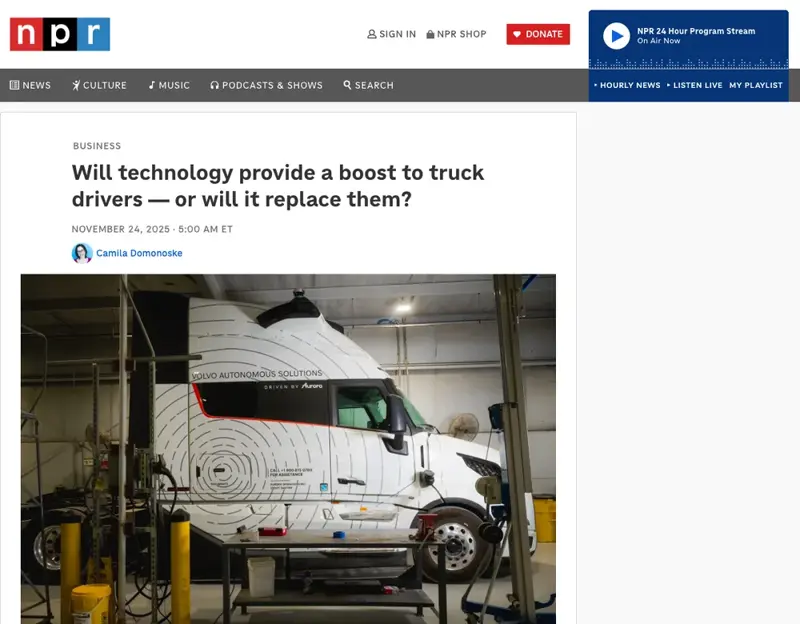
- Full self-driving freight is years out, not months. The realistic timeline for trucks running with no driver at all in regular commercial service stretches past 2027 and, by many estimates, toward the end of the 2030s. The nearer-term versions still need a human for pickup, delivery, and anything off the simple highway stretch.
- Autonomous trucks only work in easy conditions. Clear weather, mapped highway lanes, predictable routes. Urban streets, weird docks, bad weather, the thousand small judgment calls of a real haul — those still need a person.
- The job evolves; it doesn’t vanish overnight. Estimates that a million-plus transportation jobs will be “impacted” by AI mostly mean changed, not deleted — drivers overseeing systems, handling the complex last mile, focusing on the higher-value work. As one industry analysis put it plainly: complete replacement of professional drivers “is not on the horizon.”
That’s the macro. But it’s not really the question you’re asking. The question under the question is: what do I do right now so I’m on the right side of this? Here’s the answer.
What to hand AI this week (the 3 desk tasks)
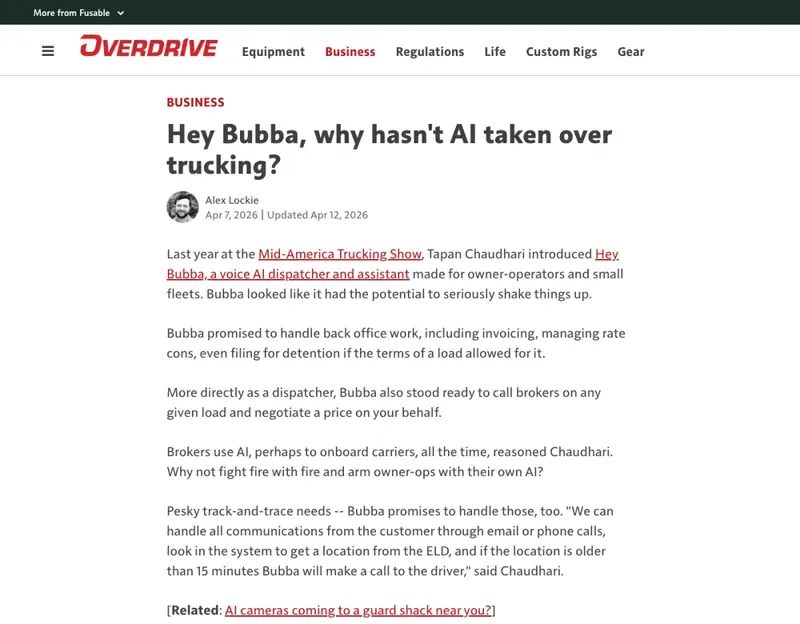
The version of AI that’s genuinely useful to an owner-operator today isn’t a robot driver. It’s a tireless office assistant. Put it to work on these three, and you’ll feel the benefit by Friday:
1. The paperwork. Rate confirmations, load-board posts, check-in and check-call messages, status updates. AI is great at turning a messy rate con into a readable checklist and drafting a clean, professional broker email in about two minutes. (We wrote a step-by-step for exactly that: turning a rate con into a broker email.)
2. The broker emails. The polite confirmation, the firm-but-not-desperate counter, the follow-up nudge. You set the number and the terms; AI helps you say it like a seasoned pro even when you’re wiped after a long day.
3. The learning. New to a term? Ask ChatGPT what “detention,” “TONU,” or “lumper fee” means, or have it explain why a rate con clause matters. It’s a patient, free tutor for the business side of trucking — the part nobody teaches you.
Notice what all three have in common: they’re desk work. They speed up the typing and the admin so you can rest or drive. None of them make decisions for you.
What stays human (the 3 things to protect)
This is the other half, and it’s where your value actually lives. Guard these:
1. Negotiation. A rate is a relationship, not a formula. Knowing when to hold, when to walk, when a broker’s bluffing — that’s earned judgment. AI can draft the email; it can’t read the room.
2. Relationships. Most good freight never hits a public load board. It comes from carriers and brokers who trust you. A truck driver pulling $300k+ said it best online: the whole game is knowing your numbers and building good relationships. No algorithm hands you that.
3. The driving itself — and the judgment around it. The gut feel that something’s wrong with the truck before the dashboard lights up. The call to shut down when the weather turns. The thousand decisions a real haul demands. That’s the part the autonomous-truck companies are still struggling with years in, because it’s genuinely hard.
The pattern across the whole industry right now is “hybrid” — AI handles the volume of communication and paperwork, humans handle the judgment. That’s not AI replacing you. That’s AI clearing your desk so you can do the parts only you can do.
What this means for you
If you’re a solo owner-operator. Your edge isn’t competing with a robot on price — it’s being the reliable, sharp, relationship-driven operator a broker wants to call back. Use AI to look professional and move fast on paperwork; spend the time you save on the relationships and the numbers.
If you’re an independent dispatcher. Your job is judgment and connections, both safe. Let AI absorb the repetitive communication so you can manage more drivers without drowning in email — but keep every rate and negotiation in your own hands.
If you’re a company driver worried about the future. The realistic move isn’t panic, it’s positioning. The drivers who learn to work with these tools — and who understand the business side — will be the ones promoted to oversee them, not replaced by them.
If you’re thinking about getting out. Don’t make a fear decision off a YouTube thumbnail. The honest timelines give you years, and the skills you build now — both trucking judgment and basic AI fluency — travel with you no matter which way the industry turns.
The bottom line
“Will AI take over trucking?” The fair answer: it’s already changing the desk part of the job, it’s years away from the driving part, and it will never own the negotiation, the relationships, or the judgment that make a good operator good. The threat was never that AI would replace truckers. The risk is that some truckers won’t learn to use it while their competitors do.
So don’t doomscroll the autonomous-truck videos. Spend twenty minutes this week pointing ChatGPT at your paperwork, and put the rest of your energy where it’s always belonged — on the road and the relationships.
The fastest place to start is our AI for Trucking course, built around the practical owner-operator workflows. And if AI is brand new to you, AI Fundamentals gets you comfortable in an afternoon — no fleet software, no jargon, just the basics that put you ahead.