

Anthropic, the company behind Claude, just told its investors something it has never been able to say before: this quarter, we’ll make money.
If you pay for Claude — the $20 Pro plan, a team account, or API credits for an app you’re building — there’s a tempting thought hiding in that headline. The company is finally profitable. Maybe my bill is about to get cheaper.
It isn’t. And the reason why is worth understanding, because it tells you something real about how AI pricing actually works.
What Anthropic actually announced
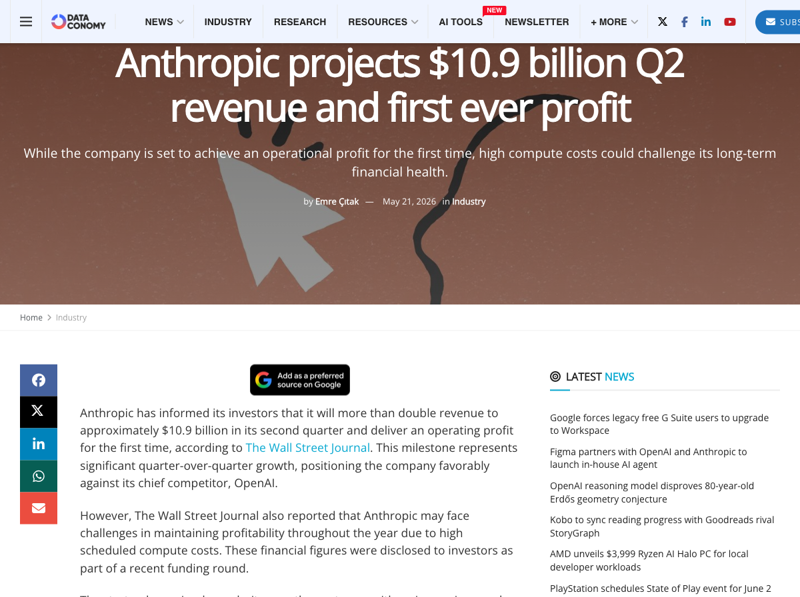
Here are the numbers, reported by the Wall Street Journal on May 20 from projections Anthropic shared with investors.
Anthropic expects about $10.9 billion in revenue for the second quarter of 2026. That’s up from roughly $4.8 billion the previous quarter — more than double, in three months. On top of that, the company projects its first-ever operating profit: around $559 million.
For a company that told those same investors, less than a year ago, that it didn’t expect to make a profit until 2028 at the earliest, that’s a genuine shift. The engine behind it is Claude Code — Anthropic’s coding tool — which businesses have adopted fast enough to drag the whole company into the black ahead of schedule.
Two things matter before you celebrate, though.
First, this is a projection, shared with investors during a fundraising round — not an audited earnings report. There’s no public filing to check it against.
Second, “operating profit” is a specific, narrow term. It counts the cost of running and training the models. It leaves out stock-based compensation, and it isn’t the same as net profit or actual cash in the bank. A respected critic, the writer Ed Zitron, has argued the number leans on a temporary discount on compute costs and some friendly accounting — he called it a “profitability swindle.” Anthropic itself added a quiet caveat: it might not stay profitable for the full year, because it’s about to spend heavily on new computing infrastructure.
So: real milestone, fragile footing. Hold both of those in your head.
Why a company profit doesn’t become your discount
Here’s the part that actually answers the question.
Anthropic’s profit came from two places. One is volume — far more businesses paying for Claude than before. The other is efficiency: it now spends about 56 cents on computing power for every dollar of revenue, down from 71 cents a quarter earlier. The models got cheaper to run.
Your instinct says: if it’s cheaper to run Claude, shouldn’t Claude cost me less?
In almost any other industry, maybe. In AI, no. And it comes down to where that saved money goes.
When an AI company spends less on computing, it doesn’t bank the difference or hand it back to customers. It pours it straight into the next model. Today’s efficiency gain becomes tomorrow’s training run for the next, smarter version of Claude. The savings are real — they just get reinvested, not refunded.
Think of it like a restaurant that finally figures out how to cut its food waste. It doesn’t drop its prices. It opens a second location. Growth eats the savings.
There’s a second reason, too. Anthropic isn’t competing on price right now — it’s competing on capability. As long as people choose Claude because it’s good, not because it’s cheap, the company has zero reason to start a price war with itself. A profit doesn’t change that math. If anything, it confirms the strategy is working.
What this means for you
If you pay $20 a month for Claude Pro: Nothing changes. Your plan isn’t getting cheaper, and — here’s the genuinely good news — it’s not getting more expensive either. A company that just turned a profit has no emergency reason to hike your price. Fragile profit or not, “we’re making money” is a much calmer place to run a business from than “we’re burning cash.” Read this as stability, not savings.
If you run a small business on Claude: This is the most useful angle. An unprofitable supplier is a risky supplier — the kind that might suddenly double prices or get acquired. Anthropic crossing into profit, even shakily, lowers that risk. It’s a slightly safer foundation to build your team’s workflows on. That’s worth more than a few dollars off.
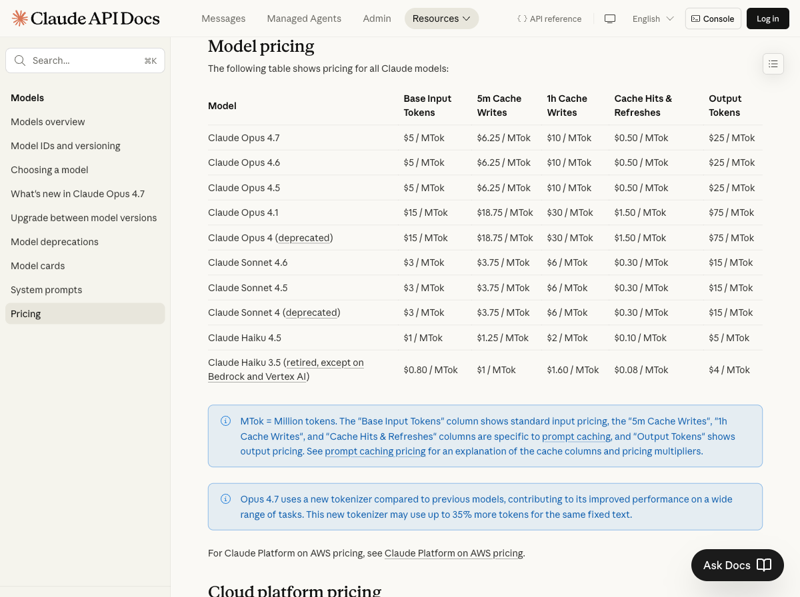
If you build with the Claude API: Don’t budget for a price cut. Claude’s token prices — roughly $1 to $5 per million for the small Haiku model, up to $5 and $25 for the top Opus model — are set by competition and capability, not by Anthropic’s profit margin. The real savings lever is still on your side of the line: prompt caching cuts repeated-context costs by up to 90%, and the batch API runs non-urgent jobs at half price. Those will save you far more than waiting for a list-price drop that isn’t coming.
If you’re choosing between Claude and ChatGPT: Worth knowing the context. OpenAI is preparing to go public, which adds pressure to raise prices over time. Anthropic just showed it can fund itself without that pressure — for now. Neither fact should decide it for you. Pick the one that does your actual work better. But if “will this company still exist and still be sane in two years” is on your mind, a profit is a small point in Claude’s favor.
What this won’t change
Your bill, in either direction. No drop, no spike. The profit news is an investor story, not a customer story.
The competition. Claude Pro is $20 a month because ChatGPT Plus and Gemini are also $20 a month. That shared price is the real ceiling — and the real floor. One company’s margin doesn’t move it.
The fragility underneath. That $559 million is one projected quarter, propped up partly by a temporary compute discount. Anthropic told investors it may slip back into the red later this year as it spends on infrastructure. Don’t treat “profitable” as permanent.
The honest limit on all of this. Nobody outside Anthropic has audited these numbers. They’re projections in a fundraising deck. Treat them as a direction of travel — promising, but unconfirmed — not as fact.
The bottom line
Anthropic turning a profit is good news. It means the company behind Claude can pay its own bills, which makes it a steadier tool to depend on. But “good news for the company” and “good news for your wallet” are not the same sentence. The savings from cheaper, more efficient AI don’t land in your account. They land in the next model.
So here’s the move. Stop waiting for AI to get cheaper, and start getting more out of what you already pay for. A $20 plan you use well is a bargain. A $20 plan you barely touch is the only thing here that’s actually overpriced.
If you want to close that gap, our ChatGPT vs Claude course helps you pick the right tool for each job, and Claude Code Mastery goes deep on the tool that’s quietly driving all of this — the one businesses are paying for in droves.
Sources
- CryptoBriefing — Anthropic projects first operating profit of $559M in Q2
- Dataconomy — Anthropic projects $10.9 billion Q2 revenue and first-ever profit
- PYMNTS — Anthropic on track for first operating profit as revenue surges
- Where’s Your Ed At — Anthropic’s “Profitability” Swindle
- Claude by Anthropic — Plans & Pricing
- Claude API — Pricing documentation