
If you pay for ChatGPT, the news this week probably landed as one quiet, slightly nervous question: is my bill about to go up?
OpenAI is preparing to go public. Reports broke on May 20 that the company is putting together the paperwork for an IPO, with a stock-market debut targeted for as early as September. And whenever a company you pay every month heads to Wall Street, it’s fair to wonder what happens to the price you pay.
Short version: nothing changes tomorrow. But the direction of travel just got clearer. Here’s the honest read — no stock tips, no panic, just what an IPO actually does to a product you use.
What actually happened
Let’s keep this simple, because the headlines are doing a lot of dramatic work.
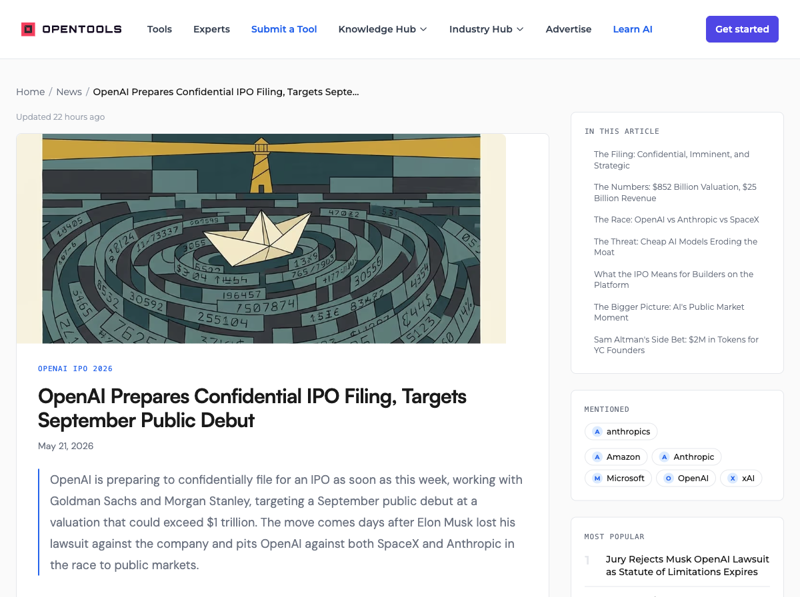
OpenAI — the company behind ChatGPT — is preparing what’s called a confidential S-1 filing. That’s the opening paperwork a company submits to start selling shares to the public. The Wall Street Journal and CNBC reported it first, on May 20. Goldman Sachs and Morgan Stanley, two of the biggest banks on Wall Street, are reportedly running the process. The target: a public listing as soon as September 2026.
A few numbers for scale. OpenAI’s last private valuation, set in an October 2025 funding round, was about $852 billion. The IPO is expected to value the company north of $1 trillion. For comparison, OpenAI brought in roughly $13 billion in revenue in 2025 — real money, but the company still spends far more than it earns.
That word confidential matters. It means the detailed financials aren’t public yet. So anyone telling you exactly what OpenAI earns per user, or exactly what it plans to charge next year, is guessing. Including the people writing the scariest headlines.
OpenAI isn’t doing this alone, either. SpaceX and Anthropic — the company behind Claude — are both expected to go public in the same rough window. Wall Street has started calling it the trio of trillion-dollar tech IPOs. And OpenAI’s timing isn’t random: it recently cleared a long-running lawsuit from Elon Musk, which removed a legal cloud hanging over its plan to operate as a for-profit company.
What going public actually changes
Here’s the part that affects you.
Right now, OpenAI is a private company. It can lose billions of dollars a year and keep running, as long as investors keep writing checks. And they have — that’s how a company with $13 billion in revenue burns through more than that and still operates comfortably.
A public company works differently. Once OpenAI’s shares trade on a stock market, it answers to thousands of shareholders, every three months, on an earnings call. Those shareholders don’t care how much you personally enjoy ChatGPT. They care about one number: is the company making more money per customer over time?
That’s the pressure. It doesn’t arrive overnight, and it doesn’t force any one specific decision. But it bends a company in a direction — toward getting more revenue out of the people already using the product.
For a consumer app like ChatGPT, there are really only two ways to do that. Raise the price. Or show more ads.
Both are already happening. ChatGPT’s free tier started showing ads earlier this year — small, targeted ones, based on what you’re talking about in the chat. And OpenAI has been quietly adding cheaper plans to catch more customers. The IPO doesn’t invent these moves. It just puts a steady tailwind behind them.
The Netflix pattern
We’ve seen this movie before. Literally.
Netflix went public in 2002. Its streaming service later launched at $7.99 a month. Today the standard plan runs around $23. That’s roughly nine separate price increases over two decades — and the steepest ones came years after the IPO, once Netflix was a giant public company under constant pressure to grow.
Spotify is the cleaner example. It went public in 2018, then held its $9.99 price for five full years before raising it. Five years. Not five months.
So here’s the pattern worth holding onto. Companies tend to keep prices flat right before going public, because cheap prices make the user-growth charts look fantastic to investors. Then they raise prices gradually in the years after. Not the week after. The years after.
OpenAI has one twist the others didn’t. It’ll be the only purely AI-focused consumer company trading publicly — Google buries Gemini inside a giant ad business, and Anthropic is going public a bit later. That makes OpenAI the stock everyone watches to judge “is consumer AI a real business?” Which means more pressure on it, specifically, to prove the math works.
What to expect, tier by tier
The free tier. Ads are already here. Expect more of them over time, and better targeted. The free tier isn’t going away, though — free users are how OpenAI fills the top of its funnel, and now they’re also an audience to sell ads against. You’re not the customer on the free tier. You’re closer to the product.
ChatGPT Go ($8/month). This cheaper plan launched globally in January 2026. It’s a signal of where OpenAI is heading: more tiers, more price points, more ways to keep you paying something instead of nothing. If you’re a light user currently on Plus, Go is genuinely worth a look — it can cut your bill by more than half.
ChatGPT Plus ($20/month). The plan most people have. No change has been announced. But $20 is the number to watch. If a hike comes, analysts expect the $25–$30 range, and it would most likely land after the IPO, not before. Worth knowing: Claude and Gemini both sit at $20/month too. That matching price isn’t a coincidence — it’s the market telling you where the ceiling is right now.
ChatGPT Pro ($200/month). The power-user tier, priced for people who get serious work value out of it. That group is less price-sensitive, so it’s less likely to be the first thing OpenAI touches.
The API and Business plans. If you build with the API or pay for team seats, your pricing is usage-based or negotiated. Watch for the quieter changes here — adjusted rate limits, reshuffled tiers — rather than a loud headline number.
What this means for you
If you’re on the free tier: You’ll see more ads, and they’ll get smarter about what they show you. That’s the trade for free. If the ads start to bug you, the $8 Go plan is the cheapest way out.
If you pay $20 for Plus: Don’t cancel today out of fear — nothing has changed yet. But do one useful thing this month: look at how you actually use ChatGPT. If you’re firing off a few questions a day, you might be a Go-sized user paying Plus-sized money.
If you run a small business on ChatGPT: Your team seats are the most negotiable part of OpenAI’s pricing, which cuts both ways. If you’re weighing an annual plan, locking in this year’s rate before the IPO isn’t a crazy hedge. It’s just sensible.
If you build with the API: The headline price is unlikely to jump. The fine print might. Keep an eye on rate limits and how the tiers are defined — that’s where margin pressure usually shows up first.
If you’re deciding between ChatGPT and Claude: Good news. All three big assistants — ChatGPT, Claude, and Gemini — cost $20/month right now. That competition is the single biggest reason none of them can raise prices casually. Pick on quality, not on fear.
What an IPO won’t do
It won’t change your bill tomorrow. Filing paperwork is the start of a months-long process. Your next charge is the same as your last one.
It won’t tell you anything precise yet. The filing is confidential. The real financials — revenue per user, profit margins, actual plans — stay hidden until OpenAI chooses to show them.
September is a target, not a promise. IPO timelines slip all the time, depending on the markets and the regulators. Treat the date as a soft estimate.
It doesn’t mean ChatGPT gets worse. Public-company pressure cuts both ways. It pushes toward higher prices, yes — but also toward shipping features fast enough to justify them.
And it is not a reason to buy “pre-IPO OpenAI shares.” You’ll see ads for that. Most of those offers are traps — overpriced, illiquid, or outright scams. If you ever do buy a public stock, do it after the company is actually listed, through a normal broker, with money you can afford to lose. This post is about your subscription, not your portfolio.
The bottom line
OpenAI going public is a big deal for Wall Street and a small, slow deal for you. Your $20 isn’t moving this month. But the IPO is a signal worth reading: the era of venture investors quietly subsidizing your cheap AI subscription is ending, and the era of AI companies needing to actually earn that money from you is starting.
The smart response isn’t to panic or to cancel. It’s to get good enough at these tools that you’d happily pay $25 if it ever came to that — because you’re getting far more than $25 of value back. That’s the only price protection that actually works: being the kind of user who’d miss it.
If you want to get there, start with our AI Fundamentals course (first 2 lessons free), or if you’re already a daily ChatGPT user, GPT-5.4 for ChatGPT Users will help you squeeze real work value out of the plan you’ve already got.