Your next buyer isn’t starting their home search on Google. They’re typing “best 3-bedroom under $650K in [their zip] with a yard” into ChatGPT, into Ask Zillow on Zillow.com, into Ask Redfin on Redfin.com, into the Realtor.com chat — and getting a list of properties back. Which list of properties they get back is the most important real-estate question of 2026. If your listings appear, you win the tour. If they don’t, the buyer never knew you existed.
Memorial Day weekend kicks off the peak of spring buying season. This 30-minute self-audit tells you exactly which of your listings AI is recommending today — and which three fields to fix this weekend so it starts recommending the rest.
What just changed — and why your listings might already be invisible to buyers
Three major shifts in the last 7 months, all aimed at the same audience: buyers who’d rather chat than scroll.
Zillow launched its ChatGPT app on October 6, 2025, making it the first real-estate app available inside ChatGPT. Buyers can now type natural-language questions (“Show me homes with a big backyard near good schools under $800K”) and get live Zillow listings with photos, maps, and pricing, with deep links back to schedule tours or contact agents. Available on all Free, Plus, and Pro ChatGPT plans for U.S. users.

Source: Zillow Group Press Release — Zillow debuts the only real estate app in ChatGPT
Redfin followed on February 6, 2026 with its own ChatGPT app — same model, Redfin’s listings, market trends, and neighborhood data instead of Zillow’s. Users connect via ChatGPT profile → settings → apps → search “Redfin” → start chat.
Realtor.com launched its ChatGPT app in late March 2026, positioning around the “pre-search” phase — affordability questions, neighborhood discovery — then routing buyers back to Realtor.com for full listings and agent contact.
And Zillow launched its own conversational “AI Mode” on March 25, 2026 — accessible through “Ask Zillow” at the bottom of search results on desktop and mobile. It compares listings, estimates renovation costs from local data, analyzes affordability trends, gives negotiation insights based on competitiveness and price history, schedules tours, and connects buyers to local pros. There’s a built-in Fair Housing Classifier acting as a real-time guardrail so the assistant doesn’t accidentally steer buyers in ways that violate federal, state, or local fair-housing law.
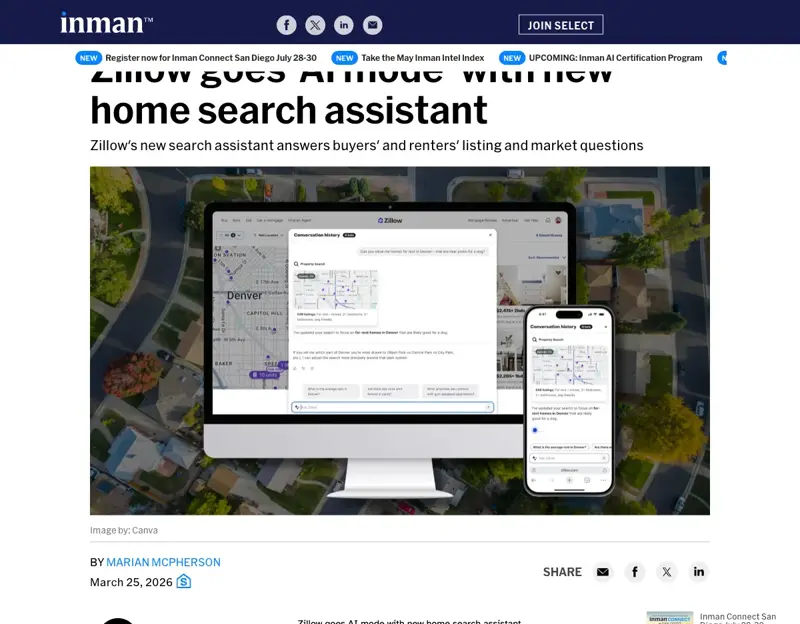
Source: Inman — Zillow Goes ‘AI Mode’ With New Home Search Assistant
The MLS data fight is happening at the same time. On May 18, 2026, Midwest Real Estate Data (MRED), the Chicago-area MLS, threatened to suspend Zillow’s listing-data feed, arguing Zillow was suppressing certain listings in violation of IDX/VOW licensing rules. MRED followed through on May 20. Zillow countered by filing a federal antitrust suit against MRED and Compass. The dispute is ongoing as of this writing, but the practical effect for Chicago-area agents: Zillow’s listing inventory dropped from ~5,000 to ~3,300 listings overnight. If you list in MRED territory, your visibility on Zillow and Trulia is suddenly partial.
The volume of buyers actually using AI for the search is the reason this matters. A Realtor.com survey from October 2025 found that 82% of Americans had used AI tools to learn about the housing market, with ChatGPT at 67% and Gemini at 54%. The same survey: 62% still said real-estate agents were their most trusted source for accurate information — so AI isn’t replacing you, but it’s now the front door to the conversation that ends with you. A separate 2026 Delta Media broker survey reported by RealEstateNews found 97% of brokerage leaders say their agents now use AI tools (up from 80% in 2024). What almost no agent is doing yet: auditing whether AI tools are finding their listings.
That’s what this post is about.
The 30-minute audit (5 queries × 4 platforms = 20 results to compare)
Pick one of your active listings — ideally the one priced between $400K and $800K (the band where buyers do the most AI searching, per Realtor.com data). Note its zip code, school district, and one defining feature (yard, finished basement, walking distance to X). You’ll type 5 queries that a real Memorial Day weekend buyer would type, into 4 different AI surfaces, and screenshot every result.
The 5 queries to run
1. "Best 3-bedroom under [your listing's price ceiling, e.g., $650K] in [your zip] with a [your defining feature, e.g., yard]"

2. "Family-friendly homes near [your school district name] under [your price ceiling]"

3. "Move-in ready properties in [your neighborhood name] with a [your defining feature, e.g., finished basement]"

4. "Listings with low HOA in [your city]" — or "single-family homes with no HOA in [your zip]" if HOA is your differentiator

5. "Open houses this weekend within 10 miles of [your zip]"
These five queries cover the four buyer archetypes most active over Memorial Day: the price-sensitive first-time buyer (#1), the family relocating for schools (#2), the move-up buyer with specific feature needs (#3), the cost-conscious buyer worried about ongoing fees (#4), and the in-market shopper ready to tour (#5).
The 4 platforms to test on
For each query above, run it on:
- Ask Zillow — go to zillow.com, find the “Ask Zillow” chat button at the bottom of search results, type the query
- Ask Redfin — go to redfin.com, find the AI chat, type the query
- Realtor.com chat — realtor.com, open the chat interface, type the query
- ChatGPT — chat.openai.com, with all three ChatGPT apps (Zillow, Redfin, Realtor.com) installed under “Apps & Connectors,” type the query and see which app surfaces results
20 screenshots total. Save them in a folder named with the date — you’ll re-run this audit in 30-60 days to measure your fix progress.
The scoring (5-second per result)
For each of the 20 results, score on three axes:
| Score | Meaning |
|---|---|
| 🟢 Listed + accurate | Your listing appears in the top 3-5 results AND the description matches reality |
| 🟡 Listed but wrong | Your listing appears but the AI got something wrong (square footage, feature, price, school district) |
| 🔴 Not listed | Your listing doesn’t appear at all |
Total your scores. Most agents I’ve talked to this week score 30%+ red on the first audit, even on their best listings. That’s the gap to close.
The 3 fixes (do these this weekend)
After the audit, here’s what to fix in order of leverage. Each one takes 20-40 minutes per listing.
Fix 1 — Rewrite the first 100 characters of your listing description
AI assistants — both the portal-native ones and ChatGPT — give disproportionate weight to the opening of your listing description. The reason: their summarization passes truncate aggressively. If your listing opens with “Welcome to this charming home in the heart of…” you’ve spent your first 100 characters on filler. The same 100 characters could be: “4-bed 3-bath in [school district name], finished basement, 0.5 mile to [landmark], $XX/sqft.”
The rule: the first sentence should answer the buyer’s actual filter criteria. Beds, baths, defining feature, location anchor, price-per-square-foot. Specific. No “welcome to,” no “stunning,” no “must-see.” Save those for the second paragraph if you must.
@GrauTweets posted this morning (May 20): “If you’d like to know how dumb ANY ai platform is just ask it for a real estate analysis of a home for sale. It will just rattle off whatever the description of the property is from zillow.” That’s the problem and the opportunity in one sentence. AI parrots your description. Write a description worth parroting.
Fix 2 — Fix your photo order
AI assistants pull cover photos and the first 3-5 photos when generating their listing summaries. If your cover photo is the worst angle of the kitchen and photos 2-5 are bathroom close-ups, you’re handing the AI an unhelpful visual story. The right order for most listings:
- Exterior front (cover) — the buyer’s first visual impression
- Best interior shot — usually the main living area in good light
- Kitchen — buyers care about this most after the exterior
- Primary bedroom
- Defining feature — backyard, finished basement, view, mudroom, whatever your description leads with
This is not a deep secret of AI — it’s the same photo order that’s worked on MLS for 20 years. But because AI is now reading the order programmatically, it matters more.
Fix 3 — Optimize your agent bio for “best Realtor in [city]” queries
@Blakeman posted Thursday (May 22): “Clients are asking ChatGPT for the best Realtor near them. If you’re not the answer, you’re invisible.” The post had low engagement but the underlying truth is real. ChatGPT picks “best Realtor in [city]” responses primarily from:
- Your Google Business Profile — must be claimed, must have specialty keywords in the business description, must have recent reviews (last 90 days), must list service areas explicitly
- Your agent bio on Zillow / Redfin / Realtor.com — must specify the neighborhoods you specialize in, must have closed-deal counts and average days-on-market, must mention specific buyer types you serve (first-time, relocating, downsizing, military)
- Your personal website — must have a clear “About” page with the same keywords, must be linked from your Google Business Profile
The pattern across all three: specificity beats polish. “Specializing in single-family homes in [3 specific neighborhood names] for relocating families with school-age children” outranks “Award-winning local Realtor with a passion for helping clients find their dream home.” The AI is looking for matchable keywords, not literary flourish.
Homebot’s April 2026 guide on GEO for real estate breaks down the broader optimization framework — generative engine optimization across listing pages, agent bios, and Google Business Profile is the layer that decides which agents get cited in AI responses. Set a calendar reminder for 60 days from today to re-run the 5-query audit and measure your delta.
What this means for you
If you’re a single-vertical residential agent (most readers): the audit takes 30 minutes, the three fixes take 2 hours per listing. Do the audit this morning, fix your top 3 active listings before Monday. Re-audit June 23 and measure the lift.
If you’re a listing agent at a small brokerage: propose this as a brokerage-wide initiative. The first agent at the brokerage to systematically audit and fix listings owns the AI-search visibility for the brokerage’s entire inventory in your market. That’s a real competitive advantage that compounds.
If you’re an STR / Airbnb host or property manager: same framework, different surfaces. ChatGPT-routed queries for “best 2-bedroom Airbnb in [destination] with hot tub” pull from Airbnb’s listing descriptions and your direct-booking site if you have one. Same rules apply: first 100 characters answer the filter criteria; photos in buyer-priority order; host bio mentions specific guest types you cater to.
If you’re at a luxury brokerage: Haute Living’s reporting flagged that luxury real estate ranks dead last in AI search visibility — most $5M+ listings don’t appear in AI results because their descriptions read like editorial copy, not buyer-filter answers. That’s a 24-month window to fix before the AI ranking catches up. The fix is the same: rewrite the first 100 characters to answer actual buyer queries, then rebuild around that.
If you list in MRED Chicago territory: check whether your listings show on Zillow this week. If they don’t, send your seller a one-paragraph email explaining the data-feed dispute, your alternative syndication strategy (Realtor.com, Compass site, your own marketing), and what you’re doing this weekend to make sure their property is still finding buyers. Don’t wait for the seller to ask.
What this audit can’t fix
It can’t fix MLS visibility if your data feed is suspended. The MRED-Zillow situation is a structural problem; no description rewrite changes that. If your area is affected, focus on the platforms where your data still flows.
It can’t catch listings AI hallucinates. @Kaizenkate warned this week (May 20): “AI is changing real estate, simplifying tasks like MLS listings and descriptions. But always double-check its output — it can exaggerate features, making a small cottage sound like a grand estate!” If AI is describing your 1,800 sq ft Cape Cod as a “spacious 3,000+ sq ft estate” in its responses, that’s a problem you can’t fix from your side. Document it with screenshots and flag to your MLS board.
It doesn’t replace the agent conversation. The 62% of buyers who still trust agents most after using AI are looking for the agent who shows up at the open house and answers their actual question. AI gets them to the open house. You close the deal.
It doesn’t help with new construction not yet on MLS. If you’re representing new construction that’s pre-MLS, your audit will return zero results across all four platforms. That’s expected — the fix there is different (direct outreach + a “coming soon” Zillow listing).
The Fair Housing Classifier on Zillow AI Mode is a one-way guardrail. It prevents the AI from steering. It doesn’t prevent you from accidentally writing description copy that violates fair-housing rules (no “family-friendly” if your jurisdiction reads that as steering, no “perfect for [demographic],” no implicit signals about who “belongs”). Run your own listings through your broker’s fair-housing review the same way you always did — the AI doesn’t catch what you wrote, just what it generates in response.
The bottom line
The audit is the unlock. Most agents in your market won’t do it this weekend. The ones who do will know within 30 minutes whether their inventory is invisible to AI-routed buyers — and which three fields to fix first. By the next quarter, the agents who audited and fixed will be capturing the AI-routed buyer traffic that the others are still losing without knowing.
If you want the deeper toolkit — how to write AI-optimized listing descriptions at scale, how to set up Google Business Profile signals that ChatGPT actually weights, how to brief your transaction coordinator on the photo-order rule — our AI for Real Estate Agents course walks through the full system. For the production side of the funnel (the Gemini Omni listing-video walk-through we shipped yesterday), see Real Estate with AI — together they cover both “create better listings” and “be found in AI search.”
The bigger question to put on Tuesday morning’s team meeting: of our active listings this week, how many would an AI assistant actually recommend to a Memorial Day buyer? Run the audit. Find out. Fix the gaps before next weekend.
Sources
- Zillow Group Press Release — Zillow debuts the only real estate app in ChatGPT (Oct 6, 2025)
- Redfin Press Release — Redfin Debuts Real Estate App in ChatGPT (Feb 6, 2026)
- HousingWire — Redfin rolls out ChatGPT app for real estate searches
- RealEstateNews — Realtor.com the latest portal to launch search app in ChatGPT
- Inman — Zillow Goes ‘AI Mode’ With New Home Search Assistant (March 25, 2026)
- GeekWire — Zillow at 20: Real estate giant leans on AI
- MRED GlobeNewswire — Zillow listing suppression dispute (May 18, 2026)
- The Real Deal — Zillow files federal antitrust suit against MRED + Compass
- Inman — 82% of Americans now use AI tools to learn about the housing market (Oct 2025 Realtor.com survey)
- RealEstateNews — 97% of brokerage leaders say their agents now use AI tools (Delta Media 2026 survey)
- NAR — Statement on Zillow’s ChatGPT app integration
- Homebot — GEO for Real Estate Agents (April 2026)
- Haute Living — Luxury Real Estate Ranks Last in AI Search Visibility
- Hank Bailey — Ask Redfin, Ask Zillow: What AI Can (and Can’t) Tell You About a Home
- The Lazy Agent — Zillow AI Mode: What Every Real Estate Agent Needs to Know in 2026
