It’s graduation-and-block-party season, the phone’s ringing with “is the castle free Saturday?”, and the dozen bounce-house listings on your website still say “Bounce house available. Fun for kids!” You know they’re thin. You also know that sitting down to write twelve real descriptions — plus the weather-cancellation reply, the deposit text, the “how many kids fit?” answer — is the chore that never makes it to the top of the list when you’re loading a trailer at 7am.
Here’s the reframe: that blank-page problem is exactly what ChatGPT is good at. Not the safety calls, not the anchoring rules — the writing. A solo operator can knock out a month of listings, a stack of canned replies, and a season of promo posts in one focused afternoon, then spend the saved evenings actually booking jobs. Let me show you the routine — and the one category of words you must never let it touch.
Why this matters more in 2026
Customers don’t only Google anymore. They ask ChatGPT, Perplexity, and TikTok “where can I rent a bounce house near me?” — and the operators who show up are the ones with rich, specific, well-written listings and a complete Google Business Profile. Thin copy doesn’t just read badly to a parent; it reads badly to the AI deciding who to recommend.
The fundamentals the rental-software world agrees on: set your Google Business Profile primary category to “Party Equipment Rental Service,” fill all 750 characters of the description, post a short update weekly (Google posts expire after 7 days), and keep photos fresh — picture-rich profiles pull noticeably more clicks. ChatGPT can’t take the photos, but it can write everything else.
Step 1: A month of listings from your inventory list
Pull your inventory — name, size, capacity, age range, footprint, price — into a simple list or copy it out of your booking software. Then hand it to ChatGPT once:
You’re helping me, a bounce-house rental owner, write listings. Here’s my inventory with the exact specs: [paste your list — name, dimensions, capacity, age range, price]. For EACH item, write three versions: a short one (about 50 words) for the booking cart, a medium one (100–120 words) for the product page, and a longer SEO version (160–200 words) for a category page. Use ONLY the size and capacity I gave you. Do not invent dimensions, weight limits, or any safety claim. Warm, parent-friendly tone, and mention it’s commercial-grade and cleaned between rentals if I’ve told you that’s true.
That “do not invent specs or safety claims” line is not optional — it’s the whole reason this stays safe. You get three clean versions per unit, you paste them where they go, and the part of your website that’s been embarrassing you for a year is fixed in an afternoon.
Step 2: The replies you send fifty times a summer
Every operator answers the same handful of questions all season. Write them once, well:
Write 6 short, friendly canned replies for my bounce-house rental business, in my voice: (1) “yes, that date’s available,” (2) “that date’s booked — here are two alternatives,” (3) explaining the deposit and how to pay it, (4) the setup space and surface I need (flat, access for the trailer), (5) a polite “we’ll make the weather call by [time] the morning of,” and (6) a thank-you after the event with a review request. Keep each under 5 sentences.
Now availability questions get a same-day answer instead of a someday answer — and fast, warm replies are what turn a “just checking” message into a paid booking. Our client communication template skill keeps these organized, and the trade business marketing writer handles the promo side.
Step 3: A season of promo posts in 15 minutes
Demand peaks around spring, graduations, and back-to-school fundraisers. Get ahead of it:
Create 4 weekly Google Business posts and 4 Facebook posts for my bounce-house rental business for [month], themed around [grad parties / summer block parties / church & school fundraisers]. Each 80–100 characters with a clear call-to-action, and include a safety reminder (adult supervision) in at least two of them.
Schedule those, and your “marketing” is handled for the month — without you staring at a blank Facebook box on a Sunday night.
The line you don’t cross
This is the part that’s different from every other trade, so read it carefully.
ChatGPT writes the marketing. It never writes the safety or the policy.
- Never the anchoring or setup rules. Stake counts, tie-downs, distance from obstacles, surface requirements — those come from the manufacturer’s manual, not a chatbot. Wrong numbers here hurt children.
- Never the weather and wind thresholds. The wind speed you shut down at, lightning rules, evacuation steps — manufacturer and local amusement-ride code, every time. AI can rephrase your approved policy for clarity; it cannot author it.
- Never the waiver or legal language. Assumption-of-risk, liability, insurance terms — that’s your insurer and your attorney. If you want it in plainer English, paste your reviewed policy and say “rewrite for a 7th-grade reading level, do not change any numbers, thresholds, or legal clauses.”
- Never invented specs. Capacity and weight limits come off the unit’s tag, not the bot’s imagination.
Inside those lines, write freely. Outside them, the words come from the manual, the insurer, and the law.
What this means for you
If you’re a one-person operation: this is the marketing department you can’t hire. The listings, replies, and posts that used to eat your evenings now take one afternoon, and they read like a real business instead of a hobby.
If you’re growing past yourself: build the prompts once with your true specs and brand voice, then any helper can run them. Consistency across every listing is the professional look that wins the bigger community-event bookings.
If you’re brand new: fix the listings and the Google Business Profile before you spend a dollar on ads. A complete, well-written presence is what makes the AI assistants — and the parents — pick you.
What this won’t do for you
- It won’t set your safety rules. Anchoring, wind, supervision, capacity — manual and code, not chatbot. Non-negotiable.
- It won’t write your waiver. Legal language is your insurer’s and attorney’s job.
- It won’t invent specs you didn’t give it. Every dimension and limit comes off the real unit.
- It won’t take your photos or run your deliveries. The copy is the easy half; the trailer is still yours.
- It won’t sound like you on the first try. Paste a real text you’ve sent so it matches your voice — generic AImush converts worse than your own plain words.
The bottom line
The rental businesses that book solid every summer aren’t writing better than you at midnight — they’ve just stopped writing at midnight. They let AI draft the listings, the replies, and the posts, kept a tight leash on every number and safety claim, and spent the saved hours answering the phone. That’s the whole edge, and it’s available to you this afternoon.
If you want the full routine in one place, our AI for Business course is built for non-technical owners, and Social Media Marketing with AI covers the promo-calendar side. Write the listings. Keep the safety where it belongs. Book the summer.
Sources
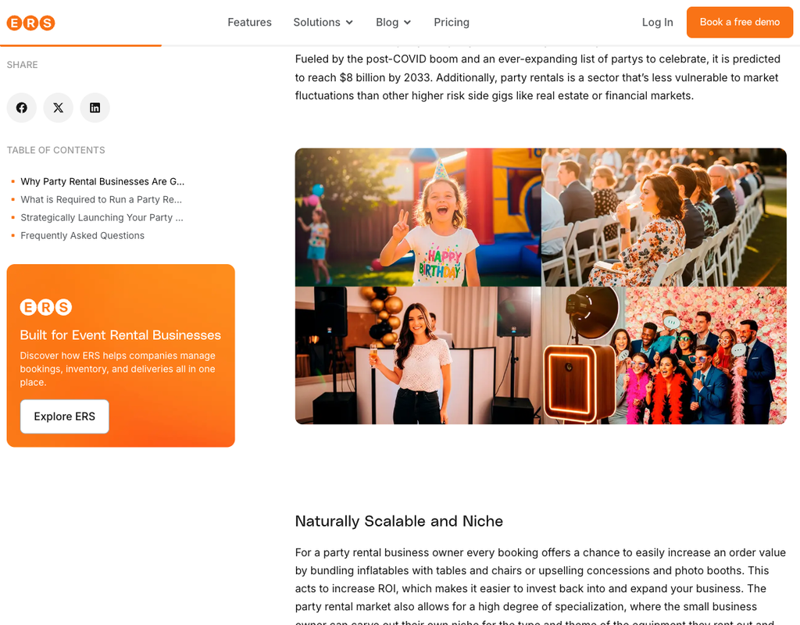
- How to Scale a Party Rental Business 2026 (listings, GBP, online booking) — Event Rental Systems
- Bounce House Marketing Ideas: 40+ Bookings Your First Season — JumpOrange
- Marketing Your Bounce House Rental Business — RentMy
- Marketing Strategies for Rental Businesses 2026 — TapGoods
- Google Business Profile photo & posting best practices (35% more clicks) — RentSync
- Bounce-house safety & commercial-grade equipment requirements — Big Top Inflatables
