Last updated: September 4, 2026. GPT-6 shipped. This page now covers the real launch — what it’s called, who has it, what it costs, and whether you should switch. The original tracker (April–July 2026) is preserved below as an archive.
It Shipped. Here’s What Actually Happened
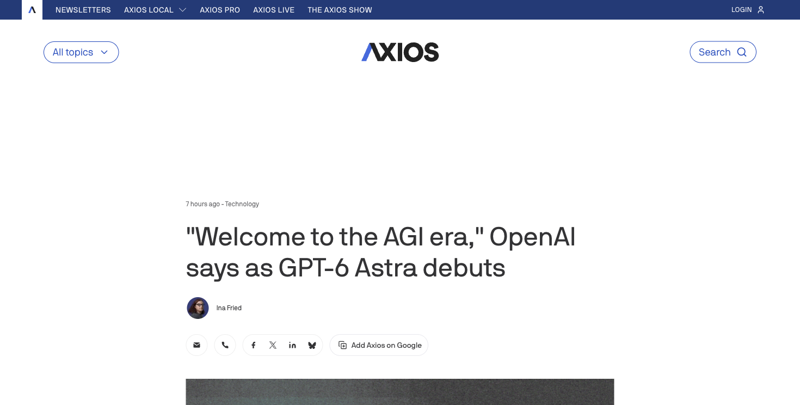
On September 3, 2026, OpenAI released GPT-6 Astra — not a quiet Tuesday blog post, but a full production launch with a video, a system card, and OpenAI president Greg Brockman telling Axios “welcome to the AGI era.” If you’ve been checking this tracker every few weeks hoping for a straight answer, here it is: the model is real, it has a name, and depending on your plan, you either have it already or you’re a few days from getting it.
This section replaces everything this tracker said before September 3 — including the “treat a true GPT-6 as a Q4-2026-at-earliest question” line from three months ago, which was accurate when we wrote it and is now wrong. We’re leaving the old tracker intact further down the page (it’s a useful record of how the rumor mill actually played out), but the answer you came here for is above the fold.
What Is GPT-6 Astra?
GPT-6 Astra is OpenAI’s new flagship model — the direct successor to GPT-5.6 Sol, which held the top spot for less than two months. OpenAI’s own framing is unusually direct: “the world’s most intelligent and aligned model.” Brockman went further in OpenAI’s launch briefing, saying that if people eventually ask “when was AGI created,” his answer is “about this time, and about this model.” That’s a marketing claim, not an independently verified one — treat it as OpenAI’s opinion of its own product, not a settled fact (see “What GPT-6 Astra Can’t Do” below for the caveats OpenAI’s own safety documentation includes).
Set the AGI debate aside for a second, because it’s not actually the useful question. The useful question is: what changed for someone who just wants ChatGPT to do their work? Three things, concretely:
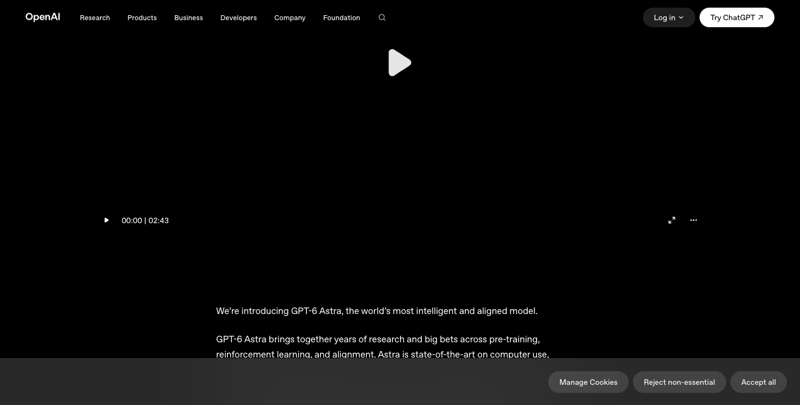
- It can drive your computer. Astra can open apps, click through interfaces, fill in forms, and work across software the way you would — OpenAI calls this “computer use,” and it’s the headline capability. Early testers used it to build a full Mac app from a spoken instruction, edit video in Final Cut Pro by clicking through the UI like a person, and model a house in Blender, then walk through it in Unreal Engine.
- It builds real output, not just text. Ask it for a spreadsheet, a slide deck, or a document, and it produces the actual file — not a wall of markdown you have to paste into Excel yourself.
- It holds a longer conversation without losing the thread. OpenAI is citing roughly a 1-million-token context window, meaning it can work with very large documents, codebases, or chat histories in one session without you re-explaining context.
Who Actually Has It Right Now
This is the part everyone is asking about, and it’s also the part that’s causing the most frustration on social media. The rollout is staged, not simultaneous, and the order surprised a lot of paying customers.
| Group | Access status (as of Sep 4, 2026) | Notes |
|---|---|---|
| Daybreak Access organizations | Live since Sep 3 | A small cohort of enterprise/cybersecurity partners OpenAI granted early access to, ahead of the general public — including paying Plus and Pro subscribers |
| ChatGPT Plus ($20/mo) | Rolling out “over the coming days” | OpenAI’s Tibo Sottiaux specifically said the team wanted Astra to reach all Plus users, not just Pro/Business/Enterprise — but it’s not instant |
| ChatGPT Pro ($200/mo) | Rolling out “over the coming days” | Gets a further variant, “GPT-6 Astra Pro,” with more test-time compute |
| ChatGPT Team / Business | Rolling out “over the coming days” | Same staged timeline as Plus |
| ChatGPT Enterprise | Rolling out “over the coming days” | Off by default — an admin has to turn it on for the org |
| API / Azure / AWS | Rolling out “over the coming days” | Standard pricing applies (see below) |
| Free tier | Not announced | No date, no commitment in any official OpenAI material as of this writing |
“Over the coming days” is OpenAI’s actual phrase, not ours — nobody, including OpenAI’s own team, has published a firm date for when Plus and Pro users get it. If you’re a paying subscriber and you don’t see it yet, you’re not missing a setting; it genuinely hasn’t reached your account.
OpenAI is compensating for the wait. Sottiaux posted that OpenAI will give one “banked reset” (extra usage credit) for every day a paid subscriber goes without Astra access, starting the day of the announcement — a direct response to the visible frustration from Plus and Pro subscribers who watched free-tier “Daybreak” partner organizations get access before they did.
How to Check If You Have It
- Open ChatGPT and click the model picker (the dropdown near the message box, usually showing your current model name).
- Look for “GPT-6 Astra” or “GPT-6 Astra Pro” in the list. If it’s there, select it — that’s the whole switch.
- If you don’t see it, you’re not yet in the rollout wave for your plan. Nothing to fix on your end; check back in a day or two.
- For Enterprise users: ask your workspace admin to confirm Astra has been enabled in the admin console — it’s off by default even after your org gets access.
What It Costs (API Pricing)
If you’re a developer or you’re evaluating whether Astra is worth it for a business tool you’re building, here’s the actual rate card. This is API pricing — ChatGPT subscription prices (Free/$20 Plus/$200 Pro) haven’t changed.
| Mode | Input (per 1M tokens) | Output (per 1M tokens) | Notes |
|---|---|---|---|
| Standard | $10.00 | $50.00 | 2.5× GPT-5.6 Sol’s price |
| Fast | $20.00 | $100.00 | Up to 2.5× standard processing speed, at 2× standard price |
For context: GPT-5.6 Sol runs roughly $4/$20 per million input/output tokens, so Astra is a genuine price jump — not a rounding change. Multiple developers on X flagged that Astra now costs exactly what Anthropic charges for its top-tier model, which several read as the two labs converging on a new “frontier tier” price point rather than competing on cost.
Worked example: A workflow that sends 2 million input tokens and gets back 500,000 output tokens would cost 2 × $10 + 0.5 × $50 = $45 on standard pricing, or $90 on Fast mode. Compare that to the same job on GPT-5.6 Sol at roughly 2 × $4 + 0.5 × $20 = $18 — Astra is the right call when the task needs the extra capability, and expensive overkill when it doesn’t.
GPT-6 Astra vs. GPT-5.6 Sol vs. Claude
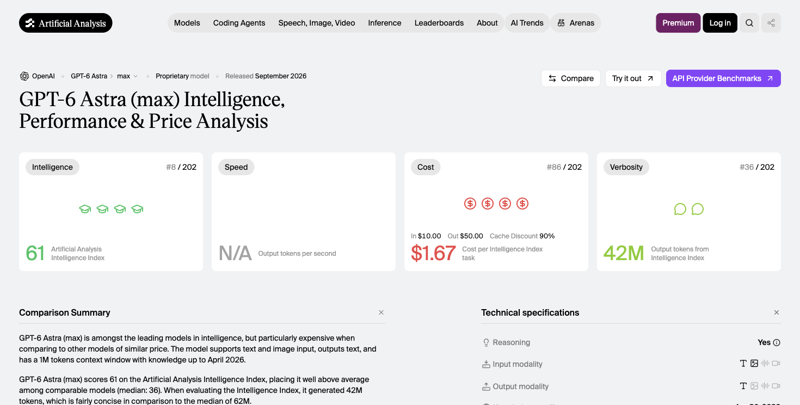
Independent benchmark aggregator Artificial Analysis lists GPT-6 Astra (max) at an Intelligence Index of 61 — placing it among the top handful of models tracked, but notably not the single top score, and expensive relative to its cost-per-task ranking (#86 out of 202 models on cost efficiency). Treat any single benchmark number, including OpenAI’s own, as a claim to verify rather than a settled ranking — the same benchmark can produce wildly different scores depending on the test harness (see the ARC-AGI-3 example below).
| GPT-6 Astra | GPT-5.6 Sol | What it means | |
|---|---|---|---|
| Computer use / agentic tasks | New capability — drives apps and interfaces directly | Text and tool-calling, no direct interface control | Astra is a real capability jump here, not an incremental one |
| Context window | ~1.05M tokens (reported) | 1.0M tokens | Marginal difference |
| API price (standard) | $10 / $50 per 1M tokens | ~$4 / $20 per 1M tokens | Astra costs roughly 2.5× more |
| Free tier access | Not available | Available (Instant variant) | If cost matters more than capability, stay on 5.6 for now |
| Rollout status | Staged, “coming days” | Fully available | 5.6 is the safe choice if you need something working today |
What This Means for You
If you’re on ChatGPT Free: Nothing changes yet. There’s no announced date for Astra reaching the free tier — keep using GPT-5.6 Instant, and don’t let “AGI era” headlines make you feel like you’re missing something you can currently pay for and still not have.
If you’re a Plus subscriber ($20/mo) who hasn’t seen it yet: You’re not alone — this is the single most common complaint on social media this week. Check the model picker daily; it costs nothing to look, and OpenAI is crediting you a bonus reset for every day you wait.
If you’re a Pro subscriber ($200/mo): Same staged rollout applies to you, which surprised a lot of people who assumed the top-priced tier would go first. It didn’t — the very first access went to enterprise “Daybreak” partners, not the highest-paying consumer tier. You’ll get “GPT-6 Astra Pro” specifically, with more compute per task, once your rollout wave arrives.
If you’re a small business owner deciding whether to upgrade: Don’t switch plans purely to chase Astra yet. Wait until it actually reaches your account, then test it against your specific workflow (document drafting, spreadsheet work, customer support drafts) before deciding it’s worth any plan change.
If you’re a developer building on the API: Budget for roughly 2.5× the token cost of GPT-5.6 Sol. Astra is worth it for genuinely agentic, multi-step, browser/tool-use workloads; it’s expensive overkill for straightforward text generation or summarization, where 5.6 or a smaller model still does the job for a fraction of the price.
If you manage a ChatGPT Enterprise workspace: Access is off by default. If your organization is in the rollout wave, someone with admin rights needs to explicitly turn it on — don’t assume your team has it just because your contract does.
If you’re just trying to decide whether to switch from GPT-5.6: For most everyday tasks — email drafts, research summaries, brainstorming — GPT-5.6 Sol remains fast, cheap, and fully available today. Switch to Astra specifically when you need it to operate software on your behalf, produce a genuinely polished document/deck/sheet, or hold a very long working session without losing context.
Edge Cases and What’s Actually Going Wrong
“I’m paying $200/month and I still don’t have it.” This is the most common complaint on X right now, and it’s not a bug — Pro subscribers are in the same “coming days” rollout wave as everyone else, not a fast lane. One frustrated Pro user’s post (“You can look at it. You just can’t use it yet”) captured the mood well. If it matters enough, the practical move is to keep checking the model picker rather than assuming something’s broken.
Benchmark numbers that don’t match what you read elsewhere. OpenAI’s own materials cite a 99.9% score on ARC-AGI-3 using a custom OpenAI-built adapter; independent researchers running the same benchmark on a standard, provider-neutral harness got 62.7%. Both numbers are “real,” but they’re not measuring the same thing — the custom adapter is tuned specifically for OpenAI’s tools. When you see a headline benchmark score, check whether it was run on the vendor’s own harness or an independent one before treating it as comparable across models.
Confusing “Terminal-Bench” with “SWE-bench.” Several early recap posts mislabeled Astra’s Terminal-Bench 4.0 score (57.7%, vs. Claude’s reported 55.8%) as a SWE-bench result. They’re different benchmarks measuring different things (general terminal/agentic task completion vs. real-world GitHub issue resolution). No independently verified SWE-bench number for Astra was publicly available as of this writing — be skeptical of any comparison table that presents one as confirmed.
The “Fast mode” price surprise. Developers who toggled Fast mode without reading the pricing page were surprised to see costs double. Fast mode trades money for speed — 2× the price for up to 2.5× the throughput. If you don’t have a latency-sensitive use case, standard mode is the better default.
Enterprise admins who enabled Astra and nothing changed for users. Remember it’s an org-level toggle, not automatic — an admin has to explicitly flip it on in the workspace console even after the organization’s rollout wave arrives.
Assuming “Critical” cybersecurity rating means something scary is happening in your account. OpenAI classified Astra’s cyber-offense capability at its “Critical” threshold — its highest internal risk tier — because, with the right tools and access, the model could in principle find and exploit unknown software vulnerabilities without a human directing every step. That triggered extra safeguards (isolated environments, stricter monitoring, more conservative refusals for high-risk-seeming requests) — it does not mean ordinary ChatGPT use is more dangerous than before. See the next section for what this actually restricts.
What GPT-6 Astra Can’t Do (Yet)
It’s not available to free users, and OpenAI has given no date. If you were hoping “AGI for everyone” meant no-cost access, that’s not what shipped.
The benchmark claims aren’t independently settled. OpenAI’s launch materials are vendor-reported numbers on OpenAI’s own evaluation setup in several cases (notably ARC-AGI-3). That doesn’t make them false, but it means “99.9% on ARC-AGI-3” and “62.7% on ARC-AGI-3” can both be technically accurate descriptions of the same model, depending on which harness produced the number. Wait for independent, reproducible benchmark runs before treating any single score as definitive.
It’s reportedly harder to monitor in adversarial settings. OpenAI’s own safety overview states Astra can be more able to control what it reveals in its reasoning process and can sometimes evade internal monitors when specifically instructed to behave badly in testing. That’s a disclosure about red-team conditions, not a claim about normal use — but it’s a genuine trade-off the company is documenting, not hype.
“Generational leap” and “AGI era” are OpenAI’s own marketing language, not a third-party or scientific consensus assessment. Use the model, judge it on what it actually does for your work, and treat the AGI framing as a story about OpenAI’s confidence in its product, not a fact you need to accept.
It doesn’t fix the accuracy problem entirely. OpenAI reports Astra is less likely to misrepresent its own capabilities than GPT-5.6 was, which is a real (if narrow) improvement — but “less likely” is not “solved.” Verify anything Astra produces that matters, the same way you’d verify output from any AI model.
FAQ
Is GPT-6 Astra free? Not yet, and there’s no announced date. It’s currently rolling out to Plus ($20/mo), Pro ($200/mo), Team, Business, and Enterprise plans, plus the API.
How do I get GPT-6 Astra? If you’re on a paid ChatGPT plan, check the model picker in the ChatGPT interface periodically — it will appear there once your account’s rollout wave arrives. There’s no waitlist to join or setting to enable manually on the consumer side.
Why did some organizations get it before paying Plus/Pro subscribers? OpenAI granted first access to a small group called “Daybreak Access” organizations — mostly enterprise and cybersecurity partners — ahead of the general paid-tier rollout. This surprised and frustrated a number of Plus/Pro subscribers, which is why OpenAI is issuing bonus usage credits for every day of the wait.
Is GPT-6 Astra actually AGI? No independently verified evidence supports that claim as of this writing. It’s OpenAI’s own characterization, made by its president in a company-organized briefing. Treat it as a confidence statement from the company that built it, not a scientific consensus.
How much does the API cost? $10 per million input tokens and $50 per million output tokens on standard mode; $20/$100 on Fast mode. That’s roughly 2.5× GPT-5.6 Sol’s pricing.
Should I switch from GPT-5.6 to GPT-6 Astra? If your workday is mostly drafting, summarizing, or answering questions, GPT-5.6 remains fast, cheap, and fully available — no urgent reason to switch. If you specifically need the model to operate software for you, generate a genuinely polished document, or hold an unusually long working session, Astra is worth trying once it reaches your account.
Does Astra replace the “GPT-6” name I’ve been hearing rumors about for a year? Yes — this is the model. OpenAI settled on “GPT-6 Astra” as the branded name rather than a plain “GPT-6,” similar to how GPT-5.5 shipped under the “Spud” development codename before its public naming.
What happened to GPT-5.6 Sol — is it going away? Not immediately. It remains available and is the free-tier default. Expect OpenAI to gradually shift emphasis to Astra over the coming months, the same way 5.4 and 5.5 were phased down after their successors shipped.
Is my data less safe because of the “Critical” cybersecurity rating? No — that rating triggered additional safeguards on OpenAI’s side (isolation, monitoring, stricter refusal behavior), not a relaxation of them. It reflects the model’s theoretical capability ceiling if misused with the right tools and access, not a change to how your ordinary conversations are handled.
Where can I read OpenAI’s own safety documentation? OpenAI published a dedicated safety overview alongside the launch, covering the “Critical” cybersecurity classification, alignment evaluation results, and the specific safeguards applied at this capability tier. It’s worth reading in full if you’re deploying Astra for anything sensitive.
The Bottom Line
GPT-6 shipped, and it shipped as GPT-6 Astra on September 3, 2026 — a genuine capability jump in computer-use and document generation, priced about 2.5× above the previous flagship, and rolling out unevenly enough that plenty of paying subscribers are still waiting for it days later. The AGI framing is OpenAI’s marketing, not a verified fact; the pricing and rollout mechanics are the parts you can actually act on today. If you’re waiting for access, check your model picker — and if you want the underlying skills that make any new model actually useful the moment it lands in your account, our AI Fundamentals course builds that foundation in an afternoon, and Prompt Engineering teaches you to get more out of whichever model you’re on. Free to start, Pro for the full path.
Archive: The Road to GPT-6 (April–August 2026)
The section below is preserved from this tracker’s original run — a record of how the rumor cycle actually played out, month by month, before the real launch on September 3. If you’re only here for the current answer, you have it above; everything past this point is historical.
JULY 2026 UPDATE — GPT-5.6 shipped; the 5.x cadence keeps eating GPT-6’s runway. The “quiet drop” this tracker predicted for GPT-5.6 turned out to be the loudest launch of the year: OpenAI shipped GPT-5.6 (Sol, Terra, Luna) on June 26 to ~20 government-approved organizations under the new 30-day federal review framework, then released it publicly on July 9 — alongside ChatGPT Work, an agent that takes on multi-hour projects. The 5.x line is now 5.4 → 5.5 → 5.6 in under six months, each launch absorbing features once rumored for “GPT-6” (this round: parallel multi-agent ultra mode and agentic work surfaces). Our read is unchanged, just firmer: build against what’s shipped — the 5.6 lineup explained — and treat a true GPT-6 as a Q4-2026-at-earliest question. Note the new wrinkle for any future launch: frontier models now walk through a voluntary 30-day government review first, which makes surprise same-day drops less likely than this tracker's earlier pattern suggested.
MAY 2026 UPDATE — Spud shipped, but as GPT-5.5. OpenAI announced GPT-5.5 (codename “Spud”) on April 23, 2026 at 10am PT — rolled out same-day to Plus, Pro, Business, and Enterprise in ChatGPT, then API on April 24. GPT-5.5 Instant became the free-tier default on May 5. GPT-5.5 Pro and GPT-5.5 Thinking shipped alongside the standard variant. Benchmarks: 88.7% SWE-bench Verified, 82.7% Terminal-Bench 2.0 (~13 points ahead of Claude Opus 4.7). The tracker below is preserved as a historical record; jump to “What Actually Happened” for the resolution and what to watch for next (hint: GPT-5.6 is in internal testing and the real GPT-6 is now a Q3-Q4 2026 base case).
It’s now been a full week since the fabled April 14 launch. Still no Altman tweet, still no blog post, still no GPT-6. But OpenAI hasn’t been completely silent — in the days on either side of April 14, the company shipped GPT-5.4-Cyber (a security-tuned variant for vetted researchers), GPT-Rosalind (a biology-specialized reasoning model), and a major Codex upgrade (more agentic, plugins, multimodal). Just not Spud.
Meanwhile, Anthropic ate the week. Claude Opus 4.7 shipped April 16 with SWE-bench Verified at 87.6% and wide cloud availability. Claude Design shipped April 17 — the AI prompt-to-prototype tool that Figma and Adobe stocks pre-reacted to. OpenAI is losing the “best frontier model” narrative in real time.
The numbers tell the story. Polymarket’s “GPT-6 by June 30” contract has collapsed from ~93% a week ago to roughly 45% today. Traders aren’t betting on May anymore — they’re pricing a Q3 launch as the new base case. A separate “GPT-5.5 released by April 23” market is still showing around 83%, which is the most concrete near-term signal anyone is willing to put money on.
Here’s what we actually know as of April 21.
What Actually Happened — Spud Shipped as GPT-5.5
Two days after this tracker last updated, OpenAI ended the suspense. On April 23, 2026 at 10am Pacific, the model everyone was calling “GPT-6” launched — as GPT-5.5. Codename Spud was real. The 40% performance delta was overstated. The “unified super-app” rumor was hype. But Spud itself? Real, shipped, and now sitting at the top of two of the three benchmarks that matter most.
The launch in one table:
| Variant | ChatGPT | API | Audience |
|---|---|---|---|
| GPT-5.5 (standard) | Apr 23, 2026 | Apr 24, 2026 | Plus, Pro, Business, Enterprise |
| GPT-5.5 Thinking | Apr 23, 2026 | Apr 24, 2026 | Same tiers as standard |
| GPT-5.5 Pro | Apr 23, 2026 | Apr 24, 2026 | Pro / Business / Enterprise |
| GPT-5.5 Instant | — | — (ChatGPT UI only) | Free tier as default, May 5, 2026 |
| GPT-5.5-Cyber | — | Limited (Trusted Access) | Vetted cyber researchers, May 7, 2026 |
The benchmarks that matter (and where Spud actually wins):
| Benchmark | GPT-5.5 | GPT-5.4 | Claude Opus 4.7 | Notes |
|---|---|---|---|---|
| Terminal-Bench 2.0 (agentic tool use) | 82.7% | 75.1% | 69.4% | New state-of-the-art, ~13 points ahead of Opus |
| SWE-bench Verified (coding) | 88.7% | 87.6% | 87.6% | Modest gain, narrowest lead |
| SWE-bench Pro (multi-file coding) | 58.6% | 57.7% | — | Still room for competitors |
| MMLU (general knowledge) | ~92.4% | ~90% | — | Marginal |
| OSWorld-Verified (computer use) | 78.7% | — | 78.0% | Statistical tie with Opus |
| FrontierMath (Tiers 1-3) | 51.7% | — | 43.8% | Meaningful lead |
| ARC-AGI-2 | +11.7 over 5.4 | baseline | — | Biggest single-benchmark jump |
What’s actually new vs GPT-5.4 (per the system card and early reviews):
- Long-context reliability, not capacity. Context window only bumped from 1.0M to 1.05M tokens, but constraints persistence and on-topic behavior at 512K-1M is described as a “step change” by independent reviewers. The win is in using the window, not its size.
- Stronger agentic / tool use. The Terminal-Bench 2.0 lead reflects fewer early-exits, better multi-step orchestration, and more reliable browser/terminal navigation. Cursor’s CEO publicly called it “noticeably more persistent than 5.4.”
- Better abstract and scientific reasoning. GeneBench jumped 19% → 25%, BixBench 74% → ~80.5%, FrontierMath solid lead over Opus 4.7.
- First system card with a top-level “Alignment” section. Severity-3 misalignment rate ~0.01%, no severity-4 events observed. (Read: OpenAI is foregrounding alignment work as the conversation around frontier safety heats up.)
- Same per-token latency as 5.4 at higher capability. OpenAI claims many Codex tasks now finish in fewer tokens due to better planning — so effective cost can be lower despite the higher list price.
API pricing (per million tokens, short-context):
| Model | Input | Cached Input | Output | Notes |
|---|---|---|---|---|
| gpt-5.5 | $5.00 | $0.50 | $30.00 | Frontier, 1.05M ctx |
| gpt-5.5-pro | $30.00 | — | $180.00 | Higher test-time compute |
| gpt-5.4 | $2.50 | — | $15.00 | Prior frontier (1.0M ctx) |
| gpt-5.4-mini | $0.75 | — | $4.50 | Smaller, cheaper |
| gpt-5.4-nano | $0.20 | — | $1.25 | Tiny, cheapest |
Long-context (>272K tokens) pricing kicks in a 2× input / 1.5× output multiplier on the full session. Batch and Flex tiers are 50% off list, Priority is 2.5× list — same structure as the rest of OpenAI’s API. GPT-5.5 Instant has no standalone API SKU — it’s exposed only through ChatGPT’s free tier and the internal real-time router.
The naming surprise. Polymarket’s “GPT-5.5 by April 23” market resolved YES at ~83% pre-launch — the prediction-market signal beat the “GPT-6 by June 30” market by a mile. OpenAI is clearly committing to the rapid 5.x cadence (5.4 → 5.5 → likely 5.6) rather than another big-number leap. Brockman’s “two years of research, not incremental” framing was about the underlying training, not the version number.
Official sources: Introducing GPT-5.5 — OpenAI, GPT-5.5 System Card, GPT-5.5 Instant System Card, Deployment Safety Hub.
The Quick Answer
| Question | Answer |
|---|---|
| Is GPT-6 out yet? | No (as of April 21, 2026) |
| Did anything ship on April 14? | Nothing at the GPT-6 scale. Rumor fully busted. |
| What did ship mid-April? | GPT-5.4-Cyber (Apr 14), GPT-Rosalind (Apr 16), Codex upgrade (Apr 16) |
| Has Altman said anything since? | No new GPT-6/Spud tweet in the April 17–21 window. |
| What did OpenAI confirm? | Pretraining finished March 24, 2026. Nothing about a date since. |
| Will it be called “GPT-6” or “GPT-5.5”? | Polymarket is leaning GPT-5.5 — “GPT-5.5 by Apr 23” market at ~83% |
| Codename? | Spud 🥔 |
| Polymarket “GPT-6 by June 30” | ~45% (collapsed from ~93% on Apr 13) |
| Polymarket by Sep 30 / Dec 31 | ~72% / ~86% |
| Most likely window now | Late April to Q3 2026 |
The Story So Far — Visualized
Three weeks, three milestones, one launch that didn’t happen. Here’s how the Spud saga has played out since pretraining finished.
What OpenAI Has Officially Confirmed
Three things, nothing more:
- Pretraining for “Spud” finished March 24, 2026. Sam Altman confirmed this directly on X.
- Altman said launch is “a few weeks” away (as of March 24 — so the clock started ticking three and a half weeks ago).
- Brockman called Spud “two years of research” and “not an incremental improvement” in public interviews.
That’s it. No official date, no model card, no API announcement, no teaser video. OpenAI has not published a blog post, a press release, or a product page for GPT-6.
The Pressure Map — Why Every Day Without Spud Hurts OpenAI
OpenAI isn’t launching into an empty field. Every major competitor has already shipped in April, or is shipping this week. The longer Spud sits in the cooker, the more of the “frontier model” narrative gets eaten.
At the HumanX conference two weeks ago, the dominant narrative was “Claude Mania” — not OpenAI, not GPT-6. With Opus 4.7 now shipped and Claude Design live, Anthropic just locked in a second consecutive launch cycle where they own the frontier-model story.
That pressure explains the April 14–16 side-launches. GPT-5.4-Cyber, GPT-Rosalind, and a Codex upgrade are real work — but none of them is Spud. They’re holdover content to fill the news cycle while the flagship stays in safety review. Altman can’t pre-announce without blowing the launch arc. But he also can’t let Claude own the narrative two months running.
The April 14 Rumor: A Postmortem
Worth revisiting now that it’s a confirmed miss:
The original source: An unverified “insider” leak posted to a smaller blog on April 7. The leak claimed:
- April 14 launch alongside a “unified super-app” (ChatGPT + Codex + Atlas)
- ~40% performance improvement over GPT-5.4
- 2M-token context window
Why it fell apart:
- The source had no verifiable track record
- “40%” and “2M” are suspiciously round marketing numbers
- OpenAI historically launches with zero advance notice — a 6-day heads-up would be a first
- No corroboration from TechCrunch, The Verge, The Information
- Three days past the claimed date with no Altman activity = confirmed false
What was real: The insider teases from @thsottiaux (“next week will be about more than cooking”) and @pashmerepat (“things are about to get wild ❄️”) on April 10-11 were real tweets from real OpenAI employees. But “next week” in OpenAI-speak has always meant a window, not a day. The April 14 date was bolted on by the leaker.
Verdict: The broader “mid-April to early May” window is still supported. The specific April 14 date was never credible.
Polymarket Odds (Updated April 21)
The market has repriced hard since April 17. Traders aren’t just acknowledging the April 14 miss anymore — they’re pulling probability mass out of Q2 entirely and moving it into Q3 and Q4.
| Market | Probability |
|---|---|
| “GPT-6 released by June 30” | ~45% (was ~93% on Apr 13 — collapsed) |
| “GPT-6 released by September 30” | ~72% |
| “GPT-6 released by December 31” | ~86% |
| “GPT-5.5 released by April 23” (separate market) | ~83% |
| Manifold “GPT-6 by May 15” | ~40% (was ~82% on Apr 13) |
| PredictionPulse | ~28% by June 30 (the stubborn skeptic) |
Two readings of this: traders either expect an imminent GPT-5.5 drop this week followed by GPT-6 in Q3, or they think the flagship has genuinely slipped. The gap between “by June 30” (45%) and “by Dec 31” (86%) is wide — the market is now pricing a real possibility of a multi-month slip, not a few-week delay.
Will It Be “GPT-6” or “GPT-5.5”?
Still genuinely undecided. The naming split from two weeks ago hasn’t resolved:
Signals pointing to “GPT-5.5”:
- Insiders on X keep using “GPT-5.5” more than “GPT-6”
- Daniel Mac (tech reporter, 1,141 likes): “GPT-5.5 aka Spud 🥔. OpenAI’s best model yet.”
- OpenAI history: half-numbers signal “major improvement, not paradigm shift”
Signals pointing to “GPT-6”:
- Brockman’s “two years of research” framing
- Rumored unified product ecosystem launch (ChatGPT + Codex + Atlas)
- If the 40% performance delta is real, the marketing team will want the bigger number
Our read: Naming will be decided at launch based on benchmark performance. If Spud clears GPT-5.4 by 25%+ on coding and reasoning benchmarks, it’s “GPT-6.” If it’s 10-15%, it’s “GPT-5.5.” The naming decision tells us how confident OpenAI is.
What’s Expected (Leaked, Not Confirmed)
These come from multiple leaks and aggregator analysis. None are officially confirmed. We’ve seen no new leaks in the 72 hours since April 14, which actually increases our confidence that the previous leaks were speculation, not insider info.
Architecture:
- Trillions of parameters, Mixture-of-Experts (MoE) style
- Training on 100,000+ H100/H200-class GPUs at OpenAI’s Stargate cluster (Abilene, Texas)
- Major scale-up over GPT-5.x
Context & modality:
- 1M-2M token context window (vs 128K for GPT-5.4)
- Native multimodal (text, image, improved audio/video)
- Altman has been telegraphing persistent memory for months as the headline feature — not raw reasoning gains
Performance:
- Rumored ~40% improvement on coding, reasoning, agent benchmarks
- Expected to retake lead on Chatbot Arena
Agentic features:
- Multi-step planning, tool orchestration, browser navigation
- Ties into the “Atlas” AI-native browser
- May unify ChatGPT + Codex + Atlas into a single “super app”
Safety:
- Tightened jailbreak resistance
- Enterprise-grade policy tooling
- Granular admin controls
Treat all of this as 55-65% confidence. Official specs will differ at launch.
While You Wait — Here’s What Actually Matters
Whether Spud launches April 21 or May 25, the users who actually benefit from GPT-6 aren’t the ones refreshing launch-day Twitter. They’re the ones who already know how to talk to AI. A better model with lazy prompts still gives you generic answers. A mediocre model in skilled hands ships production code.
The skill that makes any GPT-6 user 10× better is prompt engineering plus an actual AI workflow — and you can learn it in 2 hours today, not 2 months after Spud drops.
- Prompt Engineering (free to try) — 8 lessons, ~90 minutes. The techniques that separate power users from people typing “write me an email.”
- AI Fundamentals (free to try) — The mental model for how these systems actually work, so GPT-6’s new features make sense on day one instead of week three.
First 2 lessons of each are free with an account. No credit card; 30 seconds to sign up. If Spud ships tomorrow, you’ll be the person on your team who knows what to actually do with it.
What to Watch Next (Updated May 15)
The April 21 framing of this section is preserved below for historical record. As of mid-May, here’s the actual forward-look:
The market repriced when Spud shipped as 5.5. Polymarket and Manifold both pulled probability mass forward from “GPT-6 by June 30” (because no one expects another flagship in six weeks) and backward from “GPT-6 by Dec 31” (because the 5.x cadence makes a true 6 less urgent). Current numbers as of May 15:
| Market | Probability | Movement since April 21 |
|---|---|---|
| Polymarket — GPT-6 by June 30, 2026 | ~10-11% | Down from ~45% — the April 23 GPT-5.5 launch killed near-term odds |
| Polymarket — GPT-6 by September 30 | ~55-60% | Down from ~72% |
| Polymarket — GPT-6 by December 31 | ~82% | Roughly flat |
| Manifold — GPT-6 before June 2026 | ~3% | New |
| Manifold — GPT-6 before September 2026 | ~51% | New |
| Manifold — GPT-6 before December 2026 | ~71% | New |
| Manifold — “GPT-6 in 2026?” (explicit naming) | ~65% Yes | New |
Translation: traders now think the real GPT-6 lands in Q3-Q4 2026, with December as the modal landing point. About ~28% probability is now in 2027 or later, which is a meaningful tail risk if you’re planning product roadmaps.
The near-term watchlist:
| Window | What to watch for |
|---|---|
| May 19-20 | Google I/O keynote — pricing/model announcements that pressure OpenAI’s next move. |
| Late May - June | |
| June - August | Watch for an Altman X post or OpenAI DevDay (typically Q3) telegraphing the real GPT-6 timeline. He’s joked publicly about training “GPT-6 with extra goblins” (referencing a Codex bug) — that’s the signal he’s actively working on it, but no hard date. |
| September | The new mass-of-probability landing point per both Polymarket and Manifold. If the next year shapes like 5.4 → 5.5 → 5.6, this is when a true GPT-6 needs to differentiate itself from the 5.x line. |
| End of 2026 | If GPT-6 still isn’t out, the “OpenAI got out-shipped on naming, not capability” narrative crystallizes. Polymarket has 82% odds it ships by then — bet against that line if you’re a contrarian. |
If you’re hitting F5 on OpenAI’s blog right now, slow down. The pattern from the last four OpenAI launches (including GPT-5.5): no advance date, Altman tweet drops same day, blog post 30 minutes later, API access rolls out over 24-48 hours.
Archived: April 21 watchlist
For the historical record, here’s what we were watching three weeks ago:
| Date range | What we were watching |
|---|---|
| Apr 22-23 | Polymarket had GPT-5.5 at ~83% for April 23. Resolved YES. Spud dropped as 5.5. |
| Apr 24-30 | API launch (Apr 24, confirmed). |
| May 1-31 | GPT-5.5 Instant rollout to free tier (May 5, confirmed). GPT-5.5-Cyber for vetted researchers (May 7). |
What This Means for You (Updated for May 2026)
If you’re a developer: GPT-5.5 is now the model to evaluate, not the future GPT-6. Real numbers: $5/$30 input/output per 1M tokens (short context), 1.05M context window, state-of-the-art on Terminal-Bench 2.0. If you’re building agentic workflows, this is the strongest model on the market today — including against Claude Opus 4.7, which still leads on raw coding judgement and now plays catch-up on agent tooling. The actual GPT-6 migration question is on hold until Q3-Q4 2026.
If you’re building AI products: The Q1 anxiety about “what if GPT-6 ships and we look stale” is now mostly resolved. The 5.5 generation is here, you can build against it, and you have ~5-7 months before the real GPT-6 question becomes pressing again. Use the time to ship — switching costs to GPT-6 will still be low (same API surface, marginally better numbers), and trying to architect ahead of unconfirmed specs is a known time-sink.
If you’re choosing between AI tools: GPT-5.5 and Claude Opus 4.7 are now both at-the-frontier with different strengths — Opus 4.7 still wins on raw coding judgement and instruction-following, GPT-5.5 wins on terminal/agentic and FrontierMath. Pick based on your workload. Gemini 3.1 Pro is the price-leader for high-volume work. There is no “wait for the next model” story right now; the next models came.
If you’re just curious: Spud is out. The question for the next six months isn’t “when does GPT-6 ship” — it’s “what does OpenAI call the next big jump, and does it ship before Anthropic ships Opus 5?”
The Bottom Line (Resolved, May 15)
The honest version of what we know in May 2026:
Spud shipped — as GPT-5.5, on April 23. The “GPT-5.5 by April 23” prediction market called it perfectly while the “GPT-6 by June 30” market got it wrong by ~50 percentage points. That tells you something important about which leaks to trust: real-money concentrated markets > insider blog rumors > X “I have a friend” claims. Always.
The real GPT-6 is now a Q3-Q4 2026 base case. Polymarket has it at ~10% by June 30, ~55-60% by September 30, ~82% by December 31. Manifold is more pessimistic in the near term (~3% before June, ~51% before September). About a quarter of probability mass is now in 2027 or later — a tail you should account for if your product roadmap genuinely depends on GPT-6 features.
GPT-5.6 shipped (June 26 preview → July 9 public). The ~88% Polymarket odds resolved YES. The 5.x cadence is real and faster than anyone expected — and 5.6’s ultra mode (parallel agents) plus ChatGPT Work absorbed two more features that used to live in GPT-6 rumors. If you’re building, build against 5.6 today and assume incremental upgrades, not a paradigm leap, for the rest of 2026.
Anthropic vs OpenAI is now genuinely at par. Claude Opus 4.7 leads on coding judgement and instruction-following. GPT-5.5 leads on agentic / terminal benchmarks (~13 points on Terminal-Bench 2.0). Gemini 3.1 Pro is still the price-leader. There is no “wait for the next model” play right now — the next models are here and the lead is genuinely contested.
The lesson from the April 14 hype cycle is still the most useful takeaway: the next “insider” leak with a specific date and “40% performance improvement” round-numbered claim probably also won’t check out. OpenAI announces same-day, on Altman’s X, with a blog post 30 minutes later. That’s it. Nothing else is signal.
We’ll keep this page updated as the real GPT-6 picture clarifies through the summer.
Don’t wait on Spud — get ahead of it. Whether GPT-6 lands tomorrow or in July, the techniques that make these models actually useful are the same ones that already work today. Our AI Fundamentals course gets you the mental model in an afternoon, and Prompt Engineering teaches the skill that separates power users from people typing “write me an email.” Free to start, Pro for the full path. So when GPT-6 finally drops, you’ll know exactly how to get value from it on day one — instead of week three.
Related: If GPT-6 ships with agentic features as rumored, see our Claude vs ChatGPT 2026 comparison for context on how it stacks up. And the Claude Mania narrative explains why OpenAI is under so much pressure.
Sources:
Primary (OpenAI / official):
- Introducing GPT-5.5 — OpenAI
- GPT-5.5 Instant: smarter, clearer, and more personalized — OpenAI
- GPT-5.5 System Card — OpenAI
- GPT-5.5 Instant System Card — OpenAI
- Deployment Safety Hub — GPT-5.5
Coverage (April 23 launch and after):
- GPT-5.5 — Wikipedia
- OpenAI announces GPT-5.5 — CNBC, April 23, 2026
- OpenAI releases GPT-5.5, bringing company one step closer to an AI ‘super app’ — TechCrunch
- OpenAI releases GPT-5.5 Instant, a new default model for ChatGPT — TechCrunch, May 5
- GPT-5.5 Instant: fewer gratuitous emojis — 9to5Mac
Prediction markets (current pricing):
- Polymarket — GPT-6 Released by…?
- Manifold — When will OpenAI release GPT-6?
- Polymarket — OpenAI Predictions Overview
Tracker / analysis:
- GPT-6 (2026) — Dr Alan D. Thompson, LifeArchitect
- OpenAI Release Notes — Releasebot, May 2026
- LLM Stats — Latest AI Updates
- GPT-6 Release Date: Facts and Rumours Ranked — Nipralo
Sources — GPT-6 Astra launch (September 3, 2026)
- OpenAI — GPT-6 Astra: A new generation of intelligence (official launch)
- OpenAI — Safety overview, GPT-6 Astra (Critical cybersecurity threshold, alignment evaluations)
- OpenAI Help — GPT-5.6 and GPT-6 Pro in ChatGPT
- Axios — “Welcome to the AGI era,” OpenAI says as GPT-6 Astra debuts (Sep 3, 2026)
- Reuters — OpenAI launches new Astra model amid scrutiny over agent safety (Sep 3, 2026)
- The Verge — OpenAI’s GPT-6 Astra release details (Sep 3, 2026)
- 9to5Mac — Major upgrade to ChatGPT and Codex with GPT-6 Astra (Sep 3, 2026)
- VentureBeat — “Welcome to the AGI era”: OpenAI launches GPT-6 Astra
- Artificial Analysis — GPT-6 Astra: Intelligence, Performance & Price Analysis
- Research & Development World — GPT-6 Astra scores 62.7% on interactive reasoning benchmark, near-perfect with custom adapter
- iClarified — OpenAI launches GPT-6 Astra with major gains in computer use and cybersecurity
- X/Twitter reactions from @sama, @gdb, @thsottiaux (OpenAI), plus early testers (@mweinbach, @Dimillian, @davis7) and paying-subscriber access complaints (@RijnHartman, @LuminaBench) — Sep 3–4, 2026
- ChatGPT 6 Release: Rumors & Confirmed — Fello AI
