

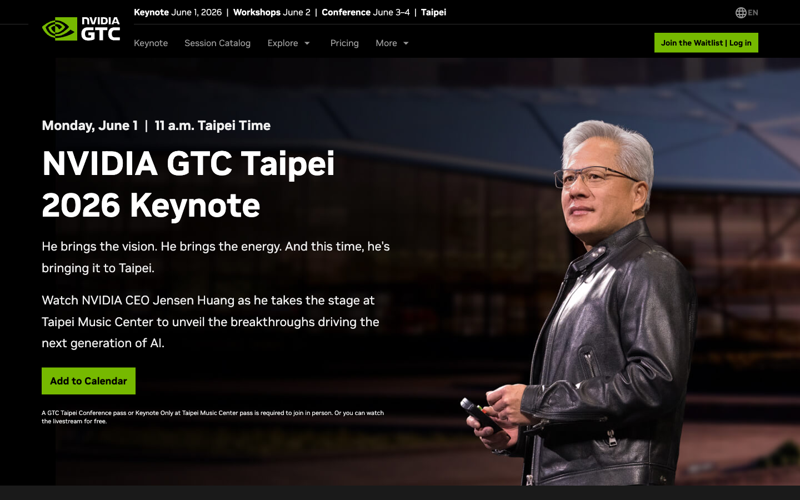
Jensen Huang landed in Taipei on Saturday May 23 and went straight to dinner with TSMC founder Morris Chang. On Monday he meets C.C. Wei, the chairman now running TSMC, to lock down CoWoS packaging capacity for the platform Jensen has called “the biggest and fastest product ramp in the history of Taiwan.” The Monday June 1 keynote at GTC Taipei is the public-facing layer of a trip whose real purpose was supply-chain diplomacy.
For most readers, the keynote will be a marketing event. For anyone signing a Q3 GPU compute renewal, negotiating a DGX SuperPOD configuration through a reseller, or planning a 2027 datacenter build, this is the single hour of the year that resets what your procurement math should look like.
Below is the briefing version. Five questions to put on a one-page handout for your team going into the keynote, what the right answer looks like for each, and the four follow-up questions to ask your NVIDIA rep on Monday morning before sales-team filters lock in.
What just changed (and why this isn’t just another product launch)
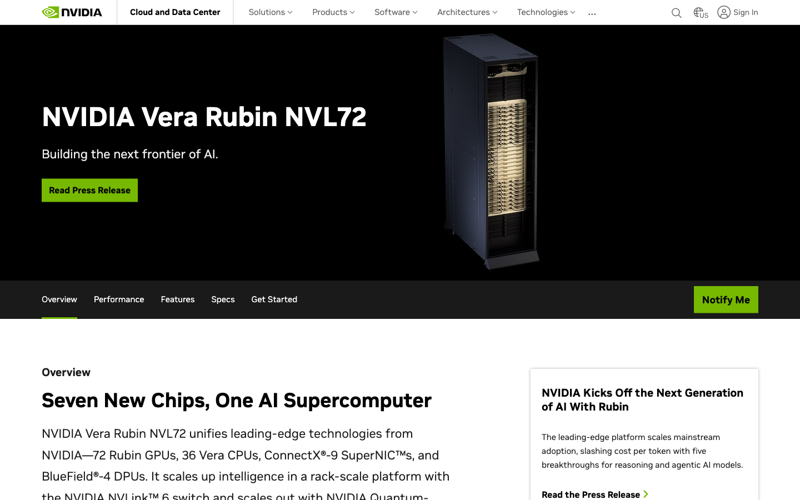
Vera Rubin is the architecture that follows Blackwell. NVIDIA claims 3.5× training and 5× inference performance per GPU, with the flagship rack-scale system — Vera Rubin NVL72 — built on the third-generation MGX NVL72 platform.
That part is the slide-deck version. Three quieter facts matter more for procurement.
One. The cost step-up is real, and it’s coming from memory. Tom’s Hardware put the NVL72 bill of materials at roughly $7.8 million per rack versus around $4 million for the equivalent Grace Blackwell GB200 rack — a 95% increase. Each Rubin GPU is itself only about $50,000 (the chips are not where the money goes); memory now accounts for about 26% of total system cost, up nearly fivefold from Blackwell. Each GPU ships with 288 GB of HBM4, giving the rack 20.7 TB of high-bandwidth memory. OEM quotes are in the $5-7 million range per rack depending on configuration, which is roughly the Futurum analyst estimate that’s been circulating since CES.
Two. NVIDIA’s order book through 2027 is reportedly close to $1 trillion. That’s up from a $500 billion mark Jensen floated in late 2025. AWS has committed to deploying more than 1 million NVIDIA GPUs starting 2026. Google Cloud is among the first cloud providers to offer Vera Rubin NVL72 in the second half of 2026. Meta has committed to millions of chips across Blackwell and Rubin. Microsoft already has Vera Rubin samples in-house — Satya Nadella confirmed it on his last earnings call. If you are not a hyperscaler and not a named launch partner, you are behind in the queue.
Three. The bottleneck is real, and it’s not silicon. It’s CoWoS packaging. TSMC’s Chip-on-Wafer-on-Substrate process is what binds CPU + GPU + HBM into a functioning AI accelerator, and it has been the rate-limiting step for AI chip volume for almost two years. TSMC is scaling CoWoS output from roughly 75-80,000 wafers per month in early 2026 toward 125-140,000 by the end of the year — one of the most aggressive packaging expansions in semiconductor history. NVIDIA has reportedly pre-booked more than half of total 2026-27 CoWoS capacity. The reason Jensen flew to Taipei this weekend is to make sure that booking holds.
That trio is the context. Now the questions.
The 5 questions to put on your team’s pre-keynote handout
Question 1 — Will Jensen confirm an enterprise Vera Rubin GA shipping window?
This is the one that resets your H2 procurement plan.
What to listen for. A confirmed “second half 2026 enterprise availability” line for NVL72 is the bull case for your Q4 build-out. A “first half 2027” framing is the realistic case and means you have permission to optimize Blackwell utilization for two more quarters. Anything vague — “in the second half” without enterprise qualifiers, “rolling availability” — should be priced as a 6-month delay buffer in your finance model.
The contrarian read worth carrying. SemiAnalysis’s Great AI Silicon Shortage argues that for any buyer mid-cycle on GB200, the smart move is to finish Blackwell rollouts through 2026 and reserve Rubin for 2027 — the early-shipment slots are going to hyperscalers and the supply chain doesn’t have enough HBM4 to honor enterprise volume until at least mid-2027 anyway. If that read is right, the “confirmed H2 2026” line is the marketing version of a truth that, for non-hyperscalers, looks more like H1 2027 at best.
Question 2 — Which named hyperscaler and enterprise commitments get stage time?
NVIDIA tends to anchor enterprise pricing and supply-tier perception by which names appear on stage. Listen for three things specifically.
If Anthropic-Vera-Rubin is named (alongside the existing Anthropic-Google-Broadcom 3.5 GW TPU deal and the SpaceX Colossus rental disclosed in the S-1 on May 20), Anthropic’s compute-supply risk model just flattened. If you are a Claude-API-heavy enterprise renewing in Q3, that’s a positive signal for capacity guarantees.
If AWS or Azure announces a multi-billion Vera Rubin commit on stage, your cloud-GPU pricing forecast for 2027 should shift down 15-25% because the supply-side competition will compress per-hour list rates by Q2 2027. Forecast accordingly in any 18-month cloud spend model your CFO is currently approving.
If Meta or Google announces an own-cluster Vera Rubin build at gigawatt scale, the next 12 months of inference-cost-per-token forecasts you’ve baked into your finance model need a refresh — they’re likely too high. Open-weight inference economics get faster.
Question 3 — Is there a “Five-Layer Cake” energy-layer partnership?
NVIDIA’s repeated framing through Q1-Q2 2026 has been the Five-Layer Cake — energy → silicon → systems → software → applications. They have most of the cake. The one they don’t is energy.
An on-stage energy-supply partnership — with a hyperscaler, a grid operator, a small-modular-reactor outfit, or a Tennessee/Texas/Arizona regional utility — would signal that the bottleneck has officially shifted from chips to power. That changes which datacenter regions your team should target for new builds. It also signals which 2027-2030 capex commitments your real-estate group should be locking in this quarter, before the price-per-MW of pre-permitted land moves.
If the keynote has no energy slide, that’s a negative signal — the supply-chain story is still about packaging, and you have one more year before the constraint changes shape.
Question 4 — What’s the new DGX SuperPOD price ceiling?
NVIDIA typically anchors enterprise pricing at major keynotes. If Vera Rubin SuperPOD pricing is anchored materially above current Blackwell SuperPOD pricing — anywhere meaningfully past the $5-7M-per-rack range that’s already leaking — your reseller-quote-negotiation window just narrowed. Most resellers and OEMs price within 8-12% of NVIDIA’s anchor.
The buyer move: get your reseller (Dell, Supermicro, HPE, Lenovo, ASUS) on a call within 48 hours of the keynote and ask explicitly for a price quote against the keynote-anchored line. If the quote is more than 15% above, the reseller is testing your sophistication; counter with the public anchor number and walk if they won’t move.
Question 5 — Is there an explicit TSMC CoWoS capacity guarantee buried in the announcement?
Jensen’s Saturday-Monday Taipei trip is specifically about this. If CoWoS capacity is explicitly or implicitly tied to NVIDIA-priority customer allocation — and the keynote uses language like “we have secured the packaging capacity needed to ship X racks per quarter through Q4 2027” — the practical signal for your team is binary.
Place your Q3 orders by July 31 or wait until Q1 2027. That’s not hyperbole. The supply pipeline NVIDIA reportedly pre-booked covers more than half of total 2026-27 CoWoS output; the residual capacity is what’s available to OEM resellers selling to enterprise. If you’re not in the queue before Q3 close, the next available slot is genuinely Q1 2027.
If the keynote avoids a hard capacity-guarantee line — and Jensen does the usual “we are working with TSMC to scale” — that’s also actionable. It means TSMC and NVIDIA didn’t reach an enforceable commitment over the weekend, and the supply pipeline is more fragile than the headline order book suggests. Your finance model should keep a 2-3 quarter delay buffer through 2027 if that’s the read.
What to ask your NVIDIA rep on Monday Jun 2 morning
The questions above are for your team during the keynote. These four are for your NVIDIA enterprise account rep on the call you should schedule for the morning after.
“Given the keynote announcements, what’s our specific Vera Rubin allocation for Q4 2026 and Q1-Q2 2027? Will you put it in writing in a side letter to our existing MSA?” — Sales reps will offer verbal “indicative allocations.” Side-letter language is what makes them real.
“Is there a launch-partner or priority-customer designation available at our spend level? What does the gating threshold look like, and what would change in our 2026-27 spend to qualify?” — This is the negotiating opening for capacity-guaranteed allocation. Even if the answer is no, the response tells you who is getting priority.
“What’s the upgrade-from-Blackwell path? Do we have any trade-in credit, residual-value commitment, or refresh-cycle discount that would offset our 2025 GB200 spend if we order Vera Rubin for 2027?” — Real for any enterprise that bought Blackwell heavily in the last 12 months. NVIDIA’s enterprise sales motion has gotten more flexible here in the last two quarters.
“What’s your contingency if CoWoS capacity slips? Specifically, if TSMC misses the year-end packaging target, what’s your committed delivery window for our allocation, and is there liquidated-damages language available?” — The point isn’t to actually get liquidated damages. The point is to surface — early — how much real risk NVIDIA itself prices into the timeline, and to give your procurement counsel the framing needed for a written contingency clause.
What this means for you
If you’re an enterprise CIO with an open Q3 GPU compute renewal
Wait for the keynote. Then schedule the rep call described above within 48 hours. Anchor any renewal commitment to the keynote-disclosed price ceiling and the side-letter allocation language. Do not let your team renew on pre-keynote pricing — the public anchor moves your negotiating range materially.
If you’re a VP-infrastructure planning a 2027 datacenter build
The energy question matters more for you than the silicon one. If the keynote produces a Five-Layer Cake energy partnership, accelerate your land/power decisions in Q3. If it doesn’t, your bottleneck through 2027 stays packaging, not power, and your existing site plan probably holds.
If you’re a platform-engineering lead at a 50-500-person AI startup
Most of this doesn’t change your day-to-day. Your model vendor (Anthropic, OpenAI, Google) carries the silicon-supply risk for you. The one signal that does matter: if Anthropic gets named as a Vera Rubin partner, your Claude-capacity outlook for Q3-Q4 improves materially and you can defer the hedge work on Bedrock / Vertex backup capacity that you’ve been carrying as a P1.
If you’re a hardware procurement specialist at a regulated industry
The contract-language questions in section “What to ask your NVIDIA rep” are the ones to take to your enterprise account team. Specifically the side-letter language and the contingency-on-CoWoS-slip language. Regulated industries get the worst end of allocation pressure because procurement governance slows your team down; the offset is contractual specificity, and the post-keynote window is when reps are most willing to commit it in writing.
If you’re a financial analyst tracking NVIDIA suppliers
This piece isn’t for you, but the ecosystem winners to watch on stage are confirmed: Foxconn won orders across all three Vera Rubin platforms (NVL72, HGX Rubin NVL8, MGX servers) per supply-chain reporting on X this week. CoWoS-adjacent Taiwanese names (Shunsin, FOCI, Browave, Landmark) have been ripping on the pre-keynote hype already.
What this briefing can’t tell you
It can’t tell you whether the keynote actually delivers any of the above. Pre-event analysis is a way to organize your listening; it’s not a prediction. Jensen has held back specific shipping windows at past keynotes when sales-cycle math was unfavorable. Plan for two scenarios.
It can’t tell you what your own model-vendor’s compute roadmap looks like. Anthropic, OpenAI, and Google publish enough to outline 12 months but not enough to underwrite a 36-month commitment. The keynote will shift their positioning but won’t tell you what they signed.
It can’t price the geopolitical risk. Any meaningful Taiwan-Strait disruption resets every CoWoS-dependent number in the model. Most CIOs already carry an unstated assumption that the supply chain is geographically concentrated; this keynote will probably reinforce that, but neither side of the equation publishes a real contingency.
It can’t substitute for your reseller relationship. Dell, HPE, Supermicro, Lenovo, ASUS account teams have material context the keynote won’t surface. Schedule the post-keynote call regardless of what’s announced.
The bottom line
Treat the keynote like a major Fed meeting, not a product launch. The market-moving information is in the specific lines about allocation, capacity, partnerships, and pricing — the things most readers tune out for the demos. Get your team a one-page handout with the five questions above, run a 30-minute debrief on the morning of Jun 2, and have the rep call booked for that afternoon.
If you’re building the AI procurement and rollout muscle on your team — covering vendor selection, contract language, capacity planning, and the hyperscaler relationship work that turns these keynotes into real decisions — our Enterprise AI Rollout Playbook walks through the procurement framework end-to-end.
Sources
- NVIDIA GTC Taipei 2026 Keynote — June 1 (NVIDIA)
- Vera Rubin NVL72 — Co-Designed Infrastructure for Agentic AI (NVIDIA)
- NVIDIA Memory Costs Soar 485% — $7.8M to Build (Tom’s Hardware)
- Jensen Huang Flies to TSMC as Vera Rubin Ramp Strains Taiwan Supply Chain (TechTimes, May 24)
- The Great AI Silicon Shortage (SemiAnalysis)
- NVIDIA CEO Jensen Huang to Host GTC Taipei Keynote (WCCFTech)
- Jensen Huang lands in Taiwan, calls Vera Rubin biggest product ramp in computer history (DigiTimes, May 23)
- CoreWeave Extends Its Cloud Platform with NVIDIA Rubin Platform (CoreWeave)
- NVIDIA GTC 2026 keynote on Blackwell, Vera Rubin (CNBC)
- NVIDIA GTC Taipei at Computex: Live Updates on What’s Next in AI (NVIDIA Blog)