A post in r/therapists last month described a clinical moment that’s becoming routine: a client opens her phone in session, pulls up a ChatGPT conversation from the night before, and starts reading it aloud — “I want you to hear what ChatGPT said about my mother…” The therapist wrote that she sat there feeling, in her words, “icky” — half a clinician, half a reviewer of someone else’s transcript, suddenly unsure whether the session was therapy or a book club for AI conversations.
A different post the same week: a client texts her therapist between sessions saying she’s spiraling about a relationship rupture. The therapist responds with the holding she always uses. The client writes back: “It’s okay, I asked ChatGPT and it gave me a 7-step plan.” The session that follows is a renegotiation of what the therapist’s role actually is.
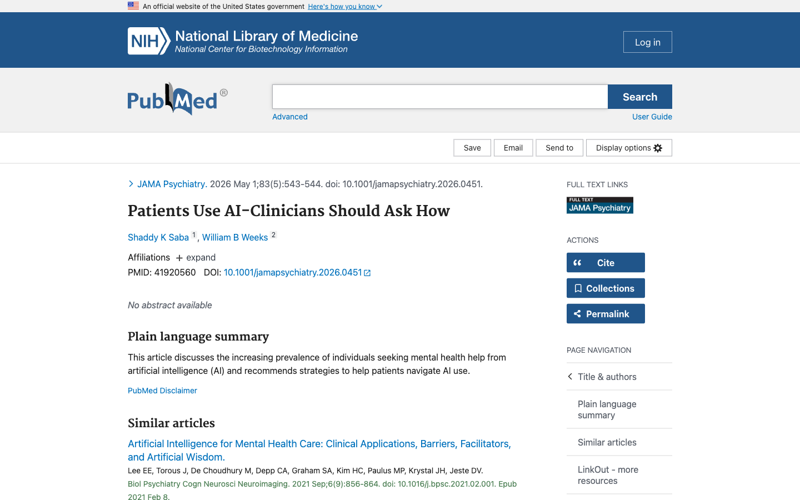
If you’re a working therapist — LCSW, LMFT, counseling psychologist, school counselor, addiction counselor, pastoral counselor — these are not edge cases anymore. Per JAMA Network Open, about 13% of young people now use an AI chatbot for mental-health advice. The chatbot mental-health market grew from $1.88 billion in 2024 to a projected $7.57 billion by 2033. The Saba and Weeks Viewpoint in JAMA Psychiatry April 2026 — Saba S, Weeks WB. “Patients Use AI—Clinicians Should Ask How.” JAMA Psychiatry. 2026;83(5):543-544 — made the case bluntly: clinicians should now ask about AI chatbot use the same way they ask about sleep, diet, exercise, and alcohol consumption. The American Psychological Association and NASW have both published 2025 ethical guidance that explicitly addresses AI in professional practice.
What hasn’t existed: a clinician-side update for your intake form, plus the in-session response framework for the moment a client says “I’ve been talking to ChatGPT about this.”
This piece is that. Four questions to add to your intake, the exact wording recommended by the JAMA Viewpoint, a 3-step in-session response, and a 2-paragraph supervision note for what to flag when AI use is heavy.
What just changed (and why it matters for your scope of practice)
Three things happened in the last 12 months that reset the clinical landscape.
One. The consumer AI-therapy app market is contracting under regulatory pressure. Nevada AB 406 (June 2025) explicitly states that AI cannot provide therapy or mental-health care. Illinois passed the Wellness and Oversight for Psychological Resources (WOPR) Act, banning stand-alone chatbot therapy, prohibiting marketing chatbots as therapeutic, and barring licensed clinicians from using AI to make therapeutic decisions — with fines up to $10,000 per violation. Both bans were specifically applied to Ash by Slingshot AI. Woebot, the consumer-facing CBT app, was retired June 30, 2025. Wysa pivoted from “AI therapist” branding to “wellbeing companion / first step of care.” The category isn’t going away; the regulated category is.
Two. The peer-reviewed literature on client-side AI use is no longer thin. The NIH PMC thematic analysis by Xu et al. (“Shaping ChatGPT into my Digital Therapist,” Jul 2025) documents five recurring themes in how people use ChatGPT psychotherapeutically: simulating a therapist, coaching ChatGPT into a specific modality (CBT, IFS, somatic), re-enacting distressing events, disclosing secrets due to perceived anonymity, and idealizing AI as objective and empathic. Brown University researchers presented at AAAI 2025 on 15 distinct ethical risks of AI as therapist — including gaslighting, false empathy (“algorithmic deception”), dismissiveness, dominating conversations, imposing solutions, validating unhealthy beliefs, mishandling suicidal ideation, and anthropomorphic deception. These are not opinion pieces. They’re the literature you can now cite in your case notes.
Three. Karen Hao at MIT Technology Review documented in September 2025 that therapists themselves are using ChatGPT during sessions without disclosure. In one telehealth case, a therapist screen-shared and a client saw their own disclosures being pasted into ChatGPT in real time. The client described the moment as a betrayal. The APA’s 2025 ethical guidance addresses this directly. The downstream effect on the therapeutic alliance — clients now distrustful that their disclosures may be entered into AI tools — shapes every intake conversation, whether you use AI in your practice or not.
The combined message: AI is now part of the clinical landscape. It is in the room whether you ask about it or not.
The 4 questions to add to your intake form (or your session-start check-in)
These four questions take about 90 seconds for a client to answer, slot cleanly into an existing biopsychosocial intake, and give you genuinely useful clinical material. Use the exact JAMA Viewpoint framing on the first one; the other three follow naturally.
Question 1 — frequency and modality
“AI is rapidly evolving, and I’ve heard from many individuals that they’re using tools like ChatGPT for emotional support. Is that something you’ve experienced? In a typical month, how often do you talk to ChatGPT, Claude, Gemini, or another AI chatbot about personal or emotional issues — never, a few times a year, a few times a month, weekly, or daily?”
The Saba and Weeks recommended wording is non-judgmental and normalizing — “I’ve heard from many individuals” names the behavior as common before the client has to volunteer that they’re one of them. The frequency scale matters: clients underestimate their own use when asked to give a number; the scale gives them an anchor.
What it surfaces clinically: prevalence and pattern. A “few times a year” client and a “daily” client are different cases. Daily-use cases warrant more attention to the next three questions.
Question 2 — content and overlap with the therapeutic frame
“If yes, what kinds of issues do you typically discuss with it? Anything you’d be comfortable also sharing with me — or do you keep some topics specifically for ChatGPT and others specifically for our sessions?”
This is the question that surfaces the most useful clinical material. Clients often use AI for the topics they’re avoiding in session — relationship ruptures they’re not ready to face, identity questions they’re embarrassed about, or self-criticism they assume you’d dismiss. The “do you keep some topics specifically for ChatGPT” framing names the avoidance pattern without confronting it directly.
What it surfaces clinically: the topics being processed outside the therapeutic frame. Pay particular attention if the client reports using AI for acute decisions (relationship-leave, job-change, family confrontation) — those are decisions where the AI’s “deceptive empathy” pattern documented in the Brown study can do real harm.
Question 3 — AI as adviser
“Have you ever asked an AI chatbot for advice on a decision in your life? How did you decide whether to follow it? Did you check it against anyone else’s perspective — friend, family member, me?”
This question separates “I use ChatGPT as a journal” (lower clinical concern) from “I ask ChatGPT what I should do” (higher clinical concern). The follow-up about checking against another perspective surfaces whether the client treats AI as one input among several or as a primary advisory voice.
What it surfaces clinically: the client’s relationship with their own decision-making authority. If the AI is the only voice they check before acting, that’s clinical material worth several sessions of work.
Question 4 — AI in relation to the therapeutic relationship
“If you’ve ever shown an AI chatbot something I said in session — or something you’ve written about therapy — how did the AI respond, and what did you do with what it told you?”
This is the most delicate of the four. Use it only if the prior three answers suggest active AI use. The question makes space for the client to acknowledge — without shame — that they may have processed your interventions through ChatGPT before bringing them back into the room.
What it surfaces clinically: triangulation. When a client routes your reflections through AI before deciding what to do with them, the therapeutic frame is being mediated by a third party that has none of your training, no awareness of the case formulation, and a documented pattern of sycophantic reinforcement. That’s not necessarily a clinical emergency; it is information that should shape your interventions.
The 3-step in-session response when a client says “I’ve been talking to ChatGPT about this”
This is the moment that wasn’t covered in your training. A 3-step framework that holds the therapeutic alliance and brings the AI material into clinical work.
Step 1 — Validate the client’s autonomy without validating the AI as a therapist
Script: “Glad you’re processing this between sessions — let’s talk about what came up.”
The reframe matters. You’re not validating the AI as a clinical authority; you’re validating the client’s instinct to keep working between sessions. Most clients who bring AI material to session are already half-expecting a reprimand. The script removes the threat without endorsing the source.
What to avoid: “You shouldn’t use ChatGPT for that.” The minute you become AI-prohibitive, the client stops telling you when they use it. The intake-form questions go from honest answers to dishonest ones in your second session.
Step 2 — Surface what the AI said versus what the client actually needs
Script: “What did ChatGPT tell you? And before we talk about whether it’s right — what were you hoping it would say?”
The second question is the clinically important one. The Brown AAAI study documented that ChatGPT’s “deceptive empathy” pattern reflects users’ framing back to them as validated truth. So a client who asks the AI “am I being unreasonable for being angry at my partner?” will reliably get “no, your feelings are valid.” That’s not therapy — that’s a mirror. Your job is to surface what the client was looking for and what need underlies it. The AI material becomes diagnostic instead of competitive.
Step 3 — Convert AI-supplied “insight” into clinical material
Script: “Tell me what that insight feels like for you in your own words — not as ChatGPT framed it, but as you would describe it to a close friend who knows you.”
This is the move that takes a session that could have become a transcript review and turns it into therapy. The client’s translation of the AI’s framing into their own language is where the clinical work happens — and you’ll often find that the AI’s “insight” was a recognition the client had been circling for weeks but couldn’t articulate. Your role is to help them own it, not to compete with where they found it.
When AI use is heavy (daily, or driving major decisions), add a fourth step: a 2-paragraph supervision note. Document the AI use in your progress notes (without violating HIPAA — see below); flag to your supervisor or case consult if (a) the AI is being used as a primary decision-maker, (b) suicidal or self-harm ideation is being processed through AI without crisis-appropriate response, or (c) the client is using AI to process material from session that you sense they’re not ready to face directly. Most supervision frameworks now address this; if yours doesn’t, raise it next group consultation.
HIPAA, scope-of-practice, and what to write in your notes
You can document a client’s AI use in your progress notes without HIPAA implications as long as you don’t paste any AI-generated content (which may itself contain identifying details) and as long as the notes are stored in your HIPAA-compliant practice management system, not in ChatGPT for “summarization.” The MIT Tech Review piece by Karen Hao described therapists pasting verbatim session disclosures into ChatGPT in real time — that’s the failure mode to avoid.
For practical documentation: a single line — “Client reports daily AI chatbot use for processing relational stressors; uses AI as primary advisory voice; explored in-session (see clinical note)” — is adequate. Don’t quote AI responses. Don’t paste in the conversation. Don’t put client identifying information into any AI tool, including ChatGPT, Claude, or Gemini, regardless of the tool’s claimed privacy posture. (For the longer version of the therapist-side AI-use question — your own use of AI for note generation and how to do it HIPAA-compliantly — our prior coverage of the HIPAA and ChatGPT for therapy notes addresses that side of the practice.)

What this means for you
If you’re a solo therapist in private practice
Add the four questions to your intake form this week. Test with your next three new clients; refine the wording to fit your voice. Add a brief AI-use clause to your informed-consent document — language like “I do not use AI tools to generate or summarize your session notes. If at any point my practice changes, I will inform you and discuss your consent.” — protects your alliance against the MIT-Tech-Review-style breach.
If you’re at a group practice or hospital-system mental-health program
The intake-form change goes through your clinical director or compliance lead. Frame it as a small addition (90 seconds per intake) tied to APA / NASW 2025 guidance. Bring the JAMA Viewpoint citation; that’s the lever that moves administrative review fastest.
If you’re a clinical supervisor
Add an “AI use” item to your standard supervision agenda. The 2-paragraph supervision note above is a starting template. The cases to attend to: clients using AI as a primary decision-maker; clients processing suicidal or self-harm ideation through AI; clients describing AI as their “real” therapist while continuing to see you. Each of those needs a supervision conversation, not silent tolerance.
If you’re a school counselor or addiction counselor
Adapt the wording for your population. With teens, replace “AI chatbot” with “Character.AI, Replika, Snapchat My AI, or ChatGPT” — name the specific tools they use. With adults in addiction-recovery work, ask separately about AI-generated motivation content (sobriety AI apps, recovery chatbots) because that’s a different clinical pattern from emotional-support use.
If you’re newly licensed (within 2-3 years)
This is the kind of clinical-landscape shift that wasn’t in your training. The good news: you’re young enough in practice to integrate the questions without rebuilding habits. The harder news: case-conceptualization frameworks taught in your master’s program don’t yet incorporate AI use. Plan to discuss with your supervisor how to integrate client-side AI use into your formulation for at least the next year.
If you’re a clinical training director or licensure board member
The training curricula need updating. The intake-question framework above is one of several pieces; the 15-ethical-risks framework from the Brown AAAI 2025 study is another. Add both to your 2026-27 curriculum review.
What these questions can’t fix
They can’t replace clinical judgment. No intake question, however well-designed, substitutes for the discernment that tells you when AI use is a casual sidebar versus a clinical concern. The questions surface material; what you do with it is still you.
They can’t reach the client who lies on the intake. Some clients will minimize their AI use, especially if they sense judgment. That’s why the in-session response framework matters as much as the intake form — the second-session moment when the client volunteers something they didn’t put on the form is where the alliance is tested.
They can’t help if the client is using AI for crisis support. A client in genuine crisis who is using ChatGPT as their first-line response needs a different conversation, immediately. The Brown study’s documentation of AI mishandling of suicidal ideation is the relevant warning here. Have your usual crisis protocol ready and use it; the AI conversation is downstream of the safety conversation, not parallel to it.
They can’t address the regulatory environment changing under you. Nevada and Illinois already restrict AI therapy. Your state may follow. Stay attached to your professional association’s advocacy work; the rules that apply to your practice are moving faster than they have in 15 years.
They can’t substitute for your own AI-use policy. If you do use AI in any part of your practice — note generation, billing letters, parent emails, anything — your clients deserve to know. Informed consent is the floor, not the ceiling.
The bottom line
Add the four questions to your intake. Use them with your next ten new clients. Refine the wording to fit your voice. Build out the in-session response over the next quarter. By Q4, the framework will feel as routine as your existing biopsychosocial intake. By 2027, this conversation will be in every accredited training program — and the practices that started early will be the ones with the most clinical experience to draw on.
If you’re building out your AI literacy as part of your clinical practice — covering both the client-side intake question above and the therapist-side workflow questions (HIPAA-compliant note generation, AI in parent emails, the boundary work around your own AI use) — our Therapists & Counselors and AI Therapy Notes HIPAA Workflow courses walk through the working framework end-to-end.
Sources
- Saba S, Weeks WB. “Patients Use AI — Clinicians Should Ask How.” JAMA Psychiatry. 2026;83(5):543-544 (PubMed)
- ‘How do you use AI?’ Therapists should ask you, experts say (NPR, April 10, 2026)
- Shaping ChatGPT into my Digital Therapist — thematic analysis (Xu et al., NIH PMC, July 2025)
- Help! My therapist is secretly using ChatGPT (Karen Hao, MIT Technology Review, Sep 9, 2025)
- Many people now trust AI with their feelings. And therapists want to talk about it (WBUR, May 2026)
- Brown study on 15 ethical risks of AI chatbots in mental health (Journal Record)
- NASW summary of Nevada AB 406 and Illinois WOPR Act (Social Work Blog)
- Mental Health Providers Should Ask Patients About AI Chatbot Use (Prism News)
- Full article: Social workers’ evaluation of ChatGPT for solving ethical dilemmas (Taylor & Francis)
- ChatGPT-isn’t-HIPAA-compliant therapist piece — FindSkill.ai prior coverage
