

The most misunderstood sentence in American healthcare is printed at the top of a document most people throw away: “This is not a bill.”
It arrives from your insurance company after a doctor’s visit, covered in numbers, and almost everyone does one of two things with it. They panic at the big number and pay it. Or they file it in the trash because “not a bill” sounds like “not important.” Both are mistakes. That document is your Explanation of Benefits, and it’s the single best tool you have for catching an error before the real bill shows up.
You can now hand an EOB to a chatbot and have it translated in seconds. That’s genuinely useful — the codes and columns are designed by insurers, not for humans. But it comes with one hard rule, the same rule that governs everything on this site: use AI to understand your EOB, never to conclude what you owe. An AI can misread the columns, invent a meaning for a code, and tell you a number with total confidence that turns out to be wrong. So let’s decode it carefully.
What an EOB actually is (and isn’t)
An Explanation of Benefits is your insurer’s summary of a claim. After you get care, the provider bills your insurance, and the insurance sends you this statement showing four things: what the provider charged, what your plan allowed, what the plan paid, and what you may still owe.
That last part is the trap. The “amount you may owe” on an EOB is an estimate from the insurer’s side. The actual bill — the one you pay — comes separately, from the provider, sometimes weeks later. The two should match. Often they don’t. And the whole point of reading the EOB first is so you’re holding the insurer’s version before the provider’s bill lands, ready to spot the gap.
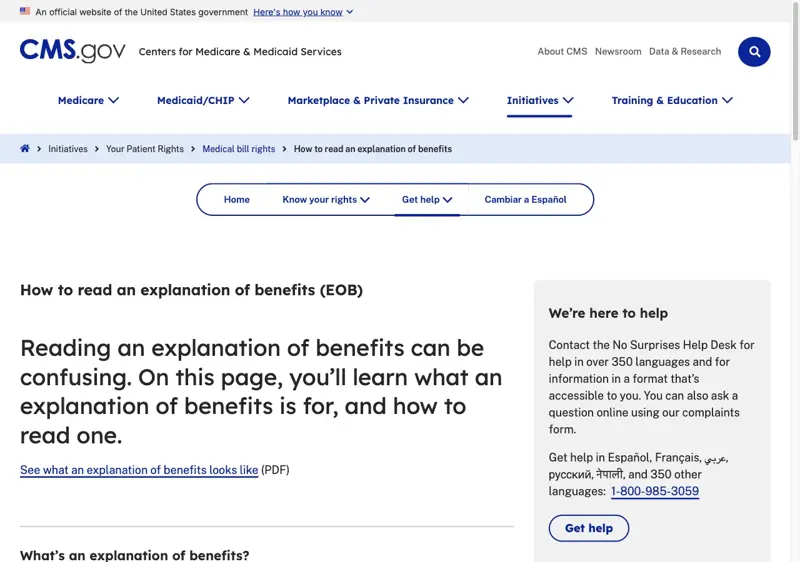
The federal government spells this out on its own patient-rights site, and it’s worth two minutes:
The four numbers on every EOB
Strip away the jargon and an EOB is really just four numbers per line. Get these and you’ve got the whole document.
The gap between the charge and the allowed amount is the discount your insurer negotiated — you don’t pay that part, and seeing it is oddly satisfying. The number that actually matters to your wallet is patient responsibility, and even that one you verify before paying.
The 5 questions to ask AI about your EOB
Before any of these, one non-negotiable step. A chatbot isn’t your insurer, and nothing you paste into it is protected by medical-privacy law. So take the person out and leave the numbers in.
Strip all of this off the EOB before you paste it:
- Your name and any family member’s name
- Your member / subscriber ID and group number
- Your date of birth
- Your address
- Your claim number and account number
Now, the five questions. You can ask them one at a time, or paste the whole prompt below.
1. What did each service actually cost? Translate the provider charges and the codes into plain English — what was each line for?
2. What did my plan actually pay? Read the “plan paid” column so you can see the insurer’s real contribution, separate from the sticker price.
3. What do I truly owe versus what’s already covered? This is the one people get wrong. Ask the AI to separate what the plan already handled from what’s left in “patient responsibility” — and to remind you it’s an estimate, not the bill.
4. What do these adjustment codes mean? Those little codes — CO-45, PR-1, PR-2 — aren’t random. More on them in a second, but the AI can give you a plain-language read on each.
5. Which line should I question? Ask what looks unusual or worth a phone call — framed as questions to check, not verdicts.
Here’s the whole thing as one copy-paste prompt, with the safety leash built in:
Act as a plain-language explainer for an insurance Explanation of Benefits
— not a lawyer, not a billing coder. I've removed my name, member ID, date
of birth, address, and claim number from the text below. Don't ask for them.

Here is my EOB (numbers and codes only):
[paste the line items, amounts, and adjustment codes — no personal details]

Please:
1. Translate each service and charge into plain English.
2. Show me what my plan paid versus what's listed as my responsibility.
3. Explain that "patient responsibility" is an estimate, and tell me what
   to compare it against when the real bill arrives.
4. Decode each adjustment/remark code (like CO-45 or PR-1) in plain words.
5. Point out any line worth questioning — as things to verify with my
   insurer or provider, not conclusions.

Do not tell me a final amount I owe. Do not tell me to pay anything. Give
me an understanding I can check against my actual bill.
The one box where all the confusion lives
If you only master one thing about EOBs, make it this: the difference between the allowed amount and your patient responsibility, and what those two-letter code prefixes mean.
- CO stands for Contractual Obligation. When you see CO-45 (“charge exceeds the allowed amount”), that’s the provider’s write-off. You don’t owe it. It’s the discount, in code form.
- PR stands for Patient Responsibility. PR-1 is your deductible, PR-2 is coinsurance, PR-3 is a copay. These are the amounts that can actually land on your bill.
So a line can show a scary “$1,800 charge,” then CO-45 wiping out most of it, leaving a PR-2 of $120. Your number is $120 — not $1,800. Miss the code prefixes and you’ll misread the whole document, which is exactly the kind of misread an AI can also make if it’s rushing. When the AI decodes these for you, check the prefix yourself: CO means the provider eats it, PR means it may be yours. That one distinction prevents most EOB panic.
What this means for you
If you just got an EOB with a big number on it: breathe, and don’t pay it. It’s not the bill. Decode it with the five questions, note what your actual responsibility looks like, and wait for the provider’s bill to compare. If the bill matches the EOB and the codes check out, then you pay.
If the EOB says a claim was denied: this is where the EOB earns its keep — it usually lists a reason code. Have the AI translate the reason in plain language so you understand why, but don’t let it tell you whether the denial was “wrong.” A denial you want to fight is a real-stakes moment: take it to your insurer’s appeals process, or your state’s Consumer Assistance Program, which helps with this for free.
If the EOB and the bill don’t match: trust the lower, verified number and start asking questions. A mismatch is common and it’s exactly what reading the EOB first is meant to catch. That’s the moment to move from understanding into action — which is a full dispute in its own right.
If you’re doing this for a family member: you’re the one pasting, so you’re the one redacting. Strip every identifier before it touches a chatbot — their name, their member ID, their date of birth — and decode the numbers, not the person.
What AI can’t do with your EOB
- It can’t turn an EOB into a bill. No matter how confidently it states an amount, the EOB is not what you pay. The provider’s bill is. Verify one against the other before any money moves.
- It can’t see your actual plan. Your deductible, your coinsurance, your in-network status — that lives in your plan documents. The AI is guessing from the average of everyone’s, and sometimes it guesses wrong while sounding certain.
- It can misread a code or a column. These are the same “mixed results” the New York Times documented when people used chatbots on medical bills in 2026 — real help and real mistakes, in the same steady voice. A confident tone is not evidence. Your EOB and plan documents are.
- It can’t keep your data private the way your insurer must. Consumer chatbots sit outside medical-privacy law. Assume anything you paste can be stored — which is the whole reason you strip your identity first.
One more boundary worth naming: everything here is patient-side. If reading EOBs and fighting denials is your actual job — a medical biller working payer appeals all day — that’s a different discipline, with real protected-health-information rules that a personal blog can’t cover. It has its own guide. This post is for the person who got the EOB in the mail, not the office that sent it.
The bottom line
“This is not a bill” is a promise, not a dismissal. Your EOB is the insurer’s version of the story, and reading it first — really reading it — is how you catch the error before it becomes a payment. AI makes that fast: four numbers per line, a handful of codes, five plain questions. Just remember which side of the tool you’re on. It decodes and explains. You verify against your own paperwork and decide what to pay. Strip your name, check the code prefixes, and never let a chatbot’s confident number override the actual bill in your hand.
Want the guided version? Understand Your Health Results With AI walks through decoding bills, EOBs, and discharge notes safely, step by step. AI Fundamentals builds the underlying habit of questioning AI instead of trusting it, and Prompt Engineering sharpens the kind of careful, leashed prompting these five questions use. And if a red number on a lab report is what’s worrying you, here’s how to read those with AI — including what RDW actually means.
Sources
- How to read an explanation of benefits — CMS.gov (Medical Bill Rights)
- Know your medical bill rights and the No Surprises Act — CMS.gov
- Patients Are Using Chatbots to Fight Medical Bills, With Mixed Results — The New York Times (April 8, 2026)
- Up to 80% of medical bills have errors — AI can spot them in minutes — Komando (2026)