
You’ve probably seen the headlines. “Chinese AI beats ChatGPT.” “The US lead in AI is over.” A model called Kimi K3 showed up this week and a chunk of the internet lost its mind.
Here’s the thing. The headlines are real. But they need translating.
So let’s do that — no hype, no jargon. What Kimi AI actually is, whether it’s any good, and the question most people ask first: can you trust it?
What is Kimi K3, exactly?
Kimi is a chatbot from Moonshot AI, a Beijing-based startup backed by Alibaba. K3 is its newest model, and it launched on July 16, 2026. You use it the way you’d use ChatGPT or Claude — open the app, type a question, get an answer. It writes, codes, translates, summarizes, and digs through documents you give it.
Two things make it stand out.
First, it’s one of the biggest AI models ever built. Size isn’t everything, but this one is genuinely enormous — bigger than anything else you can currently get your hands on.
Second, it has a huge memory. You can paste in something the length of a long novel and it keeps track of all of it. Drop in a 300-page contract or months of chat history, and it doesn’t lose the thread halfway down.
You can try Kimi AI free in the app, with a daily cap on how much you use. There are paid tiers if you want more room.
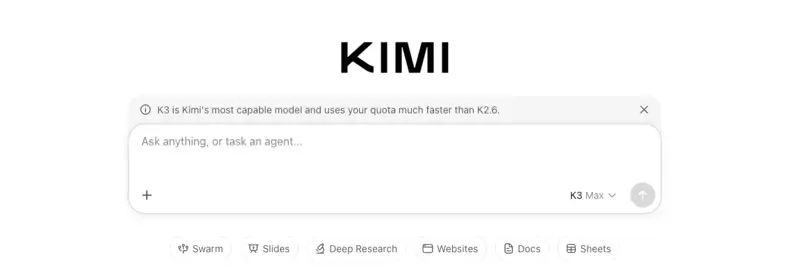
Source: kimi.com — the Kimi app, with K3 as the default model.
Why Kimi K3 is suddenly everywhere
The breakout moment came from coding. On a popular test that measures how well an AI builds the front of a website — the buttons, the layout, the stuff you actually see and click — Kimi K3 beat both ChatGPT’s and Claude’s newest models. Developers started posting screenshots: something built in China, beating the American labs at one of their own games, and costing roughly 40% less to run.
That last part is what gets attention. Cheaper and nearly-as-good is what makes someone actually switch.
But here’s the honest part. On the overall leaderboard that ranks these models — Artificial Analysis, the one most people quote — Kimi K3 landed at number three. Behind Anthropic’s Claude Fable 5 and OpenAI’s GPT-5.6 Sol. Not first. Third.
So it isn’t “the best AI in the world.” It’s a very strong model that wins at some specific things and undercuts everyone on price. That’s a big deal for the industry. For your actual Tuesday afternoon, the buzz is louder than the difference you’d really notice.
Is Kimi AI safe to use?
This should be the first question, and it’s a fair one.
Moonshot AI is a Chinese company. And China has a law — the National Intelligence Law, on the books since 2017 — that can require Chinese organizations to cooperate with state intelligence work when asked. It doesn’t matter where the servers sit or what the privacy policy promises — that obligation exists.
In plain terms: treat anything you type into the hosted Kimi app as potentially readable by someone other than you.
For a lot of what people use AI for, that’s fine. Brainstorming ideas, drafting a normal email, translating a menu, explaining a concept you’re trying to learn — low stakes. If any of it leaked, you’d shrug.
What you should not paste in is anything personal, financial, medical, or confidential to your job. Client records. Your health history. Unreleased company plans. Passwords, obviously. Not because Kimi is definitely doing something shady — but because you can’t verify that it isn’t, and that legal backdrop means “just trust us” isn’t good enough for the sensitive stuff.
This is the same rule we give for any AI tool where you can’t see behind the curtain. We wrote a whole breakdown of the ChatGPT version of this exact question. The logic is identical here — just pointed at a new company in a different country.
Is Kimi AI free — and what does it mean for you?
Short answer: yes, there’s a free tier in the app, with daily limits. Paid plans give you more.
Whether it’s worth your time depends on who you are.
If you’re just curious and not technical — poke at it for the low-stakes stuff. It’s genuinely capable, it’s free to try, and playing with a new tool is one of the fastest ways to feel what today’s AI can actually do. Just keep the private things out.
If you already pay for ChatGPT or Claude — you don’t need to switch. Your tool didn’t get worse this week. Kimi is an interesting, cheaper alternative, but “number three, sometimes better at coding” isn’t a reason to move your whole workflow. (If you’re torn on which chatbot to pay for, our ChatGPT vs Gemini comparison walks through how to choose.)
If you run a small business and “free and cheap” is calling your name — slow down. Think hard about what your team would actually be typing in. Customer details? Financials? That’s exactly the stuff to keep out of a tool you can’t audit. Cheap gets expensive fast when it’s the wrong place for private data.
What Kimi K3 can’t do (yet)
A few things worth clearing up, because the excitement tends to skip past them.
You can’t run it privately today. You’ll see Kimi K3 called “open.” Specifically it’s open-weight — which is not the same as open-source. Open-weight means the company plans to release the finished model so others can, in theory, run it on their own hardware. But those files aren’t due out until July 27. Right now there’s no private, self-hosted Kimi for a regular person — just the app and the API, both on Moonshot’s servers. So the “just self-host it if you’re worried” advice? Not possible yet, and not realistic for most people even later.
It’s not the number one model. Worth repeating. Third overall.
And the everyday gap is small. Hand the same normal task to Kimi, ChatGPT, and Claude, and most people couldn’t tell you which answer came from which. The real story is the trend — China closing the gap fast, for less money. That matters. It’s just not the same thing as “your chatbot is suddenly way better.”
The bottom line
Kimi K3 is a genuinely impressive AI, free to try, and it proves the gap between Chinese and American AI is closing faster than most people expected. It wins at some coding tasks, sits at number three overall, and costs less than its rivals.
Use it for low-stakes work and to feed your curiosity. Keep anything private, personal, or work-sensitive out of it — the Chinese-company legal backdrop makes that part non-negotiable. And ignore the slice of the headline that says your old tools are now obsolete. They aren’t.
The real skill here was never picking the one “winning” AI. It’s learning how to judge any of them, and how to use whichever one you’ve got without handing over things you shouldn’t. That’s the whole idea behind our AI Fundamentals course — and if you’re weighing your options, our ChatGPT vs Claude breakdown and our guide to writing better prompts will help you get more out of whatever you land on.
Sources
- Bloomberg — China’s Powerful New Moonshot AI Model Closes Gap With US Rivals (paywalled)
- VentureBeat — China’s Moonshot AI releases Kimi K3, the largest open model ever
- MarkTechPost — Moonshot AI Releases Kimi K3, an Open Model With a 1M-Context Window
- TechCrunch — Moonshot’s Kimi K3 is expected to close the gap with Anthropic’s Opus 4.8
- South China Morning Post — Moonshot AI unveils world’s largest open AI model