

A guest left a hotel a one-star review written by ChatGPT. You could tell — it had that tidy, over-punctuated rhythm and the giveaway em-dash. So the hotel replied. Also with ChatGPT. The two of them went back and forth, bot to bot, for four or five rounds until the guest finally typed “fk u” and gave up. Somebody screenshotted the whole thing and it went around X in a day.
That’s the cautionary tale hanging over every small hotelier right now. AI can answer your guests — the question is whether it does it in a way that sounds like a real innkeeper, or like a vending machine wearing a name tag. Because guests can smell the difference. One viral post put it bluntly: “talk to me like you’re a robot because you are. Just answer my question.” That post got over three thousand likes from people who’d all gotten the same canned reply.
Here’s the part nobody writes for you. Search “AI for hotels” and you’ll drown in enterprise software — booking engines, reputation suites, $500-a-month “guest experience platforms” built for Marriott. None of it is written for the person running a 12-room inn who is also the front desk, the breakfast cook, and the one answering messages at 11pm. So that’s who this is for. You, a free ChatGPT account, and seven messages you can copy, fill in, and start using tonight.
AI in hotels is already normal — you’re just late to your own inbox
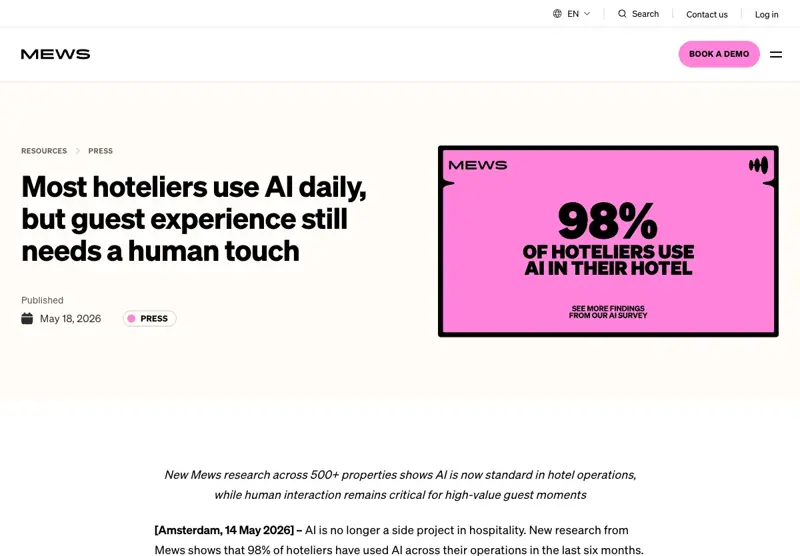
This isn’t a “should you use AI” piece. That ship sailed. A 2026 Mews survey of more than 500 properties found 98% of hoteliers used AI in the last six months, and AI now touches 11 of the 19 most common hotel tasks. Your competitors down the street are already drafting their guest replies with it. The big chains have been doing it for two years.
What’s missing isn’t the technology. It’s the playbook for a small operator who doesn’t want to buy anything. The good news is that the most useful thing AI does for a hotel — turning the same fifteen guest questions into fast, on-brand replies — needs exactly zero new software. It needs ChatGPT and a little setup.
One rule before the messages, and it’s the whole game: ChatGPT drafts, you send. Never wire it up to reply on its own to a live guest. It writes, you glance, you hit send. That one habit is the difference between “wow, they’re fast” and a screenshot on X.
The 7 messages that handle 80% of your inbox
Each of these is a prompt you paste into ChatGPT, fill in the brackets, and tweak. Build them once into a note on your phone and you’ll reuse them for years.
1. The pre-arrival message. The single best message you can send, because it kills a dozen day-of questions before they happen.
“Write a warm, short pre-arrival message for a guest named [name] arriving [date] at [hotel name], a [X]-room [boutique hotel / B&B / inn] in [town]. Include: check-in is from [time], the door/parking situation is [detail], and one local tip — [your favorite nearby thing]. Friendly, not corporate. Under 90 words. Sign it from [your name].”
2. The after-hours FAQ reply. WiFi, parking, checkout time, “is there a hairdryer.” Repetitive, factual, perfect for AI — as long as it only uses your facts.
“You’re replying to a guest at [hotel]. Answer only using these details: WiFi network [x] password [y]; parking is [detail]; checkout is [time]; [other facts]. If they ask something not on this list, say you’ll confirm with the front desk in the morning — never guess. Keep it short and friendly.”
That “never guess” line matters more than anything. A generic AI will confidently invent your checkout time. Ground it in your real details and tell it to admit when it doesn’t know.
3. The early-check-in / late-checkout reply. This is where most owners get burned, because AI loves to say yes.
“A guest asked for [early check-in at X / late checkout]. Draft a warm reply that says I’ll do my best to accommodate but it depends on the day’s bookings, and I’ll confirm by [time]. Do NOT promise it as confirmed.”
The AI drafts the tone. You make the call. Whether the room is actually free is your decision — never let the bot commit you to something housekeeping can’t deliver.
4. The gentle upsell. Free money most small hotels leave on the table because writing the offer feels pushy.
“Write a soft, no-pressure upsell to a guest arriving [date]: offer [a room upgrade / breakfast add-on / late checkout] for [$X]. One sentence of why it’s nice, easy to decline, never salesy. Under 60 words.”
5. The bad-review reply. The one that protects your reputation. AI drafts, you always edit — and there’s a method.
“Here is a real 2-star review, paste it exactly: ‘[review text]’. Draft 3 reply options that: name the specific thing they raised, own it without being defensive, mention one concrete fix we’ve made, and invite them to email me directly at [email]. Warm, human, no corporate filler. Banned phrases: ‘we strive to provide,’ ‘your feedback is invaluable,’ ‘we regret.’”
Two pro moves the research backs up. First, give it the verbatim review, not “a complaint about noise” — specifics make the reply sound human. Second, for negative replies, leave your hotel name and town out of the text, so the bad review doesn’t get a search-ranking boost. Respond within 24 hours for negatives; positives can wait a day or two.
6. The post-stay thank-you and review ask. Timing here is quietly strategic.
“Write a short post-stay thank-you to [name] who stayed [dates]. Reference [something specific about their stay if you know it]. Then gently ask them to leave a review on [Google / Booking.com / Tripadvisor]. Warm, genuine, under 80 words.”
Why nudge for reviews at all? Here’s a twist almost nobody knows. A June 2026 academic audit of how AI assistants recommend hotels found that your guest rating and how recent your reviews are drive AI recommendations — while management responses had basically zero effect on what the AI suggested. Yet those same responses lift human booking inquiries by 21–24%. So you reply to reviews for the humans reading them, and you keep a steady drip of fresh, high ratings for the AI that’s now sending travelers your way. Both matter. They just do different jobs.
7. The in-the-moment complaint. A guest messages at midnight about noise or a broken AC. This is the one to handle carefully.
“A guest just messaged, upset: ‘[message]’. Draft a calm, genuinely apologetic reply that acknowledges the specific problem, tells them exactly what I’m doing about it right now, and gives them my direct number. No chirpy tone. No ‘so sorry for any inconvenience.’”
Then — and this is the rule — you read it, you fix it, and you send it as yourself. A cheerful automated “Thanks, enjoy your stay! 😊” landing right after “there’s no hot water” is how you earn the one-star.
What this means for you
If you’re a solo innkeeper or B&B owner: Start with messages 1, 2, and 6. The pre-arrival note and after-hours FAQ alone will claw back your evenings. You’re not automating your personality — you’re automating the questions that have nothing to do with it.
If you run a 10–25 room property with one part-timer: Build all seven into a shared note so whoever’s on knows the playbook. Add message 5 (reviews) to a weekly routine — pair it with the five-minute AI shift handover so your team stays in sync without a meeting.
If you’re a small boutique hotel with a real front desk: Use AI behind the scenes — drafts, FAQs, reviews — and protect the live welcome. That 59% of hoteliers who say check-in should stay human? They’re not being sentimental. They’re right about where guests actually notice you.
What ChatGPT can’t do for your hotel
- It can’t be your welcome. The Mews survey found 59% of hoteliers — and the most AI-experienced ones most of all — say the check-in moment should stay human. Guests forgive a slow WiFi answer. They don’t forgive feeling processed.
- It can’t invent your facts. Out of the box it knows nothing about your parking, your quiet hours, or your dog policy. Feed it your details or it’ll make them up with total confidence.
- It can’t make the money calls. Refunds, comps, discounts, room moves — those are yours. Let it draft the words, never the decision.
- It can’t fake a rating. AI assistants recommend hotels on real, recent guest scores. No prompt rewrites how your last twenty guests actually felt. The product still has to be good.
- It can’t read a room. Sarcasm, a worried family, a safety issue — AI misses the subtext every time. When feelings are in the message, a human sends the reply.
The bottom line
The owners losing sleep over “AI is going to make my hotel sound generic” have it backwards. Unsupervised AI sounds generic. Supervised AI — you, editing seven good drafts — sounds like a fast, attentive innkeeper who somehow always replies within the hour. That’s not a downgrade. For a small property fighting OTA commissions and big-chain budgets, it’s the most level the playing field has ever been.
Start tonight with the pre-arrival message. Build the other six this week. If you want the full setup — the FAQ document to paste in, the tone rules that keep replies sounding like you, and the guardrails that keep AI away from the money — our ChatGPT for Business course walks a non-technical owner through it step by step. And once your inbox runs itself, point the same trick at your back office with the 5-minute AI shift handover.
Sources
- Most hoteliers use AI daily, but guest experience still needs a human touch — Mews Hotelier Survey 2026
- Whose Hotel Does the AI Recommend? An audit of LLM hotel recommendations — arXiv (June 2026)
- Cornell study links hotel reviews and room revenue — Travel Weekly
- Booking.com’s new recency-weighted review scoring explained — Hospitality Net
- USF study: AI concierges and the human-connection gap
- ChatGPT for Hotels: turnkey apps and the zero-commission shift — Hotel Tech Report