

The call comes when you’re least ready for it. It’s your daughter, and she’s crying so hard you can barely make out the words. There’s been an accident. She’s in trouble, she needs money right now, and please — don’t tell Dad. It’s her voice. The catch in it, the way she says your name. You’d know it anywhere.
Except it isn’t her.
Welcome to the AI voice scam, the con that turns a few seconds of someone’s voice into a puppet. And the reason it works isn’t that the victims are gullible. It’s that the voice really does sound right. Your ears aren’t lying to you. The technology is just that good now.
Here’s the scale of it, without the scare-reel music. In 2025, people reported losing $3.5 billion to imposter scams — the broad category where someone pretends to be a person or company you trust — across more than a million reports to the Federal Trade Commission. That’s up about 20% from the $2.95 billion the year before. For older adults the numbers land heavier: the FBI’s Internet Crime Complaint Center logged $7.7 billion in losses to fraud against people 60 and older in 2025, from more than 201,000 victims, with an average loss north of $38,000.
Most of that isn’t voice cloning — not yet. The FBI counted a bit over 3,100 complaints that specifically named AI in 2025, tied to more than $352 million in losses. Small slice, fast-growing edge. So this piece isn’t here to scare you with a number. It’s here to hand you a ten-minute fix that keeps working no matter how good the fakes get.
How the AI voice scam actually works
Voice cloning used to need a studio and an hour of clean recording. That’s over.
Back in 2023, Microsoft researchers showed off a system called VALL-E that could copy the character of a person’s voice from a three-second sample. Three seconds. Microsoft never released it to the public — it’s a research benchmark, and the company was upfront about the risk of exactly this kind of misuse. Plenty of commercial voice tools still want a minute or two of audio to sound convincing. But the direction is one-way, and the floor keeps dropping.
Here’s the part that matters for you: the raw material is already out there. A birthday video on Facebook. A voicemail greeting. Three seconds of your kid laughing in a Reel. A grandparent’s church-choir clip. The scammer doesn’t hack anything — they scrape what’s public, feed it to a model, and type whatever they want the “voice” to say. Then they spoof a caller ID, or just dial from an unknown number and let panic paper over the gap.
That’s the whole trick. Real voice, fake words, manufactured emergency. It’s the classic grandparent scam — the one where “your grandson” calls from jail needing bail — except now the voice on the line is a dead ringer instead of a stranger mumbling and hoping you’ll fill in the blanks. Same con as a deepfake video, just cheaper, faster, and pointed straight at your phone.
The 10-minute setup that stops it
You can’t out-listen a good clone. So don’t try. The defense isn’t your ear — it’s a system you set up once, while everyone’s calm, that a panicked moment can’t talk you out of.
Set a family password (this is the whole game)
Pick a word or short phrase your family agrees to use to prove they’re really them. Some people call it a safe word. Same idea. The rules that make it work:
- It’s a secret. Not your dog’s name, not your street, not anything a scammer could find on your profiles or guess from your posts. Something unresearchable. “Purple tractor.” “Aunt Rita’s meatballs.” Weird is good.
- You set it in person, or on a call you started yourself. Never over a text you didn’t initiate, never in an email. Say it out loud, once, and don’t write it anywhere it could leak.
- The rule is simple enough to hold under stress: no word, no money. If the caller can’t say it, it doesn’t matter how much they sound like your son. You hang up.
That’s it. A cloned voice can copy how your daughter sounds. It can’t know the thing you two agreed on at the kitchen table that was never typed anywhere.
Hang up and call back on a number you already have
A password is your first line. Verifying independently is the backup, and it works even if you never set a password.
If a call feels off — urgent, secret, money-shaped — end it. Then reach the real person yourself, on a number you already have saved, not one the caller gives you. Call your daughter’s actual phone. Call the school, the hospital, the relative who’d know. Nine times out of ten she picks up, confused, completely fine, and you both exhale.
And whatever you do, don’t confirm details for the caller. Scammers fish. “Mom, it’s me—” and a scared parent fills in “Katie?” — and now the scammer has the name and the relationship, and the voice gets more confident. Don’t hand them anything. Don’t say the name. Don’t confirm the college, the car, the trip. Make them prove it. When they can’t, hang up. You don’t owe a suspicious caller a conversation, and you never have to play along to “catch” them — hanging up is the win.
Know the money-movement tell
Every version of this scam ends in the same place: an urgent, oddly specific way to move money. Gift cards read out over the phone. A wire transfer. Crypto sent to a wallet address. A courier — an actual person — sent to your door to collect cash or gold.
Real emergencies don’t work like this. Hospitals don’t take Apple gift cards. Bail bondsmen don’t send an Uber for a shoebox of twenties. So if the person on the phone is steering you toward gift cards, wire, crypto, or a cash pickup, you can stop analyzing the voice. That demand alone is the scam — every time.
Shrink your family’s public voice footprint
You don’t have to go dark. But you can be a harder target. Set the profiles that carry a lot of your voice — Reels, Stories, video posts — to friends-only instead of public. Skip the trend where you talk to a wide-open audience for thirty seconds. If you’ve got kids or older parents, walk them through the same settings; a lot of older accounts are wide open because nobody ever touched the default. Less public audio means less raw material. It won’t make cloning impossible. It just makes you less convenient than the next profile — and convenience is most of what these operations run on.
What this means for you
If you’re the adult child of an aging parent: you’re the most likely first responder here, so you’re the one who sets this up. Agree on a family password with your mom or dad this week — in person if you can. Walk them through the “no word, no money” rule and the call-back habit. And gently prune their public audio. This is also the version of the scam that hits hardest, which makes the slightly awkward conversation more than worth it.
If you’re the parent or grandparent everyone worries about: you are not the punchline of this story. The scam works on smart, careful people precisely because it hijacks love — the instinct to help your kid the second they’re in trouble. That instinct is a good thing. The password just gives it a checkpoint. When a call comes in hot and secret with money attached, you get to say, calmly, “What’s our word?” — and let their answer, not your worry, make the decision.
If you post a lot of video: creators, coaches, anyone whose voice is their brand — your audio is already public and there’s no clawing it back. So lean harder on the other layers. Make sure the people who’d get a call about you — partner, parents, an assistant — know the family password, and know you will never ask them to move money by surprise.
If it’s just the two of you at home: you still want a word. Two people, one shared secret, same rule. It takes one conversation over dinner, and it covers the “honey, I’m stranded, wire me money” version aimed at spouses just as well as the grandkid version.
What a family password can’t fix
I’d be lying if I sold you the password as a force field. It’s the best cheap defense there is, and it has real holes.
- It only works if everyone actually uses it. A word nobody remembers under pressure is worthless. You have to say it out loud now and then, keep it in the family’s muscle memory, and actually stop when it’s missing — even when the voice on the line is sobbing.
- No screening app stops a cloned call from a known contact. This is the big one, and it’s why there’s a companion piece on call-screening apps. Pixel and iPhone tools are good at silencing unknown numbers. But if a scammer spoofs a number that’s already in your contacts, it rings straight through, looking exactly like your daughter. The app never flinches. The password is what catches it.
- The fakes keep getting better. Real-time voice conversion — where the scammer speaks and it comes out in the cloned voice, live — already exists in early forms. Assume the audio can hold a short back-and-forth, not just a scripted line. Which is exactly why you verify a fact or a secret, not a vibe.
- They’ll pivot. Block the voice and a determined scammer tries a text, an email, a fake caller ID reading “County Jail.” The password and the call-back habit travel across all of it. The channel isn’t the point. The “prove it independently” reflex is.
None of that is a reason to skip the setup. It’s a reason to treat it as one strong layer, not a magic word.
The bottom line
A cloned voice can fool your ears. It can’t answer a question only your real family knows, and it can’t turn a gift-card demand into something that isn’t a scam. So set the word tonight. Practice the call-back. Learn the money-movement tell cold. That’s the whole defense against the AI voice scam, and it costs you one slightly awkward conversation.
If the call already happened and you sent money, you’re not alone and it’s not too late to act. Report it to the FTC at reportfraud.ftc.gov, to the FBI at ic3.gov (older adults can also call the Elder Fraud Hotline at 833-FRAUD-11), and if you want a real person to walk you through it, the AARP Fraud Watch Helpline is free and open to anyone at 877-908-3360. Reporting feels pointless in the moment. It isn’t — it’s how these numbers get tracked and these accounts get frozen.
The deeper skill under all of this is just knowing how the tools actually work — what AI can fake, what it can’t, and where the seams are. That’s the whole reason we build courses like AI Fundamentals, Cybersecurity Basics, and Prompt Engineering: not to turn you into an engineer, but to make you hard to fool. The same clear-eyed habit runs through the rest of using AI without getting burned by it — from whether ChatGPT is even safe to use to fighting a medical bill with AI without trusting it blindly.
And if you handle this kind of fraud defense professionally — say you’re a real-estate agent facing wire-fraud and deepfake-client scams — there’s a dedicated playbook for your world that goes well past a family password. This piece is for protecting the people at your own kitchen table.
Sources
- FTC data show people reported losing $3.5 billion to imposter scams in 2025 — Federal Trade Commission (June 2026)
- 2025 Internet Crime Report — FBI Internet Crime Complaint Center (IC3)
- Elder Fraud — IC3 Elder Fraud tri-fold (age 60+ losses)
- Neural Codec Language Models are Zero-Shot Text to Speech Synthesizers (VALL-E) — Microsoft Research, arXiv:2301.02111
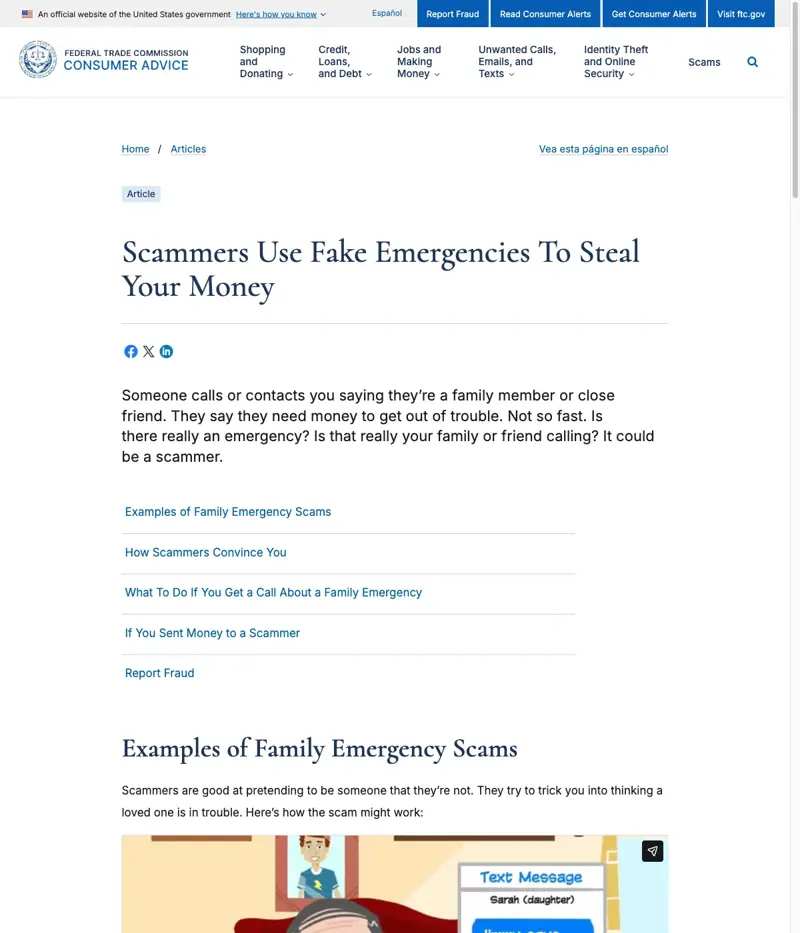
- Scammers Use Fake Emergencies To Steal Your Money — FTC Consumer Advice
- Report fraud to the FTC — reportfraud.ftc.gov
- File a complaint with the FBI — ic3.gov
- AARP Fraud Watch Network Helpline — 877-908-3360