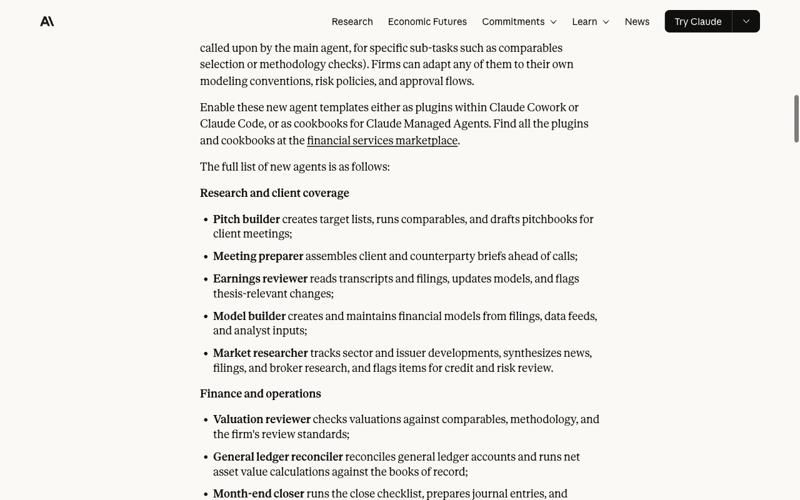
On May 5, Anthropic shipped ten “ready-to-run” agent templates for financial services. Pitchbooks, KYC screening, month-end close, the whole back-office. Each one ships as a plugin in Claude Cowork and Claude Code, and as a cookbook for Claude Managed Agents. Moody’s launched an MCP app the same day with credit data on 600M+ companies. Jamie Dimon showed up at the launch event. The Fortune coverage made it sound like the back office had finally been automated.
Then nobody ranked them.
After spending the week with the Anthropic launch documentation, the linked customer case studies, and what finance professionals have been saying on X this week, here’s the honest assessment of which templates are real workflow upgrades and which are marketing-demo fluff. Ranked by time saved per week for the user who’d actually run them — not by which has the most-impressive-sounding name.
The ranking, top to bottom
#1 — Month-End Closer (real workflow upgrade)
What it does: Runs the close checklist, prepares journal entries, generates the close report.
Why it tops the list: Month-end is the most expensive recurring waste of senior finance time in any company with more than 50 employees. Controllers spend 40-60 hours per close. The template targets the highest-volume, lowest-judgment portion of that workload — the journal-entry preparation and the variance investigations that follow a known checklist. Done right, this is the template that pays for the whole Claude Cowork subscription within one close cycle.
Honest caveat: It does not eliminate the close — it accelerates the repetitive parts. The reviewer step (CFO eyeballing the materially-different variances) doesn’t disappear. Expect 30-50% time savings in the first two cycles, more after you’ve tuned it on your specific COA.
#2 — KYC Screener (real workflow upgrade)
What it does: Assembles entity files, reviews source documents, packages escalations for compliance review.
Why it ranks here: KYC is the single most-cited time sink in financial-services compliance. Standard procedure for a new corporate customer at a mid-size bank involves 20-50 documents and 4-12 hours of analyst time per file. With the new Dun & Bradstreet MCP connector providing verified business identity data, and the Moody’s connector providing the credit-screening side, the template handles the volume. A compliance analyst who used to clear 4 files a day can plausibly clear 12.
Honest caveat: Regulatory expectation is that a human officer signs the escalation packet. Don’t expect this to eliminate compliance headcount — it shifts the time toward judgment calls and away from document assembly.
#3 — Pitch Builder (real workflow upgrade)
What it does: Builds target lists, runs comparables analyses, drafts the pitchbook. The full output: a comps model in Excel, a pitchbook drafted in PowerPoint, and a cover note ready in Outlook — all in one Claude session per the launch demo.
Why it ranks here: Investment-banking pitchbooks are the canonical “junior analyst working until 2am” task. The template tackles all three deliverables (Excel comps, PowerPoint deck, Outlook cover note) in a single flow, leveraging the cross-app Claude in Microsoft 365 launch that shipped the same day. Senior bankers won’t trust the output untouched, but a 20-page draft pitchbook in 30 minutes instead of 6 hours is a category change.
Honest caveat: The template’s output is a draft. The visual polish, the partner’s actual talk track, the bank’s house style — those still need senior eyes. The win is the draft, not the final.
#4 — Earnings Reviewer (real workflow upgrade)
What it does: Reads earnings transcripts and filings, updates financial models, flags thesis-relevant changes for the analyst.
Why it ranks here: A sell-side analyst covers 15-25 names. Every quarter, each name produces a 60-90 minute transcript, an 8-K, sometimes a deck. That’s 50-75 hours of reading every 90 days just to stay current. The template targets the reading and model-update layer — the highest-volume, most-tractable portion. Combined with the FactSet, S&P Capital IQ, and Daloopa connectors, the model-update step is dramatically faster.
Honest caveat: The thesis itself is the analyst’s contribution. The template doesn’t write the rating change — it surfaces what changed. Expect to keep the analyst, eliminate the night-of-earnings transcript marathon.
#5 — General Ledger Reconciler (real workflow upgrade)
What it does: Reconciles GL accounts and runs NAV calculations.
Why it ranks here: Back-office reconciliation work is the canonical robotic-process-automation target — except RPA broke whenever a system changed. Claude doesn’t. Funds, custodians, and back-office teams that have spent five years gluing UiPath bots to flaky vendor portals can replace them with the template and a connector. The work is high-volume, repetitive, and tolerates the “Claude flags an exception, analyst approves” governance pattern naturally.
Honest caveat: NAV calculations have legal and regulatory consequences. Run it in parallel with your existing process for at least one full quarter before cutting over. This is not the template to ship to prod on day 1.
#6 — Statement Auditor (real workflow upgrade, narrower scope)
What it does: Reviews financial statements for consistency, completeness, and audit-readiness.
Why it ranks mid-pack: Useful for internal audit teams and for tax-prep firms doing pre-filing review, but the Big 4 audit firms already have proprietary AI tools doing this work (PwC’s Argus, KPMG’s Clara, EY Helix). The template is a strong second-tier option for firms that don’t have a custom platform — or a strong baseline for in-house audit teams. The ceiling is lower than the top four templates because the workload tends to be more episodic (quarter-end, year-end) rather than continuous.
Honest caveat: Don’t expect this to replace your audit firm. It’s a pre-screen, not a replacement for the audit itself.
#7 — Meeting Preparer (medium value, depends on existing process)
What it does: Assembles client and counterparty briefs ahead of calls.
Why it ranks here: Useful, but the win is partially already captured by tools like AlphaSense, ZoomInfo, or even ChatGPT’s web search. Salespeople and RMs who don’t have an existing brief-prep workflow get real time savings. Those who already have something dialed in will find this is a 10-20% incremental improvement, not a step change.
Honest caveat: The cross-app context with the Claude in Outlook beta is what makes this more valuable — Claude can pull the brief into the actual meeting invitation Outlook is showing. Without the Outlook beta, the template is less compelling.
#8 — Model Builder (medium value, narrow audience)
What it does: Creates and maintains financial models from filings, data feeds, and analyst inputs.
Why it ranks lower: Analysts have strong opinions about how their models are structured. The template starts from a generic three-statement scaffold. For analysts at a sell-side bank with a house model template, the first 60% of the work is replacing the template’s structure with theirs. For analysts at smaller shops without an existing house standard, the template is a real starting point. The audience that gets full value is narrower than the launch coverage suggests.
Honest caveat: Pairs much better with the Earnings Reviewer (#4) than as a standalone — Earnings Reviewer + Model Builder is a real workflow; Model Builder alone is a partial workflow.
#9 — Market Researcher (medium value, competes with strong incumbents)
What it does: Tracks sector and issuer developments, synthesizes news and broker research, flags items for review.
Why it ranks here: AlphaSense, Bloomberg, FactSet StreetAccount, and several other vendors have spent years on exactly this workflow with deep industry-specific data and named research integrations. Claude’s template is competing in a category where the incumbents have a deep lead. Where it does win: smaller buy-side shops without an enterprise AlphaSense subscription, and the synthesis-into-memo step (which is where Claude’s writing quality genuinely beats the incumbents).
Honest caveat: If your firm already has AlphaSense, this is a partial substitute, not a replacement. Worth piloting on a single sector before committing to a workflow change.
#10 — Valuation Reviewer (limited scope, marketing demo)
What it does: Checks valuations against comparables, methodology, and firm review standards.
Why it ranks last: Valuation review is a specialized, judgment-heavy workflow that takes years for a senior valuation officer to build the pattern recognition for. The template can flag obvious outliers, but the actual value of a valuation review is in the nuanced “this comparable looks right on paper but the businesses are economically different” calls. The template is technically a useful pre-screen. As a workflow upgrade, it’s the most “demo-shaped” of the ten — impressive on a launch slide, narrower in practice.
Honest caveat: This is the one template I’d recommend skipping for most teams. The work is too judgment-heavy for the current state of agentic AI, and the time savings are smallest of the ten.
What the Moody’s partnership actually changes
The under-discussed part of the May 5 launch is the Moody’s MCP app, which provides proprietary credit ratings and data on 600M+ public and private companies. Combined with Dun & Bradstreet on identity, FactSet and S&P Capital IQ on market data, and PitchBook on private-company transactions, the template stack now has primary-source data access that previously required separate enterprise subscriptions.
For a mid-size bank or boutique investment shop, the practical change is that the credit-screening and entity-resolution steps inside the KYC and Pitch Builder templates can use authoritative data, not just web-scraped guesses. This is the layer that separates “interesting demo” from “I can stake my license on the output.” Don’t underweight it.
What this means for you
If you’re a controller or accounting director, start with the Month-End Closer (#1) and the General Ledger Reconciler (#5). Pilot both on the next close cycle in parallel with your existing process. Measure hours; the math should be obvious by close 2.
If you’re in BSA/AML compliance, KYC Screener (#2) is the highest-leverage pilot. Pair it with the Dun & Bradstreet and Moody’s connectors for the data access. Set a 90-day evaluation window with clear “we’ll switch if X% of files clear under Y hours” criteria.
If you’re at an investment bank, Pitch Builder (#3) is the lead candidate, but you’ll want to invest in customizing it to your firm’s house template before deploying broadly. The win is real; the customization work is non-trivial.
If you’re a sell-side equity analyst, Earnings Reviewer (#4) is the obvious starting point. Run it on one ticker for one quarter before scaling. Pair with Model Builder (#8) if you don’t have a strong house model template.
If you’re a CTO or Head of AI at a financial-services firm, the right rollout sequence is: KYC and Month-End first (high-volume, high-time-savings, clear governance), then Earnings Reviewer and Pitch Builder (higher-judgment but higher-prestige), then the operations templates (GL Reconciler, Statement Auditor) once governance patterns are proven, and Meeting Preparer and Market Researcher last — those compete with existing vendors.
If you’re a procurement officer evaluating Claude Cowork vs Copilot vs ChatGPT Enterprise for finance, the agent templates are the differentiation that puts Claude meaningfully ahead for finance workflows specifically. None of the other vendors have shipped 10 pre-configured finance agents this week. If your evaluation hinges on “which AI vendor most reduces back-office time,” Claude is the answer this week.
What it can’t do
A few honest limits.
- None of these templates eliminate the human reviewer. Each one is structured to surface work for a person to sign off on. That’s a regulatory feature, not a bug — but if your CFO is hoping to cut FTEs from this, the math is “fewer people doing more work,” not “people removed entirely.”
- The templates assume Claude Cowork, Claude Code, or Managed Agents. If you’re a Claude Free or Pro web user, you can’t run these templates as shipped — they need the Cowork/Code/Managed Agents environment with the relevant connectors.
- The data connectors are not all free. FactSet, S&P Capital IQ, PitchBook, Moody’s — these are paid subscriptions. The templates are free; the data they call is not. Budget for the connectors as a separate line item.
- The Outlook integration is still beta. Workflows that depend heavily on the Outlook leg (Meeting Preparer especially) will see rougher edges through Q3 2026.
- The templates are not turnkey for highly-regulated jurisdictions. EU AI Act, MAS guidelines, MAR/MiFID II requirements all impose specific documentation, audit-trail, and human-in-the-loop requirements. Each template will need legal/compliance review before deployment in a regulated workflow.
The bottom line
Eight of the ten templates are real workflow upgrades that justify time on a pilot. One (Valuation Reviewer) is more demo than tool. One (Market Researcher) competes with strong incumbents and only wins in narrow circumstances. The top four — Month-End Closer, KYC Screener, Pitch Builder, Earnings Reviewer — are the ones that will define whether Claude becomes the dominant finance AI vendor in 2026 or just one of three.
If you’re running a finance team or compliance function and you haven’t piloted at least one of the top four by end of Q2, you’re falling behind the firms that have.
For more on how the agentic Claude stack is being deployed in real finance teams — including the specific prompt patterns for each template and the governance checklist for the regulated-industry rollout — our AI Agents Deep Dive course covers the full deployment playbook.
Sources
- Anthropic: Pre-built financial-services agent templates (May 5, 2026)
- Anthropic: Claude for Microsoft 365 launch
- Fortune: Anthropic’s Wall Street push with Jamie Dimon
- Quartz: Anthropic launches 10 AI agents for banks and insurers
- Markets Media: Anthropic Introduces Agents for Financial Services
- CFO Office: I installed and tested Anthropic’s 10 finance agents for CFOs
- Seeking Alpha: Anthropic unveils 10 agent templates for financial services