“I’m paying for Plus — why don’t I see the new model?”
That was the most-asked ChatGPT question on launch day this week, and it has a twin: “I’m on the free plan — do I get anything?” Since GPT-5.6 went public on July 9, OpenAI’s plan lineup answers both questions in a genuinely confusing way, because which model you get now depends on where in ChatGPT you’re standing — regular chat plays by one set of rules, and the new ChatGPT Work agent plays by another.
Here’s the whole thing in plain English: every plan, every price, which model you actually get on each, and an honest answer to “should I upgrade?”
The 30-second answer
In regular chat: Free and Go stay on GPT-5.5 Instant. Plus ($20) and up get GPT-5.6 Sol, the flagship. Pro and Enterprise also get Sol Pro, a highest-quality variant.
In ChatGPT Work and Codex (the agent surfaces): everyone gets GPT-5.6 — even free users, who get Terra. Paid plans choose between Sol, Terra, and Luna.
If that split feels backwards — the free tier’s newest model lives in the agent, not the chat — you’ve understood it correctly. OpenAI put its newest technology behind the door it wants you to walk through.
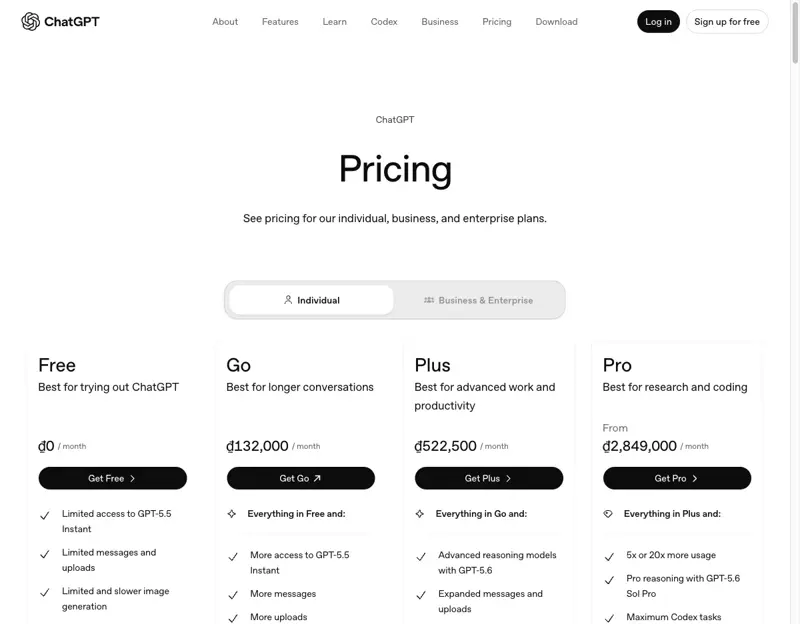
Every plan, one table
Prices and access as of July 10, 2026, from OpenAI’s own pricing and availability pages:
| Plan | Price | Regular chat | ChatGPT Work & Codex |
|---|---|---|---|
| Free | $0 (ads in the US) | GPT-5.5 Instant, ~10 messages per 5 hours, then a Mini fallback | GPT-5.6 Terra |
| Go | $8/mo | GPT-5.5 Instant, higher limits | GPT-5.6 Terra |
| Plus | $20/mo | GPT-5.6 Sol | Sol, Terra or Luna — your pick; ultra in Codex |
| Pro | $100/mo | Sol + Sol Pro, ~5× Plus limits | Sol/Terra/Luna; ultra in Codex |
| Pro Max | $200/mo | Sol + Sol Pro, ~20× Plus limits | Sol/Terra/Luna; ultra in Work too |
| Business | $25–30/user/mo | Sol | Sol/Terra/Luna |
| Enterprise | Custom | Sol + Sol Pro | Sol/Terra/Luna; ultra in Work |
Three footnotes that answer most of the launch-week confusion:
- The rollout was staged. Plenty of Plus users spent July 9 seeing only Terra and Luna in their picker and assumed Sol was Pro-only. It isn’t — updating the app or waiting a day fixed it for most people. If your picker still looks wrong, that’s the first thing to check.
- “Pro” is two plans now. Since April, Pro starts at $100 (built to compete with Anthropic’s $100 Claude Max) with the $200 level on top. Same models on both — the difference is usage headroom and, since July 9, whether ultra works inside ChatGPT Work ($200 only) or just Codex ($100).
- max and ultra are effort settings, not models. max means “think longer” and comes with any 5.6 access. ultra runs four AI agents in parallel on one task — impressive, and it burns usage roughly four times as fast.
What each plan actually changed this week
Free: nothing new in chat — but genuinely big news anyway. You now get GPT-5.6 Terra inside ChatGPT Work, a model that beats last year’s flagship on several benchmarks, for zero dollars. You also get the new voice model in its mini version. If you only ever use regular chat, your day-to-day didn’t change.
Go ($8): same story as Free — Terra in Work and Codex, regular chat stays on 5.5. Go’s real perks remain the higher message limits and scheduled tasks.
Plus ($20): the biggest single upgrade of any plan. Regular chat jumps from GPT-5.5 to Sol, the actual flagship; Work and Codex give you all three new models with the effort dials; and ultra works in Codex. Two weeks ago some of this was gated behind a government review and none of it was on Plus.
Pro ($100/$200): Sol Pro in chat is the headline — a highest-quality variant for complex work. The $200 tier’s ultra-in-Work is the other one: four parallel agents pointed at your spreadsheets, not just your code.
Business/Enterprise: Sol in chat for everyone, the full model choice in Work, and (Enterprise) ultra. The catch nobody mentions: agent-style runs on workspace plans moved to credit-based billing on July 6, so your admins are now watching a meter.
So is upgrading worth it now?
Honest answers, by the jump you’re considering:
Free → Plus ($20): the case got materially stronger this week, and for once the analysts and the users agree — the loudest launch-week complaint wasn’t “not worth it,” it was “where’s my Sol?” You get the flagship in everyday chat, all three models in Work, ultra in Codex, Deep Research runs, agent mode, scheduled tasks, and no ads. If you use ChatGPT most days for real work, $20 buys you the actual frontier now. If you use it a few times a week for quick questions — stay free and use Work. Terra there is genuinely good, and it costs nothing.
Plus → Pro ($100): only if you’re hitting limits. The models are nearly identical to Plus (Sol Pro aside); what you’re buying is 5× headroom and the 1M-token context window for huge documents or codebases. Heavy daily users know who they are — one early user put it as “Sol tokens go quick; I’ll need the bigger plan soon.” If you’ve never seen a rate-limit message, keep your $80.
Pro → Pro Max ($200): you already know if you need this. It’s for people running ultra on real work all day. Everyone else is buying a race car to drive to the corner shop.
Anyone → Business: this is about admin controls, data agreements, and shared workspaces, not model access — Business chat actually gets less than Pro (no Sol Pro). Buy it for the governance, not the AI.
What this means for you
If you’re on Free and curious about the fuss: open ChatGPT Work, give Terra one real task — a spreadsheet to clean, notes to turn into a doc — and judge for yourself. It’s the best free AI work tool available right now, and it’s the exact thing the $20 question should be tested against.
If you’re on Plus and can’t see Sol: update the app, then give the rollout a day before concluding anything. Launch week was full of people diagnosing a paywall that was actually a queue.
If you manage a team on Business: the model news is fine, but the July 6 switch to credit-based agent billing matters more to your budget than anything in this launch. Meter your pilots before you scale them.
If you’re choosing between ChatGPT and Claude money: the $100 tiers now mirror each other deliberately. The real question isn’t price — it’s which agent ecosystem fits how you work.
What no plan gets you
- A model that’s always right. Sol hallucinates less than 5.5; less isn’t never. Check numbers and names that matter, on every tier.
- Unlimited agent use. Work tasks burn allowance fast on every plan — ultra especially. The meter is real from Free to Enterprise.
- A stable menu. This is the third plan-lineup change this year. The principle is durable — pay for headroom and quality, not for logos — even when the tier names shuffle.
- Skill. A well-briefed Terra beats a vaguely-prompted Sol Pro, embarrassingly often. The plan buys horsepower; the results still come from how you drive.
The bottom line
The July 9 launch quietly rebuilt the value ladder: Free got a real frontier model (in Work), Plus got the flagship (everywhere), and the Pro tiers became about headroom and parallel agents rather than exclusive intelligence. Pick the plan by how often you hit walls — not by which model names sound newest.
And whichever tier you’re on, the skill that pays is the same: knowing what to ask and how to check the answer. Our ChatGPT for Everyday Users course covers exactly that, and it transfers intact across every plan change OpenAI ships next.
Sources
- ChatGPT Plans — Free, Go, Plus, Pro, Business, and Enterprise (OpenAI)
- GPT-5.6: Frontier intelligence that scales with your ambition — OpenAI (July 9, 2026)
- About ChatGPT Pro tiers — OpenAI Help Center
- ChatGPT finally offers $100/month Pro plan — TechCrunch (April 9, 2026)
- ChatGPT is now a partner for your most ambitious work — OpenAI (July 9, 2026)
