Update (July 10, 2026): The gate is open. On July 9, OpenAI released GPT-5.6 — Sol, Terra, and Luna — to the public, in ChatGPT, Codex, and the API, ending the two-week government-review holding pattern. The rollout is global and was scheduled to complete within 24 hours, so by the time you read this it should be in your model picker. This post is rewritten for what’s real now, including which plan gets which model.
For two strange weeks, GPT-5.6 was the model almost nobody was allowed to touch. OpenAI shipped it on June 26 to roughly 20 pre-approved organizations while the U.S. government’s new review process ran, and everyone else got headlines instead of access.
That ended July 9. GPT-5.6 is now simply out — and it arrived alongside a second launch, ChatGPT Work, that quietly matters more for most people’s day-to-day than the model itself.
Here’s the calm version of what GPT-5.6 is, what Sol, Terra and Luna each do, who sees what on which plan, and what changed between the locked preview and the public release.
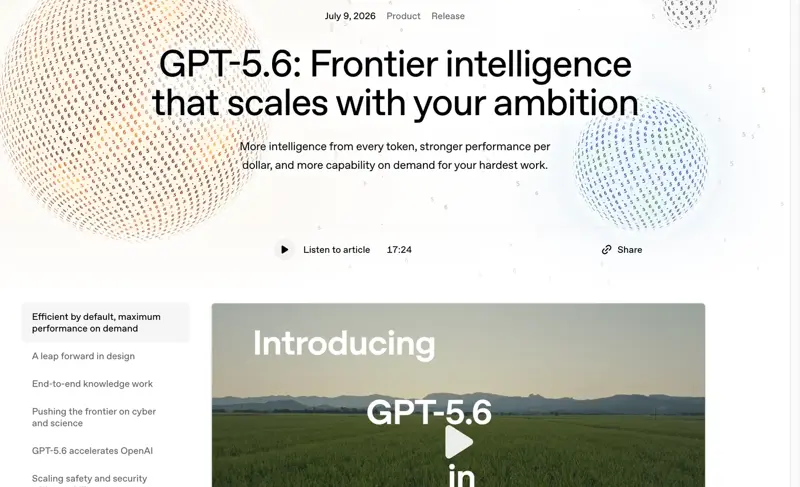
What is GPT-5.6, in plain terms?
GPT-5.6 is the next version of the “engine” that powers ChatGPT. Think of it like a phone operating-system update: same app you already open, but the thing doing the thinking underneath gets smarter and faster.
The naming carries over from the preview. Instead of one model, GPT-5.6 is a family of three, named after the sun, earth, and moon:
The clever bit is still the structure: the number (5.6) is the generation, and Sol/Terra/Luna are durable tiers that can be upgraded on their own schedules. OpenAI confirmed this framing at launch — expect “Sol” to mean “the big one” for years, the way “Pro” does on phones.
Who gets which model — the actual mapping
This is the part everyone’s confused about on launch week, because the answer is different in different corners of ChatGPT. From OpenAI’s own availability notes:
In regular Chat:
- Plus, Pro, Business and Enterprise get GPT-5.6 Sol, running at medium or higher effort settings.
- Pro and Enterprise additionally get GPT-5.6 Sol Pro — a highest-quality variant for complex work.
- Free and Go users stay on GPT-5.5 Instant in normal chat for now.
In ChatGPT Work and Codex (the agent surfaces):
- Free and Go users get GPT-5.6 Terra — yes, free users get a 5.6 model here.
- Plus, Pro, Business and Enterprise can pick between Sol, Terra and Luna, each with its own effort dial.
- max — the “think longer” setting — can be toggled on by anyone with 5.6 access in Work or Codex.
- ultra — the new top setting — is limited to Pro and Enterprise in ChatGPT Work, and Plus and above in Codex.
If you’re on Plus and can’t see Sol yet: the rollout was staged over 24 hours from July 9, and early users reported models appearing in the Work workspace before regular chat. Give it a day before assuming your plan is excluded.
What’s actually new since the preview
Three things worth knowing beyond “it’s available now.”
ultra mode is the headline feature. Sol’s new highest-capability setting doesn’t just think longer — it coordinates four AI agents working in parallel (developers can configure up to 16 through the API). On OpenAI’s numbers, ultra pushed Terminal-Bench (a hard command-line benchmark) from 88.8% to 91.9%. The plain-English translation: for big, messy tasks, ChatGPT can now throw a small team at the problem instead of one worker. It costs correspondingly more usage — early users report heavy tasks on ultra draining hours of allowance in minutes, so treat it as a special occasion, not a default.
The efficiency story is real, with an asterisk. OpenAI’s pitch is “more intelligence from every token” — Sol beats their previous model while using fewer words to get there, and Sol’s API price is identical to GPT-5.5’s ($5 in / $30 out per million tokens; Terra $2.50/$15; Luna $1/$6). The asterisk: on OpenAI’s own published table, Anthropic’s Claude Fable 5 still edges Sol on two broad intelligence measures, and Claude’s coding models still lead the SWE-Bench Pro software benchmark by a wide margin. Sol’s clearest wins are in agent-style work, computer use, and speed-per-dollar. No single model swept the board — whatever either company’s marketing implies.
It shipped with a new home. GPT-5.6 launched jointly with ChatGPT Work, an agent mode where ChatGPT takes on multi-hour projects — building spreadsheets, decks, docs and even small web apps from your connected tools. That’s where free users meet Terra, and it’s the surface OpenAI clearly considers the future. We wrote a full plain-English guide to ChatGPT Work, and a head-to-head against Claude Cowork if you’re deciding between ecosystems.
The government chapter, closed — mostly
The two-week gate was the first real test of the June 2026 executive order asking AI companies to submit powerful models for federal review up to 30 days before public release. The Commerce Department’s Center for AI Standards and Innovation ran additional testing; OpenAI sent technical staff to Washington; the public release followed.
One detail worth keeping straight, because it got messy in the coverage: reporting described OpenAI as getting government “permission” for the July 9 launch — and the White House publicly rejected that word, insisting no approval is required or granted and that release decisions “rest entirely with the companies.” The framework is formally voluntary. OpenAI, for its part, said plainly that it doesn’t want this process to “become the long-term default.”
However you read that dance, the practical takeaway is unchanged: the review happened, the model shipped, and the next frontier model will likely walk the same 30-day path. The deeper story is in our explainer on the whole episode.
What this means for you
- If you’re a regular ChatGPT user on a paid plan: check your model picker today. Sol should be there (medium effort and up). Your old chats don’t change; new ones default smarter.
- If you’re on the free plan: your route to GPT-5.6 is ChatGPT Work or Codex, where you get Terra — or the new desktop app, which carries Work on every plan. Regular chat keeps you on 5.5 Instant for now.
- If you were waiting for 5.6 to decide on Plus: the $20 plan now buys Sol in chat plus all three models in Work. That’s a materially better deal than Plus was two weeks ago.
- If you build with the API: Sol/Terra/Luna are open, priced as above, with new prompt-caching rules (30-minute minimum cache life, cache writes billed at 1.25×). The multi-agent setup behind ultra is in beta in the Responses API.
- If you just want to be good at this: the model picker matters less than knowing how to drive. Everything transfers.
What GPT-5.6 won’t change
- It won’t stop AI from making things up. Better reasoning, yes. Perfect, no. Check names, numbers, dates, and citations on anything that matters.
- It won’t read your mind. Vague prompts get vague answers from every model, including this one.
- It won’t make the “which model” question disappear. Three models × effort settings × two surfaces is more choice, not less. When in doubt: Terra for routine, Sol for hard, ultra almost never.
- It won’t know your job. A smarter engine still doesn’t know your clients, your field, or what “good” looks like for you. That judgment stays yours.
The bottom line
GPT-5.6 went from “the model you can’t have” to “the model in your picker” in exactly two weeks — and arrived with a genuinely new trick (ultra’s parallel agents), a genuinely useful free tier (Terra in ChatGPT Work), and honest fine print (Claude still wins some major benchmarks, including on OpenAI’s own chart).
The upgrade came to you. The skill of using it well still doesn’t. If you want the fast version of that, ChatGPT for Everyday Users and AI Fundamentals both transfer straight to 5.6.
Sources
- GPT-5.6: Frontier intelligence that scales with your ambition — OpenAI (July 9, 2026)
- ChatGPT is now a partner for your most ambitious work — OpenAI (July 9, 2026)
- Previewing GPT-5.6 Sol — OpenAI (June 26, 2026)
- OpenAI rolls out GPT-5.6 to the public on July 9 — Engadget
- OpenAI releases GPT-5.6 and ChatGPT Work tool — Axios
