You have ten days. On June 22, Claude Fable 5 — the most capable AI model the public has ever had access to — stops being included in Claude’s paid plans and moves to pay-per-use credits at double the price of anything Anthropic has sold before. Right now, if you pay for Claude at all, it’s sitting in your model picker for free.
Most of the advice about what to do with that window is written for developers, or it’s “reply FABLE for my DM playbook” hustle bait. This post is for everyone else: the consultant with a messy strategy memo, the analyst staring down a 200-page filing, the lawyer with a redline nobody has time to read twice. You don’t need to understand the model. You need to answer one question before June 22: is this thing worth paying for, for my work? Here’s how to find out with one test.
What just changed
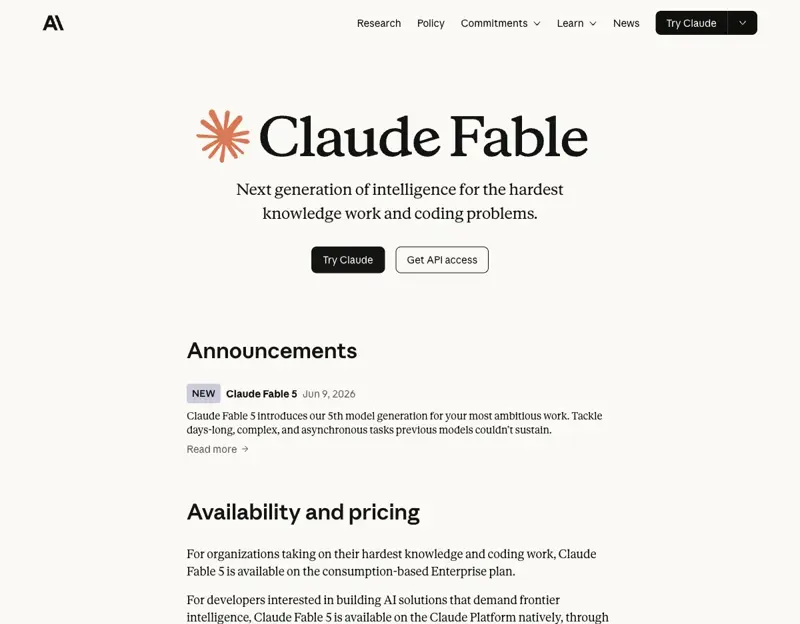
On June 9, Anthropic released Claude Fable 5 — a “Mythos-class” model, a new tier that sits above its previous flagship, Claude Opus 4.8. If you want the full backstory (why it’s called Fable, the safety system around it, the benchmark tables), we covered all of that in our Fable 5 guide. The short version that matters here:
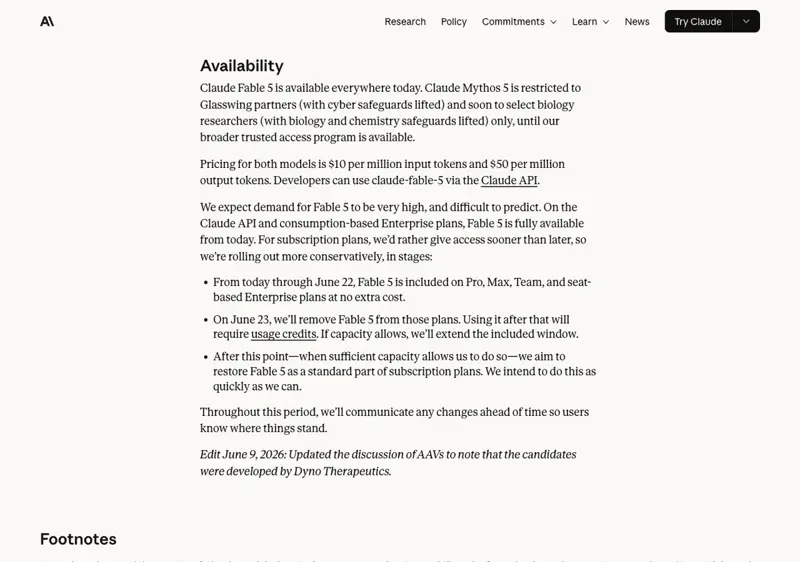
- It’s free on every paid Claude plan until June 22. Pro ($20/month), Max, Team, and seat-based Enterprise plans all include it at no extra cost through that date. You’ll find it in the model dropdown at the top of any new chat at claude.ai — no settings, no waitlist.
- On June 23, it comes off those plans. Using it after that requires usage credits, billed in line with its API price: $10 per million input tokens and $50 per million output — exactly twice Opus 4.8. Anthropic says it may extend the window “if capacity allows,” but you shouldn’t plan around a maybe.
- It’s built for exactly the work professionals postpone. Anthropic’s own guidance says to throw it at “problems you weren’t able to solve with other models” — and warns that simple tasks won’t show you what it can do. It ranked #1 on Hebbia’s Finance Benchmark for senior-level document reasoning, scored 93.4% on Harvey’s BigLaw Bench for legal drafting, and was the first model past 90% on Hex’s analytics benchmark.
That last point is the trap and the opportunity in one. If you spend the free window asking Fable 5 to write emails, you’ll conclude it’s a slower, fancier Claude and move on. The professionals getting real answers out of this window are running it against the hardest thing on their desk.
The one-task test: a 4-step protocol
Don’t “try Fable 5.” Test it. The difference is that a test produces a decision. Here’s the protocol — it takes one work session.
Step 1: Pick your hardest postponed task
The right task has three properties:
- It’s document-heavy or multi-step. A contract plus its exhibits. An earnings narrative checked against the underlying tables. A quarter of messy client data that needs a coherent story. Fable 5’s biggest measured gains over Opus 4.8 are in document vision — charts, nested tables, PDFs — and long, multi-stage analysis.
- You can verify the output. This matters more than anything. Early users consistently report Fable 5 is a major jump on tasks where the result can be checked — and a confidence trap on fuzzy, subjective ones. It states wrong guesses as fluently as right answers. Pick a task where you’d know if it nailed it.
- You actually postponed it. If it’s been on your list for weeks because it’s tedious and requires judgment, that’s the one. Quick tasks won’t differentiate Fable 5 from the model you already have.
Step 2: Give it everything upfront
One behavior surprised early users: Fable 5 doesn’t ask clarifying questions. Where Opus might check in, Fable guesses — confidently. So front-load the context: paste or attach the full documents, state the goal, the audience, the constraints, and what “done” looks like, all in the first message. Anthropic’s own prompting guidance for Fable 5 adds two tips: keep instructions shorter than you’re used to (it follows concise instructions well), and for long tasks, explicitly tell it to verify its own work before presenting conclusions — self-checking is one of the things this model actually does when asked.
Step 3: Run it head-to-head against Opus 4.8
Open two chats. Same prompt, same documents — one on Fable 5, one on Opus 4.8. This is the step almost everyone skips, and it’s the one that produces your answer. Opus 4.8 stays included in your plan after June 22 at no extra cost. The question is never “is Fable 5 good?” It’s “is the gap over what I keep for free worth paying for?”
Fair warning on pace: Fable 5 thinks before it answers, every time. First responses are noticeably slower than what you’re used to. That’s by design — it’s built for deep work, not rapid back-and-forth — but it means this test wants a coffee, not a deadline.
Step 4: Score it with the worth-it checklist
When both outputs are in, ask four questions:
- Did Fable 5 catch anything Opus missed? Harvey’s lawyer evaluators highlighted exactly this: it caught term-sheet deviations, off-market provisions, and internal inconsistencies in counterparty redlines that other models slid past. If it caught nothing extra on your documents, that’s your answer too.
- How much rework did each need? Count the corrections, not the impressions.
- What did the better output save you? An hour of senior review time has a number. Compare it against the real cost: analyzing a 50-page PDF and writing up the findings runs roughly $0.55 in Fable 5 credits at API rates, versus about $0.28 on Opus. A heavy working session might cost a few dollars. The credits aren’t the issue for occasional professional use — the question is whether the quality gap exists for your tasks at all.
- Would you have trusted it without checking? If the answer is yes and it was wrong anywhere, weight that heavily. Fluent confidence is this model’s failure mode.
What this means for you
If you’re a consultant or strategy advisor: run your messiest current deliverable — the strategy memo with conflicting stakeholder inputs, the market analysis with five data sources that don’t agree. Ask Fable 5 to stress-test the argument, find the contradictions, and list what would have to be true for the recommendation to fail. This is the “senior-level reasoning” the benchmarks measure, and it’s where the gap over Opus shows up most.
If you’re an analyst or work in finance: this is the profession the model was practically aimed at. Feed it a full filing — narrative plus exhibits — and ask it to reconcile the story management tells against the numbers in the tables. Hebbia, which benchmarks models on exactly this work, called Fable 5 the strongest finance-first model it has tested. Check every figure anyway; that’s the job.
If you’re a lawyer or paralegal: give it a contract and its exhibits and ask for internal inconsistencies, missing cross-references, and off-market terms. One honest caveat before you upload anything: Fable 5 carries a mandatory 30-day data-retention policy, even for accounts that previously had zero-retention agreements. Anthropic says retained data isn’t used for training, only safety monitoring — but if your documents are privileged or under NDA, clear it with whoever owns that risk first, or run the test on a sanitized document.
If you’re an accountant or bookkeeper: spreadsheet and table work is a quiet strength — Fable 5 beats Opus on spreadsheet tasks at every effort level and reads numbers locked inside long PDFs more reliably. A messy year-end reconciliation or a multi-entity consolidation makes a good test. The binding numbers still get your sign-off, obviously.
If you’re a solo business owner: pick the analysis you’ve been avoiding because it spans too many documents — pricing review across all your services, a contract you signed but never fully understood, a competitor landscape. One real session will tell you more than every launch-week thread combined.
What it can’t do
Five honest limits before you build expectations:
- It’s slow on small things. Always-on reasoning means even short replies take a while to start. For quick lookups and routine drafting, your current model is the better tool — and stays free.
- It burns your usage allowance faster. During the free window, Fable 5 counts roughly double against Claude’s rolling usage limits — a Pro plan gets you a couple dozen Fable messages per five-hour window, and heavy users are hitting weekly caps in days. Budget the test, don’t binge it.
- It’s not the long-context model. Fable 5 reads up to 1 million tokens — the same as Opus 4.8. If your problem is “I need to load an entire archive at once,” Google’s Gemini line still holds the context-window crown, and Gemini’s next flagship (still unreleased) is the one to watch for that.
- Some questions quietly go to a different model. Queries touching biology, chemistry, or cybersecurity get auto-routed to Opus 4.8 — Anthropic says under 5% of sessions, and you’re notified when it happens. Community reports say the filter occasionally overfires on harmless prompts. If your test result seems oddly ordinary, check which model actually answered.
- It guesses instead of asking. Worth repeating, because it’s the failure mode that bites professionals: ambiguous instructions don’t get clarifying questions, they get confident assumptions. Complete context in, or garbage confidently out.
The bottom line
Fable 5’s free window is a rare thing in AI right now: a no-risk way to answer a real business question with evidence instead of hype. You already pay for the plan. The model is already in the picker. One hard task, run head-to-head against the model you keep for free, tells you exactly whether the most capable public AI ever shipped matters for your work — before June 22 makes that knowledge cost $10 per million tokens.
And if the answer turns out to be “Opus is enough for me,” you’ve lost nothing — you’ve confirmed your current setup with data. Either way, the skill that pays here is knowing how to put a frontier model to work on real professional tasks. Our AI for Consulting & Advisory course covers exactly that workflow — framing the task, structuring the context, and verifying the output — and the ChatGPT vs Claude course helps you decide which tool earns a place in your stack after the window closes.
Sources
- Claude Fable 5 and Claude Mythos 5 — Anthropic
- Claude Fable — Anthropic product page
- Anthropic’s Claude Fable 5 is a version of Mythos the public can access today — TechCrunch
- Anthropic releases Mythos-like model, Claude Fable 5 — CNBC
- Anthropic Releases Claude Fable 5 to Pro, Max, and Enterprise Users Free Until June 22 — gHacks
- Fable 5 Leaves Your Claude Plan on June 22 — Developers Digest
- Claude Fable 5 & Mythos 5: Pricing, API Costs, Benchmarks — Finout
