On Saturday morning, at 08:29, a lot of people in Europe opened an email from OpenAI with the subject line “Updates to OpenAI’s Privacy Policy.” Buried in the legal language was the actual news: ChatGPT is getting ads in the EU, the EEA, and Switzerland, starting later this month. If you’re on the free plan — or the $8-a-month Go tier — that changes what your ChatGPT looks like.
I’ve spent the last day tracing exactly what this email says, what OpenAI has already done in nine other countries, and — because the timing made this genuinely confusing — untangling it from a completely different ChatGPT-ads story that a lot of outlets are quietly recycling from last December. Let’s sort out what’s actually happening.
What the August 15 email actually says
OpenAI Ireland Limited — the entity that handles data for EEA and Swiss users under GDPR — sent the notice to Free and Go plan holders. Not Plus, not Pro, not Business or Enterprise. Just the two lowest tiers.
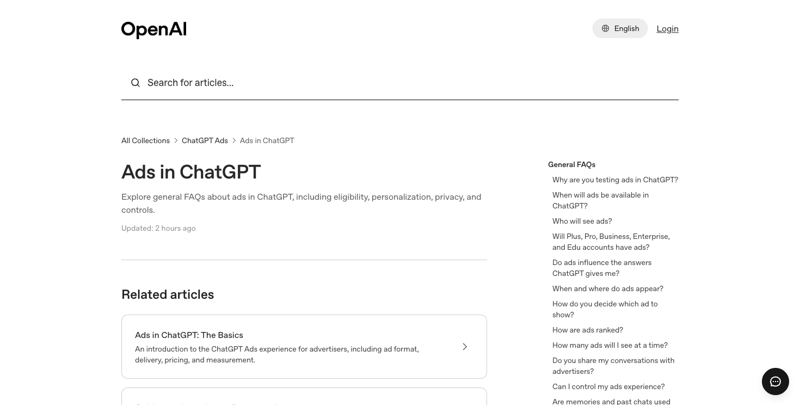
The core message: ads are coming “later this month,” and the privacy policy is being amended to spell out how those ads get picked, measured, and controlled. Here’s the part worth sitting with — at launch, the ads in Europe won’t be personalized. OpenAI’s own language is specific: targeting relies on your current conversation topic, a rough sense of your location, and your device type. Not your chat history. Not your saved memories. Personalized ads are explicitly not available in the EEA or Switzerland at launch — that’s an opt-in feature OpenAI says it’ll add later, and only if you say yes.
That’s a stricter starting point than the U.S. got. When ads first rolled out stateside back in February, OpenAI didn’t wait as long to introduce personalization options. Europe’s privacy rules pushed the company to launch with the plainer version first and layer in more capability later, if at all.
This isn’t ChatGPT’s first ad rollout — it’s the ninth country
Here’s what a lot of the coverage this week gets wrong by omission: this isn’t a sudden new idea. It’s the European leg of a rollout that’s been running since January.
| Date | What happened |
|---|---|
| January 15–16, 2026 | OpenAI announces plans to test ads for Free and Go tiers; Plus/Pro/Business/Enterprise stay ad-free |
| February 9, 2026 | Ads test begins for logged-in adult Free and Go users in the U.S. |
| March 21, 2026 | Ads expand to all U.S. Free/Go users; Criteo added as an ad-tech partner |
| May 5, 2026 | Self-serve Ads Manager opens to U.S. businesses; $50,000 minimum spend requirement dropped |
| May 7, 2026 | OpenAI announces plans to bring ads to the UK, Mexico, Brazil, Japan, South Korea |
| July 21, 2026 | Ads Manager Beta opens to advertisers in Australia, Canada, Japan, South Korea, New Zealand, UK, U.S. |
| August 6, 2026 | OpenAI confirms ads launching in Brazil and Mexico “in the coming week”; adds a carousel ad format |
| August 11, 2026 | ChatGPT Ads go officially live in the UK, Mexico, Brazil, Japan, and South Korea |
| August 15, 2026 | OpenAI Ireland emails EEA and Swiss Free/Go users: ads coming “later this month” |
By the time that Saturday email landed, ads were already running for free-tier users in nine countries. Europe is simply the tenth — and the first market where GDPR forced OpenAI to send a formal, dated compliance notice ahead of time, rather than just flipping the feature on.
Wait — didn’t ChatGPT already get in trouble for fake ads?
If you searched “chatgpt ads” this week, you probably ran into old headlines about paying Plus and Pro subscribers seeing promotional cards for Peloton and Target, and OpenAI’s chief research officer Mark Chen apologizing that the company “fell short.” A few outlets have been re-surfacing that story alongside this week’s Europe news, which makes it read like a repeat.
It isn’t. That controversy happened in early December 2025 — two full months before ChatGPT’s actual ad system even existed. I went looking for a fresh, August 2026 version of the same complaint, and I couldn’t find one. Every credible source traces back to that one December week.
Here’s what actually happened back then, and why it’s a different story:
December 1–3, 2025. Users — including people paying $20/month for Plus and $200/month for Pro — started sharing screenshots of ChatGPT recommending third-party apps like Peloton and Target in the middle of completely unrelated conversations. One widely-shared example: someone asking about Windows BitLocker got a Peloton suggestion out of nowhere.
OpenAI’s first response: denial. ChatGPT lead Nick Turley initially said “there are no live tests for ads,” and data lead Daniel McAuley described the messages as unpaid app suggestions tied to an app-discovery feature from October, with “no financial component.”
December 5–6, 2025: the reversal. As the backlash grew, Mark Chen posted on X: “I agree that anything that feels like an ad needs to be handled with care, and we fell short.” OpenAI turned the feature off. Reports at the time also referenced an internal “code red” memo from Sam Altman on December 4, directing the team to prioritize core product quality and explicitly delaying advertising work.
That’s a closed chapter — a pre-launch feature that looked like an ad, got yanked within days, and predates the actual ChatGPT Ads product by two months. The August 2026 news is a different thing entirely: the planned, disclosed, GDPR-compliant expansion of a system that’s been publicly running since February.
There is one genuine August 2026 ads controversy, and it’s worth naming so you don’t confuse it with either of the above: on August 12–13, The Register reported that OpenAI’s ad-serving system kept billing advertisers and showing their ads for up to a full day after campaigns were paused, thanks to a sync bug between campaign-level and ad-level status. That’s an advertiser billing dispute — it affects businesses paying to run ads, not people reading ChatGPT for free. Worth knowing about if you’re advertising on the platform. Irrelevant if you’re just trying to figure out whether your free ChatGPT is about to look different.
Why OpenAI is doing this at all
It’s worth being straight about the business logic here, because it explains a lot of the timing.
OpenAI has never hidden that it’s spending far more than it earns from subscriptions alone. Training and running models at ChatGPT’s scale is expensive — compute costs, not staffing, are the dominant line item — and a widely cited figure this year put OpenAI’s operating loss in the range of $8 billion for the period covering early 2026. Ads are the obvious lever: they let OpenAI keep the free tier free (or Go cheap) without subsidizing hundreds of millions of non-paying users purely out of investor capital forever.
That context matters for reading the whole ads story correctly. This isn’t a company casually deciding to monetize attention because it can — it’s closer to standard tech-industry economics: free tier funded by ads, premium tier funded by subscriptions, same model YouTube, Spotify, and Gmail have run for years. The timing (immediately following the U.S. rollout, then racing through nine more markets in seven months) tracks with a company under real pressure to show a path to sustainable revenue, especially with an IPO in its future — OpenAI filed S-1 paperwork earlier this year, and public-market investors care a lot about unit economics.
None of that makes the ads themselves more or less annoying to encounter mid-conversation. But it explains why this rolled out fast and broadly rather than as a slow, cautious pilot — OpenAI has real financial incentive to get ad revenue flowing across as many markets as regulators will allow, as quickly as possible.
How this compares to Claude, which still has no ads
If you use both ChatGPT and Claude — a lot of our readers do — this is a genuine point of difference worth knowing, not just trivia.
Anthropic, which makes Claude, has been explicit that it has no ads in its product and, as of this writing, no announced plans to add them. Anthropic’s public positioning leans hard into “we don’t want an incentive to keep you scrolling or clicking” — the company has run marketing that directly needles OpenAI’s ad rollout (a widely-noticed Super Bowl commercial mocked the idea of AI chat funded by advertising, timed within hours of OpenAI’s own U.S. ads announcement earlier this year).
| ChatGPT | Claude | |
|---|---|---|
| Free-tier ads | Yes, Free and Go tiers, expanding market by market | No ads, any tier |
| Paid-tier ads | No — Plus/Pro/Business/Enterprise ad-free | N/A |
| Public stance on ads | Framed as subsidizing free access | Publicly opposed, used in marketing |
| Revenue model on free tier | Ads (contextual, later personalized by opt-in) | None disclosed — free tier not directly monetized via ads |
The honest caveat: Claude not having ads today doesn’t mean it never will. Anthropic is under similar cost pressure to run large models at scale, and “we don’t have ads yet” is a different claim than “we will never have ads.” If avoiding ads entirely matters more to you than anything else, that’s a legitimate reason to lean toward Claude right now — just hold that decision loosely, because the whole industry’s economics are still shifting under everyone’s feet.
Who actually sees ads, and who doesn’t
This is the part most readers actually want, so here it is plainly.
| Plan | Ads shown? | Personalization (EEA/Switzerland) | Notes |
|---|---|---|---|
| Free | Yes | Not available at launch | Contextual only — topic, rough location, device type |
| Go ($8/month) | Yes | Not available at launch | Same targeting rules as Free |
| Plus | No | N/A | Ad-free by design, every market |
| Pro | No | N/A | Ad-free by design, every market |
| Business / Enterprise / Edu | No | N/A | Ad-free by design, every market |
The line has held steady across every one of the nine markets that got ads before Europe: Free and Go see them, everything above that doesn’t. OpenAI has been consistent about that since the January announcement.
One wrinkle worth flagging, because it surprised at least one user I found reporting it on Hacker News back in June: a Go-tier subscriber — paying £6.99/month — got ads from Financial Times, Shein, and Amazon and was annoyed enough to cancel. It wasn’t a bug. OpenAI’s own pricing page has said “ads may appear for users on the Free and Go plans” since ads launched. If you’re paying for Go specifically because it’s cheap and you assumed “paid” meant “ad-free,” that assumption was never accurate — and it’s worth knowing before you sign up in a market where Go is your entry point.
How to check and control your ad settings
If ads are live or about to be live in your region, here’s where the actual controls sit, based on OpenAI’s own help documentation:
- Open ChatGPT Settings and look for the “Ad Controls” section. It’s available to Free and Go users in any region where ads are live or imminent.
- Tap the three-dot menu on any ad you see and choose “About this ad” — this tells you specifically why that ad was shown to you (which topic or context triggered it).
- Use the dismiss and feedback options directly on the ad card if you don’t want to see that one again or think it’s off-base.
- Check your ad interaction history in the same settings area, and clear it whenever you want. OpenAI doesn’t make you keep a record.
- If you’re under 18 on your account, none of this applies to you — OpenAI excludes minors from ads entirely, using stated age, account age, and behavioral signals (usage timing, patterns, topics) to catch accounts that might be misreporting their age.
There’s no single global “opt out of all ads forever” toggle on Free or Go — the actual ad-free guarantee is tied to your subscription tier, not a settings switch. If seeing ads at all is a dealbreaker for you, upgrading to Plus is the only way to make them disappear completely, in every market, permanently.
Why Europe got a formal notice and nobody else did
Every other market — the U.S., UK, Mexico, Brazil, Japan, South Korea, Australia, Canada, New Zealand — got ads without a dated, individually-mailed compliance notice beforehand. Europe is the exception, and the reason is entirely about data law, not user experience.
Under GDPR, any material change to how personal data gets processed — including how ad targeting works — needs advance disclosure to the people affected, especially when a new international legal basis for data transfer is involved. Since some of the data processing for ad delivery happens outside the EEA, Switzerland, and the UK (including in the U.S.), OpenAI is relying on European Commission adequacy decisions and Standard Contractual Clauses — the same legal mechanism most American cloud companies use to move European data across the Atlantic legally.
As of this week, OpenAI hadn’t yet published the full amended European privacy policy text — just the notice that it’s coming. That means some of the exact personalization mechanics for the eventual opt-in feature aren’t nailed down publicly yet. Worth checking back on once the full document lands, especially if you’re the type who actually reads privacy policies (you should be).
What this means for you
If you’re on ChatGPT Free in Europe and don’t want ads at all. Your two real options are living with contextual (non-personalized) ads, or upgrading to Plus. There’s no third setting that removes ads while staying on Free. First move: decide now whether $20/month is worth it to you before the ads actually show up, rather than reacting once they do.
If you’re on ChatGPT Go and specifically picked it to save money. You’re still going to see ads — that’s been true in every market Go exists in since launch, not something new to Europe. First move: check whether the ~$12/month jump from Go to Plus fits your budget if ads turn out to bother you more than expected.
If you’re on Plus, Pro, Business, Enterprise, or Edu. This entire announcement doesn’t touch you. Nothing changes in your experience — you’ve been ad-free the whole time and stay that way. No action needed, but it’s worth knowing so you don’t panic-read a headline that isn’t about your tier.
If you manage a European team on ChatGPT Business or Enterprise. You’re unaffected directly, but it’s worth a two-minute Slack message to anyone on your team still using a personal Free account for work — they’re about to start seeing ads mid-task.
If you’re a small business or freelancer using ChatGPT Free to keep costs down. Ads showing up mid-conversation is a real workflow interruption, not just cosmetic. First move: if AI tooling is core to how you work, this is a reasonable trigger to actually run the cost-benefit math on Plus rather than defaulting to free indefinitely.
If you searched for this because you saw old Peloton/Target headlines and got confused. You’re not imagining things — several outlets really have been running December 2025 screenshots next to August 2026 headlines this week. The two stories are unrelated. Use this piece to sort out which one you actually read.
If you’re a parent whose teenager uses ChatGPT. Worth confirming their account correctly reflects their age — OpenAI’s age-exclusion system is supposed to catch minors and withhold ads automatically, but it depends partly on stated age being accurate.
Edge cases and things people are asking
“I’m in the EEA but I haven’t gotten the email yet — am I missing it?” The notice went to Free and Go accounts specifically, tied to the email address on file. If you signed up with a secondary or work email you don’t check often, that’s the likely reason. Check your account settings directly rather than waiting on the inbox.
“Will ads slow down my responses or change what ChatGPT tells me?” OpenAI’s stated position — consistent across every market that’s launched so far — is that ads don’t influence the actual answer content, and appear below a completed response as a clearly separate, labeled card. There’s no public evidence contradicting that so far, but “labeled sponsored content below the answer” is a different claim than “the model’s reasoning is untouched,” and it’s fair to stay a little skeptical until independent researchers have poked at it more.
“I’m on Go but in a country where ads aren’t live yet — will they hit me too, eventually?” Based on the rollout pattern so far — nine markets in seven months, each announced weeks ahead — it looks like the intent is eventually global for Free and Go. There’s no confirmed date for markets beyond the ten currently covered, so this is a reasonable expectation, not a confirmed one.
“Can advertisers see my actual conversations?” No, per OpenAI’s stated policy: advertisers get aggregated performance data — views and clicks — not access to your chat content, chat history, or memories.
“Does turning off ‘Improve the model for everyone’ also stop ads?” No, those are separate settings. One controls whether your conversations can be used for model training; the other controls ad delivery. Managing your ad experience specifically requires the Ad Controls section, not the training-data toggle.
“Is this the same as what happened with Meta or Google’s AI ads?” Broadly similar business logic (free tier subsidized by ads, paid tier ad-free) but OpenAI’s contextual-only starting point in Europe — no personalization at launch — is stricter than what some competitors shipped in the same region. Worth comparing directly if you’re weighing platforms partly on this.
“What happens if I ignore the email and do nothing?” Nothing bad happens to your account. You’ll just start seeing ads on Free or Go once the rollout hits your region, same as everyone else on those tiers. No action is required to keep using ChatGPT normally.
What we still don’t know
- The exact date “later this month” resolves to. OpenAI hasn’t published a specific day for the EEA/Swiss launch as of this writing.
- The full amended privacy policy text. Only the notice exists publicly right now — the detailed personalization mechanics for the future opt-in aren’t nailed down in a public document yet.
- Whether personalized ads will actually launch in Europe at all, or stay a “someday” feature that never ships given GDPR’s ongoing scrutiny of ad-tech.
- Whether markets beyond the current ten get ads next, and on what timeline.
The bottom line
Nothing here should be a surprise if you’ve been paying attention to ChatGPT’s ad rollout since January — Europe was always the obvious next stop, and GDPR is why it came with a formal notice instead of a quiet flip of a switch. The part actually worth remembering: this week’s ads-expansion news and last December’s Peloton/Target controversy are two completely different stories, months apart, and conflating them is exactly what a few tired blog posts are doing to you right now.
If you’re on Free or Go in Europe, ads are coming, they won’t be personalized at first, and Plus remains the only way to make them disappear entirely. If none of that applies to your plan, this was five minutes you didn’t strictly need to spend — but at least now you know why.
Curious what else is actually worth knowing about how these tools handle your data? Our AI Privacy 101 course walks through exactly what happens to your chats across ChatGPT and Claude, in plain language, with a certificate at the end.
Sources
- OpenAI Help Center — Ads in ChatGPT
- OpenAI — Testing ads in ChatGPT
- OpenAI — Our approach to advertising and expanding access to ChatGPT
- PPC Land — ChatGPT Free and Go users in Europe face ads from later this month
- PPC Land — ChatGPT ads reach Europe as its own crawler ignores publisher blocks
- Value Add VC — OpenAI Sets a Date for Ads to Hit ChatGPT in Europe
- Reuters — OpenAI to introduce ads to all ChatGPT free and Go users in US
- Business Insider — OpenAI will bring ChatGPT ads to Brazil and Mexico
- The Register — OpenAI ad service can bill customers for up to one day after a campaign is paused
- The Verge — OpenAI says it’s disabled ad-like app promotions in ChatGPT (December 2025)
- TechRadar — OpenAI walks back ad-like app suggestions in ChatGPT, saying it “fell short”
- Studio Global AI — ChatGPT Ads in Europe 2026: UK Is Live, But GDPR Blocks France, Germany, and Ireland
