It’s 11 p.m. You’re wiping buttercream off your phone when the DM lands: “hi do u do cakes? need one for my daughter sat, chocolate, around 30 ppl, unicorn theme, how much?” You know this message. You’ve answered a hundred like it. And every time, you either fire back a guess you’ll regret or you put it off until morning and lose them to the baker who replied first.
This is the part of running a home bakery that has nothing to do with baking — and it’s exactly the part AI is good at. Not the cake. Never the cake. The quote. The reply. The pricing math you keep redoing in your head.
A baker in a cottage-food group put it perfectly this spring: “ChatGPT won’t bake for you — but it can help run your business.” So let’s hand it the business side and get you back to the oven.
What this is good for (and what it isn’t)
Quick reality check before we start, because there’s a lot of overhyped nonsense out there.
ChatGPT is genuinely useful for the admin around your cakes: turning a vague request into a clean quote, drafting a friendly reply, breaking down your costs, writing captions, keeping order details straight. Bakers who use it for this stuff say the same thing over and over — “it saved me hours.”
It is not good at the things that make you you: the actual baking, the design eye, the relationship with a nervous bride, the taste. And bakers are rightly protective of that. The loudest worry in baking communities is that AI makes everything sound generic and customers can tell. They’re right. So we use it as a drafting assistant you edit in your own voice — not a replacement for the warmth that makes people come back.
With that settled, here’s the workflow.
Step 1: Turn the messy message into a clear order
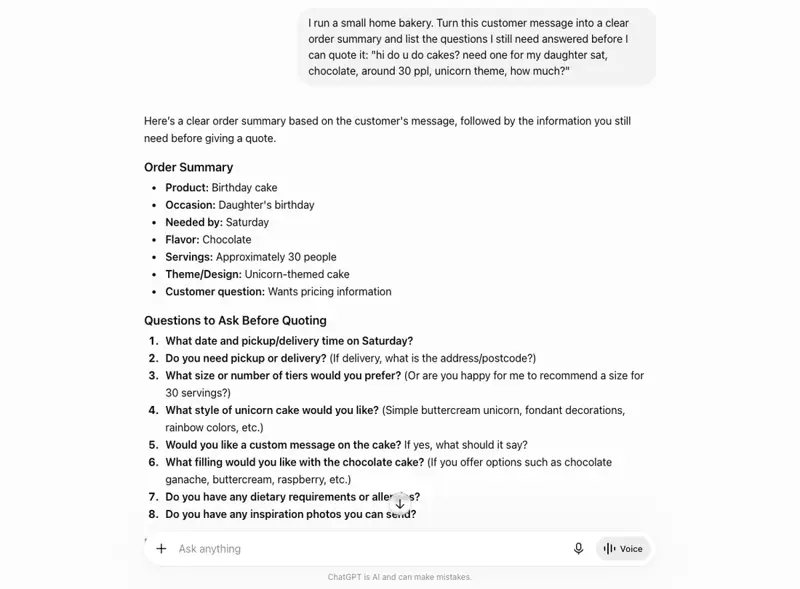
Paste this, with the customer’s actual message:
I run a home bakery. Turn this customer's message into a clear order
summary, and list the questions I still need answered before I can quote
it (size/servings, flavors, dietary needs, date, pickup or delivery,
budget, design details). Keep it short.

Customer message: [paste their exact text]
In ten seconds you get a tidy summary and the exact gaps to fill. No more re-reading a rambling DM five times.
Step 2: Build your pricing formula once
Don’t ask ChatGPT what to charge — it doesn’t know your costs or your market, and it’ll guess. Instead, set up your formula one time and reuse it. The standard one most baking-business pros use:
Cake price = ingredients + labor (your hours × your hourly rate) + overhead — then multiply by a complexity factor for difficulty, and add your profit margin.
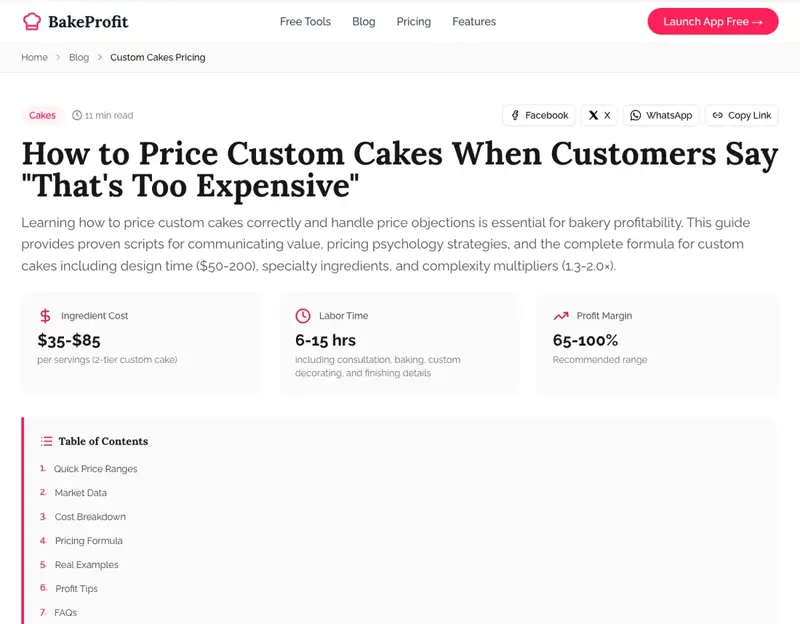
For reference, baking-business guides in 2026 put a typical 8-inch custom cake somewhere around $65–$110 for basic custom work and $80–$200+ for detailed designs, with per-serving rates running roughly $3–5 (simple), $5–8 (standard), and $8–15+ (premium/sculpted). Use those as sanity checks, not gospel — your city and your skill set the real number.
Give ChatGPT your numbers once:
Help me build a reusable cake pricing formula. My costs: ingredients
average [$X] for a [size] cake. I pay myself [$30]/hour and a custom
cake takes me about [X] hours. My monthly overhead (rent share,
utilities, packaging, insurance, tools) is about [$X] spread over about
[X] orders a month. I want a [X]% profit margin. Build me a simple
formula and show me a worked example for a [serves 30, two-tier] cake.
Save the result. Now you have a calculator that reflects your business, not a stranger’s.
Step 3: Draft the quote + the warm reply
Now combine them:
Using my pricing formula below, draft a friendly, professional reply to
this customer. Include: a priced quote (or a price range with what
changes it), 2-3 clarifying questions, two flavor/size options, my
deposit and pickup policy, and a warm closing in my voice — I'm
[warm and a little playful]. Keep it under 150 words. Don't promise
anything I haven't confirmed.

My formula: [paste from Step 2]
The order: [paste summary from Step 1]
Read it, tweak the warmth, send. Two minutes, start to finish, at 11 p.m. or 6 a.m. — whenever you actually have a hand free.
What this means for you
If you’re a weekend / side-hustle baker: This is your unfair advantage. The reason you lose orders isn’t your cakes — it’s reply speed and pricing nerves. A saved formula and a reply prompt fix both, without you staying up doing math.
If you run an established home bakery: Use it to stop undercharging. Bakers chronically forget overhead and their own labor. Building the formula once, honestly, often reveals you’ve been quoting 20–30% too low. That’s not a small thing over a year of cakes.
If you’re a cake decorator who lives in the DMs: Set up Steps 1 and 3 as saved prompts on your phone. You’ll triage inquiries in the gaps between piping instead of letting them pile up.
If “business stuff” is the part you dread: That’s exactly who this is for. You didn’t start a bakery to write quotes and policies. Let the assistant draft them; you stay the baker.
What this can’t do
- It can’t set your prices. It can do the arithmetic once you give it real costs, but if you feed it guesses, you get confident nonsense. Your numbers, your final say — always.
- It can’t see the reference photo. When a customer sends an inspiration pic, you judge whether it’s doable in your time and skill. Which leads to the big one…
- AI cake images are setting unfair expectations. More customers now arrive with a gorgeous AI-generated cake photo of something that physically can’t be baked. The reply prompt can help you gently reset expectations, but you’re the one who has to say “here’s what I can do beautifully instead.” No tool fixes that conversation for you.
- It can’t keep your voice unless you make it. Generic replies read as generic, and your customers chose you for not being a chain. Always edit the draft until it sounds like you texted it.
- It can’t handle the legal part. Cottage food rules are state-by-state — what you can sell, where, income caps, and labeling (most states require a “made in a home kitchen that is not licensed/inspected” line). ChatGPT can summarize the idea, but check your own state’s actual rules. Don’t take its word as law.
The bottom line
The cakes were never the bottleneck. The quotes, the late-night replies, the pricing math you redo every time — that’s what burns you out. Hand that to ChatGPT, keep the baking and the warmth for yourself, and you’ll answer faster, charge fairer, and close more orders without adding a single hour to your week.
Build the formula tonight. Use it on the next messy DM. See how it feels to reply in two minutes instead of two days.
Want to set up the whole system? Our ChatGPT for Business course walks small-business owners through quotes, pricing, and customer replies step by step, and AI Fundamentals covers the basics if you’re brand new to all this.
Sources
- How to Price Custom Cakes: 2026 Guide + Calculator — BakeProfit
- How to Price a Cake (a Guide for Home Bakers) — Sugar & Sparrow
- How to Price Custom Cakes for Sale (Real Numbers) — BakingSubs
- How to Use AI Assistants Like ChatGPT to Elevate Your Home Bakery — Happy Hippo Bakery
- Cottage Food Labeling Requirements (2026 update) — My Custom Bakes
