On July 31, a court in Munich handed down Europe’s first ruling that training an AI music model on copyrighted songs without a license is infringement. The loser was Suno — the tool behind a meaningful share of the AI background music in YouTube videos, podcast intros, and small-business ads right now. The winner was GEMA, Germany’s music rights society, which represents over 100,000 songwriters and publishers.
If you’ve ever generated a track in Suno and put it under a video, your first question is the practical one: am I in trouble, and can I keep using my music?
Short answer: no, you’re not in trouble — the court went after the platform, not its users, and nothing in this ruling deletes or bans your tracks. But the ruling is the loudest signal yet that the legal ground under AI music is being rebuilt, and there are three rules — none of them new, all of them newly urgent — that decide whether your use of AI music stays safe. This is the plain-English version of the whole picture, because the actual answers are scattered across a German court press release, Suno’s terms of service, US Copyright Office reports, and four different platform policies that all changed in the past year.
What actually happened in Munich
GEMA sued Suno in January 2025. The case that ended (for now) on July 31 was decided by the Munich Regional Court’s 42nd civil chamber — the same copyright-specialist chamber that ruled against OpenAI in GEMA’s ChatGPT-lyrics case in November 2025. That earlier win matters: the court applied the same logic twice in nine months, which is what makes lawyers call this a trend rather than a one-off.
The case turned on six songs you’d recognize from any German wedding playlist: “Atemlos durch die Nacht,” “Rasputin,” “Daddy Cool,” “Big in Japan,” “Forever Young,” and the chorus of “Mambo No. 5.” GEMA’s lawyers typed each song’s original lyrics, style, and title into Suno’s prompt box — no melody, no chords, nothing musical — and Suno produced tracks the court found substantially similar to the originals.
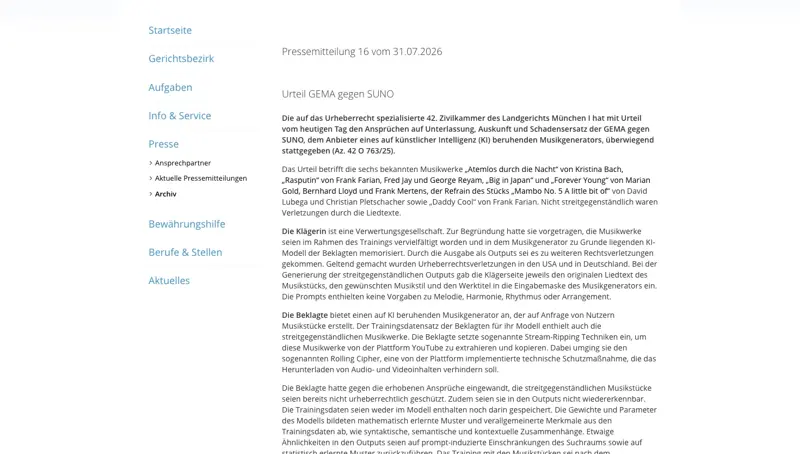
The court’s findings, from its own press release and the first legal analyses:
- The songs were “memorized” inside the model. The court concluded the six works are reproducibly contained in Suno’s model (versions 3.5 and 4) — meaning the model didn’t just learn from them, it can effectively play them back. That memorization counts as an unlawful copy under German copyright law.
- The EU’s data-mining exception doesn’t cover this. Suno pointed to the European text-and-data-mining rules that permit some automated analysis. The court said memorization goes beyond analysis — the same reasoning it used against OpenAI.
- The scraping method made it worse. The court found Suno acquired the songs by stream-ripping them from YouTube, bypassing YouTube’s “Rolling Cipher” download protection — an independently unlawful copy before any training even started.
- Suno, not its users, is responsible for the outputs. Worth reading twice if you’re a creator: the court placed liability for infringing outputs on the platform, even though GEMA’s own team wrote the prompts.
- The consequences: an injunction against continued use of the six works, disclosure of the revenue connected to the infringement, and damages in an amount still to be determined.
Two honest caveats before anyone declares the end of AI music. First, the ruling is not final — it’s a first-instance judgment, Suno says it “fundamentally mischaracterizes” its technology and is evaluating an appeal, and appeals in Germany take years. Second, the ruling formally covers six songs and one rights society in one country. Its weight comes from precedent, not from any immediate switch being flipped.
GEMA’s CEO framed the ambition plainly: “AI models built on stolen intellectual property have no protection under the law. AI service providers must pay for licenses.” That’s the world this ruling pushes toward — not AI music disappearing, but AI music companies paying for training data the way radio stations pay for airplay.
The question that actually matters: use vs. own
Nearly every “is AI music legal?” confusion collapses once you separate two things people mix together constantly:
Can I use this track? — a question about your license from the platform. Suno’s terms decide it.
Do I own this track? — a question about copyright law. The US Copyright Office (and its equivalents elsewhere) decides it.
These have completely different answers, and the gap between them surprises almost everyone.
Can you use it? Check which plan generated the track
Suno’s current plans draw a bright line, and it’s printed right on the pricing page:
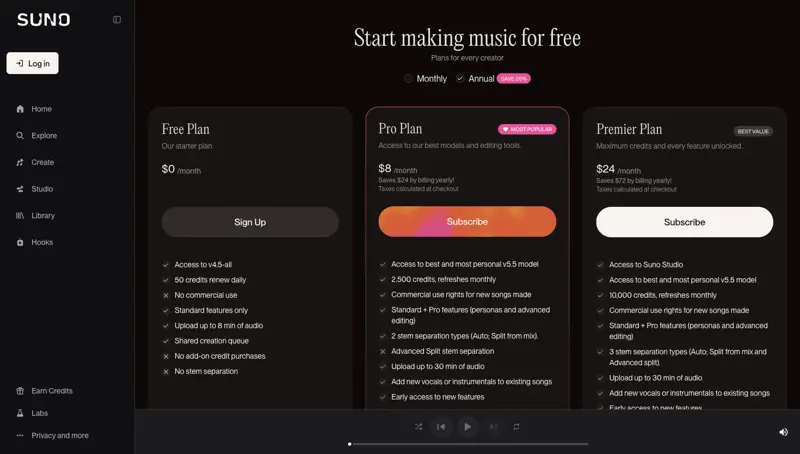
- Free plan: you may use your tracks for personal, non-commercial purposes only, with attribution to Suno. Suno — not you — owns free-tier outputs. A monetized YouTube video, a client project, a business ad: all outside the license.
- Pro ($8/mo annual) and Premier ($24/mo annual): Suno assigns you its rights in the tracks you generate while subscribed, with commercial use permitted and no revenue share.
- The retroactivity trap: commercial rights apply to songs made during a paid subscription. Upgrading today does not legalize commercial use of the tracks you generated on the free tier last year. If a free-tier track matters to your business, regenerate it (or something close) under the paid plan.
Suno itself had to clarify this publicly in January after a confusing FAQ edit — its statement was unambiguous: paid-tier users own their outputs with commercial rights; free-tier outputs belong to Suno and are non-commercial. Screenshot-worthy, because this single distinction settles most real-world questions.
One more wrinkle the Warner settlement added (more on that below): Suno’s free tier is losing download capability as licensed models roll out, and paid tiers are getting download caps. The era of pulling unlimited MP3s out of the free tier is closing regardless of what any court says.
Do you own it? Mostly, no — and that cuts both ways
The US Copyright Office’s position, laid out in its 2025 copyrightability report, is settled for now: copyright requires a human author. A track generated from a text prompt — however clever the prompt — isn’t copyrightable. Prompts, in the Office’s words, don’t provide enough human control over the expressive elements. A federal court reinforced the line in April 2026, rejecting protection for tracks generated “primarily by AI” even with heavy prompting and curation.
What that means in practice:
- You can’t register or enforce copyright in a fully AI-generated track. If someone downloads your Suno-made theme song and uses it in their own videos, you have essentially no copyright claim against them. “Your” track is, legally, nobody’s — anyone can reuse it.
- Your human contributions are still yours. Wrote the lyrics yourself? The lyrics are copyrightable as your literary work — register them, and declare the AI-generated music portion. Recorded your own melody and had AI arrange around it, or meaningfully edited and arranged the output? The human-authored elements can support a claim.
- The practical rule: the more of you in the track, the more of it you own. All-AI means all-public-domain, in effect.
For a podcast intro or video background music, ownership rarely matters — you need permission to use, not a monopoly. For anything you’d sell, license to clients, or build a brand on, the ownership gap is real: budget either human input (your lyrics, your melody, your production pass) or the acceptance that the asset is legally unprotectable.
The platform rules changed too — a 2026 map
The Munich ruling landed in the middle of a year when every major music platform drew its own AI lines. If your AI music touches YouTube, Spotify, or a distributor, this table is the current terrain:
| Platform | 2026 AI music policy | What it means for you |
|---|---|---|
| Spotify | Removed 75M+ spammy tracks in 12 months; ~39% of uploads auto-flagged for scrutiny; 1,000-stream minimum before royalties; “AI Credits” disclosure launched April 2026; impersonation banned | Legitimate, disclosed AI-assisted music is welcome; bulk AI uploads and voice clones are not |
| TIDAL | Since July 15, 2026: tracks identified as 100% AI-generated get an “AI” badge and zero royalties; listeners can filter AI music out | First major service to demonetize (not just label) fully AI tracks |
| YouTube (Content ID) | AI tracks regularly trigger false copyright claims — often matching against someone else’s similar AI-generated track registered earlier | Disputes usually win: keep your Suno subscription receipt and generation history as evidence; claimants have 30 days to respond |
| DistroKid | Accepts AI music with a mandatory AI-disclosure checkbox, if you hold commercial rights | The most workable distributor path for paid-tier Suno tracks |
| TuneCore (Believe) | Rejects 100% AI-generated tracks — and reportedly blocks Suno-made tracks specifically, citing the ongoing litigation | If you distribute, this door is closed to Suno output |
| CD Baby | Bans AI-generated content; allows AI only as a tool (e.g., mastering) | Closed |
| Amuse | Accepts with caps (10 AI releases per 7 days) but no longer registers AI tracks with Content ID | Distribution without Content ID protection |
Two patterns worth naming. The industry isn’t banning AI music — it’s building a two-tier system where disclosed, human-involved, rights-cleared AI music participates and bulk, anonymous, fully-AI content gets filtered or demonetized. And the practical hassles creators actually hit (false Content ID claims, distributor rejections) come from the platforms, not from courts — which is why “keep your receipts” appears in every experienced AI musician’s advice.
The bigger legal picture: from lawsuits to licenses
The Munich case is one front in a war that’s mostly ending in business deals:
- Warner Music settled with Suno in November 2025 — dropping its lawsuit in exchange for a licensing partnership. The visible consequences for users: licensed models replacing current ones in 2026, free-tier downloads going away, download caps on paid tiers, and Warner artists opting in to license their voices and songs for AI generation.
- Universal settled with Udio (Suno’s main rival) in October 2025, building a licensed “walled garden” AI music platform with artist compensation.
- Universal and Sony are still suing Suno in US federal court, with the fair-use question unlikely to be decided before 2027. Sony is also still litigating against Udio.
- GEMA beat OpenAI on song lyrics in November 2025 with the same Munich chamber and the same memorization logic now applied to Suno.
Follow the direction of travel: every settlement converts “AI company scrapes catalog for free” into “AI company pays for a license.” The Munich ruling accelerates that in Europe by making the free-scraping position legally untenable there. For users, the likely long-term effects are mundane — licensed training data, possibly higher subscription prices, more artist-sanctioned voice features — not shutdowns.
The 3 safe-use rules for AI music in 2026
Everything above compresses into three rules. They were good practice before July 31; the ruling and the platform changes make them the difference between “fine” and “cleanup project.”
Rule 1: Match the tier to the use. Personal listening, private projects, experiments — free tier is fine. Anything commercial — monetized videos, podcasts with sponsors, client work, ads, streaming releases — needs the track generated under an active paid plan. And remember it’s not retroactive: the free-tier track from last year doesn’t become commercial when you upgrade today.
Rule 2: Don’t prompt toward real artists or songs. The infringing outputs in Munich came from prompts containing real lyrics and titles. Platforms increasingly block artist-name prompts, but “in the style of [artist],” pasted lyrics, or recognizable melodies are exactly where legal risk concentrates — for the platform today, and plausibly for conspicuous commercial users tomorrow. Describe moods, genres, instruments, tempo. Never paste someone else’s lyrics.
Rule 3: Keep receipts, add yourself, disclose. Save your subscription invoices and generation history — they’re what wins a false Content ID dispute. Put human input into tracks that matter (your lyrics, your edits, your arrangement) — it’s the only path to owning anything. And use the disclosure checkboxes (DistroKid, Spotify’s AI Credits) rather than hiding the AI involvement — every platform that found undisclosed AI content in 2026 punished the hiding more than the AI.
What this means for you
If you’re a YouTuber or video creator: your existing videos are fine — nothing in the ruling reaches them, and no court ordered any takedowns. Going forward: generate background music under a paid plan, keep your generation history, and when a bogus Content ID claim arrives (increasingly common as AI tracks collide in the fingerprint database), dispute it with your receipts — uploaders win these routinely, sometimes on million-view videos.
If you’re a podcaster: the intro you generated on Suno Pro is licensed for exactly this. Two upgrades worth making this month: confirm the episode-music was made under the paid plan (not a free-tier experiment you kept), and if your show sells sponsorships, treat that as commercial use — because it is.
If you use AI music in ads or client work: raise your standard above “technically licensed.” Client deliverables carry the extra question of what you’re conveying — you can’t convey copyright in a track nobody owns. Say so in your contracts (“music is AI-generated and not subject to copyright registration”), or budget for licensed stock music or a human composer where the client needs exclusivity.
If you release music on streaming platforms: this is the group the 2026 changes actually squeeze. TuneCore and CD Baby won’t take fully-AI tracks (TuneCore reportedly blocks Suno output entirely); TIDAL will label and pay nothing; Spotify wants disclosure and punishes bulk uploads. The workable 2026 path: real human contribution (your lyrics, voice, arrangement), DistroKid with the AI disclosure checked, and no impersonation of anyone.
If you’re a musician or songwriter: the ruling is the strongest signal yet that your catalog has enforceable value against AI companies — that’s what “must license training data” means. Watch what your rights society and label do with it: opt-in licensing programs (like Warner’s) are where “AI trained on my work” turns into “AI pays me royalties,” and the opt-in decision will land on you sooner than you think.
If you run a small business: the jingle you generated for your shop’s Reels needs a paid Suno plan — that’s the whole compliance story for most small commercial uses. If the music becomes part of your brand, remember you can’t own it; anything you’d trademark your identity around deserves either human authorship or a proper license.
A worked example: one podcast intro, done right
Abstract rules stick better with a concrete run-through. Say you host a weekly marketing podcast and want a 30-second intro theme. Here’s the whole workflow with the 2026 rules applied:
Generate under the right plan. You subscribe to Suno Pro ($8/month billed annually) and prompt: “Upbeat 30-second intro theme, modern indie-pop, driving drums, warm synths, builds to an energetic finish, instrumental.” Notice what’s not in the prompt: no artist names, no song titles, no pasted lyrics. Genre, mood, instruments, structure — that’s the safe vocabulary.
Save the evidence the moment it works. You keep three things in a folder: the subscription invoice from your email, a screenshot of the generation in your Suno library showing the date, and the downloaded file. Total effort: two minutes. This folder is what wins disputes later.
Use it, disclose where asked. The intro goes into your episodes. Your podcast has sponsors, so this is commercial use — covered, because the track was made under an active Pro plan. When you later clip episodes for YouTube, nothing extra is needed; if you ever distribute the theme as a standalone release through DistroKid, you tick the AI-disclosure checkbox.
Handle the claim that eventually comes. Eight months in, a YouTube clip gets a Content ID claim from a music entity you’ve never heard of. This is the most common real-world incident in AI music right now — usually a different AI-generated track with a similar fingerprint that someone registered with Content ID before you published yours. You dispute, attach the subscription receipt and the dated generation history, and note the track was generated by you on Suno Pro. The claimant has 30 days to respond; in the typical case, the claim releases — creators have won these disputes on videos with over a million views.
Know what you don’t have. If a rival podcast starts using an intro that sounds like yours, you have no copyright claim — the track has no author in law. If that bothers you (for most podcasts it shouldn’t), the fix is human input: hum your own melody, record it, and use Suno’s audio-upload features to build the theme from your material. Now there’s a human-authored core you can actually own.
That’s the entire compliance story for a working creator: one paid plan, one clean prompt, one evidence folder, one honest disclosure. None of it changed because of Munich — Munich just made ignoring it feel riskier.
Edge cases and troubleshooting
Six problems creators actually hit with AI music, and what works:
1. “I got a copyright claim on my own AI track.” The classic. Usually a fingerprint collision with someone else’s similar AI track, occasionally bad-faith registration of AI music into Content ID. Dispute it with your paid-plan receipt and generation history; don’t just delete the video. Creators report claims releasing after dispute even on high-traffic videos. If the same track keeps drawing claims, regenerating a fresh variant and swapping the audio is the pragmatic fix — one BGM channel operator described exactly that workflow after a false “acoustic fingerprint” match.
2. “My distributor rejected the track.” Check which door you knocked on. TuneCore rejects fully-AI tracks and reportedly blocks Suno-origin uploads outright; CD Baby bans AI content. DistroKid accepts with the AI-disclosure checkbox if you hold commercial rights. Creators have publicly documented pushing a release date just to switch distributors — pick the right one first.
3. “I upgraded to Pro — can I now sell the tracks I made on free?” No. Commercial rights attach to tracks generated during the paid subscription, not before. Regenerate the concept under the paid plan. (And keep the new generation’s date visible in your library — that’s your proof it’s the paid-tier version.)
4. “Suno pulled a track out of my library / flagged my prompt.” Platforms tightened prompt filters through 2026 — artist names, real song titles, and lyric pastes increasingly get blocked or produce deliberately-degraded output. If a prompt bounces, that’s the platform protecting both of you; rewrite with genre and mood language rather than looking for workarounds. Workarounds are exactly the behavior the Munich evidence was built from.
5. “A stem I exported matches an existing recording.” One producer described stemming drums out of a Suno track and having their DAW’s sample-checker flag the loop as someone else’s copyrighted recording. Rare, but it’s the memorization problem showing up at the user level. If any generated element matches a real recording that specifically, don’t use it — regenerate. The odds are low per track; the cost when it hits a monetized project is not.
6. “TIDAL labeled my release AI and paid nothing.” Since July 15, 2026, TIDAL demonetizes tracks it identifies as 100% AI-generated. There’s no dispute path around the truth — the fix is upstream. Tracks with real human authorship (your vocals, your instrumentation, your composition with AI assistance) aren’t in the 100%-AI category. If your workflow is fully-AI, plan your release strategy around platforms that pay under disclosure rules instead.
What this ruling can’t fix (or ruin)
- It can’t take down your existing tracks. No mechanism in the judgment reaches end users’ generated music, and Suno keeps operating (including in Germany) while the appeal runs.
- It can’t settle US law. Germany has no fair-use doctrine; the US cases turn on one. A US court could still bless AI training on copyrighted music in 2027 — the Munich reasoning is persuasive, not binding, across the Atlantic.
- It can’t make your AI tracks copyrightable. The ownership gap is a copyright-office question, untouched by this case. All-AI output remains unprotectable in the US regardless of who wins the training-data wars.
- It can’t stop AI music. Licensed models are already the announced path (Warner-Suno, UMG-Udio). The realistic future is AI music with a licensing bill, not a ban.
- It can’t protect you from platform enforcement. False Content ID claims, distributor rejections, and demonetization are platform policies operating on their own logic — the three rules above are your protection there, not any court outcome.
FAQ
Is it illegal to use Suno now? No. The ruling is against Suno the company, over its training data — not against users, and not against the act of generating music. Suno continues to operate while it considers an appeal.
Can I still monetize YouTube videos with AI music? Yes, if the track was generated under a paid Suno plan (which grants commercial rights) and doesn’t imitate a real artist or song. Keep your subscription receipt and generation history in case of a mistaken Content ID claim.
Do I have to delete tracks I already made? No. Nothing in the ruling requires or enables takedowns of user-generated tracks. The one cleanup worth doing is voluntary: stop commercial use of tracks generated on the free tier, because those never had commercial rights to begin with.
Can I copyright a song I made with Suno? Not the AI-generated music itself — the US Copyright Office requires human authorship. If you wrote the lyrics, you can register the lyrics and disclaim the AI-generated music. Meaningful human editing, arranging, or added performance can also support a claim on those human elements.
Does the German ruling affect me if I’m in the US? Not directly — it binds Suno regarding six songs in Germany. Indirectly, yes: it strengthens rights holders’ hands everywhere, pressures Suno toward licensing (as Warner already extracted), and its “memorization” reasoning is being read closely by US courts handling the UMG and Sony cases.
Will Suno shut down or get more expensive? Shutdown is unlikely — Warner’s settlement points to the licensed-model future, and the damages here (six songs) are survivable. Price and product changes are already announced: licensed models in 2026, no free-tier downloads, download caps on paid tiers. More licensing costs generally mean subscription prices drift up, not down.
Is AI music “copyright free”? It’s the opposite of what people usually mean by that. Fully AI-generated music has no copyright — which means you don’t need anyone’s permission, but also that you can’t stop anyone from using “your” track. Copyright-free cuts both ways.
What about Udio, Lyria, and other AI music tools? Same framework, different licensing positions. Udio settled with Universal and Warner and is building a licensed platform; Google’s Lyria was trained under Google’s own licensing arrangements (and its output carries similar ownership limits). The use-vs-own distinction and the three rules apply to all of them. Our Lyria vs Suno comparison covers the tool differences.
Can my rights society get me money from AI companies? That’s precisely what GEMA is building — the disclosure order exists to calculate damages, and GEMA has said it’s preparing licensing frameworks. If you’re a registered songwriter, AI licensing revenue distributed through societies and labels (like Warner’s opt-in program) is now a realistic medium-term income line.
Did the court say AI outputs are all illegal copies? No — it found these six outputs, prompted with the songs’ own lyrics and titles, were substantially similar to memorized training data. Ordinary generic outputs (“upbeat lo-fi for studying”) weren’t the subject of the case.
The bottom line
The Munich ruling didn’t make your AI music illegal — it made unlicensed AI music companies look legally doomed in Europe, which is a different thing. For creators, the rules of the road were already written in places nobody reads: Suno’s tier terms, the Copyright Office’s human-authorship line, and platform policies that hardened all year. The ruling just turned the lights on.
Use the three rules — paid tier for commercial use, clean prompts, receipts plus disclosure — and AI music stays what it’s been all along: a genuinely useful tool with sharp edges exactly where the fine print said they were.
If music is part of what you make, our Music Production with AI course covers the full creative workflow — including the human-input techniques that make your tracks actually yours — and AI Music Marketing covers releasing and promoting in the disclosure era.
Sources
- Landgericht München I — Pressemitteilung 16: Urteil GEMA gegen SUNO (July 31, 2026)
- Reuters — German court rules AI music firm Suno broke copyright rules
- Variety — Suno loses landmark AI lawsuit to GEMA in Germany
- Music Ally — German collecting society GEMA wins its copyright-infringement lawsuit against Suno
- Music Week — GEMA wins court ruling on breach of copyright by AI music firm Suno
- Suno — Pricing and plan terms
- Suno — Terms of Service (ownership and commercial use)
- US Copyright Office — Copyright and Artificial Intelligence, Part 2: Copyrightability (2025)
- Reuters — Warner Music settles lawsuit with AI company Suno (November 25, 2025)
- Variety — TIDAL announces AI music policy: zero royalties for 100% AI-generated tracks
- Spotify Newsroom — Spam filtering and AI disclosure updates
- Music Business Worldwide — Suno infringed copyright in GEMA case, German court rules
- Reed Smith — Analysis of the Munich judgments on AI training and memorization
