Scroll through r/slp lately and you’ll hit the anxiety fast. One thread about a wave of “train our AI” job postings drew a top reply that captured the mood with 104 upvotes: “Everyone using AI for their jobs right now is training AI for free.” Another SLP put the resistance more bluntly — “I paid $85,000 for grad school. We need to use our brains.” The fear is real, it’s spreading, and it deserves a straight answer instead of either hype or doom.
So here it is, as honestly as we can give it: No, AI is not coming for your speech therapy job — and the data backs that up, not just the reassurance. But the picture is more useful than a simple “you’re fine,” so let’s actually look at it.
What the numbers say
If AI were quietly replacing SLPs, you’d see it in the job market. You see the opposite.
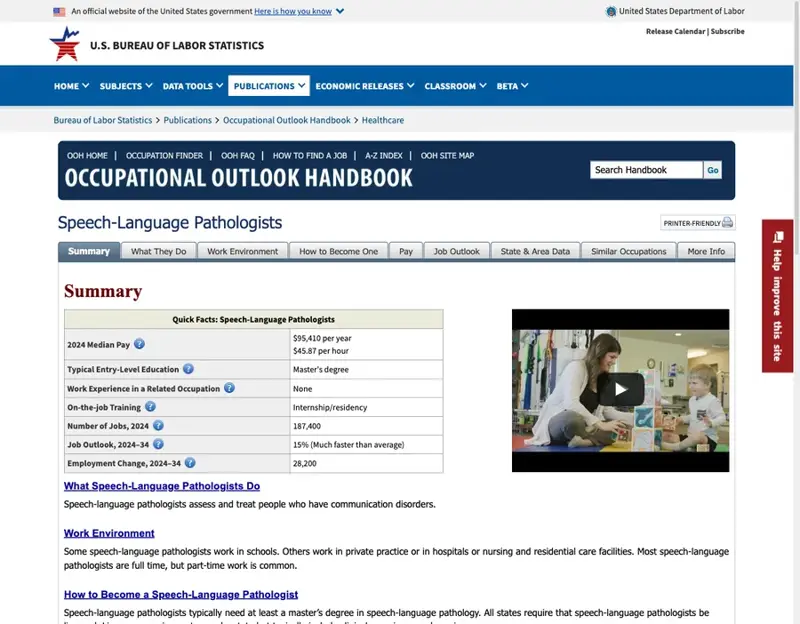
The U.S. Bureau of Labor Statistics projects speech-language pathology employment to grow 15% from 2024 to 2034 — which BLS classifies as “much faster than the average for all occupations.” That’s roughly 13,300 new openings every year over the decade, driven by an aging population and retirements. The median SLP wage was $95,410 in May 2024. And ASHA’s own 2024 survey found 79% of school-based SLPs say there are more job openings than job seekers in their area.
That’s not a profession being automated away. That’s a profession in a sustained shortage.
ASHA’s official position is just as direct. Its generative-AI guidance states plainly: “AI cannot replace the audiologist, speech-language pathologist, or assistant.” In a formal August 2025 letter to the U.S. Department of Education, ASHA reaffirmed that licensed providers “should have ultimate decision-making authority” over how AI is used in care, and that “keeping a human in the loop of any AI workflow is essential.”
What AI genuinely cannot do
The reassurance isn’t just institutional — it’s structural. The core of your job is made of things current AI simply can’t do:
- Dynamic assessment. Adjusting a test in real time based on a child’s responses, and telling a language difference apart from a language disorder, is judgment built on training and experience. A model can’t do it.
- Therapeutic rapport. The trust that gets a frightened six-year-old to attempt a sound they’ve been avoiding — that’s the actual engine of therapy, and it’s deeply human.
- Clinical judgment in context. Reading prosody, eye contact, affect, and pragmatics together to make a differential diagnosis. Knowing when the standardized score doesn’t tell the real story.
- Swallowing evaluations. AI cannot perform a bedside swallow exam, a modified barium swallow study, or a FEES. Full stop.
- AAC fitting and dialect-sensitive assessment. Programming a communication device for one specific kid, or assessing a multilingual learner without mistaking a dialect for a disorder — current models, trained on non-diverse data, get this wrong.
Notice the pattern: everything AI can’t do is everything that made you want to become an SLP. What it can do is the paperwork you never wanted in the first place.
So what is AI actually good for? The 3 tasks worth handing off
Here’s the reframe that the anxious threads miss. AI isn’t a replacement — it’s a way to claw back the 6 hours a week ASHA says you lose to documentation, the workload that has 27% of school SLPs considering leaving. The SLPs who are genuinely happier with it use it for exactly three things:
- Turning de-identified session data into parent-ready summaries. Feed it stripped-of-identifiers progress data, get back a warm, plain-language update to review and edit. (Here’s the safe step-by-step.)
- Drafting candidate IEP goals to choose from. A 2025 study in Exceptional Children found AI-drafted IEP goals were statistically equal in quality to teacher-written ones — but you still pick and modify. It’s a starting point, not a final answer.
- Generating leveled therapy materials. Articulation word lists, leveled reading passages, social stories — no student data required, infinite variations, minutes instead of an evening.
The honest caveat that runs through all three: it drafts, you decide. One SLP described it best — “You supply the data, AI supplies the structure.” Never the other way around.
What this means for you
- If you’re scared of being replaced: Breathe. The shortage is real, the BLS outlook is strong, and the parts of your job that matter most are the parts AI can’t touch. The bigger career risk isn’t AI replacing SLPs — it’s burning out on paperwork before you get to do the work you trained for.
- If you’re anti-AI on principle: That’s a defensible stance, and you’re not wrong that careless use creates problems (privacy, accuracy, deskilling). But there’s a middle path between “let AI do my job” and “refuse to touch it”: use it only for de-identified busywork, and keep every clinical decision yours.
- If you’re already using it: Audit yourself against the line above. Drafting summaries and materials from de-identified data? Great. Letting it write eval reports or near anything with a student’s name? Stop — that’s where colleagues have gotten burned with reports that came back “wrong and contradictory.”
- If you manage a team: The win here is retention. Giving clinicians a safe, sanctioned way to cut documentation time is a burnout intervention, not a cost-cutting one.
The bottom line
Is AI coming for speech therapy jobs? No. The job market is in a shortage, BLS projects 15% growth, ASHA is unambiguous that AI can’t replace you, and the heart of your work — assessment, rapport, judgment, swallowing, AAC — is exactly what AI can’t do. What’s actually happening is smaller and more useful: AI can take the documentation load off your plate so you can spend your hours on therapy instead of typing. Use it for the three drafting tasks above, keep it away from anything clinical or identifiable, and it becomes a tool that protects your career rather than threatens it.
The SLPs who’ll do best aren’t the ones who fear AI or the ones who hand it everything — they’re the ones who know exactly which tasks to delegate and which to guard. If you want to build that judgment, AI for Healthcare Workers covers where AI helps and where it’s dangerous in clinical settings, and AI for Clinical Notes: A HIPAA-Safe Workflow shows you the safe way to put it to work.
Sources
- Occupational Outlook Handbook: Speech-Language Pathologists — U.S. Bureau of Labor Statistics (Aug 2025)
- Generative Artificial Intelligence for Clinicians — ASHA
- ASHA Comments to the U.S. Department of Education on AI in Education (Aug 2025) — ASHA
- Waterfield et al., “IEPs in the Age of AI” — Exceptional Children (Feb 2025)
- Transforming Speech-Language Pathology with AI — NIH/PMC (Sep 2025)
