

A client sits down, opens their phone, and says: “So I put my bloodwork into ChatGPT and it says my cortisol’s high and I’m probably overtraining — can we deload?” They’ve already got a diagnosis, a cause, and a plan. All you have to do is agree.
Don’t.
That moment is going to happen more and more, and how you handle it is the whole ballgame — for your client’s safety and for your own liability. As of July 23, ChatGPT can connect directly to people’s medical records and Apple Health, so “I asked ChatGPT about my labs” is about to become a standard opening line in your sessions. Here’s how to be genuinely useful with it without stepping one inch over your scope of practice.
What’s actually happening
OpenAI just turned on “Health in ChatGPT” for US adults. People can now link their actual lab results, medications, and Apple Health data, then ask ChatGPT to explain what it all means. Your clients don’t need to be tech people to do this — it’s built into an app most of them already have.
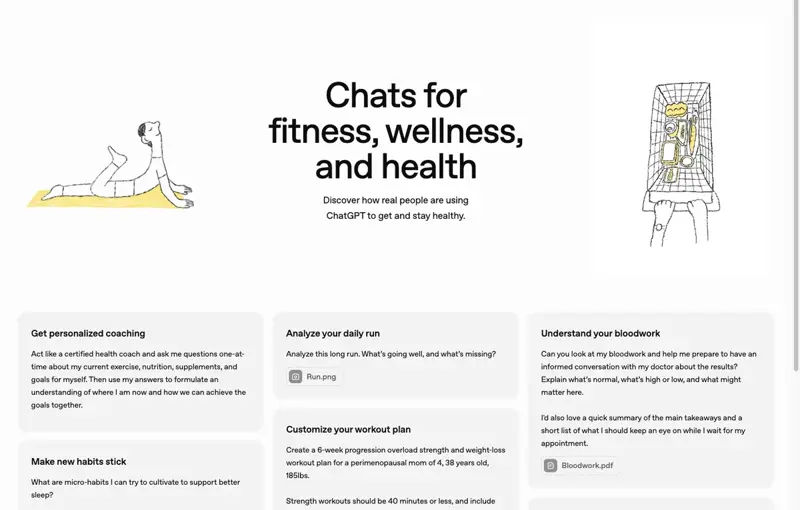
OpenAI actively promotes this: “Understand your bloodwork” and “Act like a certified health coach” are example prompts on ChatGPT’s own site. Your clients are being nudged to do exactly this. Source: OpenAI.
So they show up “pre-interpreted.” The lab panel comes with an AI story attached: what’s wrong, why, and what to change. For a personal trainer, a nutrition coach, or a wellness coach, that story is a minefield — because the moment you act on it, endorse it, or build a program around it, you may have quietly stepped from coaching into practicing medicine or dietetics without a license.
Let me draw the line clearly, because it’s the most important thing in this piece.
The line you cannot cross
Here’s the part that isn’t negotiable. Certified personal trainers and health coaches sit below registered dietitians in the credentialing hierarchy — and even registered dietitians, who train for years, generally can’t diagnose conditions or prescribe treatment without extra medical credentials. In one 2025 study of nutrition professionals, dietitians described their own ceiling plainly: their role is “meal management and nutrition screening or assessment,” while diagnosis and treatment belong to medical doctors. If a licensed RD’s scope stops short of diagnosis, yours stops well before that.
Reading a client’s AI-generated lab summary does not upgrade your credentials. You can’t informally become a diagnostician because ChatGPT handed your client a paragraph. The research on fitness professionals and nutrition is blunt about this — one 2020 study literally titled itself “A Blind Man Leads a Blind Man?” and called for the field to spell out “the professional and ethical boundaries” of what trainers do. So here’s the boundary, spelled out:
You may not: diagnose a condition, tell a client what a lab value “means” medically, prescribe a therapeutic diet for a disease, tell them to change or stop a medication, or treat anything. Not even if ChatGPT already said it. Especially not because ChatGPT said it.
You may: notice that something looks off, keep training within safe general guidelines, and — this is the valuable part — steer the client to the right professional.
The 4-step workflow that keeps you safe and useful
You don’t have to be useless here. You just have to be useful in your lane. When a client brings you AI-read labs, run this:
- Listen and look at directions, not verdicts. “Your resting heart rate has drifted up over three weeks” is a trend you can legitimately notice and factor into recovery. “You have adrenal fatigue” is a diagnosis you ignore. Focus on the movement of numbers over time, which is coaching, not the labels ChatGPT slapped on them.
- Catch red flags and take them seriously. If a client’s shared data or symptoms suggest something that could make exercise unsafe, your job is not to solve it — it’s to stop and refer for medical clearance. That’s textbook scope of practice, and it’s the single most protective habit you have.
- Turn the AI output into better questions, not answers. The genuinely helpful move: “That’s interesting — here are three questions I’d bring to your doctor about it.” You’re helping the client get more from their actual clinician instead of substituting for one. That’s coaching value ChatGPT can’t replace.
- Refer, and say why. “I’m a coach, not a doctor, so I’m not going to interpret those numbers — but your physician or a registered dietitian can, and I’ll build the training around whatever they clear you for.” Clients respect that. It signals competence, not a gap.
One more thing that’s easy to miss: client health data is sensitive, and you’re not a HIPAA-covered clinic. Don’t store screenshots of someone’s labs in your phone’s camera roll or a shared coaching spreadsheet. If a client wants to share something, look at it together and let it stay on their device.
What this means for you
If you’re a personal trainer: Your zone is movement, load, and recovery. Use trends (sleep, resting heart rate, how a client feels) to program smart. The second a conversation turns to “what does this lab value mean for my health,” you’re a referral service, and a good one.
If you’re a nutrition coach (not an RD): Be extra careful here, because nutrition is exactly where the AI feels most authoritative and is often wrong. General habits — more vegetables, more protein, more consistency — are yours. A therapeutic diet for a diagnosed condition is not. Know the difference and refer the second it crosses over.
If you’re a wellness or health coach: You’re the connector. Your superpower is helping a client organize a messy picture and walk into their doctor’s office prepared — not being the doctor. Lean into that and you become more valuable, not less.
If you run a gym or a coaching business: Make this a team policy, not a per-coach guess. A one-line standard — “we don’t interpret labs; we refer” — protects your staff, your clients, and your business. Train it in.
What ChatGPT can’t do here — and why “it said so” is dangerous
This is the part to internalize, because your clients will trust the AI more than they should. It reads confidently. That’s not the same as being right.
- On nutrition, it’s a coin flip on hard cases. Tested against clinical guidelines, ChatGPT’s dietary advice was appropriate only about 55% to 73% of the time depending on the condition — and it fell apart on people with more than one condition at once, exactly the clients who bring in labs. It even contradicted guidelines outright in some tests.
- It’s bad at the numbers. In a 2025 study estimating nutrients from meal photos, ChatGPT was off by an average of about 27%, underestimated most nutrients, and got a 100% miss on vitamin D. Against seven real dietitians, its agreement was “poor” to only “moderate.”
- On lab interpretation, it fails more than it passes on hard questions. When physicians posed lab-medicine questions, GPT-4 answered under half correctly — roughly 47% — and was flatly wrong or irrelevant on 30%. A European lab-medicine working group concluded outright that these tools “cannot be used for diagnosis.”
- It can’t see your client. It has no exam, no history it fully understands, no context for who’s in front of you. Researchers keep landing on the same conclusion: AI lab output “should not be used for diagnostic purpose or treatment advice,” and every result needs a human clinician who can weigh the whole person.
And the stakes are not hypothetical. In late July 2026, a Florida man sued OpenAI, alleging ChatGPT told him his symptoms were “not something dangerous” and to take it easy — shortly before a near-fatal pulmonary embolism. It’s an allegation the courts will weigh. But imagine that conversation happening in your gym, with your name on the program. When in doubt, the answer is always the same: refer to a human who’s licensed to say it.
The bottom line
Your clients bringing AI-read bloodwork isn’t a threat to your job — it’s a chance to be the calm, competent professional who knows exactly where their expertise ends. Use the trends, catch the red flags, sharpen their questions, and refer the medical stuff to medical people. Do that and you’re more valuable than any chatbot, because you know the one thing it doesn’t: where the line is.
Want to fold AI into your coaching business the smart way — client comms, program drafts, marketing — without wandering into risky territory? Our ChatGPT for Business course shows you where AI genuinely helps a service pro and where to keep a human firmly in charge.
Sources:
- Launching Health in ChatGPT — OpenAI
- Personal Trainer Scope of Practice — Fitness Education Online
- Is ChatGPT an Effective Tool for Providing Dietary Advice? — Nutrients (2024)
- An Evaluation of ChatGPT for Nutrient Content Estimation from Meal Photographs — Nutrients (2025)
- Quality of Answers of Generative LLMs vs Peer Patients for Interpreting Lab Test Results — arXiv/JMIR
- “A Blind Man Leads a Blind Man?” Nutrition attitudes and knowledge of fitness trainers — IJERPH (2020)
- Dietitians’ scope of practice and prescribing rights — BMJ Nutrition, Prevention & Health (2025)
- Florida man sues OpenAI over dangerous medical advice — CBS News