On July 24, Anthropic made Claude Opus 5 the default model on Claude Max — which means a lot of paying subscribers woke up talking to a different model than the one they went to sleep with. If you’ve seen the “Opus 5 is disappointing” takes flying around, most of them are coders whose custom setups broke. For everyday use, that noise doesn’t really apply to you.
Here’s the question that actually does: with four Claude models and three plans to choose from, which one should you be using? Not by benchmark scores — by what you’re actually trying to get done.
Let me make this simple. This isn’t another Opus 5 explainer (we already wrote the deep dive on Opus 5). This is the decision guide: which model, when, and whether you’re paying for the right plan.
The four Claudes, in plain English
Anthropic runs four consumer models right now. The names sound like a fantasy novel, so ignore the branding and think about them as a speed-versus-brains trade-off.
- Haiku is the fastest and cheapest. Great for quick questions and short back-and-forth. It has a smaller memory than the others, so it’s not the one for a 40-page PDF.
- Sonnet is the balanced workhorse — the one most people should live in for writing an email, drafting a plan, or doing normal research. Fast enough to feel instant, smart enough for real work.
- Opus 5 is the heavy hitter for complex, multi-step tasks: reasoning across a long messy document, untangling a thorny problem, careful analysis. As of July 24 it’s the default on the Max plan and the strongest option on Pro. It comes close to Fable-level smarts at half the price.
- Fable 5 is the frontier model — the most capable Anthropic ships publicly. It’s always thinking hard, which makes it powerful and slower. Reserve it for problems where nothing else is good enough.
The honest truth? For 80% of what a normal person does with Claude, Sonnet is plenty. You reach up to Opus when a task is genuinely hard, not by default.
When to reach for a stronger model
The instinct is “bigger is always better, so use the smartest one for everything.” That’s wasteful — slower answers, and on paid usage, more of your quota burned. The research on this is pretty consistent: a bigger model earns its keep on messy, open-ended, multi-step work. On simple lookups and quick rewrites, you won’t notice the difference.
There’s a dial for this too. Opus 5 added an “effort” setting — low, medium, high — that lets you tell it how hard to think before answering. Low is fast and cheap for routine stuff; high (the default) is for genuinely complex tasks. We won’t rehash it here because we already broke it down in our guide to Claude’s effort settings — but know that it exists, and that turning it down for simple questions saves you time.
There’s also a Fast mode that runs Opus about 2.5× quicker when you care more about a snappy reply than deep reasoning. Different lever: effort trades speed for depth, Fast mode trades cost for raw speed.
Free vs Pro vs Max: which plan?
This is where people actually overspend. The plans differ mostly in how much you can use Claude and how fast you get the newest models — not in whether you can do the basics.
| Plan | Price | Roughly who it’s for | Usage |
|---|---|---|---|
| Free | $0 | Trying Claude, light daily use | Capable everyday model, tight 5-hour rolling limit |
| Pro | $20/mo ($17 billed yearly) | Regular users, most professionals | ~5× Free’s usage, the newer stronger models, Projects, Research, tools |
| Max 5× | $100/mo | Heavy all-day users | 5× Pro’s usage, priority, Opus 5 as default |
| Max 20× | $200/mo | Power users living in Claude | 20× Pro’s usage, highest limits |
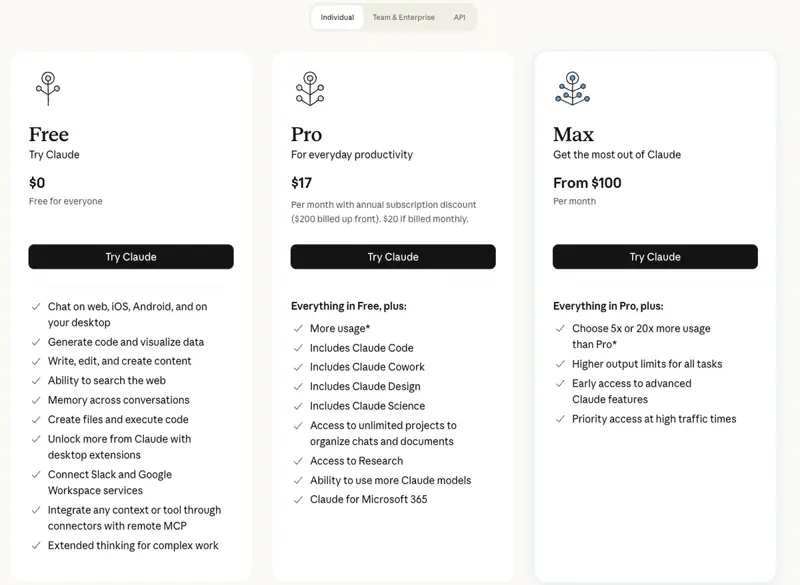
Straight from Anthropic’s pricing page: Free is $0, Pro is $17/mo billed yearly ($20 monthly), and Max starts at $100. Notice Pro’s whole pitch is “more usage” — not a different brain. Source: Anthropic.
Read that table and then read this: most people do not need Max. Anthropic markets Max at folks who “work with Claude throughout the day and want longer, uninterrupted sessions.” If that’s not you — if you dip in a few times a day to write, plan, and research — Free or Pro covers it. The jump from Free to Pro is the one that actually changes your life (5× the usage plus the good tools for twenty bucks). The jump from Pro to Max is about volume, not smarts.
A quick gut check: are you hitting usage limits and waiting for them to reset? Then Max earns its price. Are you not? Then you’re paying for headroom you’ll never touch.
What this means for you
If you’re a writer, marketer, or student: Live in Sonnet on the Pro plan. It’s fast, it’s smart enough for drafting and research, and $20 gets you enough usage to lean on it daily. Only reach for Opus when you’re wrestling something genuinely complex — a dense report, a tricky analysis.
If you mostly ask quick questions: Stay on Free. Seriously. If you’re not bumping into limits, you don’t need to pay. Try Pro for a month only if you start hitting the wall.
If you run a small business or do heavy research: Pro is your baseline; consider Max 5× only if you’re clearly maxing out your usage every day. Test Pro first for a few weeks and watch whether you actually hit the ceiling.
If you already pay for Max: You now have Opus 5 as your default — the same near-frontier smarts Fable has, at a lower tier. You don’t need to change anything. Just know that “Opus 5 is disappointing” chatter is about broken developer workflows, not your writing and research.
What this can’t tell you — the honest limits
- Benchmarks aren’t your life. Opus 5 scoring roughly 3× higher than the next model on some novel-reasoning test is real, and also irrelevant to writing an email. The “best model” is the one that fits your task, not the one that tops a leaderboard.
- The lineup changes constantly. Anthropic has shipped several models in under two months. Whatever’s “the default” today may shift again. Don’t over-invest in memorizing the current chart — invest in the habit of matching model to task.
- A confident answer isn’t a correct one. This is the big one. A 2026 study of nearly 2,000 people found most felt the AI “did most of the thinking” for them — and the people who passively accepted its answers lost confidence in their own judgment. Other 2026 research found we all overrate ourselves when using AI, regardless of how smart we are. A stronger model sounds more sure. It isn’t automatically more right. Treat every answer as a draft to check, especially for anything that matters. (More on that in our piece on whether you can trust AI.)
- More power can mean more slowness. The frontier models think longer. For a quick reply, that’s a downgrade, not an upgrade. Speed is a feature.
The bottom line
Stop asking “which Claude is best” and start asking “which Claude fits this task.” Sonnet for most things, Opus when it’s hard, Haiku when you want it now, Fable for the rare monster problem. On plans: Free if you’re light, Pro if you’re regular, Max only if you’re genuinely hitting the ceiling every day.
The real skill isn’t picking a model — it’s knowing when to trust what any of them tell you. If you want to build that instinct across every AI tool you touch, our ChatGPT vs Claude course walks you through choosing and steering the right assistant for the job.
Sources:
- Introducing Claude Opus 5 — Anthropic
- Claude models overview — Anthropic
- Claude pricing — Anthropic
- Anthropic debuts Claude Opus 5 with cost-vs-capability toggle — Fortune
- Claude Pricing in 2026: Every Plan Explained — CloudZero
- Passive AI acceptance and reasoning confidence (2026) — Technology, Mind, and Behavior, via TechXplore
- Using AI narrows the confidence gap between people (Feb 2026) — Computers in Human Behavior, via Phys.org
