

There’s a conversation you’re dreading. Asking for the raise. Pushing back on a client who keeps moving the goalposts. Telling your sister something she won’t want to hear. You’ve rehearsed it in the shower, in the car, in your head at 2am — and it still comes out wrong when it counts.
As of July 23, you can rehearse it out loud instead, with something that talks back and then tells you how you came across. Anthropic upgraded Claude’s Voice Mode so you can practice a real conversation, get feedback on your tone and clarity, and run it again before it matters for real. It’s free to try.
Now, honest framing up front: this is a genuinely useful capability, and the demand for it is still early. Not many people know it exists yet. So think of this as a head start, not a bandwagon.
What just changed
Claude has had a voice mode since 2025, but it was limited — it ran on the small, fast Haiku model, good for quick chatter but not for a nuanced back-and-forth. The July 23 update fixed that. Voice conversations can now run on the bigger Sonnet and Opus models, which means Claude can actually hold up its end of a complicated, emotional, multi-turn talk.
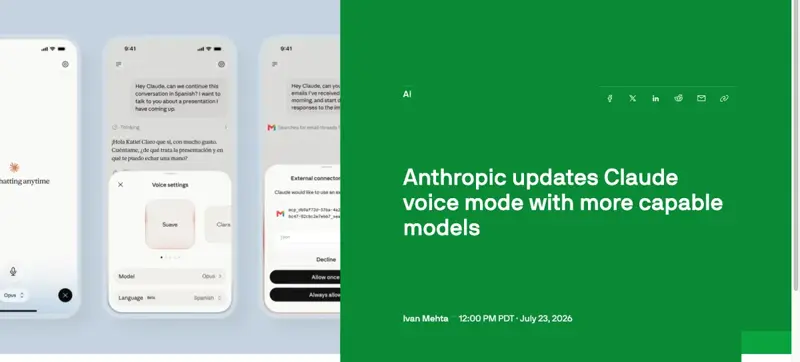
The upgraded Voice Mode lets you pick a voice and a model (Opus, Sonnet, or Haiku) and pull in connected apps mid-conversation. Source: TechCrunch, image credit Anthropic.
A few things worth knowing:
- It’s turn-based. You speak, it waits, then it replies. No talking over each other. That’s fine for practice — it feels like a phone call with someone patient.
- It’s free to try. Voice Mode is in beta on every plan, including Free. Free users get the Haiku model and can connect one outside app; paid users get the smarter models and more connections.
- It can pull in your stuff. With permission, it reaches connected tools like Gmail, Google Calendar, Google Docs, and Slack — handy if you want it to prep you using a real email thread or calendar.
- It speaks about eleven languages, though the non-English ones are still labeled beta, and you have to switch languages manually.
The headline feature for our purposes is the one that’s easy to skim past: it can give you feedback on how you communicate, and it can role-play a person you need to talk to.
How to actually use it to practice
The trick is to set the scene, play it out, and then ask for the feedback. Most people do the first two and skip the third — which is the whole point.
Here’s a setup you can copy, out loud, word for word:
“I want to practice asking my manager for a raise. You play my manager — you’re a little skeptical and worried about budget. Push back on me realistically. After we’re done, tell me where I sounded unsure, where I rambled, and where I was convincing.”
Then just… have the conversation. Let it push back. Fumble it. Recover. When you’re done, it’ll walk you through where your voice wavered, where you over-explained, where you buried the ask under three sentences of apology. Fix one thing. Run it again. That second pass is where the magic is — you’ve already heard yourself do it badly once, in private, where it’s free.
It works for a lot of dreaded talks: a job interview, a hard client call, a pitch, a tricky family conversation, even a toast you don’t want to flub.
Does practicing with AI actually work?
Fair question. And the research is more encouraging than you’d guess — with one big caveat we’ll get to.
The strongest evidence is in interview prep. A virtual-agent interview trainer has been through several randomized trials, and people who used it measurably improved their interview performance and their confidence, and cut their interview anxiety, compared to people who prepped the usual way. In one program, half the people who added the AI practice landed a competitive job within six months — versus about one in eight who didn’t.
There’s a fascinating wrinkle from a 2026 study on language speaking exams: people were noticeably less anxious rehearsing with an AI than with a human. The AI didn’t make them smarter — it removed the fear that was tanking their performance. That’s exactly what a private rehearsal is for. You get to be bad, out loud, with zero social cost, until you’re not bad anymore.
What this means for you
If you’re job hunting: This is the clearest win. Run mock interviews out loud, ask it to grade your filler words and how clearly you answered, and do it until the nerves drain out. The research on interview practice is real, and this is a free version of it.
If you’re a manager or team lead: Rehearse the conversations you avoid — the performance talk, the “we’re not doing your idea” message, the layoff you have to deliver with care. Hearing yourself say hard things once, in private, makes the real version steadier.
If English isn’t your first language: Practicing speaking with an AI can take the edge off the anxiety that trips you up with a live audience. Switch it to your target language and rehearse the meeting before the meeting.
If you just hate confrontation: Use it for the personal stuff too — the boundary you need to set, the apology you owe. It won’t judge you, and you can restart as many times as you need.
What it can’t do — and the honest limits
Here’s the caveat. This is a rehearsal partner, not a coach who knows you.
- It’s good at the measurable stuff, weaker at the human stuff. Research on AI communication feedback is consistent: it nails the objective metrics — filler words, pace, whether you rambled — but struggles with the higher-level read, like whether you were reading the room or whether your delivery felt authentically you. It also tends to hammer your weaknesses instead of building on your strengths, which a good human coach would do.
- It doesn’t know your actual manager. It’s role-playing a generic skeptic, not the specific person with the specific history you have with them. Real conversations have context the AI can’t see.
- It can nudge you toward a flat, generic style. Because it optimizes for “correct,” AI feedback can quietly push everyone toward the same polished, personality-free delivery. Keep your voice. If its feedback would make you sound like a robot, ignore it.
- Leaning on it too hard can backfire. A 2026 study found people who relied heavily on AI got worse at the underlying skill over a few weeks — while about a quarter of them thought they were getting better. Use it to rehearse, then go have real conversations with real humans. The practice is the warm-up, not the game.
On privacy, since it’s your voice: Anthropic says dictation audio is turned into text and then deleted, and it limits you to a few preset voices specifically to stop voice cloning. The transcript of your practice gets saved to your chat history like any other conversation — so if you rehearsed something sensitive, delete the chat after.
The bottom line
The conversation you’re dreading gets easier the second and third time you have it — the problem has always been that the first time is the real one. Claude’s Voice Mode gives you a free, private, judgment-free first draft. Use it to hear yourself, fix one thing, and walk in steadier. Just don’t mistake the rehearsal for the skill: the goal is to go have the real conversation, better.
Want to get genuinely good at putting AI to work like this across your whole week — not just the scary conversations? Our Become AI Fluent course turns “I heard you can do that” into things you actually do.
Sources:
- Anthropic updates Claude voice mode with more capable models — TechCrunch
- Use voice mode — Claude Help Center
- Claude’s voice mode just got smarter — Engadget
- Virtual Reality Job Interview Training outcomes (randomized trials) — PMC / NIMH
- AI- vs human-facilitated speaking exams and anxiety (2026) — PMC
- Expert perspectives on AI-assisted public-speaking feedback (2025) — arXiv
- Heavy AI reliance and skill decline (April 2026) — The Guardian, on an MIT study