

It’s the first week of September, and somewhere in your building there’s a stack of physician’s orders on your desk that weren’t there in June. A new kindergartner with a peanut allergy. A fourth grader whose seizure protocol just changed. A transfer student with type 1 diabetes and a carb-ratio nobody’s written down yet. Every one of them needs an Individualized Healthcare Plan before you can promise a classroom teacher that you’ve got it handled — and right now, the honest answer is that you’re building each one from a blank template, a stack of past-years’ PDFs, and whatever’s still in your head from last May.
This is the one week of the year where school nursing workload peaks hardest, and it’s also the first September where a genuinely useful AI drafting workflow exists for it — if you know the one rule that keeps it safe. That rule is simple: de-identify before you paste anything. Strip the name, the room number, the birthdate, everything that could point back to a specific kid, before a single word touches ChatGPT, Claude, or Gemini. Do that, and you can turn a physician’s order into a structured first-draft IHP in about ten minutes instead of the better part of an hour. Skip it, and you’ve created a FERPA problem you didn’t need.
What an IHP actually is (and why AI can only draft, never decide)
An Individualized Healthcare Plan is the document you already know cold: the nursing-process write-up — assessment, nursing diagnosis, goals, interventions, expected outcomes — that turns a physician’s order into something a classroom teacher, a substitute, and a front-office aide can actually follow during the school day. The National Association of School Nurses’ own position statement on IHPs is explicit about who owns that document: the school nurse is the sole professional qualified to develop, implement, evaluate, and update IHPs. Not the pediatrician’s office, not the district’s EHR vendor, not a chatbot. You develop it in collaboration with the family, the student when appropriate, and the treating clinician — but the clinical judgment inside it is yours, full stop.
That’s the frame for everything below. AI doesn’t write IHPs. It writes first drafts of the parts you’d otherwise be typing from scratch — the boilerplate sections, the plain-English summary for the classroom teacher, the structure that matches your district’s format — so the ten or fifteen minutes you’d spend formatting go instead into the two or three minutes that actually require your judgment: does this interaction make clinical sense, did I miss a step, would I sign this.
NASN’s guidance breaks a proper IHP into the same nursing-process structure you learned in school and use every day, whether or not you’ve ever written it out this formally: assessment, nursing diagnosis, goals, nursing interventions, and expected outcomes/evaluation — the ADPIE framework applied to a specific student’s health need. The purpose, per NASN’s own position statement, is fivefold: document standards of school nursing practice, document the nursing process itself, support evidence-based management of the condition, spell out exactly what non-nursing school staff need to know and do to support the student’s access to their education, and prepare everyone in the building for a prompt, correct response if something goes wrong. That last point is why the Emergency Action Plan section carries so much weight — it’s often the only part of the IHP a classroom teacher or paraprofessional will ever actually read closely.
One more thing worth knowing before you start: NASN itself has been moving away from a pure headcount-based caseload ratio toward what it calls a workload model — one that accounts for medical complexity, safety risk, and the time a nurse actually spends per student, not just the raw number enrolled. The old benchmark ratios (roughly 1 nurse per 750 general-population students, tightening to 1:225 for students needing daily interventions, 1:125 for complex needs, and as low as 1:1 for a student who needs continuous nursing care) were set in the 1970s and NASN itself now says the research base behind them is thin. What isn’t thin is the reality on the ground: more than half of surveyed school nurses report managing fewer than 750 students, which — read the other way — means a substantial share are managing more, often while also covering a second building. If that’s your September, the time math in this workflow isn’t a nice-to-have. It’s the difference between finishing your new IHPs by Friday or by Columbus Day.
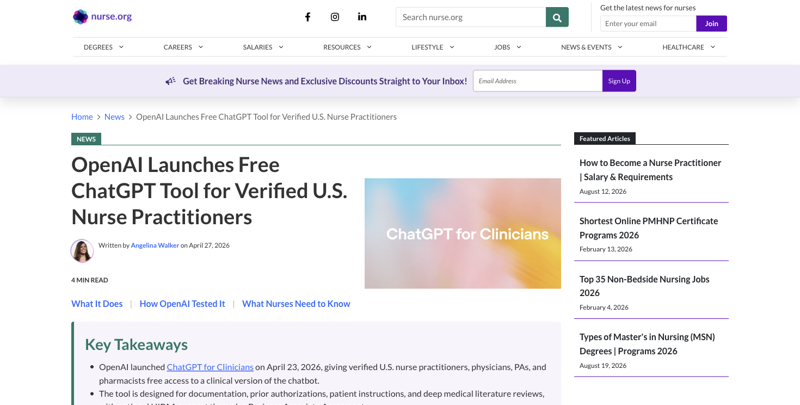
You may have heard that OpenAI launched something called ChatGPT for Clinicians on April 23, 2026 — a free clinical version of ChatGPT for verified U.S. nurse practitioners, physicians, PAs, and pharmacists, built for documentation, prior authorizations, and cited medical-literature review. It’s a real tool and it’s worth knowing about, but two things matter for a school nurse specifically. First, its verification path is built around NP/physician/PA/pharmacist license types — most school nurses (RNs, not NPs) won’t clear that gate, so this isn’t the tool this workflow depends on. Second, and more important: even for the clinicians it does verify, HIPAA compliance is optional, gated behind a Business Associate Agreement your employer has to sign — without it, pasting real patient identifiers into the tool is not HIPAA-compliant, full stop. The de-identify-first workflow below sidesteps that problem entirely by never putting a real name, birthdate, or student ID into any AI tool in the first place — consumer or clinician-tier, BAA or no BAA.
Why now: the SERP for this is a wall of blank government PDFs
Search “individualized healthcare plan template” right now and you’ll land on a state department of education page, a district’s PDF, or a $3 Teachers Pay Teachers download. Every one of them gives you a blank form. Not one of them shows you how to fill it faster.
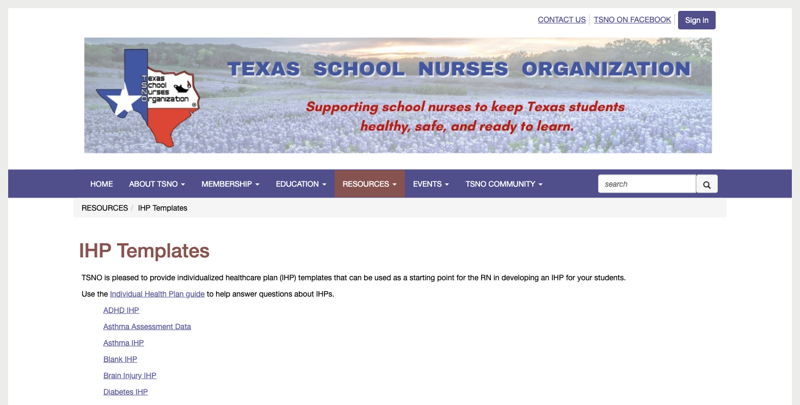
That’s the gap this workflow fills — not a new template, but a faster, safer way to fill the one your district already uses. And it’s worth saying plainly: this is genuinely underused ground right now. We ran a search of X/Twitter conversation from school nurses and school-health staff across all of August 2026 — the exact month back-to-school IHP season peaks — and found essentially no one talking about using AI to draft these plans, and zero posts raising FERPA concerns about it either way. Nobody’s built the habit yet, good or bad. That means you’re not late to a trend; you’re early to a workflow that’s about to become normal, and the way you set it up now is the way you’ll still be doing it in three years.
The 5-step workflow: doctor’s order to signed IHP
Step 1 — De-identify the order before it touches any screen
Take the physician’s order and strip every direct identifier: full name, date of birth, student ID number, room or homeroom number, parent’s name, home address. Replace the name with a placeholder like “Student A” or “the student.” This part trips people up more than it should — de-identifying isn’t just deleting the name at the top. An order that says “the new transfer student who moved from the district’s only bilingual elementary program” still identifies the kid to anyone in your building, even with the name gone. The FERPA-safe standard is: after de-identification, could a staff member reading this reasonably guess who it’s about? If yes, strip more. Keep the diagnosis, the medication and dose, the frequency, the emergency protocol, and any allergy or trigger information — none of that identifies a specific student on its own.
Step 2 — Paste the de-identified order into your AI drafting prompt
Open ChatGPT, Claude, or Gemini — the free or Plus tier is fine for this step, because there’s no PHI in what you’re pasting. Use a prompt structured like this:
I'm a school nurse. I'm going to paste a de-identified physician's order
(no student name, ID, or other identifiers — just diagnosis, medication,
dose, frequency, and any protocol details). Turn it into a first-draft
Individualized Healthcare Plan using this structure: Assessment, Nursing
Diagnosis, Goals, Nursing Interventions, Expected Outcomes, and an
Emergency Action Plan section. Use "the student" throughout — do not
invent a name. Flag anything in the order that seems incomplete or that
you'd want a nurse to double-check before finalizing.

De-identified order:
[paste here]
That last line — “flag anything incomplete” — matters more than it looks. Physician’s orders are frequently missing a piece a school-specific IHP needs (a weight-based dose range instead of an exact mg amount, no mention of what happens if a second dose is needed). Asking the model to flag gaps instead of silently filling them is what keeps this a draft-assist tool instead of a hallucination risk.
Step 3 — Worked example: a 4th-grader with a new type 1 diabetes diagnosis
Here’s the full loop with a realistic (fully de-identified) order:
De-identified input:
“Student A, age 9, new diagnosis type 1 diabetes mellitus. Insulin pump, target BG 80-150 mg/dL. Check BG before lunch and before any PE activity. Treat hypoglycemia (BG under 70) with 15g fast-acting carbs, recheck in 15 min. Treat hyperglycemia (BG over 300) per pump bolus calculator; contact parent if BG over 300 twice in one day or ketones present. Student is pump-independent for boluses but needs adult supervision for site checks.”
AI first-draft output (abbreviated):
Assessment: The student has a new diagnosis of type 1 diabetes mellitus, managed via insulin pump. Requires blood glucose (BG) monitoring at scheduled times and is at risk for both hypoglycemic and hyperglycemic episodes during the school day.
Nursing Diagnosis: Risk for unstable blood glucose level related to new-onset type 1 diabetes and insulin pump therapy.
Goals: The student will maintain BG within target range (80-150 mg/dL) during school hours; hypoglycemic and hyperglycemic episodes will be identified and treated promptly per protocol.
Nursing Interventions: Check BG before lunch and before PE. Supervise insulin pump site checks. Maintain fast-acting carbohydrate supply in health office. [Flagged: order does not specify who performs BG checks if student is absent from health office at scheduled time — confirm with parent/physician whether student self-checks in classroom.]
Emergency Action Plan: If BG < 70: administer 15g fast-acting carbs, recheck in 15 minutes, repeat if still low, notify parent. If BG > 300 twice in one day or ketones present: contact parent immediately, follow pump bolus calculator per physician order. [Flagged: no ketone-testing supplies or frequency specified in the order — confirm whether ketone strips are provided and when to test.]
Notice what happened: the draft is structurally complete and clinically reasonable, and it caught two real gaps in the sample order (who supervises a mid-class BG check, and ketone-testing supplies) that you’d otherwise have to spot yourself on a re-read. That’s the actual value — not replacing your judgment, but giving your judgment a complete, correctly-formatted draft to react to instead of a blank page.
A second worked example, condensed — severe food allergy:
De-identified input: “Student B, age 6, diagnosed severe peanut and tree nut allergy, history of anaphylaxis. Carries EpiPen Jr (0.15mg), two doses available in health office, one in classroom go-bag. Symptoms of concern: hives, facial swelling, difficulty breathing, vomiting. Avoid all peanut/tree nut products in classroom; cafeteria to provide allergen-free seating option.”
AI first-draft output (abbreviated): Assessment notes the diagnosed severe allergy and anaphylaxis history. Nursing diagnosis centers on risk for anaphylactic reaction related to accidental allergen exposure. Goals target zero exposure incidents and rapid, correct EpiPen administration if exposure occurs. Interventions cover classroom allergen-avoidance protocol, cafeteria coordination, and staff training on recognizing early symptoms. The Emergency Action Plan lists the exact epinephrine dose, the two-dose location split (health office plus classroom go-bag), and step-by-step anaphylaxis response — and flags that the order doesn’t specify whether a second EpiPen dose is authorized if symptoms don’t improve after the first, which is a standard field on most state EAP forms. That’s the pattern worth trusting: a well-formed draft, plus an honest flag on the one detail a rushed re-read might miss.
Both examples share something worth noticing: the AI consistently flags procedural gaps (who does what, when, with what supplies) rather than inventing clinical specifics it wasn’t given. That’s the behavior the prompt in Step 2 is designed to produce — and it’s worth spot-checking on your own first few drafts before you trust it as a pattern.
Step 4 — Drop it into your district’s actual template and add the student’s real information
This is the step every AI-skeptical nurse should notice: the student’s real name, ID, and identifying details never left your device and never touched the AI tool. You copy the de-identified draft into your district’s real IHP template (Word, PDF form, or your student information system’s care-plan module) and fill in the actual name and identifiers there, locally, exactly like you would have without AI involved.
Step 5 — Verify, edit, and sign
Run the same four-question check you’d run on anything a colleague drafted for you: Did the AI add any clinical detail that wasn’t in the original order? Does every dose, timing, and threshold match the physician’s order exactly? Are the flagged gaps resolved — did you call the parent or the prescriber to fill them in? Would you be comfortable if this IHP were pulled for a state audit tomorrow? Only once you can answer yes to all four does it get your signature. The IHP isn’t valid, useful, or legally yours until you’ve done that — AI drafts, you decide.
AI-assisted drafting vs. your other options
| Approach | Time per IHP | Cost | FERPA/HIPAA risk | Who’s actually accountable |
|---|---|---|---|---|
| Blank template, typed from scratch | 45–75 min | Free | None (no third party involved) | You, entirely |
| Copy last year’s IHP for a similar condition | 20–30 min | Free | Low, but risks stale/wrong details carrying over | You, but easy to miss what changed |
| De-identify-first AI draft (this workflow) | 10–15 min | Free (consumer ChatGPT/Claude/Gemini) | Low — no PHI ever leaves your device | You — AI never touches the decision |
| ChatGPT for Clinicians (with BAA) | 10–15 min | Free tool; BAA is a district-level agreement | Compliant only if your district signs the BAA | You, plus a district compliance step first |
| Paid AI charting/EHR-integrated tool (e.g., ambient scribes marketed to clinics) | 10–15 min | $30–150+/month, usually enterprise-priced | Vendor-dependent; built for clinics, not K-12 SIS workflows | You, plus a vendor contract most districts haven’t signed |
| Outsourcing to a paid IHP-writing service | Varies | $15–40 per plan (where these exist) | Depends entirely on vendor’s data handling | Shared — and you still have to verify it |
The de-identify-first row is the one most school nurses can start using today, with zero procurement process, zero new vendor contract, and zero PHI exposure — which is exactly why it’s the practical default until (if ever) your district signs a BAA with a clinician-grade tool.
Worth noting: IHP format and requirements vary by state and sometimes by district — Colorado, for instance, publishes standardized care-plan templates for the four most common chronic conditions (asthma, allergy, seizures, diabetes) through its Department of Education, while other states leave the exact format to district discretion. That variance is precisely why a generic AI draft is a starting point, not a finished document — the structure this workflow produces (assessment, diagnosis, goals, interventions, EAP) maps onto nearly every state’s format, but the exact fields, checkboxes, and required signatures still need to match what your state and district actually require. Five minutes checking your draft against your official template is time well spent before anything goes to a parent or a file.
What this means for you
If you’re a new school nurse in your first September: Start here before you’ve built up a personal library of past IHPs to copy from. This workflow gives you a structurally sound first draft on day one instead of hunting through a shared drive for something close enough to adapt.
If you’re a per-diem or substitute school nurse: You’re walking into a building without the context a full-time nurse has built up over a year. A de-identified order plus this workflow gets you to a competent first draft fast, without needing to lean on incomplete notes left by whoever you’re covering for.
If you’re a veteran nurse who’s skeptical of AI in a clinical setting: Fair — and the workflow is built around that skepticism. The AI never sees a real student, never makes a clinical call, and every output is flagged for your review before anything gets signed. Try it on one low-stakes plan (an asthma action plan for a stable, well-controlled student) before trusting it with anything higher-acuity.
If you’re covering multiple schools or a whole district as the only RN: This is where the time savings compound hardest. Fifteen minutes saved per IHP across twenty new plans in September is five hours back — five hours you can spend on the kids whose plans actually need extra attention, not on reformatting boilerplate.
If you’re also your building’s 504 coordinator: IHPs and 504 plans are different documents with different legal frameworks, but the same de-identify-first prompting approach works for drafting the health-management sections of a 504 plan — just don’t let the AI draft the legal/accommodations language, which isn’t a nursing document and isn’t what this workflow is built for.
If you’re a school administrator or principal: The FERPA risk in your building isn’t a hypothetical — it’s whether your staff have a safe default before they improvise one under September pressure. Point your nurse to this workflow, and separately, ask your compliance office whether a district-level AI tool agreement (with a signed DPA) is worth pursuing for next year.
If you’re a district health services director: This workflow is a bridge, not a destination. It’s what your nurses can do safely today with zero procurement lead time. If you’re evaluating a BAA-covered clinical AI tool for next year, this same de-identify-first discipline should be the fallback your nurses use for every tool you haven’t yet signed a DPA for.
Edge cases and troubleshooting
The parent forwards a photo of a handwritten order that’s hard to read. Type out what you can read with confidence, mark anything ambiguous as [illegible — confirm], and paste the typed version — never the photo itself, since a photo of a real document is much harder to reliably de-identify (letterhead, clinic stamps, and handwriting can all carry identifying detail).
The AI invents a dosage or detail that wasn’t in your original order. This is the single most important thing to catch, and it will happen occasionally — models fill gaps confidently. That’s exactly why Step 5’s “did it add anything I didn’t write” check is non-negotiable, not optional.
A new order conflicts with an existing IEP or 504 plan for the same student. The AI can’t reconcile that for you — it doesn’t have access to (and shouldn’t be given) the other document. Flag the conflict yourself and loop in the case manager; this is a judgment call, not a drafting task.
You’re covering a student with multiple conditions at once (diabetes plus a seizure disorder, say). Run each condition through the workflow as a separate de-identified pass, then combine the outputs yourself into one IHP. Asking the AI to hold two complex conditions in one prompt increases the odds it blends details incorrectly.
The family’s home language isn’t English, and you need a parent-facing summary. Draft the IHP in English first using this workflow, then run a separate translation pass on the already-verified, de-identified plain-English summary — never translate and draft in the same step, since that doubles the chance of an error slipping through unnoticed.
A substitute nurse is covering without access to your usual documentation history. The de-identify-first workflow is actually easier for a sub to use safely than digging through unfamiliar files, precisely because it doesn’t depend on institutional memory — just the physician’s order in hand.
You’re not sure whether something counts as “identifying” enough to strip. When in doubt, strip it. A slower, over-cautious de-identification pass costs you thirty extra seconds. An under-cautious one costs you a FERPA incident.
Your district’s IT or compliance office says AI tools are banned outright. Respect that policy — this workflow assumes your district allows AI use with appropriate safeguards. If yours doesn’t yet, that’s a conversation to have with your health services director, not a rule to work around.
You’re drafting an IHP for a condition you’ve never personally managed before (a rare metabolic disorder, an unusual seizure protocol). The AI draft can still give you a reasonable structural starting point, but this is exactly the situation where you should loop in the prescribing specialist directly rather than leaning on the AI’s general medical knowledge to fill gaps — ask the physician’s office to clarify anything the order doesn’t spell out, rather than letting the model infer it.
Your union or professional association has a stance on AI use in documentation you’re not sure about. Check with them before making this routine — some districts and unions have negotiated specific language about AI tools and student data that supersedes general guidance like this. When in doubt, ask first.
What this can’t do
It can’t replace your clinical judgment or your signature. Every IHP a school nurse signs is a professional attestation. AI drafts language; it doesn’t make the clinical call, and it never will under this workflow.
It can’t verify anything with the parent or the prescribing physician. If the order is ambiguous or incomplete, the AI can flag that — but only you can pick up the phone and close the gap.
It doesn’t know your district’s exact IHP template or state-specific requirements unless you tell it. Some states mandate specific IHP language or formats; the AI draft is a generic best-practice structure, and matching it to your district’s exact form is still on you.
It can hallucinate a plausible-sounding but wrong medical detail. This is the sharpest edge of the tool. A confidently wrong dosage or threshold reads exactly like a correct one until you check it against the source order.
It’s not a substitute for a signed BAA if you’re working with real patient data anywhere in the process. This entire workflow only stays safe because real student identifiers never touch the AI tool. The moment that changes — even by accident — the compliance picture changes with it.
FAQ
Is it legal to use ChatGPT or Claude to help write an IHP? Yes, as long as no personally identifiable student information is included in what you paste. Consumer-tier ChatGPT, Claude, and Gemini accounts don’t meet FERPA’s “school official” exception requirements — no data-processing agreement, no contractual restriction on model training — so PHI or PII should never go into them directly. De-identifying first is what makes this legal and safe.
Does “de-identifying” just mean removing the student’s name? No — and this is the most common mistake. You need to remove or generalize anything that could let a reader identify the student by context: unusual circumstances, specific dates tied to a single enrollment event, or combinations of details (age plus rare diagnosis plus grade) that narrow it down to one kid in a small school.
Can I use ChatGPT for Clinicians for this instead? Only if your district has signed a Business Associate Agreement with OpenAI for it, and even then, most school nurses (RNs) won’t clear the tool’s verification gate, which is built around NP, physician, PA, and pharmacist license types. For most school nurses, the de-identify-first consumer-tool workflow is the more realistic option right now.
What’s the difference between an IHP and an Emergency Care Plan / Emergency Action Plan? An IHP is the full nursing-process document covering ongoing management of a condition. An Emergency Care Plan (sometimes called an Emergency Action Plan) is the shorter, urgent-response subset — what to do right now if the student has a reaction, seizure, or acute episode. Most IHPs include an EAP section; some conditions (like a well-controlled food allergy with no other daily management needs) may only need a standalone EAP.
Should I paste the student’s actual physician order verbatim, minus just the name? Not quite — go further. Strip the name, DOB, student ID, home address, parent name, and any date that’s uniquely tied to a specific enrollment or incident. Keep the clinical content: diagnosis, medication, dose, frequency, and protocol details.
What if the AI’s draft uses medical terminology or a format that doesn’t match my state’s requirements? Treat the AI draft as a structural starting point, not a final answer. Cross-check it against your state’s IHP guidance and your district’s required template before it goes anywhere near a signature.
Is there a NASN-endorsed AI tool for this? Not as of this writing. NASN’s position statements govern IHP content and the nurse’s professional accountability for them — they don’t currently name or endorse a specific AI drafting tool. This workflow is built to stay compliant with NASN’s core principle (you’re the sole professional who develops and owns the plan) regardless of which AI tool you use.
How is this different from just using a template library? A template library gives you a blank form for a condition category. This workflow gives you a filled-in first draft based on the actual physician’s order in front of you — closer to the real document you need, faster, without a search through last year’s files.
My school nurse-to-student ratio is way above the NASN-recommended 1:750. Does this actually save meaningful time? More than half of surveyed school nurses report ratios that already exceed 750 students, and NASN itself has moved from a simple ratio model to a broader “workload” model that accounts for medical complexity, not just headcount. If you’re managing IHPs for a caseload that size, ten minutes saved per plan across dozens of new plans in September adds up to real hours — hours that go straight back into higher-acuity care.
The bottom line
The safest AI workflow in school nursing this year isn’t the flashiest one — it’s the one where real student data never leaves your hands. De-identify first, let AI draft the structure, verify every clinical detail against the actual order, and sign only what you’d stand behind without the AI in the room. That’s not a shortcut around your professional judgment. It’s a way to spend less of your September typing boilerplate and more of it actually looking at the kids who need you.
If you want the full routine — the exact prompts, a printable verify-before-sign checklist, and condition-specific templates for diabetes, severe allergies, asthma, and seizure disorders — FindSkill’s AI for Nurses course walks through the whole ANA-aligned framework this workflow is built on, in about an hour.
Sources
- National Association of School Nurses — Position Statement: Individualized Healthcare Plans
- National Association of School Nurses — Position Statement: School Nurse Workload
- Nurse.org — “OpenAI Launches Free ChatGPT Tool for Verified U.S. Nurse Practitioners”
- FierceHealthcare — “OpenAI launches ChatGPT for Clinicians, a free AI tool for physicians, NPs and…”
- TechTarget — “OpenAI launches ChatGPT for Clinicians”
- Texas School Nurses Organization — IHP Templates
- Montana DPHHS — Individualized Healthcare Plans and Emergency Care Plans
- Sonomos — “FERPA and AI: Can Schools and EdTech Use ChatGPT With Student Data? (2026 Guide)”
- PubMed — “Individualized Healthcare Plans: A School Nurse Primer”
- Seton Hall University — “Nursing Professor’s Study Calls into Question Standard Caseload Ratios”
- PMC — “Reported impact of COVID-19 workload and stressors on school nurses”
- Grok/X research: August 2026 X search across 20+ targeted queries (school nurse + IHP/504/EAP + AI/ChatGPT/FERPA terms), confirming no measurable community discussion connecting AI drafting tools to school-nurse care-plan workflows as of this writing