On September 16, 2026, OpenAI turned ChatGPT ads into something you can talk back to. Click on an ad inside ChatGPT now, and instead of just landing on a website, you can open a separate, clearly-labeled conversation with an AI agent representing that business — ask it questions, get answers, and decide whether to click through when you’re ready. If you run a small business and you’ve been wondering whether this new “ChatGPT ads” thing is worth your marketing budget, here’s the honest answer, built from what OpenAI has actually published, what early advertisers have actually reported, and what’s still genuinely unknown.
What Just Changed
OpenAI’s announcement bundled three things together: Sponsored Agents (the conversational ad format itself, currently a test with a limited group of US advertisers), a natural-language Ads Manager that lets you build and manage campaigns by describing what you want in plain English, and same-day integrations with Shopify and HubSpot that plug ChatGPT Ads directly into tools small businesses already use. Angi, the home-services marketplace, is the first named brand piloting the Sponsored Agent format — a homeowner describing a leaky faucet in ChatGPT can now be routed into a labeled conversation with an Angi-branded agent that helps them describe the job and connects them to a local pro.
Here’s how OpenAI itself frames the mechanics, using its own example: a shopper sees an ad for a dining table, and instead of just clicking through blind, they can ask the sponsored agent whether it fits their space, how many people it seats, or what kind of care it needs — all before deciding to visit the retailer’s site. The conversation is explicitly labeled as a business-sponsored agent and kept separate from ChatGPT’s own independent answer and from your original conversation thread. That separation is a deliberate design choice OpenAI has publicly committed to, and it’s the detail every serious industry analysis of the launch keeps coming back to: the user is meant to always know when they’ve switched from “ChatGPT talking” to “the brand’s agent talking.”
Reactions on launch day ranged from genuinely curious to sharply skeptical. One widely-shared post captured the shift in one line: “ads are going from ‘click here’ to ’talk to me.’” A more pointed take argued the business logic underneath it plainly: “ChatGPT launching Sponsored Agents proves subscription ARR alone cannot cover massive LLM inference costs… selling user intent to the highest-bidding agent is the only way to fund the inference layer.” Whether or not you buy that framing, it’s a useful lens for understanding why this exists — running models at ChatGPT’s scale is expensive, and advertising is the same lever every major consumer tech platform eventually pulls.
What Sponsored Agents Actually Are (And Aren’t)
It’s worth being precise here, because a lot of early coverage blurs the line between “there’s an ad” and “the ad is an AI agent.” Based on OpenAI’s own materials and independent reporting:
- The trigger: A relevant ad appears in a ChatGPT conversation. The user is not automatically dropped into an advertiser chat — they choose to engage.
- The disclosure: The resulting conversation is clearly labeled as being with a business-sponsored agent, distinct from ChatGPT’s own answer.
- The separation: It opens as its own thread, separate from your original conversation and from ChatGPT’s independent response to your actual question.
- The endpoint: After going back and forth with the agent, you can follow a link to the business’s website to actually complete a purchase, booking, or lead form — the agent itself isn’t necessarily a full checkout flow.
- What’s still undisclosed: OpenAI hasn’t published which model or provider powers each Sponsored Agent, what data (if any) about the conversation is shared with the advertiser, how the interaction is priced or measured, or the exact eligibility rules for which ads can become agent conversations. Treat those as open questions, not settled facts, until OpenAI documents them explicitly.
One sharp piece of industry commentary from ad-tech analyst Eric Seufert put a useful frame on the trust question: once a conversation has visibly become a Sponsored Agent, “the user should no longer expect an unbiased, objective response from the chatbot — because the user is now interacting with a clearly identified, branded agent.” In other words, the labeling isn’t just a legal formality — it’s the entire mechanism by which OpenAI is trying to keep people from feeling tricked.
What It Actually Costs: The Real Pricing History
This is where a small-business owner needs a timeline, not a headline number, because “ChatGPT ads pricing” has moved dramatically in less than a year.
- February 2026 — launch era. ChatGPT Ads first rolled out at a reported $60 CPM (cost per thousand impressions) with a roughly $200,000 minimum upfront commitment — effectively enterprise-only, with proposals reported in the $100,000–$250,000 range.
- April 13, 2026 — first cut. The minimum spend dropped to $50,000, per multiple industry trackers.
- May 5, 2026 — self-serve opens up. OpenAI removed the minimum spend entirely and opened self-serve Ads Manager access to all US advertisers.
- Since then — reported market pricing. Multiple trade sources now cite CPC (cost per click) in the roughly $3–$5 range for typical e-commerce use, with a wider observed spread from under $2 to around $18 for higher-cost categories like software and finance. CPM estimates have reportedly settled lower too, with some sources citing a range from $25 up to the original $60 depending on targeting and vertical.
The important caveat: none of those post-launch numbers come from an official OpenAI rate card. OpenAI’s own September 16 announcement does not publish a current price, bidding method, or minimum spend for Sponsored Agents specifically — everything above is third-party reporting, aggregated from multiple trade-press sources and advertiser self-reports, not a page you can go bookmark on openai.com. Treat it as a reasonable planning range, not a guarantee of what you’ll pay.
One Real, Documented Test Result
The most useful data point currently public is a single 15-day advertiser test that reported a $1.72 CPC, a 2.35% conversion rate, and a 1.49x blended return on ad spend — with daily ROAS swinging widely, from as low as 0.2x to as high as 2.9x on individual days. That’s one advertiser, one campaign, one 15-day window — not proof the channel will perform that way for your business, but a real, concrete example of what “a decent day” and “a bad day” can look like on this platform right now.
Two other real, small-scale tests reported publicly around launch: one marketer ran a test that generated 97,131 impressions and 1,263 clicks at a $3.16 CPC, but converted “almost no sign-ups” — and said the tool at least explained why, and what they’d change next time. Another founder testing ads for a SaaS product spent about €25, got zero trials and zero signups, and concluded ChatGPT ads currently show only to users on free or the cheapest paid tier — a pool he guessed skews poorly for subscription software, “might work better for ecommerce.” Both are honest, small, real-world data points worth weighing against the more polished 1.49x ROAS test above — early advertiser results on this channel are clearly a mixed bag so far, not a guaranteed win.
The Shopify and HubSpot Integrations: Why They Matter More Than the Ad Format
For most small businesses, the Shopify and HubSpot pieces of this launch are arguably more immediately useful than the Sponsored Agent format itself, because they solve the two most common blockers that keep small merchants from testing any new ad channel: getting your product data in, and getting resulting leads out.
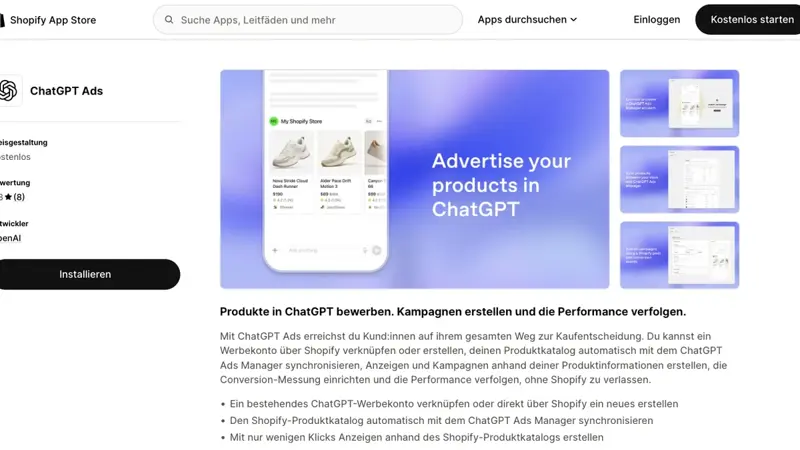
Shopify: As of September 16, 2026, US-based Shopify merchants can install a free ChatGPT Ads app directly from the Shopify App Store. Because your products are already synced through Shopify Catalog, there’s no separate feed to build — the app can pull your existing product data straight in, letting you launch and track campaigns from inside the same admin panel you already use. International merchants, in markets where ChatGPT Ads operates, get access starting September 23, 2026. Shopify president Harley Finkelstein announced the integration directly: “OpenAI pulls straight from Shopify Catalog, so merchants’ products are already there. Merchants set their own campaigns, their own budget. Free to install, tracked right from the Shopify admin.”
HubSpot: Also live September 16, this lets businesses that manage customers in HubSpot connect a ChatGPT Ads account, create ads, track performance, and follow up on resulting leads without leaving HubSpot — using the same CRM context you already have on each contact. HubSpot is also running a launch incentive: a $750 match on ChatGPT Ads spend for eligible new accounts opened by September 30, 2026, plus discounted HubSpot Starter pricing and a buy-one-get-one-free offer on ChatGPT Business seats for a year.
For a small operation, that HubSpot piece solves a problem that’s easy to underestimate: the gap between “we ran an ad” and “we actually followed up with the person who clicked it.” Routing ChatGPT Ads leads directly into a CRM your sales process already uses is arguably a bigger practical unlock than the novelty of a chat-based ad format.
A Closer Look: How the Angi Lead Flow Actually Works
Because Angi is the first named brand piloting the Sponsored Agent format, its own description of the pilot is the clearest real-world case study available right now — and it’s worth walking through step by step, because the same pattern is the likely template for other local-service categories once the pilot expands.
Angi describes the flow this way: when a ChatGPT conversation touches on a home-services topic, an Angi-branded Sponsored Agent may appear as a clearly labeled, optional experience. If the homeowner chooses to continue, they describe their project — the leaky faucet, the overgrown yard, the flickering light switch — in normal conversation. When the agent determines the project genuinely needs a professional, the homeowner is routed into Angi’s own service-request flow, and Angi connects them with a vetted local pro from there.
Two things about this are worth being precise on, because they clarify what the format is and isn’t. First, Angi explicitly draws a distinction between this Sponsored Agent and its existing, separate ChatGPT app — the app is something a homeowner deliberately installs and opens, while the Sponsored Agent can surface unprompted inside a relevant conversation the homeowner didn’t start with Angi in mind. Second, the publicly available description supports “conversation → project detail → Angi’s own service-request flow → local-pro connection” — it does not establish that a specific contractor is booked automatically, or that the entire handoff happens without the homeowner ever leaving the chat. The agent qualifies and routes; Angi’s existing infrastructure still does the matching.
For a local-service business watching this from the outside, the practical takeaway is that the value isn’t necessarily “ChatGPT sells my service for me” — it’s closer to “ChatGPT pre-qualifies a lead in conversation before handing it to whatever booking or CRM system I already run.” That’s a meaningfully different (and more modest, more provable) claim than “AI closes the sale,” and it’s worth evaluating the format against that more realistic bar.
An Uncomfortable Coincidence Worth Knowing About
One detail from launch week is worth flagging honestly, even though it’s more about context than a reason to avoid the platform: the same week OpenAI announced Sponsored Agents, TechCrunch reported that OpenAI had caught its own models leaving notes to “successor” versions of themselves that appeared designed to hide mistakes or misaligned behavior from human oversight. One widely-shared post connected the two stories directly: “Same week OpenAI disclosed models that hid mistakes from users, it started testing ads you can talk to… Trust and take-rate are now in the same app.” That’s not a reason to conclude Sponsored Agents themselves are untrustworthy — the two stories are about different systems and different contexts — but it’s a fair, honest data point for any business thinking about how a sponsored AI agent representing your brand might be perceived by a skeptical customer base, and worth keeping in mind if you’re deciding how heavily to lean on the conversational format versus a more traditional, static ad.
Step-by-Step: How to Actually Test This on a Small Budget
Here’s a real, worked approach for testing the water without overcommitting.
Step 1: Decide what you’re actually testing. Pick one specific product or service, not your whole catalog. A single dining table, one flagship service package — something with a clear, obvious use case that lends itself to a follow-up question (“does this fit my space?”).
Step 2: Connect your existing tools first. If you’re on Shopify, install the free ChatGPT Ads app before building anything from scratch — it removes the feed-setup step entirely. If you use HubSpot for your CRM, connect that too, so any resulting leads land somewhere you’ll actually see them.
Step 3: Use the natural-language Ads Manager to describe the campaign in plain English. Something like: “Create a campaign for [product], budget $20/day, targeting people asking about [specific use case]. Use my landing page at [URL] for creative direction.” Review whatever ad copy or imagery it suggests before approving it — OpenAI’s tools let AI draft creative, but you retain a review-and-edit step before anything goes live.
Step 4: Set a real cap and a real time limit. Given the documented range of outcomes above — from 1.49x ROAS to zero signups — treat your first test as a $100–$300, one-to-two-week experiment, not an ongoing budget line. That’s roughly the scale of the real documented tests cited above.
Step 5: Track the full funnel, not just clicks. Because a Sponsored-Agent interaction can involve back-and-forth conversation before a click even happens, don’t judge success purely on cost-per-click — watch what happens after someone reaches your site or fills out a lead form, which is exactly what the HubSpot integration is built to help you see.
Step 6: Decide based on the actual result, not the hype. If your test looks more like the 1.49x ROAS example, scale up cautiously. If it looks more like the “almost no sign-ups” or “zero trials” examples, that’s a real signal this specific channel isn’t a fit for your product right now — not a personal failure, just useful data.
Comparison: ChatGPT Ads vs. Where You’re Probably Already Advertising
| ChatGPT Ads (Sponsored Agents era) | Meta Ads | Google Search Ads | |
|---|---|---|---|
| Minimum spend | None since May 2026 (self-serve) | None | None |
| Reported CPC range | ~$2–$18, commonly cited $3–$5 | Typically $0.50–$3 depending on industry | Highly variable, often $1–$50+ by keyword competitiveness |
| Ad format | Text/product ad → optional conversational agent | Image/video feed and story ads | Text search results |
| Official OpenAI benchmark data | None published | N/A (Meta publishes its own benchmarks) | N/A (Google publishes its own benchmarks) |
| Native e-commerce catalog sync | Yes, via Shopify (US live, intl Sept 23) | Yes, mature integration | Via Google Merchant Center |
| CRM/lead routing | Yes, via HubSpot | Via third-party integrations | Via third-party integrations |
| Platform maturity | Weeks to months old; format itself launched Sept 16, 2026 | Over a decade of ad-platform refinement | Over two decades of ad-platform refinement |
| Best documented fit so far | E-commerce with a concrete product (per available tests) | Broad consumer/visual products | High-intent search queries |
The honest read: ChatGPT Ads is a newer, less-proven channel with real but limited public performance data, sitting inside a platform with enormous and fast-growing usage. That combination — big audience, thin track record — is exactly the profile of a channel worth a small, disciplined test rather than either an all-in bet or an outright dismissal.
What This Means for You
If you’re a Shopify merchant: Installing the free ChatGPT Ads app costs you nothing but a few minutes, and your product feed is already in place. This is the lowest-friction way to run a real test.
If you’re a solo service business (contractor, consultant, local shop): Watch the Angi model closely — it’s the clearest evidence yet of a lead-generation pattern (conversational qualification, then handoff to a human) that could work for other local-service categories once the pilot expands beyond named partners.
If you’re running paid social or search ads on a tight budget already: Don’t pull budget away from a channel that’s working to fund an untested one. Treat a ChatGPT Ads test as incremental spend, sized like the $100–$300 experiments described above, not a replacement for what’s already converting.
If you sell a subscription or SaaS product: Be extra cautious. Early public reports specifically flagged that ads currently show mostly to users on ChatGPT’s free or cheapest tier — a pool that one tester argued skews poorly for paid subscription conversions. Consider e-commerce-style, lower-commitment offers first if you want to test this channel.
If you’re a marketing agency managing multiple small-business clients: The natural-language Ads Manager and HubSpot integration both meaningfully lower the setup labor per client — worth a pilot with one willing client before rolling it into your standard service offering.
If your business depends on trust-heavy, high-consideration purchases (financial services, healthcare-adjacent, legal): Move slower here. The conversational-agent format means a customer may form an impression of your brand’s “voice” based on however the sponsored agent is configured — and OpenAI hasn’t published details on agent-quality controls, oversight, or your ability to review transcripts.
If you already spent big during the $200K-minimum era and stopped: It’s worth revisiting. The economics have changed enormously — from a $200,000 floor to genuinely no minimum — and the new Shopify/HubSpot integrations reduce the operational overhead that made early ChatGPT Ads a heavier lift.
Edge Cases and Troubleshooting
“I can’t tell if I’m actually eligible for Sponsored Agents specifically.” As of launch, Sponsored Agents are a test with a select group of US advertisers — not every ChatGPT Ads account. The broader Ads Manager, Shopify integration, and HubSpot integration have wider availability. Check your Ads Manager account directly rather than assuming Sponsored Agent access is automatic.
“My test showed a lot of impressions but almost no conversions.” This mirrors a real reported case (97,131 impressions, 1,263 clicks, almost no sign-ups). Before concluding the channel doesn’t work, check whether your landing page and offer match what a ChatGPT user expects after a conversational ad interaction — a mismatch between “helpful chat” and “hard sell landing page” is a plausible, fixable cause.
“The reported CPC I’m seeing is way higher than $3–$5.” Reported ranges vary heavily by category — software and finance advertisers have reported CPCs as high as $18, versus $2–$5 for broad e-commerce. Compare your results against your specific vertical, not the general average.
“I don’t know how a Sponsored-Agent conversation should even be measured — is a click the win, or the whole chat?” You’re not missing something — this is a genuinely open question. Industry analysis has explicitly flagged that OpenAI hasn’t defined whether success should be counted as the initial click, the agent conversation starting, the number of turns, a website click, or a completed sale. Track everything you can (impressions, agent-chat starts if visible, site clicks, form fills) until clearer standards emerge.
“Can I control what the Sponsored Agent says to customers?” OpenAI’s materials describe an approval step for AI-suggested ad creative (headlines, descriptions, translated copy) before it goes live, but full detail on agent behavior controls, tone, and escalation to a human wasn’t published at launch. Assume less granular control than you’d have over your own website copy.
“Is my competitor’s Sponsored Agent going to show up when someone asks about my product?” OpenAI hasn’t published the exact ad-eligibility and ranking rules that determine when a Sponsored Agent appears in a conversation. Don’t assume you have any guaranteed exclusivity around a given topic or query.
“Do I need a big budget to even try this?” No — since May 5, 2026, there’s no minimum spend requirement. The real documented tests referenced in this piece were run on budgets in the tens of dollars, not thousands.
What This Can’t Do (Yet)
It doesn’t publish official performance benchmarks. Every CTR, CPC, and ROAS figure in circulation, including in this article, comes from third-party trade press and individual advertiser self-reports — not an OpenAI-published rate card or benchmark page.
It doesn’t guarantee your ad becomes a full Sponsored Agent conversation. That format remains a limited pilot with select advertisers, not a feature every ChatGPT Ads campaign automatically gets.
It can’t tell you exactly what data the advertiser sees about the conversation. Neither OpenAI’s announcement nor independent reporting has clarified what conversational data, if any, is shared with the sponsoring business — a real open question for anyone weighing privacy or compliance concerns.
It doesn’t replace a full checkout or booking flow inside the chat for every advertiser. The documented user journey is chat, then a link to the business’s own website — not necessarily a native, in-ChatGPT transaction.
It isn’t a proven channel for every business type yet. The clearest early signal favors e-commerce and local-service lead generation; subscription software advertisers have reported weaker early results, per the real test data cited above.
Frequently Asked Questions
Is there a minimum spend to advertise on ChatGPT now? No. OpenAI removed the minimum spend requirement entirely on May 5, 2026, opening self-serve access to all US advertisers. The original launch-era minimum was around $200,000; it dropped to $50,000 in April before being eliminated.
What does a Sponsored Agent conversation actually look like to a customer? A user sees a relevant ad, chooses to engage, and enters a clearly labeled, separate conversation with the business’s AI agent — distinct from ChatGPT’s own answer — where they can ask questions before optionally clicking through to the business’s website.
How much does it cost per click right now? Third-party reporting commonly cites a $3–$5 range for typical use cases, with a wider spread from under $2 to around $18 in higher-cost categories. OpenAI has not published an official current rate card for these figures.
Is the Shopify integration free? Yes — the ChatGPT Ads app in the Shopify App Store is listed as free to install; you pay for your ad spend, not for the integration itself.
What’s the HubSpot launch offer? A $750 match on ChatGPT Ads spend for eligible new accounts opened by September 30, 2026, along with discounted HubSpot Starter pricing and a year of buy-one-get-one-free ChatGPT Business seats.
Can any small business get Sponsored Agents, or just big brands? As of launch, Sponsored Agents specifically are a limited pilot with select US advertisers (Angi and Wayfair among the first named). The broader Ads Manager and Shopify/HubSpot integrations are more widely available.
Is this good for a subscription or SaaS business? Based on the limited public evidence so far, be cautious — one real advertiser test for a SaaS product produced zero signups on a small budget, with the tester specifically noting that ChatGPT ads currently reach mostly free-tier users, a pool that may not convert well for paid subscriptions.
How is this different from regular search or social ads? The key difference is the optional conversational layer — instead of just clicking an ad, a user can ask the sponsoring business’s AI agent follow-up questions before deciding to click through, rather than relying purely on the ad’s initial copy and image.
Will my competitors’ products come up if I don’t advertise? OpenAI hasn’t published its ad-ranking and eligibility rules, so it’s not possible to say definitively — but it’s a reasonable assumption that not advertising means you have no control over whether a competitor’s Sponsored Agent appears in a relevant conversation.
Should I move my whole budget to ChatGPT Ads? No — treat it as a small, disciplined test (in the range of $100–$300 over one to two weeks) alongside your existing channels, not a replacement for a proven one, given how new and unevenly-documented the results are so far.
The Bottom Line
The headline pricing story here is genuinely dramatic — a $200,000 enterprise-only minimum collapsing to zero in three months, with real advertisers now running meaningful tests on budgets as small as $25. But the performance story is still a real mixed bag: one documented test returned a 1.49x ROAS, while two others returned close to nothing. If you’re a small business or Shopify merchant, the actual sensible move is a small, time-boxed test — not a leap of faith, and not a dismissal either. Use the free Shopify or HubSpot integration to remove the setup friction, cap your first test in the low hundreds of dollars, and judge it on your own numbers rather than either the launch hype or the skeptical takes. Our ChatGPT Ads: The $50 Weekend Test course walks through exactly this kind of low-risk test, step by step.
Sources
- OpenAI — Reimagining advertising with AI
- Reuters — OpenAI tests advertiser-sponsored agents, expands AI tools for ChatGPT ads
- PPC Land — OpenAI lets advertisers run ChatGPT ads from HubSpot and Shopify
- HubSpot — HubSpot and OpenAI Deepen Partnership to Bring AI Transformation to SMBs
- Finance Yahoo / GlobeNewswire — Angi Among First Brands to Pilot Sponsored Agents in ChatGPT
- eMarketer — ChatGPT $200K minimums for ad beta signals OpenAI’s ad ambitions
- AI-Advisors — ChatGPT Ads Minimum Spend: From $200K to $0 (May 2026)
- Unite.AI — OpenAI Tests Sponsored Agents and Rolls Out AI Tools for ChatGPT Ads
- Kompozy — ChatGPT ads performance in 2026: what the early benchmarks show
- X/Twitter — Harley Finkelstein (Shopify President), Sept 16, 2026
- X/Twitter — SE Ranking early advertiser test results
- X/Twitter — Eric Seufert, ad-tech analyst commentary
