Thirty-two students asked you for a letter this fall. You said yes to all of them, the way teachers do, and now it’s the last week of August and the first ones are due in six weeks. If you’re staring at a blank document at 9pm wondering how you’re going to write thirty-two individual, honest, non-generic letters without losing your entire October to it — you’re not alone, and you’re not wrong to reach for AI to help. The mistake isn’t using it. The mistake is using it the way that produces a letter admissions readers can spot from the first paragraph.
Here’s the actual number, so you know you’re in company: in a 2024 Foundry10 survey of 425 U.S. high school teachers, roughly 31% said they’d used generative AI to help write at least one college recommendation letter. Reducing stress was the top reason — not replacing judgment, not cutting corners. This is already a mainstream practice among people doing exactly your job. The gap isn’t whether to use AI. It’s the difference between the 20-minute batch that works and the 5-minute shortcut that produces a letter nobody should send.
What actually changed, and why this is urgent right now
Nothing about the technology changed overnight — AI-assisted letter writing has been quietly normal since at least 2024. What’s urgent is the calendar. Early-decision and early-action deadlines cluster in October and November, which means the letters attached to those applications are due to you, the recommender, well before then. If you’re the teacher or counselor thirty students are counting on, the writing window that matters is happening right now, not in December when the stress peaks and the quality drops.
The other reason this is worth getting right, not just fast: readers notice. Admissions offices read thousands of these letters a year, and a specific pattern has become recognizable — not because AI leaves a technical fingerprint, but because rushed AI output defaults to a particular kind of empty praise. More on exactly what that looks like below, because knowing the pattern is how you avoid writing it.
What makes a letter sound AI-written — and it’s not what you think
Here’s the myth to drop first: there’s no secret word list that gets a letter flagged. Admissions readers aren’t running your letter through a detector and rejecting it for using an em dash. Reliable AI-detection for a single letter isn’t something anyone — not colleges, not you — can do with confidence. A 2023 academic-medicine study found that experienced letter readers could distinguish AI-authored from human-authored letters only 59.4% of the time. That’s barely above a coin flip.
What readers do notice, reliably, is genericness. Not “this was written with a tool” but “this letter could describe any student.” That’s the actual failure mode, and it happens whether a human or an AI writes it — a rushed teacher produces the same empty-praise letter as a lazy prompt.
Here’s what that genericness looks like in practice, and what to do instead.
| Pattern | Why it weakens the letter | Fix |
|---|---|---|
| Inflated stock phrases — “a beacon of,” “a testament to,” “unwavering,” “rich tapestry” | Communicates praise with zero evidence behind it | Replace the abstraction with an observed action, setting, and result |
| Broad superlatives with no comparison — “exceptional,” “one of the best” | Reader can’t calibrate the claim without a reference point | “Among the 86 students I taught in AP Biology over two years, she was one of the few who…” |
| List-heavy, résumé-style paragraphs | Just recites the application file back — adds nothing new | Pick two or three real episodes and explain what you personally saw |
| Evenly smooth paragraphs, each naming then restating a virtue | Reads templated, not like a real relationship | Let it be uneven — a concrete opening scene, an honest limitation, real specifics |
| Technically fluent, zero lived detail | Coherent prose without personal connection is the exact thing a 2024 Nature commentary flagged as AI’s core weakness in this genre | Include a witnessed moment and the student’s response to feedback or difficulty |
Here’s the difference in practice — a weak, generic opening versus the same student, done right:
Weak, generic:
Maya’s unwavering dedication and vibrant leadership are a testament to her exceptional character. She is a beacon of hope for her peers and will undoubtedly thrive in any academic tapestry.
Evidence-led revision:
During our robotics team’s regional competition, Maya noticed that two newer members had stopped contributing after repeated coding failures. She rebuilt the testing schedule so each student owned a smaller subsystem, stayed after school twice that week to troubleshoot with them, and made sure they presented the final fix. That combination of technical persistence and attention to quieter teammates is what I expect she’ll bring to a college engineering community.
Same student, same recommender. The second version gives the reader something no model can invent without you supplying it. That’s the whole game.
What the research actually says about whether this is “cheating”
Jennifer Rubin, the Foundry10 researcher who led the 2024 survey, told Education Week that ChatGPT output tends toward generic language and that strong letters depend on personalization — but she explicitly distinguished brainstorming and polishing from asking AI to generate a full letter with little revision. That’s the line that matters, not “AI touched this document at all.”
Maroun Khoury, writing in Nature from the dual perspective of someone who both writes and receives letters, makes the same point from the reader’s side: AI-written letters can be coherent and grammatically sound, but they lack the personal touch, specificity, and nuance that comes from firsthand experience. His recommendation — use AI sparingly, for polishing or turning your detailed notes into prose, then refine it yourself — is close to the exact workflow below.
And on the “will I get caught / will my student get penalized” fear specifically: there’s no verified state or district policy, and no NACAC position, that treats AI-assisted recommendation letters as a distinct violation category. NACAC’s own chief policy officer described the organization as being in “listening mode” on AI broadly. The honest, defensible version of this for your own peace of mind: a letter is unlikely to be rewarded or punished because AI helped draft it. What matters is whether the final letter offers a credible, specific, firsthand evaluation. A polished-but-generic letter doesn’t get flagged — it just doesn’t help the student. That’s the real risk, not detection.
Before you write anything: the privacy rule
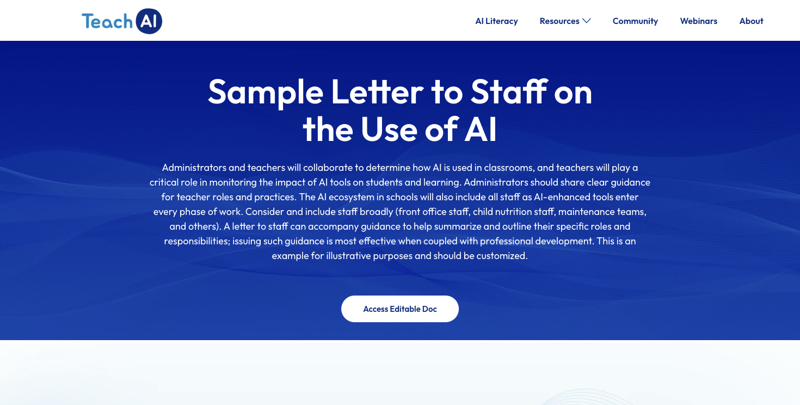
This is the part that’s easy to skip when you’re racing a deadline, and it’s the one that actually matters. Consumer AI accounts — the free or personal version of ChatGPT, Claude, or Gemini — are not automatically FERPA-compliant just because you’re using them for school work. The U.S. Department of Education’s Student Privacy Policy Office is specific about this: a tool only qualifies for the “school official” exception that lets it touch education-record data if it performs a function the school would otherwise do itself, stays under the school or district’s direct control, and doesn’t reuse or redisclose the information for anything else.
In plain terms: don’t paste a student’s real name alongside grades, transcript details, disciplinary history, health or disability information, or family circumstances into a consumer AI account unless your school or district has specifically approved that tool for that use. That’s not a hypothetical caution — it’s the actual boundary the Department draws.
Here’s the two-lane rule to actually follow:
| Lane | What can go in the prompt | How to use it |
|---|---|---|
| Unapproved consumer tool (personal ChatGPT/Claude/Gemini account) | No student-identifying information. Use a placeholder, generalized facts, or a de-identified outline. | “Draft a 450-word recommendation-letter structure for a student applying to engineering programs; leave brackets for details I’ll add locally.” |
| District-approved, contract-covered tool | Only the minimum necessary information, per your district’s data agreement and staff authorization. | Provide scoped notes; you still verify every factual claim and write the final version yourself. |
The reusable trick: replace identifying details with placeholders like [Student], [course], [project], and [quantified result] — and keep the actual mapping (which placeholder means which real student) in your own local document, never inside the AI chat itself. Pseudonyms alone aren’t enough if the surrounding facts would still identify the student to anyone reading closely.
A quicker path: does your school already have an approved tool?
Before you default to your personal AI account, it’s worth a two-minute check with your instructional-technology lead. OpenAI launched a dedicated “ChatGPT for Teachers” workspace in late 2025, built specifically around education-grade privacy — it doesn’t retain student data for model training, and it’s positioned to align with FERPA’s requirements in a way a personal consumer account isn’t automatically covered by. By some counts, over 150,000 teachers and staff across U.S. districts already have access through their school. If yours is one of them, that’s your Lane 2 from the table above — you can work with more real context than the de-identified prompt requires, though you’re still the one verifying every fact and writing the final version.
If your district hasn’t rolled out something like that, don’t wait for it. The de-identified-lane workflow in this guide works with any free consumer account, today, without needing anyone’s approval — it’s just slower to get the full context in because you’re working through placeholders instead of real names. That trade-off is exactly why Step 1 (your own notes, kept separately) matters as much as it does: the placeholders in the prompt and the real names in your notes only ever meet on your own machine, never inside the AI chat.
The 20-minute batch: step by step
This is built to run once per student, in roughly 20 minutes, using notes you already have in your head. No new software, no district approval needed if you follow the de-identified-lane rule above.
Step 1 — Gather your raw material (5 minutes). Before you open any AI tool, jot down, in your own words: two or three specific episodes where you watched this student do something — solve a problem, help a classmate, handle a setback, show up for something hard. Not traits (“hardworking”). Moments (“stayed after school twice to help two struggling teammates”). If you can’t think of three, one strong one is enough. This is the part AI genuinely cannot do for you, and it’s also the part that makes the letter worth reading.
Step 2 — Run the constrained prompt (2 minutes). Use a prompt that blocks invention rather than inviting it. Here’s the exact structure, adapted from Coursera’s letter-writing guidance and built specifically to stop the model from filling gaps with fabricated praise:
You are helping me prepare a first draft only. Do not invent facts,
statistics, awards, quotations, relationships, or motives. If any detail
is missing, write [INSERT DETAIL] rather than guessing.

Audience and purpose:
- Letter type: [college / scholarship / program]
- Intended length: [350–500 words]
- Tone: [warm, direct, credible, not overly effusive]
- My role and relationship: [course/position, years known, frequency of contact]

Student details:
- Use the pseudonym: [Student]
- Do not include identifying data, grades, discipline information, health,
  disability, family, or financial details.
- Academic/intellectual strengths I personally observed: [2–3 items]
- Character/collaboration strengths I personally observed: [2–3 items]
- Comparison context, if accurate: [e.g., "among 90 students I taught over two years"]
- Future fit: [specific academic/community contribution]

Evidence:
1. [A brief witnessed episode: setting, challenge, what the student did, outcome]
2. [A second witnessed episode]
3. [Growth, response to feedback, or contribution to peers]

Writing constraints:
- Build the letter around the two episodes, not a résumé list.
- Use direct, concrete language.
- Avoid clichés and flowery metaphors.
- Do not use: "beacon," "testament," "unwavering," "tapestry," "delve,"
  "transformative," or "without reservation."
- Avoid excessive em dashes, bullet-like lists, and generic superlatives.
- Include one calibrated, evidence-based comparison only if I supplied one.
- Return a draft with a short "facts to verify" list after the letter.
Step 3 — Read the “facts to verify” list first (2 minutes). Before you read the letter itself, check the list the prompt asked for. Anything on it that isn’t accurate, cut or correct now — it’s much easier to catch one flagged item than to hunt through prose for a hallucinated detail.
Step 4 — The voice-matching pass (5 minutes). Read the draft aloud. Anywhere it doesn’t sound like something you’d actually say, rewrite that sentence in your own words. This step alone fixes most of the “smooth but hollow” feeling — your actual voice has rhythm the model’s doesn’t, and a human reader picks up on that difference even when they can’t name it.
Step 5 — The specificity check (3 minutes). Scan for any sentence that could describe a different student without changing a word. If you find one, either cut it or replace it with something from your Step 1 notes. This is the single highest-leverage edit you can make — it’s the difference between the two Maya examples above.
Step 6 — Final read and send (3 minutes). One more full read-through, checking tone and length against what the program actually asked for, then send it the way you normally would.
What this means for you
If you have 30+ letters and six weeks — start with your five most time-sensitive students (early decision/action deadlines) and run the full batch on each. Don’t try to speed past Step 1 for these; the specificity is what makes an early-decision letter carry weight.
If you’re a first-year teacher without years of “among the 90 students I’ve taught” comparison data — that’s fine. Comparison context is optional in the prompt template for a reason. Lean harder on the specific episode instead; a single well-observed moment does more work than a fabricated-sounding comparison would anyway.
If a student asks you to write a letter for someone you don’t know well — this is the case where AI can hurt you most, because there’s nothing in Step 1 to draw from. Be honest with the student that a thin letter from you may help less than a strong one from someone who knows them better, and consider recommending a co-signer or additional recommender instead.
If your district has an approved AI tool with a data agreement — use the second lane from the privacy table above. You can include more real context, but you still personally verify every fact and write the final version — the tool being approved doesn’t change that part.
If you’re a school counselor writing letters for 100+ students — the batch process still works, but budget your Step 1 time carefully; that’s genuinely the part that doesn’t compress. Consider a quick 5-minute intake form for each student (favorite project, a challenge they overcame, a specific goal) collected earlier in the fall specifically to feed this step later.
If you’re worried a student will think less of you for using AI — you don’t owe students a disclosure of your drafting process any more than you’d disclose using a grammar checker. What you owe them is a letter that’s actually about them, specifically, which is exactly what this workflow is built to produce.
If you’ve already sent a few letters you’re not proud of — it’s not too late to send a stronger one for students whose applications are still open, especially if a first draft leaned generic. A quick specificity pass using Steps 1 and 5 above can rescue an existing draft without starting over.
Edge cases and troubleshooting
“The AI keeps inventing an award or activity I never mentioned.” That’s exactly what the “do not invent facts” instruction and the mandatory “facts to verify” list are for — if you’re seeing fabricated details slip through anyway, add a stronger line: “If a detail is not explicitly provided above, do not include it under any circumstances, including plausible-sounding achievements.”
“My district blocks ChatGPT and Claude entirely on the school network.” Run the de-identified-lane version of the prompt (no real student details at all) from a personal device, or ask your school’s IT/instructional-technology lead what’s actually approved — many districts have a sanctioned tool even when the consumer versions are blocked.
“I only have one strong memory of this student and it’s from two years ago.” One real, specific memory beats three invented-sounding virtues. Use it. Pair it with something more recent, even minor, to show the relationship continued.
“The letter feels too short after I cut the generic filler.” That’s usually a sign you need a second episode, not more adjectives. Go back to Step 1 and add one more concrete moment rather than padding the existing one.
“A student wants to see the letter before I send it.” Most programs ask you to keep the letter confidential from the applicant (check the specific waiver on their application). This workflow doesn’t change that policy either way — handle it the same way you would a hand-written letter.
“I’m worried this whole approach is more work than just writing it myself.” For your first one or two, it might take closer to 30 minutes while you get used to the prompt. By the fifth or sixth letter, the template and your instincts for what to fill in speed up dramatically — that’s the actual “batch” part of the name.
“Can I reuse the same prompt template for a scholarship recommendation instead of college?” Yes — just change the “Letter type” and “Intended length” fields at the top. The rest of the structure works for any recommendation-letter context.
What this can’t do
It can’t supply the relationship. Every genuinely strong letter in this guide comes from something you personally witnessed. No prompt, however well constructed, substitutes for actually knowing the student.
It can’t guarantee the letter won’t read as AI-assisted to a careful reader. Following this workflow dramatically reduces the generic “tells,” but there’s no detection-proof formula — nor should there be one you’re chasing. The goal is a genuinely good, specific letter, not a letter engineered to fool a detector.
It can’t verify facts you didn’t give it. The “facts to verify” list only catches what the model flagged as uncertain — it won’t catch a wrong grade level or an inaccurate club name if you stated it confidently and incorrectly yourself. Read your own inputs carefully too.
It doesn’t replace your district’s data-privacy rules. Following the de-identified prompt lane keeps you safer, but if your school has a specific AI policy, that policy governs — this guide is a general framework, not a substitute for your actual employer’s rules.
It won’t make a thin relationship into a strong letter. If you genuinely don’t know a student well, no amount of prompt engineering fixes that. Say so, or decline, rather than manufacture false specificity.
Frequently asked questions
Is it okay for teachers to use ChatGPT or Claude to help write college recommendation letters? Yes, using AI as a drafting and editing assistant is a mainstream practice — about 31% of teachers surveyed by Foundry10 in 2024 had done it. The distinction that matters is between AI-assisted drafting you personally verify and rewrite, versus asking AI to generate a full letter with no revision.
Can colleges detect AI-generated recommendation letters? Not reliably. A 2023 study on academic-medicine letters found experienced readers correctly identified AI-authored letters only 59.4% of the time — barely better than guessing. There’s no verified, reliable detection method for a single letter.
Is it a FERPA violation to use ChatGPT for a recommendation letter? It can be, if you include a student’s identifiable education-record information (grades, disciplinary history, health details, etc.) in a consumer AI account your school hasn’t approved for that use. The safe approach is the de-identified-lane prompt described above, or your district’s approved, contract-covered tool.
What phrases make a recommendation letter sound AI-written? Inflated stock phrases (“a beacon of,” “a testament to,” “unwavering,” “rich tapestry”), broad superlatives with no comparison point, résumé-style lists of traits, and evenly smooth paragraphs with no lived detail. The fix in every case is the same: replace abstraction with a specific, witnessed episode.
Will my student be penalized if I use AI to help write their letter? There’s no verified NACAC policy or state/district rule treating AI-assisted letters as a violation category. The real risk isn’t detection or penalty — it’s that a generic letter simply doesn’t help the student’s application as much as a specific one would.
How long should a college recommendation letter be? Most guidance points to roughly 350–500 words — enough for two or three specific episodes plus context, not so long that it dilutes the strongest details.
What should I never include in an AI prompt about a student? Their real name alongside grades, transcript data, disciplinary records, health or disability information, or family/financial circumstances — unless you’re using a tool your district has specifically approved and contracted for that data.
Should I tell the student I used AI to help draft their letter? There’s no requirement to, the same way you wouldn’t disclose using a grammar checker or thesaurus. What matters is the letter’s accuracy and specificity, not the tools used to draft it.
Is ChatGPT for Teachers different from the regular free version? Yes. It’s a separate education-focused workspace OpenAI launched for schools, built around FERPA-aligned privacy practices and without using student data for model training. Check with your school whether you already have access before defaulting to a personal account.
What if I’m writing for a student applying somewhere with a very specific prompt, like “describe this student in one word plus an explanation”? Adapt the Writing Constraints section of the template to the exact format the program asks for — the core structure (your real episodes as evidence, banned generic phrases, a facts-to-verify list) works underneath almost any letter format or length requirement.
The bottom line
The teachers already doing this well aren’t using AI to skip the work of knowing their students — they’re using it to skip the mechanical part, the blank-page paralysis, the hour spent hunting for a synonym for “hardworking.” The actual differentiator between a rec letter that helps a kid and one that just takes up space in their file was never the tool. It’s whether the letter contains something only you could have written. Do Step 1 honestly, and everything after it gets faster.
If you’re building out a broader AI workflow for the school year — grading, parent communication, lesson planning — our Claude for Teachers course walks through the same privacy-first approach applied across a full teaching week.
Sources
- Education Week — Teachers Use This High-Tech Hack to Knock Out Recommendation Letters
- foundry10 — Navigating College Applications with AI (white paper)
- Nature — Why AI-generated recommendation letters sell applicants short
- Pangram — Comprehensive Guide to Spotting AI Writing Patterns
- PMC — Brain versus bot: Distinguishing letters of recommendation authored by humans vs. AI
- U.S. Dept. of Education — Student Privacy Policy Office, Privacy and Data Sharing
- U.S. Dept. of Education — FERPA FAQ on Online Tools and Applications
- U.S. Dept. of Education — Responsibilities of Third-Party Service Providers under FERPA
- TeachAI — Sample Letter to Staff, AI Guidance for Schools Toolkit
- Coursera — ChatGPT Letter of Recommendation: How to Use AI to Write a Reference Letter
- Inside Higher Ed — Admissions Offices Turn to AI for Application Reviews
- Inside Higher Ed — Can AI Make College Counseling More Equitable?