

OpenAI just looked at 800,000 real work messages from ChatGPT business users and found something that flips the whole “will AI take my job” conversation on its head. Among messages tied to a specific occupation, 43.5% were people using AI to do work that traditionally belongs to a different job. The marketer fixing a website. The salesperson running the data analysis. The HR generalist reading a contract.
While everyone’s been asking whether AI will replace them, the actual data says something stranger: AI has been quietly handing you pieces of your coworkers’ jobs. And most people doing it haven’t noticed — let alone gotten paid for it.
What the study actually found
The report is called “Work at the Frontier,” published July 27 by OpenAI’s economic research team. They sampled 800,000+ work-related ChatGPT messages from US business users, matched each user to one of eight occupation groups (customer experience, design, engineering, finance, HR, legal, marketing, sales), and checked every message against the Department of Labor’s O*NET database — the official map of which tasks belong to which jobs.
The numbers:
- 16.8% of all work messages involved a task historically belonging to another occupation. Strip out generic work everyone does (emails, summaries, scheduling), and 43.5% of the job-specific requests crossed role lines.
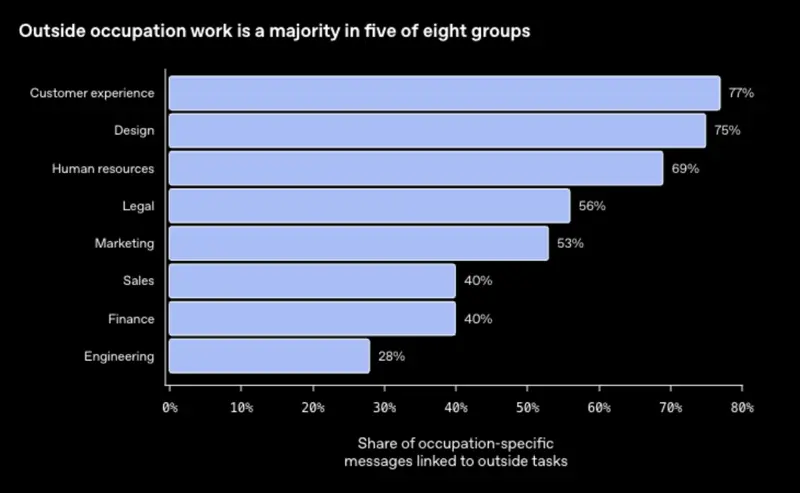
- The crossover leaders: customer experience workers (77%), designers (75%), HR (69%), legal (56%), marketers (53%) — in each case, that’s the share of their occupation-specific AI use that reached into someone else’s lane.
- The tasks that travel farthest: financial calculations and computer troubleshooting showed up as top “outside” tasks in nearly every group. Marketing work spread widely too — people in five other fields regularly draft marketing materials now.
- It’s strongest at small companies: crossover ran 18.9% in workspaces with 2–5 seats vs 16.3% at 101+ seats. When there’s no analyst down the hall, the person closest to the problem just… handles it, with AI as the missing department.
One honest caveat, straight from the report: this measures what people attempted with AI, not whether the output was good, used, or checked by a specialist. It’s a map of where work is flowing, not a guarantee that every crossing succeeds. Keep that in mind — it’s also the foundation of the one rule at the bottom of this post.
Why this reframes the fear
“Will AI take my job” assumes jobs are fixed containers and AI either fits in yours or replaces it. The data describes the opposite: the containers are leaking. Tasks are detaching from job titles and flowing to whoever’s closest to the problem, because AI lowers the cost of attempting work outside your lane from “take a course” to “ask a question.”
That can play out two ways for you, and the difference is mostly whether you do it on purpose:
- The bad version has a name — job creep. You quietly absorb three people’s tasks, your title and pay stay the same, and the extra work becomes invisible expectation. People are already worrying about exactly this: one role doing what three used to, with no raise attached.
- The good version is the deliberate one. You pick the adjacent tasks that are most valuable next to your role, get demonstrably good at them with AI, make the wins visible, and turn them into scope, title, or pay. Same behavior. Completely different outcome.
The rest of this post is the good version.
Five adjacent tasks to steal on purpose
These map directly to the crossover routes the study found people already taking. Each comes with a starter prompt — paste it into ChatGPT, Claude, or Gemini and fill in the brackets.
1. First-draft design (the marketer’s and founder’s steal)
You’re not replacing your designer. You’re arriving at their desk with something concrete instead of “make it pop.”
I need a first-draft layout concept for [a one-page flyer / a
LinkedIn carousel / a landing page section] promoting [thing].
Audience: [who]. Brand feel: [3 adjectives]. Give me: a layout
description section by section, headline and subhead options,
and image suggestions. Then list 3 questions a professional
designer would ask me before finalizing.
2. First-pass data analysis (the salesperson’s steal)
The single most-traveled task in the study. Export the spreadsheet, then:
Here's my [sales/customer/campaign] data: [paste or attach].
1. What are the 3 most important patterns here?
2. Which numbers changed most vs the previous period, and what
   might explain each?
3. What would you check next if you were an analyst?
Show which columns/rows support each conclusion so I can verify.
3. The contract pre-read (the HR generalist’s and freelancer’s steal)
Not legal advice — a briefing that makes your eventual conversation with an actual lawyer ten times faster:
Read this contract: [paste]. In plain English:
1. Summarize what each party promises.
2. Flag the 5 clauses most worth a closer look (payment terms,
   termination, liability, IP, non-compete) and say why.
3. List the questions I should ask a lawyer before signing.
Do not tell me it's fine to sign — that's not your call.
4. Computer troubleshooting (everyone’s steal)
The other most-traveled task. Before you file the IT ticket and wait two days:
I'm hitting this problem: [describe or paste the error].
System: [what you're using]. Walk me through the 3 most likely
causes in order, with the exact safe steps to check each. Tell
me clearly which step is the point where I should stop and hand
this to IT instead.
5. The financial sanity check (the founder’s and manager’s steal)
Here are my numbers: [revenue, costs, whatever you have].
1. Build a simple monthly summary and tell me what stands out.
2. Calculate [margin / burn / break-even / unit economics].
3. What would a finance person warn me about in these numbers?
Show your math so I can check it.
What this means for you
If you’re at a small company or run one: You’re not deciding whether to do crossover work — at 2–5 people, you already do it daily. The upgrade is doing it with receipts: use the prompts above, and when the AI-assisted version saves you a contractor invoice or a week of waiting, write that down. Small-company generalists with AI leverage are quietly becoming the most productive people in the economy.
If you’re an employee at a bigger company: Pick one adjacent task — the one your team always bottlenecks on — and get visibly good at it. Then say the quiet part in your next review: “I’ve been covering first-pass analysis for the team since March; here’s what it saved us.” Visible scope becomes titles and raises. Invisible scope becomes job creep.
If you’re a specialist watching amateurs enter your lane: The study is not your obituary — it explicitly found attempts, not specialist-grade results. But your job is shifting from doing every first draft to being the review layer and the standard-setter. The designers and analysts who thrive will be the ones who teach the amateurs where the cliff edges are, and charge accordingly.
If you’re job hunting: Job descriptions lag reality — this data shows work reorganizing before titles do. In interviews, the strongest story you can tell right now is a crossover story: “I’m a [your role], and I also handle [adjacent thing] with AI — here’s a result.” That’s what “AI skills” actually means to an employer, not a list of tools.
If you manage people: Your org chart says who owns what; your team’s AI usage says who actually does what. Route review by consequence, not by title — a junior marketer can draft the financial summary, but a finance person still signs off before it reaches a client. And when someone’s absorbed real scope, pay for it before a competitor does.
What this can’t do
It can’t make you a specialist. 43.5% measures attempts. The gap between “drafted a contract summary” and “knows which clause will burn you in year three” is the specialist’s entire career. Steal the first draft, never the final call.
It won’t pay you by itself. Nothing in the data says crossover work automatically converts to raises — that part is negotiation, and it only works if your extra scope is visible and measured.
It can’t carry the liability. When the AI-assisted financial model is wrong, “the AI did it” is not a defense anyone accepts. Whoever ships the work owns the work.
It doesn’t apply evenly. This is knowledge-work data from ChatGPT business accounts — if your job is physical, licensed, or safety-critical, the boundaries move much more slowly, and often legally can’t move at all.
The bottom line
The scary question was “will AI replace me.” The real question, according to the largest dataset anyone’s published on actual AI use at work, is “which of my coworkers’ tasks am I already doing — and am I getting credit for it?” Pick your adjacent tasks deliberately, verify before you ship, keep receipts, and turn the quiet expansion of your job into a loud one.
One rule above all: the person who verifies is the person who’s safe. If you want to build that skill properly — from first prompt to knowing when the AI is confidently wrong — our AI Fundamentals course is the place to start. First two lessons are free.
Sources
- OpenAI — How AI is expanding what people do at work (Jul 27, 2026)
- OpenAI — Work at the Frontier: full report PDF
- Axios — Workers are crossing job boundaries with AI, OpenAI research shows
- TechTimes — ChatGPT Scrambles Specialization: Nearly Half of Job-Specific AI Use Crosses Role Lines
- The Decoder — OpenAI says more workers are using ChatGPT to do other people’s jobs