

“AI-fluent.” It’s on job posts now the way “proficient in Excel” used to be. Recruiters ask for it. Managers write it into reviews. And here’s the strange part: almost nobody can tell you what it means.
TestGorilla asked employers straight out. In their State of Hiring for AI Fluency 2026, 95% said AI fluency is now a hiring requirement. But only 71% had actually defined it. And 59% admitted they’d already made a bad AI hire. Someone who looked fluent and wasn’t.
So the bar is everywhere, the definition is missing, and people are getting hired and passed over against a standard nobody wrote down.
Most people fill that gap with a guess: getting good at AI means getting good at prompts. Learn the magic words, save a few clever templates, done.
That guess is mostly wrong. And it’s a big reason so many “AI-fluent” hires flop.
Here’s the reframe. In the clearest framework we’ve got, prompting isn’t the skill. It’s a slice of one of four skills. Call it a quarter of a quarter. The other 75% of being AI-fluent has nothing to do with the wording of a prompt. It’s choosing the right work to hand off, judging what comes back, and owning what you ship.
Let me show you the whole thing.
What “AI-fluent” actually means
The most useful definition doesn’t come from a job post. It comes from a framework built by two professors, Rick Dakan at Ringling College and Joseph Feller at University College Cork, together with Anthropic. They teach it in a free course called AI Fluency: Framework & Foundations.
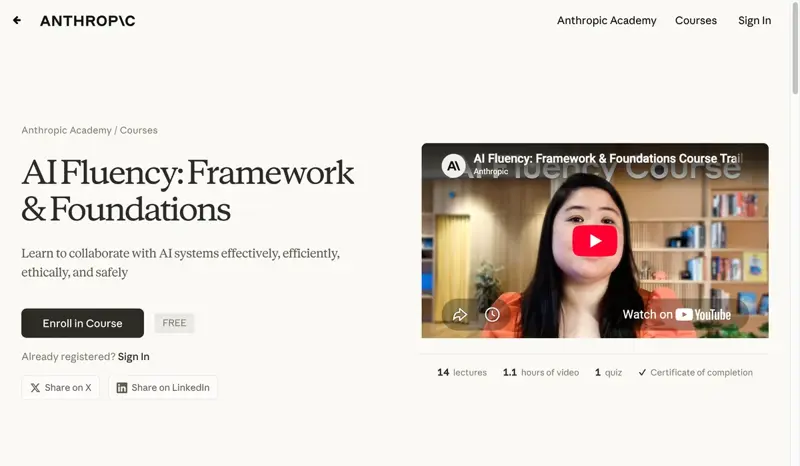
Their definition is refreshingly plain. AI fluency is “interacting with AI systems in ways that are effective, efficient, ethical and safe.” Not “knowing the tools.” Interacting well. And they split that into four habits. They call them the four D’s.
- Delegation. Deciding whether, when, and how to bring AI in at all. What to hand off, and what to keep.
- Description. Telling the AI what you want well enough to get something useful back. This is where prompting lives. Only here.
- Discernment. Judging what comes back, and spotting the answer that’s confident and wrong.
- Diligence. Taking responsibility for what you do with AI and how you do it.
See what happened? Prompting, the thing everyone trains for, is part of exactly one of these. The other three are about judgment, not wording.
There’s a second layer worth knowing, because it changes how you use all four. Dakan and Feller describe three modes of working with AI. Automation, where you give an instruction and the AI executes it. Augmentation, where you and the AI think together, back and forth. And Agency, where you set the AI up to act on its own. Same four skills, different weight depending on the mode. Hand a task to an autonomous agent and suddenly Diligence matters a lot more than it did in a quick back-and-forth.
What an employer actually means by it
Strip away the jargon and “AI-fluent” on a job post usually comes down to four concrete things:
- You reach for AI on the right problems, and you can say when you deliberately didn’t.
- You drive it past the first answer. You iterate and steer instead of re-typing a fresh prompt every time. One Amazon hiring manager put the bar bluntly: people who “ask a new prompt every time, without any environment engineering or steering documents” are “under the bar.”
- You check the output. You catch the hallucination before it lands in the deck.
- You can point to a real result. An actual workflow you sped up. Not “I use ChatGPT.”
That’s the whole gap, right there. A faster typist versus a faster operator. Employers are paying for the second one.
The 4 habits that get you there
Good news: you don’t need a bootcamp. You need four habits, and you can start every one of them this week. One per D.
Delegation: run the hand-off test
Before you open a chat, ask three quick questions about the task. Can I describe what “good” looks like? Can I check the result? What’s the cost if it’s wrong and I miss it?
If you can describe it and check it, hand it off. If you can’t check it, a medical dose, a legal clause, a number going in front of your CEO, then either keep it yourself or switch into full verify-every-line mode. The skill isn’t using AI on everything. It’s spotting the one task on your list where you shouldn’t.
This week: pick your most repetitive task and your most consequential one. Hand off the first. Keep the second. Feel the difference between them.
Description: give it context, not keywords
Most weak prompts aren’t badly worded. They’re starved of context. The AI doesn’t know who you are, who the work is for, or what “good” looks like to you, so it averages. Average in, average out.
Here’s a pattern that works on any tool:
Role: You're a [specific role].
Goal: I need [specific outcome] for [audience] by [when].
Context: [2-3 real lines: the situation, the constraint, what's failed before].
Format: [length, tone, structure].
Here's an example of "good": [paste one].
Draft it. Then tell me what you assumed.
That last line pulls its weight. “Tell me what you assumed” drags the AI’s guesses into the open before they cost you anything. And notice there’s nothing clever in here. No secret words. Just enough context that the model stops averaging and starts answering you.
This week: take one prompt you lean on a lot and add the three context lines. Watch the output change.
Discernment: assume it’s wrong until you’ve checked one thing
AI sounds equally sure whether it’s right or making things up. That’s the trap. So build one small ritual. Before you use any AI output, find the single load-bearing claim, the fact or number or name that everything else rests on, and check it against a source you trust.
Ask for links. Paste the paragraph back and ask “what here is most likely wrong?” Cross-check the one stat that would break the whole thing if it were false. You’re not fact-checking every word. You’re finding the word that matters and testing it.
This week: next time AI hands you a fact you’re about to repeat, look it up before you send. Do that five times and you’ll start to sense where the model tends to slip.
Diligence: the ten-second responsibility check
Before anything leaves your hands, three checks. Did I verify the facts I can’t personally vouch for? Should I say AI helped make this? Am I about to paste in something I shouldn’t, a password, a client’s private data, an unreleased number?
That’s the whole thing. It sounds obvious, right up until you notice how many AI blunders in the news are just that: nobody ran those three checks. Owning the output is the part no model can do for you. It’s also the part that keeps you employed.
This week: write those three questions on a sticky note. Use it once. You’ll keep using it.
What this means for you
Four habits. So where do you actually start? Depends who you are.
- If you’re a marketer: Description is your fastest win. Stop hoarding prompts. Build one solid brief for your top recurring deliverable, the context, the audience, an example of “good,” and reuse it everywhere.
- If you’re a manager: Delegation and Diligence. Your job isn’t to out-prompt your team. It’s to decide which work AI should touch, and to set the norm for checking it. Run the ten-second check out loud so people copy it.
- If you’re job-hunting or switching careers: put down the certificate checklist. Build one demonstrable result, a workflow you rebuilt, a real before-and-after, and learn to tell that story in two minutes. That’s what the 59% of burned employers are now screening for. (For the money side, see why AI-fluent workers earn more.)
- If you run a small business: start with Delegation, the tasks eating your evenings that you can describe and check. And if you’d rather follow a structured course, Anthropic has a free small-business version. I broke it down here.
- If you’re a student: Discernment is the muscle that’ll matter longest. The tools will change five times before you graduate. Knowing when the answer is wrong won’t go out of date.
What being “AI-fluent” is NOT
Let me clear up the myths, because they waste the most time.
It’s not prompt memorization. A folder of “10 magic prompts” is not fluency. The people who look sharp for a week and then flop are usually the ones who only ever learned Description.
A certificate isn’t fluency. It’s a fine start, and free ones exist (that Anthropic course runs about an hour). But a badge proves you sat through something. Employers want a demonstrated result, which is exactly why 59% of them still made a bad hire off credentials that looked right on paper.
It’s not tied to one app. The whole point of the four D’s is that they outlast the next model, the next tool, the next pricing change. So don’t chase every launch. Chase the habits.
It doesn’t retire the need to check. Fluency doesn’t mean trusting AI more. Oddly, it means trusting it less, but more precisely. Discernment and Diligence aren’t training wheels you take off once you’re good. They are the job.
The bottom line
“AI-fluent” isn’t a mystery, and it isn’t really about prompts. It’s four habits: pick the right work, describe it well, judge what comes back, and own what you ship. Prompting is one corner of one of those. The other 75% is judgment. And judgment is learnable.
The stakes, if you need a nudge: AI skills now carry a 62% average wage premium, and roles that ask for them are growing roughly 8x faster than the rest of the market, according to PwC’s 2026 Global AI Jobs Barometer (built on more than a billion job ads across 27 countries). Meanwhile generative AI has reached about half the population in three years, per Stanford’s 2026 AI Index. The tools are everywhere now. The people who can actually direct them are not. That gap is the opening.
Want a structured, hands-on start? Our AI Fundamentals course walks through all four habits from zero, and Prompt Engineering goes deep on the Description piece once you’re ready for it. Not sure where you stand? Take the 5-minute self-check.
Start with one habit this week. That’s how fluency actually begins. Not with a magic prompt, but with a better decision about what to hand over.