
Black Friday is November 27, and some of the people shopping for gifts will start by asking an AI assistant. Adobe’s holiday forecast says AI traffic to US retail sites, counted as shoppers clicking a link, will rise 130% over last year this season. Shopify says 65% of shoppers say they will use AI for at least one shopping task.
If you sell handmade goods, run a small Shopify store or have your own site, the natural question is whether you can get into those answers. This post tries to answer it honestly. No source I found says that publishing a gift guide will make ChatGPT, Gemini or Perplexity recommend you. What the sources do say is what the platforms look at, what you control, and where independent tests show retailers and editorial sites collecting much of the citation share. The plan below is built from those facts, and it ends with limits, because the limits are most of the story.
I read Adobe’s forecast, Shopify’s holiday post, OpenAI’s and Google’s own pages for merchants and site owners, the FTC’s endorsement guide and three independent studies on November 19, 2026. I did not run a campaign or measure any sales, so nothing here is a result. It is a reading of what is published.
The short answer
TL;DR. The forecasts point to fast growth. Do the things the platforms themselves say matter: accurate product facts, prices that match everywhere, clear shipping and return terms, and, if you want, one useful gift guide on your own site that a search engine can index. Google says there is no special optimization for AI Mode. OpenAI says Shopify and Etsy catalogs are already connected to ChatGPT shopping with no extra setup, and that shopping is live for US users. Independent tests show retailers and editorial sites getting much of the citation share, so treat a gift guide as a cheap long shot, not a plan to count on.
Five things to hold on to:
- Black Friday is November 27. Thanksgiving is the day before, Small Business Saturday is November 28 and Cyber Monday is November 30.
- Adobe’s AI-traffic forecast is a growth rate, not a share. It counts clicks on a link, so by itself it does not say how big AI traffic is next to other traffic.
- Platforms say what they look at. ChatGPT says it considers structured product metadata such as price and description, plus reviews and context. Google says nothing special is needed beyond being indexed and eligible for a snippet.
- Independent studies are small and mixed. None of them separates independent shops from big retailers and publishers across assistants for the same gift prompts. The nearest evidence points to retailers and editorial sites.
- Disclose what you earn. If your guide includes affiliate links, free products or paid placements, the FTC says to disclose clearly and conspicuously.
What the forecasts actually say
Adobe published its holiday forecast on September 28, 2026, covering November 1 to December 31. On AI, its press release says it expects AI traffic to US retail sites “this holiday season (measured by shoppers clicking on a link)” to rise 130% year over year. The biggest rise is expected on Thanksgiving, up 159%, then Black Friday, up 95%, and Cyber Monday, up 88%.
A growth rate says nothing about how large the starting point is, so the right reading is “growing fast”, not “a big share”. The same release adds a consumer survey fielded in July 2026 with 5,000 people. Of those who have used AI for online shopping, 77% say they feel more confident in their purchases and 69% say they are less likely to return items. That is a result for people who already use AI to shop, not for all shoppers.
Shopify’s post of October 6 says 65% of shoppers say they will use AI for at least one shopping task this season, citing its 2026 Global Holiday Retail Report. The post does not say how many people were surveyed, where, or when. It also says shoppers mostly use AI to research before they buy, and that only one-third trusted an AI agent to buy on their behalf. For independent businesses, it reports that 71% of regular AI users are more likely to pick an indie brand this year than last. Those are Shopify’s survey claims as its page reports them.
Shopify also lists three brands’ own results: Stanley 1913 reports “five times as many AI-referred orders in the U.S.” against the same window last year, ILIA reports AI-referred sales “nearly triple”, and Cottonique reports AI-referred sales up 276%. Those are the brands’ own results, reported on Shopify’s page, not independent measurements.
| Source | Figure | What it measures | What it does not tell you |
|---|---|---|---|
| Adobe, Sep 28, 2026 | AI traffic to US retail sites up 130% this season | Clicks on a link from AI, a forecast | AI’s share of all traffic, or any seller’s own result |
| Adobe, Sep 28, 2026 | Up 159% Thanksgiving, 95% Black Friday, 88% Cyber Monday | The same forecast by day | The same |
| Shopify, Oct 6, 2026 | 65% will use AI for at least one shopping task | Shoppers’ stated plans, per Shopify’s report | Survey size, countries, dates |
| Shopify, Oct 6, 2026 | One-third trusted an AI agent to buy for them | Stated trust | Whether they will |
What the platforms say they look at
Instead of guessing, read what each platform has published. I opened these pages on November 19.
ChatGPT. OpenAI’s help page on shopping says product results are not ads. When it decides which products to surface, it considers structured metadata from first-party and third-party providers, such as price and product description, plus other third-party content. Merchants are ranked on availability, price, quality and whether they are the maker or primary seller. It adds that merchant pricing and shipping updates may take some time to show. Review summaries are generated from reviews on public websites, and OpenAI says reviews and ratings are not verified by OpenAI.
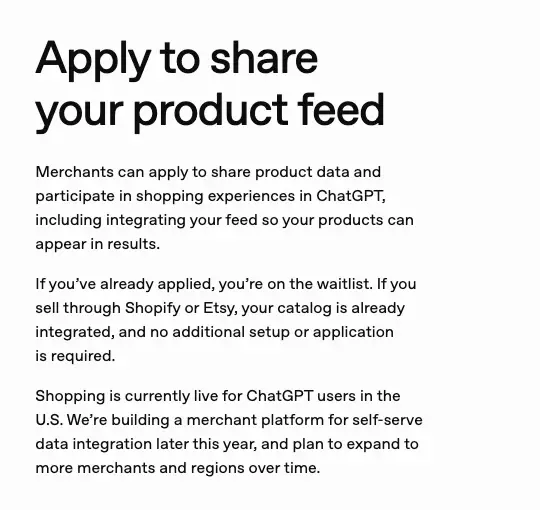
On merchants, OpenAI’s product page says: “If you sell through Shopify or Etsy, your catalog is already integrated, and no additional setup or application is required.” It also says shopping is currently live for ChatGPT users in the US, and that customers complete purchases on the merchant’s site or app. Merchants who want to share a direct feed can apply.
Google AI Mode and AI Overviews. Google’s Search Central page says: “There are no additional requirements to appear in AI Overviews or AI Mode, nor other special optimizations necessary.” To be eligible as a supporting link, a page must be indexed and eligible to be shown in Google Search with a snippet. The page lists ordinary best practices: allow crawling, link to your content internally, give a good page experience, make sure important content is in text, support it with good images and video, make sure structured data matches the visible text, and check that your Merchant Center and Business Profile information is up to date. It also says you do not need new machine-readable files, AI text files or special markup. And it says indexing and serving are never guaranteed.

| Assistant | What its own page says it uses | What you can control |
|---|---|---|
| ChatGPT shopping | Structured metadata such as price and description, reviews, third-party content, merchant availability and quality | Your product data, your prices, your page text, your policies |
| Google AI Mode and AI Overviews | Pages that are indexed and snippet-eligible; “query fan-out” searches across related topics. Indexing and serving are not guaranteed | Whether your pages are crawlable and indexed, clear text, accurate Merchant Center and Business Profile data |
Google’s page also says AI Mode and AI Overviews may use a “query fan-out” technique, which means issuing several related searches across subtopics to build an answer. For you, the practical meaning is that one gift question can reach a page by way of several related searches, such as the recipient, the budget and the occasion. That is my reading of how it could affect a gift guide.
What independent studies say about who gets cited
None of what follows is a Black Friday measurement, and each study is small or narrow. I list them so you can see what the evidence can and cannot support.
- GEOly (published November 3, 2026). A commercial AI-visibility vendor analyzed one weekly run of ChatGPT shopping cards, dated September 4, 2026: 159,227 cards, 156,423 of them with a link domain, and 4,320 holiday-tagged prompts across 1,066 categories. Among linked holiday cards, walmart.com had 16.2%, bestbuy.com 6.3%, etsy.com 5.5% and target.com 5.2%. Etsy’s share was 0.5% across all prompts, so it gained a lot on holiday prompts. The study says it is “the holiday baseline, not a Black Friday reading”, covers one engine, one country and one run, and does not tell us how often assistants link to independent shops directly.
- 5WPR (test run October 12, 2026). Three gift-style prompts about perfume and skincare, one run each, through ChatGPT, Perplexity and Gemini. Across the nine answers, retailer pages were 31 of 66 cited sources (47%), editorial outlets 32% and brand sites and specialist blogs 21%. Perplexity cited 12 editorial sources out of 27. Gemini named 49 brands, Perplexity 14 and ChatGPT 8. The authors write that “this data is directional”. It is beauty only.
- Seer Interactive (December 10, 2025). Looking at 90,000 gift-related prompts across Gemini, AI Mode and AI Overviews, Seer found that only 11.9% of cited domains appeared in all three, that Reddit was the only domain in the top five for all three, and that brand awareness and market share did not reliably predict AI visibility. The author wrote that other players have “an opportunity to compete based on merit”.
- Grok’s reading of Reddit (November 19, 2026). Grok summarized seller threads on Reddit and said that sources in a gift-prompt test skewed to large retailers and publishers, that few independent shops got mentioned, and that Etsy sellers find it harder to claim a direct presence in ChatGPT’s tools. I could not find the threads it described, so I use none of its numbers. Take it as a mood, not as data.
- Perplexity’s check (November 19, 2026). A search through EBSCOhost found no peer-reviewed gift-query audit, and nothing public that separates big retailers, editorial gift-guide sites and independent shops as citations for the same gift prompts across ChatGPT and Google AI Mode. Nothing I found tells a small seller whether a gift guide or a product page is the better bet.
Put those together and the sensible conclusion is modest. Retailers and editorial sites collect a lot of the citations in the small samples we have, which is the reason I would not bet your Black Friday on one blog post. At the same time, Seer’s finding that brand size did not reliably predict visibility, and OpenAI’s statement that Shopify and Etsy catalogs are already integrated, mean a small seller is not locked out.
The plan, in order
The idea is to do the checks that the platforms’ own pages support, in the order that costs least. Each step has an expected result. Do steps one to four before Thanksgiving, and the rest as you can.
1. Ask the assistants about your own products. Open ChatGPT, Gemini and Perplexity and ask the question a buyer would ask, for example “a gift for someone who loves ceramic mugs, under $40”. Write down, in a notes page, the date, the assistant, the exact prompt and whether your shop, your product or a competitor appeared. Expected result: a baseline. You will likely not appear. That is useful information, not a failure.
2. Make your product facts impossible to misread. For each of your best gift products, state on the page: the price, who it is for, what it is made of, the sizes or variants, when it ships, and the return terms. Shopify’s own holiday post says an agent should be able to understand what you sell, who you sell it to, and whether your brand can be trusted, and quotes Material Kitchen saying why a product is worth buying, who it is for and what the money supports “has to be written where the agent can find it”. Expected result: a page that makes sense with the photos hidden.
3. Make prices and stock agree everywhere. OpenAI’s help page says merchant price and shipping updates may be reflected after a delay, and Google’s page says to check that Merchant Center and Business Profile information is up to date. Before Black Friday, change a sale price in one place and see where else it needs to change. Expected result: no listing that shows the old price.
4. Decide whether to publish one gift guide. If yes, make it useful to a person first. Guide structure below.
5. Make sure search engines can index it. Google says a page must be indexed and eligible for a snippet to be a supporting link, and recommends verifying your site in Search Console. Check that the page is not blocked by robots.txt and that other pages on your site link to it. Expected result: a page Google can find.
6. Record where visits come from. Seer’s advice to merchants is to measure AI referral traffic, filtering analytics for Gemini, ChatGPT and Perplexity. Perplexity’s note is to count mentions, citations, product-card links, referral visits and orders as five separate things. Expected result: after Black Friday, you know whether any of this moved anything.
7. Disclose. If the guide has affiliate links, free products or paid placements, say so next to the recommendation, in plain words. More below.
What a gift guide on your own site should look like
Google’s guidance is to make helpful, reliable content for people, so the format that serves a person also serves a crawler. A structure that follows what the studies and platforms say, without claiming it will win:
- A title with the recipient and the budget, such as “Gifts for people who love ceramics, under $40”.
- A one-paragraph summary above everything: what the guide covers and who wrote it.
- Four to eight items, each with the price, who it suits, what it is made of, when it ships and a link to the product page.
- A short “how to choose” section: size, care, delivery cut-off dates, returns.
- Honest limits: what is not in stock, what will not arrive by the holiday.
- A disclosure line if you earn anything from a link.
The 5WPR article’s advice for brands points the same way: describe products in plain, conversational language, show prices near the top and update them, and align with recipient-based guides because prompts name recipients.
Here is a sample skeleton I wrote to show the shape. It is not a tested page, and the shop and products in it are invented.
Gifts for people who love ceramics, under $40 (sample) Written by [shop name], a one-person studio. Last updated [date]. This guide has six pieces under $40 from our own studio. Everything below ships within [X] business days; the last order date for delivery by December 24 is [date]. 1. The 12 oz stoneware mug, $[price]. For someone who drinks coffee all day. Stoneware, microwave and dishwasher safe, holds 12 oz. Ships in [X] days. [Link to the product page] How to choose. Mugs for daily use, small dishes for rings and keys, [add your own]. Returns within [X] days, unused.
A prompt you can give a general chatbot to draft your own page from your own facts, so it does not invent any:
Here are the facts about my product. Use only these facts and do not add any detail that is not here. Write a 60-word product description for a gift buyer, then three question-and-answer pairs a gift buyer might ask (who is it for, what is it made of, when does it ship). If a fact is missing, write "[MISSING]" instead of guessing.

Facts: [paste your listing text, price, materials, size, ship date, return terms]
Read the output and check every line against your facts before it goes live. A chatbot that makes up a material or a ship date is worse for your shop than no description.
Which of these matters most for your kind of shop
| If you sell on | What the primary pages say | Your most useful first move |
|---|---|---|
| Shopify | OpenAI: Shopify product data is already integrated through Shopify Catalog, no additional work needed. Shopify: Catalog structures your product data so agents can read it | Make the product data complete and consistent; watch your referral reports |
| Etsy | OpenAI: if you sell through Shopify or Etsy, your catalog is already integrated, no setup or application. Shopping is live for US users | Fix the listing text, price and shipping facts on your best gift items |
| Your own site (not Shopify) | OpenAI: merchants can apply to share a direct product feed. Google: no special markup needed; be indexed and snippet-eligible | Make pages indexable; check Merchant Center; consider applying for a feed |
| Amazon | Covered in our Amazon listing audit | Follow that audit rather than this post |
| Outside the US | OpenAI’s page (read November 19) says shopping is currently live for US users | Do the product-fact and price work; do not expect the ChatGPT shopping surface yet |
What this means for you
If you sell handmade goods on Etsy. OpenAI’s merchant page says your catalog is already integrated, so the work is in the listings themselves. First action: pick your five best gift items and rewrite each title and description so the recipient, material, size and ship date are stated plainly. We covered the listing side in Etsy Just Launched Inside ChatGPT: Your 30-Minute Listing Audit.
If you run a Shopify store. Shopify says Catalog structures your data for agents. First action: open your best gift product pages and check that each one answers who it is for, what it costs and when it ships. Check your referral reports after the weekend.
If you have a store on WooCommerce or another platform. Nothing in the pages I read says you are already connected. First action: check that your product pages are indexed, check Merchant Center, and read OpenAI’s feed application page before deciding to apply.
If you are a one-person shop with little time. Do steps two and three, which are fixes to what you already have. First action: change nothing but your top three gift products’ facts, and make the prices match everywhere.
If you sell on Amazon. Use the Amazon audit we already published; this post is about your own site and your Etsy or Shopify storefront. First action: read Amazon Listing Audit for Alexa for Shopping.
If you already have a content calendar for Small Business Saturday. Fold the gift guide into it. First action: add the guide’s publish date to your plan, and reuse the prompts in Small Business Saturday 2026: AI Prompts for Shop Owners.
If you are outside the US. OpenAI says shopping is currently live for ChatGPT users in the US, so the ChatGPT shopping surface may not apply to your customers yet. First action: do the product-fact work anyway, because it also helps ordinary search.
Disclosing what you earn
The FTC’s endorsement guide says that when a connection that a significant minority of consumers would not expect could affect how they evaluate a recommendation, you should disclose it clearly and conspicuously. Payment or anything of value is usually a reason to disclose. For affiliate links, it says to disclose clearly and conspicuously on your site, that “affiliate link” alone may not be understood as meaning you are paid, and that “paid link” next to an affiliate link is adequate. Its example of a recommender’s own brand is an influencer: when the influencer’s own brand is obvious from the endorsement, no disclosure is necessary, and when it is not clear, that fact should be disclosed.
For a gift guide, that gives a simple rule. By analogy, if the guide is only your products and that is obvious, say “from our shop” and carry on. If it mixes your items with other brands, say plainly which are yours. If you get a commission, a free sample or a payment for any item, say so next to that item.
Edge cases and troubleshooting
You asked the assistants and you are not there. That is the expected result in the small samples we have. Do not conclude your pages are broken. Check that the page is indexed, then check that the facts on it are complete.
An assistant shows the wrong price. OpenAI says merchant price and shipping updates may take time to show. Update the source of truth first, whether that is your store admin or your feed, then your own pages, then wait.
Your Etsy shop does not appear in ChatGPT’s own merchant tools. OpenAI’s page says Etsy catalogs are already integrated, with no additional setup. Grok said Etsy sellers find it harder to claim a presence directly in ChatGPT’s tools, which I could not verify. The pages I read give no way to claim an Etsy shop, so check Etsy’s own help for your account.
Your guide is not showing in Google. Google says indexing and serving are never guaranteed. Check robots.txt, add internal links to the guide from your home page and relevant product pages, and use Search Console to see what Google can reach.
A model-generated label appears beside your product. OpenAI says labels like “Budget-friendly” are generated by ChatGPT and are not guarantees. Make sure the real price on your page is right.
Reviews are the weak spot. OpenAI says its review summaries come from public websites and that reviews and ratings are not verified by OpenAI. You cannot manufacture reviews. Ask real customers to review, within your platform’s rules.
You wrote the page with a chatbot and it invented a detail. Use the “only these facts” prompt above, and check every line against your own data before publishing.
Traffic arrives and nobody buys. The step after discovery is your product page. See our 30-minute audit for AI-pre-sold visitors.
What this can’t fix
It cannot guarantee a placement. Google says indexing and serving are not guaranteed, and neither OpenAI page I read promises a merchant any placement.
It cannot beat a big retailer’s reach. In GEOly’s data walmart.com alone was 16.2% of linked holiday cards, and in 5WPR’s small test retailer pages were 47% of cited sources. A small shop starts far behind in volume.
It cannot tell you your own result. The forecasts are for the whole of US retail. They say nothing about any one shop. You will only know your own result from your own analytics.
It cannot work for shoppers who are not on these surfaces. OpenAI’s page, read on November 19, says shopping in ChatGPT is live for US users, and GEOly’s study is US-English.
It cannot replace the basics. Accurate prices, clear shipping dates and a clear return policy matter whether or not an assistant is involved.
FAQ
How big is the AI shopping surge for Black Friday 2026? Adobe expects AI traffic to US retail sites, counted as clicks on a link, to be up 130% over last year across the season, with Thanksgiving up 159%, Black Friday up 95% and Cyber Monday up 88%. It is a growth rate, and Adobe’s release does not give AI’s share of all traffic.
What percentage of shoppers will use AI this holiday season? Shopify’s October 6 post says 65% of shoppers say they will use AI for at least one shopping task. It does not say how many people were surveyed.
Can I get my products recommended by ChatGPT? OpenAI says product results are not ads and that it considers structured metadata such as price and description, plus reviews and context. It says Shopify and Etsy catalogs are already integrated and that other merchants can apply to share a feed. It does not promise placement.
Do I need special markup or an AI file to appear in Google’s AI Mode? Google’s Search Central page says there are no additional requirements and no special optimizations needed, and that you do not need new machine-readable files, AI text files or special schema.org markup.
Will a gift guide on my site make AI recommend my products? No source I found says so. A crawlable guide that is indexed and snippet-eligible can be a supporting link, which is a different outcome from a product card or a buy button. Treat it as a cheap long shot.
Does ChatGPT shopping work outside the US? OpenAI’s page, read on November 19, says shopping is currently live for ChatGPT users in the US and that it plans to expand to more merchants and regions over time.
Is ChatGPT’s shopping answer an ad? OpenAI’s help page says product results are not ads and that ads are separate.
Do I have to disclose affiliate links in a gift guide? The FTC says to disclose clearly and conspicuously on your site, and that “affiliate link” alone may not be understood. A “paid link” label next to an affiliate link is adequate, per the FTC’s page.
How do I know if AI sent me a customer? Seer’s advice to merchants is to filter analytics for Gemini, ChatGPT and Perplexity. Google’s AI Mode and AI Overviews traffic is counted within normal Search Console data, so it will not show as a separate source.
Which is better, a gift guide or better product pages? I found no study that compares the two. Fix the product pages first, because they are what every other step points to.
The bottom line
The forecasts say AI shopping traffic is growing fast, and Shopify says nearly two in three shoppers expect to use AI for something this season. What no one has shown is how a small shop gets into those answers. The platforms themselves point to the same unglamorous work: accurate and complete product facts, matching prices, clear shipping and return terms, and pages a search engine can index. A well-made gift guide is a cheap addition to that, not a replacement.
So the plan is small: test where you stand today, fix the facts on your five best gift products, line up prices, publish one honest guide if you have the time, disclose what you earn, and measure after the weekend. If it moves nothing, you still have better product pages for every shopper, human or not.
To go deeper on being found by AI shoppers, try AI Gift-Discovery Audit for Small-Shop Sellers (first 2 lessons free): Start lesson 1 free →
Your first step today: ask ChatGPT for a gift in your category under your price point, and write down whether your shop, your product or a competitor appears.
Sources
- Adobe, “U.S. Holiday Shopping Season to Hit Record $275.1 Billion Online, Rising 6.7% YoY”, September 28, 2026
- Shopify, “Welcome to the first holiday season of the agentic era”, October 6, 2026
- OpenAI Help Center, “Shopping with ChatGPT Search”
- OpenAI, “Power product discovery in ChatGPT”
- Google Search Central, “AI features and your website”
- FTC, “FTC’s Endorsement Guides: What People Are Asking”
- GEOly, “AI gift shelf”, published November 3, 2026
- 5WPR, “What’s the Best Beauty Gift for 2026?”, test run October 12, 2026
- Seer Interactive, “What’s the impact of Google’s AI changes on holiday shopping”, December 10, 2025
- Seller threads on Reddit, as summarized by Grok on November 19, 2026 (the threads were not opened)