On Thursday, October 22, 2026, Etsy published new rules for AI in listings, and sellers were soon arguing online about whether Etsy had banned AI. It hasn’t. Etsy banned some specific things, tightened one rule about photos, and left the rest alone. The difference decides whether your shop needs ten minutes of work or a rebuild.
Here is what Etsy actually wrote, which parts are new and which are old, and what each kind of seller should do about it. I read Etsy’s three policy pages in full instead of relying on headlines, because the headlines and the policy don’t always agree.
A note on how this was put together. I read Etsy’s announcement, its Listing Image Requirements policy and its page on AI creations. I read coverage from Retail Dive and Value Added Resource, read two law-firm alerts on a California law, ran a Perplexity research pass with its Academic source attached, and ran a Grok search of X and the web for seller reactions. I did not run the prompt in this post, and the example output in it is written by us to show the shape: the shop, the listing and every name in it are invented. Where I couldn’t confirm something, I say so.
TL;DR. Etsy now requires at least one unedited photo of the real item for most listings, bans AI-generated patterns, recipes and other instructions, and bans listings made by bots with no human involved. AI art is still allowed if you play a clear creative role and say in the listing description that AI was used. Check your listings against four questions: is there one untouched real photo, are the other photos honest, is anything you sell an AI-written set of instructions, and does every AI-made item say so in its description.
What changed on October 22
Etsy’s announcement was written by James Ossman, its vice president of customer operations, and it lists five policy changes. These are the ones that matter, in Etsy’s own words, cropped from the page:
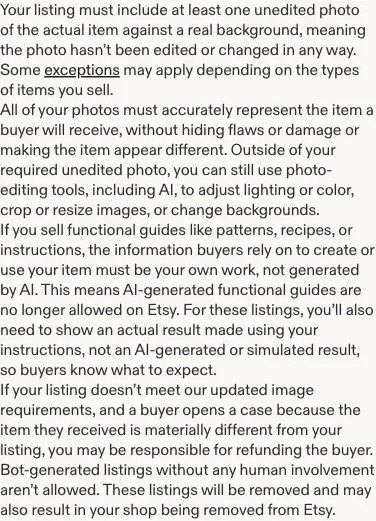
In plain English:
- One unedited photo. Your listing must include at least one photo of the actual item against a real background, and that photo must not be edited or changed in any way. Etsy says some exceptions apply depending on what you sell.
- Honest photos, everywhere. Every photo must show what the buyer will receive, without hiding flaws or damage. Outside the one required photo, you can still use editing tools, including AI, to adjust lighting or color, crop or resize, or change backgrounds.
- No AI-generated functional guides. If you sell patterns, recipes or instructions, the information buyers rely on must be your own work. You also need to show a real result made from your instructions, not an AI-generated or simulated one.
- Refund risk. If your listing doesn’t meet the image requirements and a buyer opens a case because the item is materially different from the listing, you may have to refund the buyer.
- No bot-only listings. Listings made by bots with no human involvement are removed, and Etsy says they can also get your shop removed.
Etsy also announced three things that are not rules. Its October 22 announcement said it would add guidance to the listing form that tells you when it detects AI-generated images, and later extend that guidance to existing images. It said it is investing in tools to better identify authentic versus misleading images and to detect and remove listings that use AI to create fraudulent inventory. And it said it would add a new reason to the “Report this item to Etsy” flag so buyers can report listings that may use misleading AI imagery. Etsy said that, to start, those reports will help it understand how members perceive potential AI misuse and won’t result in immediate enforcement action.
Etsy gives its reason in one sentence: “Today, many active buyers say they can’t tell which items involve AI-generated content. It’s become a top-three barrier to shopping more often on Etsy.” The announcement doesn’t say how many buyers were asked or how, so treat that as Etsy’s claim rather than a measured result.
Ossman also wrote: “These changes are our starting point, not the finish line.” Expect more.
What’s new and what isn’t
A lot of the panic came from treating every rule as new. Several aren’t. Etsy’s own pages and a 2024 news report let me sort them.
| Rule | Is it new? | What the source says |
|---|---|---|
| AI art with disclosure | No | Etsy “will continue to allow” AI-generated art when the seller plays a clear creative role and is transparent |
| Say AI was used, in the listing description | No | Etsy’s rule since July 2024, reported by TechCrunch: “Sellers must disclose within their listing description if an item is created with the use of AI” |
| Selling AI prompt bundles | No | Banned since July 2024: TechCrunch reported listings such as “10,000 Midjourney Prompts” being removed from that day |
| One unedited photo of the real item | New | Part of the October 22 announcement and policy update |
| AI-generated patterns, recipes, instructions | New | Etsy: AI-generated functional guides “are no longer allowed on Etsy” |
| Bot-generated listings | Etsy lists it among the October 22 changes | The announcement says bot-generated listings are not allowed, and the AI creations page says Etsy prohibits “entirely bot-generated AI content” |
| Refund liability for materially different items | Tied to the new image rules | Applies when a listing misses the updated image requirements |
If you read a post saying prompt packs were banned this week, or that Etsy just started asking for disclosure, it is two years of rules compressed into a headline. I wrote about the older disclosure rule in our July post on AI photos and disclosure, which still holds on the description line.
One more correction, because it’s circulating. Some seller blogs say Etsy introduced an AI checkbox, a mandatory switch to a “Designed by” label, or a count of removed listings in January 2026. Perplexity could not find an Etsy announcement of that, and neither could I. TechCrunch reported the “Designed by” label for AI-assisted items in July 2024. If a guide tells you to tick a specific box on the listing form, check it against your own listing editor and Etsy’s pages first. Etsy’s AI creations page doesn’t mention one.
The photo rule, step by step
The unedited photo applies to most products, so it’s the rule to start with. Here is how it works, using Etsy’s Listing Image Requirements page, which says at the bottom that it was last updated on October 22, 2026.
Step 1: take one plain photo of the real item. It should show the actual item against a real background. Etsy’s wording for most products is “at least one unedited photo of the actual item against a real background.”
Step 2: leave that photo alone. Etsy’s policy says to not use photo editing software or AI tools to alter this required photo. That means no crop, no straightening, no brightness fix and no background swap on that one file. Secondary coverage disagrees on how strict this is, but Etsy’s own wording doesn’t, and sellers in the Grok search found it strict.
Step 3: keep the original file. This is my advice, not Etsy’s rule. If a listing is ever questioned, the untouched camera original is the simplest proof.
Step 4: edit everything else honestly. Other photos can be edited, with AI if you like, provided the final result remains an accurate representation of the physical product. Etsy’s table of edits is short enough to read in a minute:
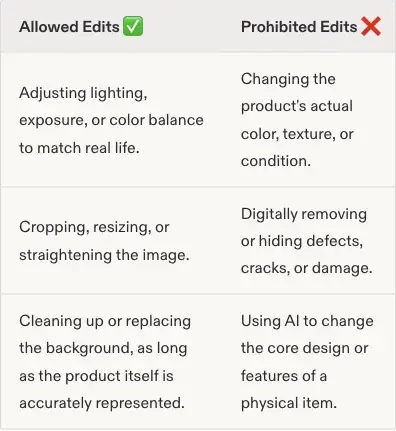
Step 5: put the clearest photo first, if you can. Etsy recommends that the first photo be “the clearest, most realistic representation” of the item. That’s a best practice, not a requirement. The rule says the unedited photo must be in the listing, not that it must be photo one. The Grok search flagged “it has to be the first photo” as a misreading.
Step 6: if AI edited your photos, say so. Etsy suggests noting in the listing description whether images were edited. Etsy puts this under best practices. A sentence like this works: “Photo 1 is unedited. Photos 2 and 3 use an AI-generated background; the item itself is unchanged.” That line is mine, not Etsy’s wording.
The consequence of getting this wrong is spelled out on the same page. If an item arrives materially different from the pictures and the buyer opens a case, Etsy may refund the buyer and you may be responsible for the refund. Etsy may also remove misleading listings, and repeated violations can lead to further action up to and including shop removal.
Patterns, recipes and instructions
If you sell a knitting pattern, a recipe or a build plan, this is the section that decides whether your shop has a problem.
Etsy defines functional instructions as content whose primary purpose is to instruct a buyer how to make, prepare, build, repair, use or complete a specific task. Its examples are craft patterns (knitting, crochet, sewing, embroidery, quilting, beading), recipes, building and woodworking plans, instruction or assembly manuals, and instructional guides or e-books that give directions for completing a task. So calling a pattern an “e-book” doesn’t take it outside the rule.
Etsy’s stated reason is practical: AI-generated instructions “may be more likely to contain errors or lead to poor results, and buyers often won’t discover the problem until they’ve already spent time and materials following them.”
Two things follow.
First, disclosure doesn’t save you. The rule is not “label your AI pattern”. It is that the instructions themselves can’t be AI-generated. A guide written by a chatbot and labeled honestly is still a banned listing.
Second, you need a real photo of a real result. Etsy’s image policy asks for at least one real, unedited photo of something made using your product, such as a finished crochet project or a flower grown from your seeds, and says AI-generated images can’t be the only ones showing the finished result.
What I couldn’t settle from Etsy’s pages is the edge: whether using AI to proofread, translate or tidy the formatting of instructions you wrote yourself counts as “generated by AI”. Etsy’s text says the information buyers rely on must be your own work and doesn’t address assistance. If your listings sit on that line, ask Etsy through Help and keep what they say. Until then, the safe approach is that every step, count and measurement in the pattern is yours.
AI art and the disclosure line
If you sell AI-assisted art, wall prints or digital downloads, your product type survived. Etsy’s own FAQ says it will keep allowing AI-generated art when sellers “play a clear creative role in what they create and are transparent about their process.” The example Etsy gives is a fantasy scene based on a seller’s original prompt or inputs and produced by an AI generator. Its AI creations page adds a custom portrait of a buyer’s pet generated with AI tools.
Two limits come with that. You must disclose that an item was created with AI, and you can’t present AI-generated work as handmade or entirely your own creation.
The rule says disclosure goes within the listing description. Etsy doesn’t prescribe a sentence. Here are examples of the kind of line that fits, written by me:
- “This artwork was generated with AI from my own prompts. I chose the composition and edited the colors and details.”
- “The illustration was created using AI from my original prompts and refined by me. A print partner prints it on the mug.”
Only claim what you did. If you didn’t edit anything, don’t say you refined it.
Don’t call AI art “handmade” anywhere in the listing. Etsy says you can’t misrepresent AI-generated work as handmade or entirely your own creation.
Don’t sell the prompts. Selling AI prompt bundles has been banned since 2024. Etsy’s reasoning is that the prompts are part of the creative process and shouldn’t be sold apart from the finished artwork.
Print-on-demand, digital downloads and custom work
The rule that confused sellers most is “one unedited photo”, because it doesn’t fit every product. Etsy’s image policy carves out exceptions by product type. This table puts them side by side:
| Your product | What the photo rule asks for | Etsy’s detail |
|---|---|---|
| Print-on-demand item | A stock photo mockup is allowed if its owner has authorized it | For your original design printed by a production partner on a standard base product, such as a t-shirt or mug |
| Digital download with visuals | The policy says it should include a visual preview or excerpt of the content buyers receive | Applies to digital downloads other than those with no visual elements |
| Digital item with no visuals, such as audio | Representative imagery is allowed | Including AI-generated images, as long as it doesn’t mislead buyers |
| Custom or made-to-order item | Photos of real, finished items you’ve made in the past | For customized items you make yourself, such as custom drawings or hand-monogrammed accessories |
| Pattern, recipe, seeds | At least one real, unedited photo of something made using your product | AI-generated images can’t be the only images of the finished result |
A few readings of that table that the Grok pass surfaced as misreadings online, checked against Etsy’s page:
- “Mockups are banned for print-on-demand.” No. Authorized stock mockups are an explicit exception.
- “You must print and photograph every digital download.” The policy says such downloads should include a visual preview or excerpt of the content. The Grok search reported seller claims that Etsy support said otherwise, but I couldn’t open those threads, so I’m treating that as unverified.
- “All AI is banned.” No, as covered above.
- “The unedited photo has to be the first photo.” No, at least one in the listing.
A shop check with a free chatbot
Etsy says existing listings that don’t meet the new image requirements need updating, and as of October 25 its text gives no deadline. So a sensible first move is to go through your top listings and sort them into “fine”, “fix a photo” and “fix the words”.
A free chatbot can do the boring part: it reads your listing, compares it with the rules you paste in, and tells you what to look at. Give it the photos, or a line describing each one: it only knows what you give it. It can be wrong, so treat its answer as a pointer and check against Etsy’s pages.
Open Etsy’s announcement and Listing Image Requirements, copy the relevant text, and paste it into a chat in ChatGPT, Claude or Gemini. Then paste in a listing and use this prompt. Each sentence is on its own line so Copy keeps it tidy:
You are helping an Etsy seller check one listing against Etsy's AI rules of October 22, 2026.
Use only the Etsy rule text I pasted above. If the text doesn't answer something, say so instead of guessing.
Here is my listing title, description, category and the product type.
Here is a list of my photos, one line each: what it shows and whether it was edited or AI-generated.
Check four things and answer each with Fine, Check or Fix.
1. Is there at least one unedited photo of the actual item against a real background? If I sell a pattern, recipe or seeds, is there a real photo of a result?
2. Do the other photos show the item as the buyer will receive it, without changing its color, texture, condition or design?
3. Is any part of what I sell AI-generated instructions (a pattern, recipe, plan or manual)?
4. If any part of the item was created with AI, does the description say so, and does anything call it handmade?
After the four answers, give me one corrected sentence for the description if it needs one.
Quote the line of Etsy's text each answer is based on.
Here is a sample answer, written by us to show the shape, for an invented listing: a printable “Sunday planner” PDF sold by a made-up shop, with three photos, one of them an AI-generated desk scene and none of them untouched. We didn’t run it in a chatbot, so your result will read differently.
1. Check. Your three photos are all a mockup of the planner on a desk. For a digital item with visuals, Etsy's policy says it should include a visual preview or excerpt of the content. If one photo is a real screenshot of a page, say so; if not, add one.
2. Check. The AI-generated desk scene is allowed as a secondary image if the planner looks the way a buyer will receive it. If the pages in the picture differ from the file, change the picture.
3. Fine. A planner isn't a functional guide, as I read Etsy's definition.
4. Check. The description doesn't say the desk scene was AI-generated. Etsy suggests noting whether images were edited, which is a best practice rather than a rule. Suggested line: "Photos 1 and 2 are mockups; photo 2 uses an AI-generated desk. The planner pages in them are the actual file."
Look at what the sample does and doesn’t do. It points to a line of Etsy’s text, it hedges where the text is silent, and it never claims to have seen a photo. If your chatbot’s answer sounds certain about the photos, treat that as a warning sign: it was only told what you typed.
Finish with a dated note for each listing you touched, such as “Oct 25: replaced photo 1 with an unedited one, added AI line to description”. If a listing is ever questioned, a dated record is the fastest way to show you acted.
The laws on top of Etsy’s rules
Etsy’s rules are one layer. Two legal rules sit above them, and Etsy points to one of them itself.
California SB 1050. Etsy’s announcement says that if you sell to buyers in the United States, California’s SB 1050 (signed September 16, 2026) may treat listing images or videos as advertisements that need a clear disclosure when they prominently feature an AI-generated synthetic performer. Etsy defines that as a figure, voice or representation created with generative AI that realistically appears to be a human performer but isn’t an identifiable real person. The law takes effect January 1, 2027. Etsy tells sellers to consult their own legal counsel.
I read two law-firm alerts, from Crowell and from BakerHostetler, and not the statute. Both say it was signed on September 16, 2026, and that it targets advertisements that prominently include a synthetic performer: one that appears in the foreground demonstrating or illustrating the product, voices the narration or commercial message, or reacts to it. They quote disclosure wording “substantially similar to” “This performance features a synthetic performer” or “No human performer is depicted.” Baker describes the law as covering audio, video and audiovisual ads, while Etsy mentions images too, so a still picture of an invented model is a question for a lawyer, not me. The two firms also describe enforcement differently (Baker mentions the attorney general and a fine of up to $2,500 per violation; Crowell says the existing false-advertising and unfair-competition laws apply and private lawsuits are possible), so I’m not going to state a penalty. For a typical shop the practical question is narrow: do any of your images or videos show an invented, realistic-looking person modelling or demonstrating your product?
EU AI Act, Article 50. Perplexity reports that the Commission’s guidance puts the application date at August 2, 2026, and that people who generate deepfake image, audio or video content must disclose its artificial origin. I didn’t open the Commission’s page, so read it yourself if you sell to EU buyers. Our July post covers what the rule asks of a typical shop. One point matters here: Etsy’s description line is not necessarily the same thing as a legal duty to disclose at the point someone sees an image.
Neither rule is an Etsy rule. Etsy’s own FAQ treats the California law as separate from its policy (“Beyond Etsy’s policies, are there other regulations I should be aware of?”), so check each on its own.
What this means for you
If you sell physical handmade goods and use AI only for marketing. The photo rule is the part that applies to you. Do two things: make sure one photo per listing is truly unedited, and make sure none of the edited ones change the item’s color, texture or condition. Your first action: open your best-selling listing and find the untouched photo. If there isn’t one, take one this week.
If you sell knitting, crochet or sewing patterns. The rule affects you most. If you wrote the pattern, you’re fine, but you need a real photo of a result. Your first action: check that each pattern listing has at least one real photo of a finished piece made from the pattern. If any pattern was written by an AI, the listing is a problem to remove, not to relabel.
If you sell AI-assisted art or digital prints. You can keep selling. Your first action: add a plain disclosure sentence to the description of every AI-assisted item, and remove the word “handmade” from any of them.
If you run print-on-demand. Authorized stock mockups from your production partner are explicitly allowed for your design printed on a standard product. Your first action: confirm that your mockups are provided by your partner and that the printed product looks like the mockup.
If you sell digital downloads, such as printables and templates. The photo rule isn’t “print everything”. The policy says the download should include a preview or excerpt of the content. Your first action: make sure at least one image is a real excerpt of the file, not an invented render.
If you run a shop with hundreds of listings. Don’t audit them all. Start with the top ten by sales, because they carry the refund risk and the attention. Your first action: run the shop check on the top five this week.
If you write recipes or build plans. The same rule as patterns covers you. Your first action: find any instructions that a chatbot drafted. Rewrite them yourself, test them and photograph a real result.
Problems sellers are hitting
These come from the Grok search of X and the web and from the policy text. I did not open the threads, so these are themes, not quotes, and I name no one.
“Unedited” turned out to mean untouched. Sellers are frustrated that the one required photo can’t be cropped or color corrected. Etsy’s page is clear that it can’t. Fix: take the photo carefully the first time, in daylight, on a plain surface, then upload the camera original. Put your corrected version second.
A raw photo shows things you’d rather hide. Sellers called raw photos with pets, feet or a cluttered room in the background intrusive. Etsy asks for a real background and doesn’t define it. Fix (my reading, not Etsy’s definition): a clear table or a plain wall is still a real place. If you’re unsure, ask Etsy through Help.
Pattern designers worry about the time to make and photograph a sample. Etsy requires a real result, and an AI render doesn’t count. Fix: make the pattern once yourself and photograph that piece.
Sellers can’t tell if print-on-demand mockups are still fine. The page says they are, for authorized stock mockups. Fix: check your partner’s terms, and keep the mockup faithful to how the product looks.
AI-art sellers fear being flagged anyway. Etsy says it is investing in tools to better identify authentic versus misleading images. Value Added Resource noted that Etsy hasn’t explained how detection will separate prohibited from permitted AI use, and I found no published error rate. A Perplexity search found research showing AI-image detectors make mistakes, but nothing that measures Etsy’s detector. Fix: keep a record. Work-in-progress files, prompts, your edits and the original photos help if a listing is removed. Etsy says you can appeal through the Policy violations page in Shop Manager.
Claims that Etsy will remove existing listings overnight. Etsy’s text says listings must be updated and that it will expand guidance over time, but its text announces no deadline as of October 25. Value Added Resource noted the same gap on October 24. Fix: don’t panic-delete. Work through your best sellers first.
Advice to tick a certain box. As above, I couldn’t verify it. Fix: follow the wording of Etsy’s rule: say it in the description.
What the rules can’t do
They can’t tell you how Etsy will detect AI. Etsy says it is investing in detection tools, and as of October 24 hadn’t described how they work. I found no published false-positive rate for them.
They can’t make your AI-written pattern acceptable. No label, test or disclosure turns an AI-generated functional guide into an allowed one.
They can’t guarantee a clean review. A report from a buyer is only a signal at first, according to Etsy, but a refund case isn’t.
They can’t settle your edge case. Proofreading, translation and similar help on your own instructions isn’t addressed in the text I read.
They don’t fix a missing legal check. The laws above stand apart from Etsy’s policy.
FAQ
Did Etsy ban AI art? No. Etsy says it will continue to allow AI-generated art when the seller plays a clear creative role and is transparent about the process. You must disclose, and you can’t present it as handmade.
Can I still use AI to edit my listing photos? Yes, except the one required unedited photo. Other photos can be edited if the item still looks the way the buyer will receive it. Etsy says editing to adjust lighting or color, crop, resize or change backgrounds is allowed.
Does the unedited photo have to be my first photo? No. Etsy requires at least one in the listing. It recommends making the first photo the clearest and most realistic one.
What counts as an unedited photo? A photo of the actual item against a real background that hasn’t been edited or changed in any way. Etsy’s FAQ adds that some exceptions apply depending on the item.
Are print-on-demand mockups still allowed? Yes, authorized stock photo mockups of your original design on a standard base product, such as a shirt or mug, are an exception.
Do I need a physical photo for a digital download? Etsy’s policy says most digital downloads should include a visual preview or excerpt of the content. Items with no visual elements, such as audio files, may use representative imagery, including AI-generated images, as long as it isn’t misleading.
Can I sell AI prompts? No. That ban dates to July 2024.
What happens if someone reports my listing? Etsy says the new report reason will, to start, help it understand how members perceive potential AI misuse and won’t result in immediate enforcement action. A removed listing can be appealed through the Policy violations page in Shop Manager.
The bottom line
Etsy’s October 22 update is narrower than the reaction to it. Etsy’s October 22 list has three changes at its core: one untouched photo of the real item, no AI-written patterns, recipes or instructions, and no bot-only listings. Two things you may think are new aren’t: disclosure of AI-made items in the description, and the ban on prompt bundles. And the thing most worth doing this week is dull: open your five best sellers and check the photos and the words.
Start with the check above. If it shows a listing that needs more than a fix, the course AI for Etsy Sellers (first 2 lessons free) walks through listing audits and rewrites, and Crafts & Handmade Business with AI (first 2 lessons free) covers the maker side of the business. Start lesson 1 free →
Which of your listings would you check first?
Sources
- Important updates to AI use on Etsy, Etsy Seller Handbook, October 22, 2026
- Listing Image Requirements, Etsy, last updated October 22, 2026
- What is Etsy’s stance on AI creations?, Etsy Seller Handbook
- Etsy updates AI use policies to emphasize craftsmanship, Retail Dive, October 23, 2026
- Etsy Bans AI-Generated Patterns, Tightens Listing Photo Rules, Value Added Resource, October 22, 2026 (updated October 24)
- TechCrunch’s report on Etsy’s July 2024 generative AI policy, July 9, 2024
- California Follows New York’s Lead in Requiring AI “Synthetic Performer” Disclosures in Advertising, Crowell
- Roll the disclosures: California enacts synthetic performer disclosure law, BakerHostetler
- Do You Have to Tell Buyers Your Photos Are AI? Etsy and Shopify Rules, FindSkill.ai, July 12, 2026