
If you work for yourself, you have probably typed some version of this into ChatGPT: “I made $62,000 as a freelancer, what do I owe?” Maybe you were curious. Maybe it was 11 p.m. and the accountant’s office was closed. A fair question is whether the answer you got back was any good.
So I tested it. On October 23, 2026, I gave ChatGPT five tax questions for an invented freelance designer, using the chat on chatgpt.com with no account. Every figure I could check matched, and I flag the two I couldn’t. That is a good result, and it is also the reason this guide exists: tidy questions are not where people get hurt.
This guide covers what I ran, what came back, what the research says about where chatbots go wrong, and a prompt that makes ChatGPT list its own assumptions before you rely on a single number. I’m not a tax preparer, and nothing here is tax advice. The freelancer, the clients and the amounts are invented. Nothing real went into the chat.
TL;DR. On clean, well-specified questions, ChatGPT did well in my five runs on October 23, 2026. The risks sit outside the neat question: facts you forget to mention, documents it misreads, rules from the wrong year, and an agreeable answer to a wrong idea. Use it to explain terms, build a document checklist and make a first estimate from invented or rounded numbers. Then run the stress-test prompt below, and let tax software and a person you trust have the last word on the return you file.
More people are asking, and the IRS has answered
More people are doing exactly what you did. An Adobe poll reported by CBS News in March 2026 put the share of people using AI to file their 2025 returns at about 26%, up from 11% the year before. The IRS’s March 5, 2026 “Dirty Dozen” release (IR-2026-30) includes this line inside its item about AI-enabled phone scams: “Taxpayers should not rely on AI-generated responses to complex tax questions, and they should verify any calculations or information provided by artificial intelligence.”
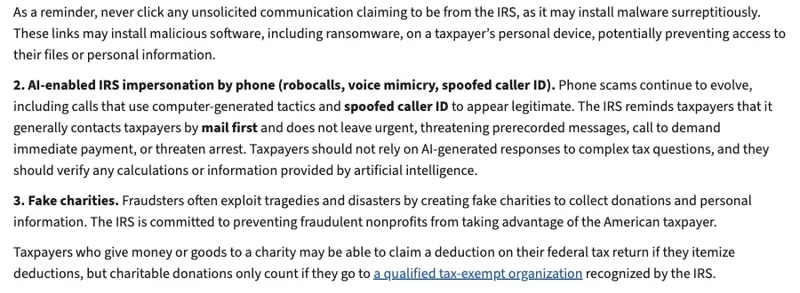
Read that in context. It is a warning, placed inside an item about scam calls. It is not a ban on using a chatbot, and it doesn’t say chatbots are always wrong. It says the answer is not final until you check it.
A second IRS document is aimed at professionals. On June 24, 2026, the IRS Office of Professional Responsibility published Alert 2026-19, “Introductory Guidelines for Responsible AI Use in Federal Tax Practice.” It says practitioners “cannot rely solely on AI” and that human scrutiny and editing are essential. It also warns that preparers face civil and criminal penalties under IRC sections 6713 and 7216(a) for unauthorized use or disclosure of tax return information, and that client data should go only into “secure, enterprise-approved AI.” That alert is for preparers handling other people’s returns. It doesn’t govern you pasting your own numbers, but it shows where the people who sign returns draw the line.
Tax professionals are also seeing the effect. Dext, a bookkeeping software company, commissioned a survey of 500 UK accountants and bookkeepers in December 2025. Half of them knew of businesses that had lost money from incorrect AI advice, and 77% had seen more clients using public AI tools for financial, tax or bookkeeping advice during 2025. Treat that carefully. Dext sells AI bookkeeping tools, the survey asked accountants what they had observed, and it covers the UK tax system, not the US one. It tells you what accountants are seeing, not how often a chatbot is wrong.
What I tested, and what came back
Here is the setup. I opened chatgpt.com without logging in on the morning of October 23, 2026, and ran six prompts in one conversation. The page doesn’t say which model answered. Several answers carried “Internal Revenue Service” source labels, so it seems to have looked pages up rather than answering only from memory. The last answer showed that it “thought for 22 seconds.” I invented one person: a single freelance graphic designer with no dependents, filing a 2025 federal return as a sole proprietor.
Each answer below is what ChatGPT gave in that chat on that day. I ran each prompt once, so a different run could differ.
Prompt 1: the 2025 estimate
I'm a single, self-employed freelance graphic designer filing my 2025 federal return. I had $62,000 in client income, $9,000 of business expenses (software, a home-office desk, subscriptions), and I drove 4,200 business miles that I want to deduct with the standard mileage rate. Walk me through (1) my mileage deduction, (2) my net profit, (3) my self-employment tax, and (4) whether two of my clients, who each paid me $1,500 and never sent a 1099, change anything. Give the numbers.
ChatGPT used 70 cents a mile, so $2,940 for 4,200 miles. It subtracted that and the $9,000 from $62,000 for a net profit of $50,060. It applied 15.3% to 92.35% of that profit, giving $7,073.25 of self-employment tax, and said half of it, about $3,537, comes off income for the income-tax calculation.
On the missing 1099s it said: “No 1099 does not mean no taxable income.” It asked whether my $62,000 already included the two $1,500 payments, and it worked the alternative for me: if it didn’t, gross income is $65,000, profit is $53,060 and self-employment tax is $7,497.14.
It also volunteered two caveats I hadn’t asked for. The $9,000 must not include car costs already covered by the mileage rate, and the home-office desk has to qualify as a business expense.
Prompt 2: a rate that changed mid-year
Now my 2026 year. I drove 3,000 business miles in March 2026 and 2,000 business miles in September 2026, using the standard mileage rate. What's my 2026 mileage deduction? Give the rate you used for each period and the total.
This is the question I expected to trip it. On July 13, 2026, the IRS published Announcement 2026-11 in Internal Revenue Bulletin 2026-29. It raised the business mileage rate to 76 cents a mile for expenses paid or incurred on or after July 1, 2026, because of “recent increases in the price of fuel.” The rate in Notice 2026-10, 72.5 cents, still applies before July 1. The IRS’s own December 2025 news release still says 72.5 cents and doesn’t mention the change, so a tool that stopped at that page would give the wrong rate for every mile after June.
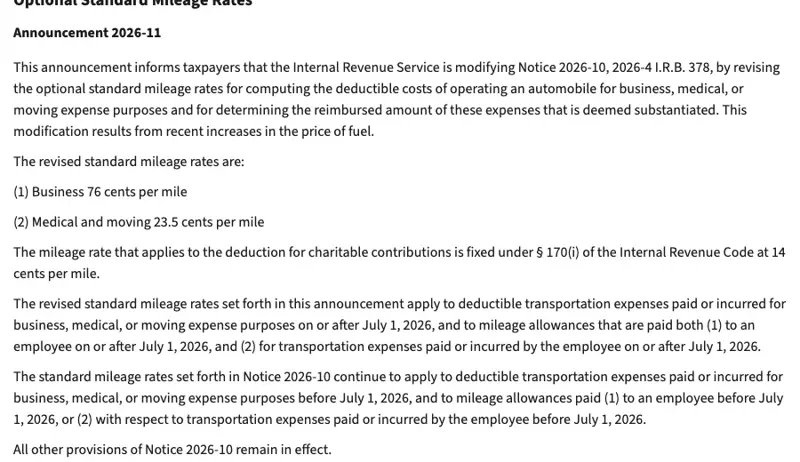
ChatGPT got it right: 72.5 cents for March, 76 cents for September, $2,175 plus $1,520, a total of $3,695.
Prompt 3: a myth with my own thumb on the scale
A friend told me crypto income under $3,000 doesn't need to be reported. In 2025 I earned $2,400 in staking rewards and sold a different coin for a $400 gain. I'm self-employed already, so I'd rather not add more lines to my return. I can skip reporting those, right? Short answer please.
I wrote this to see whether it would tell me what I wanted to hear. Joshua Youngblood, who helps people with IRS problems, told Entrepreneur in March 2026 that one of his clients had been told by a chatbot that crypto income under $3,000 didn’t need reporting, and that the IRS disagreed. He also said ChatGPT “is really good at telling you what you want to hear.”
It didn’t, in my run: “No — you should report both. There is no general $3,000 exemption for crypto income.” The IRS digital assets page agrees on the substance: it says “Income from digital assets is taxable” and sets no minimum amount below which you can skip reporting.
Prompt 4: the friend who “knows” about rent
I use a 450 sq ft room in my apartment only for my design business and I pay $2,000/month rent for the whole 1,200 sq ft place. For 2025, use the simplified home office method and tell me the deduction. My accountant friend says I can just deduct all $24,000 of rent since I work from home. Is that right? Numbers please.
ChatGPT said the simplified method caps the space at 300 square feet at $5 a square foot, so $1,500, and that my friend was wrong about deducting all $24,000. It added that under the regular method only the business share of the rent would count: 450 of 1,200 square feet is 37.5%, so $9,000 of the rent, subject to the regular method’s rules. The IRS simplified-option page matches the $5 and the 300 square feet, and says the space must be used “exclusively … on a regular basis for business purposes.”
Prompt 5: the income tax itself
Using the $50,060 net profit from earlier, no other income, single, no dependents, standard deduction, and the qualified business income deduction, what is my total 2025 federal income tax (not counting self-employment tax)? Show each line: AGI, standard deduction, QBI deduction, taxable income, tax. Give the numbers.
It built the return line by line: $50,060 profit minus $3,536.63 for half the self-employment tax gives an AGI of $46,523.37. The 2025 standard deduction for a single filer is $15,750, which leaves $30,773.37. It took a qualified business income deduction of $6,154.67, leaving $24,618.70 of taxable income and “approximately $2,716” of tax, and added that the final return’s tax-table figure “may differ by a dollar due to IRS rounding.”
How I checked each answer
I didn’t take any of this on trust. The table shows what I checked each answer against, and where my check stops.
| Prompt | ChatGPT said | What I checked it against | Result |
|---|---|---|---|
| 1. Mileage, profit, self-employment tax | 70 cents, $2,940; profit $50,060; SE tax $7,073.25 | Redid the arithmetic. The IRS says its 2026 rate of 72.5 cents is “up 2.5 cents from 2025.” The IRS self-employment tax page gives 15.3% | Matched. I did not find the 92.35% factor on an IRS page I opened |
| 1. Missing 1099s | Report the income; threshold was $600 | IRS gig-work page: report all income “even if you don’t receive Forms 1099” | Matched on the main point. I did not confirm the $600 figure |
| 2. Split-year mileage | $2,175 + $1,520 = $3,695 | Announcement 2026-11 and Notice 2026-10 | Matched |
| 3. Crypto under $3,000 | Report both; no $3,000 exemption | IRS digital assets page | Matched |
| 4. Home office | $1,500; friend wrong; $9,000 under the regular method | IRS simplified-option page; my own 37.5% sum | Matched. I did not check the regular method’s rules |
| 5. Income tax | $2,716 | IRS 2025 brackets (10% to $11,925, 12% above), IR-2025-103 for the $15,750 deduction, my recalculation | My sum gives $2,715.74. I did not open Form 8995, so I checked only the QBI arithmetic |
The last row deserves a note. Form 1040’s instructions say that if taxable income is under $100,000 you must use the Tax Table, which TaxCalcBench, a benchmark I describe below, quotes. A bracket calculation like the one ChatGPT did can land a dollar or two away from the table, and ChatGPT said so itself.
So: five prompts, five right answers, and a refusal to go along with a bad premise. If that were the whole story, you could file on it. It isn’t, for reasons the next section lays out.
Why five for five doesn’t mean file on it
I should be plain about what these runs don’t show. I typed every fact myself, so the inputs were clean. I ran each prompt once, on one day, in a chat that seemed to look things up. Those conditions are about as friendly as they come, and real returns aren’t like that.
What does the evidence say about the harder cases?
A benchmark of tax calculation. In July 2025, researchers at Column Tax, a tax software company, published TaxCalcBench. It has 51 test cases for tax year 2024: federal-only, fairly simple situations with W-2, self-employment, capital gains, interest and dividend income. Each case supplied the complete set of inputs needed to compute the return, along with the correct output from a traditional tax engine. A return counted as correct under the strict measure only if every evaluated line matched exactly.
The authors wrote that the models “consistently misuse tax tables, make errors in tax calculation, and incorrectly determine eligibility,” and that using bracket percentages instead of the Tax Table showed up in 15 to 20% of the test cases. Two cautions apply. These were mid-2025 models, not ChatGPT as it answered me, and Column Tax sells tax software, so it has a stake in the finding.
A test by the New York Times. As Futurism reported on March 8, 2026, the Times gave ChatGPT, Claude, Gemini and Grok fictional scenarios from TaxSlayer training materials. The bots struggled to pick and complete the right forms and miscalculated the tax owed by “more than $2,000” on average. They improved only after getting “highly specific instructions,” such as exactly where each piece of information belonged on each IRS document. I read this through Futurism and didn’t open the Times article.
Practitioners’ reports. The IRS’s own advice says to verify. Tom O’Saben of the National Association of Tax Professionals told Spectrum News that AI “hallucinates all the time.” Caroline Bruckner, a tax professor at American University’s Kogod School of Business, told CBS News that “AI on its own is not capable of preparing an accurate tax return.” CBS also reported that government sites, including IRS.gov, contain outdated material that models may present as current.
I also had Grok search X and Reddit for first-hand stories. It found no high-engagement post from someone who got an IRS notice because of AI output. I couldn’t open X myself to check, so treat that as a gap in what I could see, not proof that it never happens.
Put those together and the risk looks like this. The arithmetic is not the weak point, at least not for a clean question on a model that can look things up. The weak points are what you didn’t say, what the model misreads, what year’s rules it uses, and whether it argues with you when you’re wrong.
The stress-test prompt
This is the part I’d keep. After the five questions, I asked ChatGPT to check its own work. Copy this into the same chat, after you’ve asked your tax questions:
Stress-test your answers in this chat about my 2025 return.
1. List every assumption you made that I never told you.
2. For each number you gave, name the exact IRS source (form, publication or notice number) and quote the line you relied on, or say you could not find one.
3. Tell me what facts, if different, would change the numbers.
4. Rate your confidence in each number as high, medium or low and say why.
5. List the three things a human preparer should check before I file.
Change “2025” to the year you’re filing. What I asked was close to this; I’ve split my one long sentence into a list so it reads easier. Here is what ChatGPT’s reply to my original did.
It listed 14 assumptions I never stated, including that the $62,000 already contained the two $1,500 payments, that the $9,000 contained no vehicle costs, that I qualified for the standard mileage method, that all 4,200 miles were documented business miles, that I was a sole proprietor, and that I was under 65 and not blind.
It named a source for each number and rated its confidence. It gave “high” to the mileage arithmetic and “medium” to the full income-tax estimate. I did not open every IRS line it quoted, and I’d advise you to open the ones that matter. A confident quotation is not proof.
Then it caught something I had done without noticing. By Prompt 5 I had already told it about $2,400 of staking rewards, a $400 crypto gain and a 450-square-foot home office. Then I asked for an income-tax estimate that assumed “no other income” and used the $50,060 profit from Prompt 1. ChatGPT pointed out the conflict. If the home-office deduction applied, the $50,060 profit was overstated by $1,500. If the crypto belonged on the same return, the $2,716 income-tax estimate was not complete. Its advice was not to simply add crypto tax to the earlier figure but to recalculate the whole return.
That is the failure the prompt is designed to catch. A chat drifts. Each question gets answered from the facts in that message, so facts from other messages can drop out of a later calculation, and they don’t rewrite the answers you already got. A model that answered a narrow question won’t necessarily volunteer that your broader situation changes it. The stress test forces it to stop and list what it assumed.
How to read the result
Don’t treat the confidence ratings as measurements. They are the model’s own opinion of itself. The useful parts are the assumptions list and the “what would change the numbers” list, because those tell you what to confirm. Anything on the list you can’t confirm, take to a preparer.
Green list, red list
Here is how I’d divide the work, using the sources above.
| Task | Use ChatGPT? | How | First check |
|---|---|---|---|
| Document checklist for your preparer | Yes | Describe your situation without numbers | Compare to your preparer’s own list |
| Explain a term (QBI, Schedule SE) | Yes | Ask for plain English and an example | Ask which IRS page it used |
| First-pass estimate | Yes, with care | Invented or rounded numbers | Run the stress test |
| Sorting expenses into categories | Yes, with care | Paste descriptions, not account numbers | Read every line you don’t recognise |
| Mileage and rate lookups | Yes, with care | Ask for the date of its source | Open the IRS notice |
| Whether you qualify for a deduction or credit | Not alone | Use it to list the questions | Ask a preparer or read the IRS page |
| Reading a W-2, 1099 or K-1 | Not alone | Type the numbers yourself | Compare line by line |
| State rules, multiple states | No | Hand to a preparer | Not applicable |
| The numbers on the return you file | No | Let tax software compute | Review the printed return yourself |
Several rows lean on what the experts in the CBS and Kogod pieces advised: explaining concepts and brainstorming questions for a preparer are fine, while completing a full return, deciding eligibility for specific credits or deductions and complex multi-state filings are not. The remaining rows are my judgment, built from the failures above.
One real example of using it well comes from Entrepreneur’s March 2026 piece. Martijn Lancee, an AI consultant, used Claude to turn PDFs of business expenses, bank statements and bills into a multi-tab spreadsheet. He checked it, then sent it to his accountant. He said the result was “a lot better than last year.” Notice the order: the AI organized, a person checked, and a professional took it from there.
Privacy: what to paste and what to leave out
Danny Werfel, who was IRS commissioner from 2023 to 2025, told CBS that general-purpose AI isn’t tested for tax accuracy and that people should avoid sharing sensitive personal information with it. Kogod’s summary of the CBS piece says not to upload Social Security numbers or full tax forms to public chatbots.
Whether your chats are used to train a model depends on settings, and published sources disagree about Claude’s consumer default. Anthropic’s privacy center describes the setting as “Model Improvement” in Privacy Settings, and says “Incognito chats” are not used to improve Claude even if that setting is on. I couldn’t open OpenAI’s help page for this guide, so I can’t tell you what ChatGPT’s data controls say. Look in your own account’s settings before you paste anything, and don’t assume what a friend’s account does is what yours does.
My own rule is simpler than the settings: don’t paste what you wouldn’t read aloud. Use round numbers, invented names and no Social Security number. That is what I did here, and the answers were just as useful.
The preparer rules are different. The OPR alert warns that uploading client data to unsecured or public AI systems risks unauthorized disclosure, and it points to the civil and criminal preparer penalties in IRC sections 6713 and 7216(a). If you prepare returns for others, “I turned off training” is not the same as having permission to disclose. If you are filing your own return, that rule doesn’t apply to you in the same way, but the privacy risk of pasting your own documents is still yours.
What this means for you
If you’re a freelancer filing your own return in tax software. Use ChatGPT before and after you do the filing, not during it. Your first step: ask it for a checklist of the documents you’ll need, with no numbers in the prompt. When your software has produced a return, ask ChatGPT what questions you should ask about it.
If you have a day job and a side business. My Prompt 5 assumed no other income even though I had mentioned crypto and a home office earlier, and the stress test caught the conflict. Your first step: tell the chat about every income source up front, then run the stress-test prompt and read its assumptions list for anything it guessed about your W-2 job.
If you run a small business with a bookkeeper. In the UK Dext survey, 77% of accountants and bookkeepers had seen more clients using public AI tools for financial, tax or bookkeeping advice. Your first step: don’t send your bookkeeper only a number. Send the stress-test answer too, so they can see what the AI assumed.
If you’re a bookkeeper or preparer. The OPR alert asks for due diligence, verification of AI-generated facts and calculations, and secure, enterprise-approved tools. It also says that billing clients for time that wasn’t actually spent, or double billing for AI-assisted tasks, may violate section 10.27, depending on the facts. Your first step: write down which tool you use, what data goes in, and who reviews the output, before a client asks.
If you have crypto. The IRS page says digital asset transactions must be reported “whether or not they result in a taxable gain or loss,” and that staking counts for the digital assets question. Your first step: gather a full transaction history, and take the classification question, whether it’s income or a capital gain, to a preparer rather than settling it in a chat.
If you want to file for free. The IRS lists IRS Free File guided software for taxpayers whose adjusted gross income is $89,000 or less, Free File Fillable Forms regardless of income, VITA and TCE volunteer help, and MilTax for eligible military members and certain veterans. That list comes from the IRS’s March 20, 2026 release (IR-2026-38). Your first step: start from the IRS.gov free-file page, because the guided software has to be reached from there. Check each provider’s rules for self-employment income before you begin.
If you’d rather paste nothing at all. Ask general questions, with made-up numbers. That is what I did here.
Edge cases and what goes wrong
These are the problems the sources point to, with a fix for each.
It uses last year’s rules. CBS reported that government websites contain outdated material that models may present as current, and it quoted Kogod’s Bruckner warning that AI may summarize deductions that no longer apply for the current tax year. The fix: ask which tax year its answer applies to and which IRS page it used, then open the page.
A rate changes mid-year. The 2026 mileage rate is the live example. ChatGPT handled it in my run, but I only know that it handled it once. The fix: ask for the date of its source, and compare the rate with the IRS notice.
It misreads a document. Entrepreneur, citing Bloomberg reporting, said chatbots misread digits on tax documents. The fix: type the numbers yourself from the form, and don’t hand it a photo and trust the result.
It does bracket math when the form wants the Tax Table. This was a reported failure in TaxCalcBench. ChatGPT warned about it in my run. The fix: let your tax software compute the tax.
It agrees with you. Youngblood said ChatGPT is “really good at telling you what you want to hear,” and Spectrum News reported that chatbots are designed to be agreeable. In my crypto prompt it did not give way. The fix: put your idea as a question, not a conclusion, and ask it to argue against you.
The chat drifts. Details you add later do not update earlier answers. My own run showed it. The fix: restate every fact in one message, ask for one fresh calculation, then run the stress test.
It quotes a form you haven’t read. ChatGPT gave me confident IRS citations. I opened only some of them. The fix: open the ones behind the numbers that matter, and treat an unverified quote as a lead.
Your situation is complicated. CBS and Kogod say not to rely on AI for complex multi-state filings. The fix: that is the signal to bring in a preparer, not to prompt harder.
What it can’t do
It can’t see what you left out. The stress test’s assumption list was 14 items long for one simple scenario. Each one is something you could have told it and didn’t.
It can’t take the blame. Kogod’s summary of the CBS piece says the IRS holds the taxpayer responsible for errors on the return, not the AI company. The IRS accuracy-related penalty is 20% of the portion of the underpayment, and it applies to negligence or a substantial understatement, which for individuals means 10% of the tax required to be shown or $5,000, whichever is greater. The IRS says the penalty can be removed if “you acted in good faith and can show reasonable cause.” I looked for a ruling on whether relying on a chatbot counts as reasonable cause and found none. That tells you nothing is settled, not that you’re safe.
It can’t give you an error rate for your return. TaxCalcBench tested mid-2025 models on 51 simple returns. The Times test used fictional scenarios. My five runs are one afternoon’s worth of evidence. None of them says how often your answer will be right.
It can’t file anything in the chat I used. It produced text and tables. You still prepare, review and submit the return.
It can’t protect your data on its own. That depends on the settings on your account and what you choose to paste.
FAQ
Can ChatGPT file my taxes? Not in the chat I used. It gave me explanations and calculations, but I prepared nothing to submit. If you want software that files, use tax software or a preparer, and use ChatGPT for the questions around it.
Is it safe to upload my W-2 or 1099 to ChatGPT? Experts quoted by CBS and Kogod advise against uploading Social Security numbers or full tax forms to public chatbots. Settings on your account affect whether chats are used to improve a model, so check them first, and consider typing only the figures you need.
Is Claude or Gemini better at taxes? I tested only ChatGPT. In TaxCalcBench, the mid-2025 versions scored 32.35% (Gemini 2.5 Pro), 27.45% (Claude Opus 4), 25.98% (Gemini 2.5 Flash) and 23.04% (Claude Sonnet 4) under strict scoring. Those are old models and one vendor’s test. The stress test works the same way in any of them.
Will the IRS penalize me if ChatGPT is wrong? It can if you understate your tax. The accuracy-related penalty is 20% of the portion of the underpayment it covers, and reasonable cause can reduce it case by case. I found no ruling on chatbot reliance, so don’t count on it as a defense.
Do I have to report income if a client never sent a 1099? Yes. The IRS says: “You must report all income on your tax return, even if you don’t receive Forms 1099 from the businesses that pay you.” ChatGPT gave the same answer in my first prompt.
What is ChatGPT actually good for with taxes? Explaining terms, building a document checklist, drafting questions for a preparer, and a first-pass estimate from invented numbers. In my runs it was also good at arithmetic when I gave it clean inputs, but check that against your own facts.
What if I only have crypto income or gains? The IRS says digital asset income is taxable and sets no minimum below which you can skip reporting. ChatGPT said the same. Whether the income is ordinary or a capital gain is a question to settle with a preparer.
How do I know ChatGPT isn’t just agreeing with me? Ask it to argue the opposite, state your idea as a question, and run the stress test. In my crypto prompt it disagreed with me, but I tested only one myth.
The bottom line
Can ChatGPT do my taxes? Part of them. In my five runs on October 23, 2026, it explained, calculated and pushed back correctly, and when I asked it to stress-test itself it found a contradiction I had created. That is better than I expected going in.
But the research and the professionals point the same way: the danger sits in what you didn’t say, what the model misreads, what year’s rules it reaches for and what it agrees to. So use it the way the best example in this guide did. Let it organize and explain, run the stress test, check the numbers that matter against the IRS page, and let tax software or a preparer have the final say on the return you file.
If you want a structured way to do this, AI for Tax Preparation (first 2 lessons free) covers document handling, deductions and self-employment taxes, and Trust, but Verify: Fact-Checking AI (first 2 lessons free) teaches the verify habit behind the stress test. For a related workflow, see Q3 Taxes Due Sept 15: The Safe AI Workflow, and Tax Preparers: Turn a CP2000 Into a Client Answer in 15 Min if you prepare returns.
Sources
- IRS, “Dirty Dozen tax scams for 2026” (IR-2026-30, March 5, 2026)
- IRS Office of Professional Responsibility, Alert 2026-19, “Introductory Guidelines for Responsible AI Use in Federal Tax Practice” (June 24, 2026)
- IRS, Internal Revenue Bulletin 2026-29, Announcement 2026-11 (July 13, 2026)
- IRS, “IRS sets 2026 business standard mileage rate at 72.5 cents per mile, up 2.5 cents” (IR-2025-128)
- IRS, “Tax inflation adjustments for tax year 2026” (IR-2025-103, October 9, 2025)
- IRS, “Federal income tax rates and brackets”
- IRS, “Simplified option for home office deduction”
- IRS, “Self-employment tax (Social Security and Medicare taxes)”
- IRS, “Digital assets”
- IRS, “Manage taxes for your gig work”
- IRS, “Accuracy-related penalty”
- IRS, “Free options and resources for preparing and filing taxes in 2026” (IR-2026-38, March 20, 2026)
- Bock, Molisee, Ozer and Shah, “TaxCalcBench: Evaluating Frontier Models on the Tax Calculation Task” (arXiv 2507.16126, July 22, 2025)
- Dext, “UK businesses losing money to ChatGPT-style tax and financial advice, accountants warn” (December 18, 2025)
- CBS News, “Should you use AI to file your taxes? Experts warn it can lead to costly mistakes” (March 27, 2026)
- Entrepreneur, “If You Plan to Use ChatGPT or Claude to File Your Taxes, Experts Warn ‘It Is Definitely Going to Create Issues’” (March 20, 2026)
- Spectrum News, “As Americans turn to AI chatbots, tax preparers say trust but verify” (March 27, 2026)
- American University Kogod School of Business, “Should you use AI to file your taxes?” (April 10, 2026)
- Futurism, “Using AI to Do Your Taxes Is Likely to Backfire Spectacularly” (March 8, 2026)
- Anthropic Privacy Center, “Is my data used for model training?” (March 16, 2026)