
It’s a Saturday in June, you’re elbow-deep in a clay-bar job, and your phone buzzes for the ninth time: “hey how much for a full detail on an SUV?” You’ll see it in two hours when you finish. By then they’ve already booked the guy who answered in ninety seconds. That’s not a marketing problem. That’s a response-time problem — and it’s the single most expensive habit in mobile detailing.
The numbers are brutal: a lead you reply to within five minutes converts at around 25–32%. The exact same lead, answered an hour later, converts at 3–5%. The industry-average first response is something like 42 hours. Summer is your peak season, your phone never stops, and every “how much?” you can’t answer mid-job is roughly $200 walking to a competitor. This is exactly the gap ChatGPT closes — not by detailing the car, but by handling the typing while your hands are busy.
What detailers are actually using AI for (and what’s just hype)
Scroll detailing X/Twitter for ten minutes and you’ll see two kinds of posts. One is the AI-agency crowd selling “fully autonomous booking systems” and “AI receptionists” for a few hundred a month. The other is actual detailers, quietly using a $20 ChatGPT account to do four boring things faster:
- Turn before/after photos into a week of social posts. You shoot 5–6 photos per job anyway; AI turns each into a caption that sells the transformation.
- Fire back instant “how much” replies that quote a range and push to booking, instead of leaving the DM on read.
- Write booking confirmations, reminders, and review replies so the follow-up actually happens.
One 2026 detailing marketing guide found shops that post consistent before/afters with geo-tags pull 25–40% more inquiries than shops that rarely post. Another reported solo operators cutting admin time from about 8 hours a week down to 2. You don’t need an AI agent army for that. You need three saved prompts.

The before/after caption engine
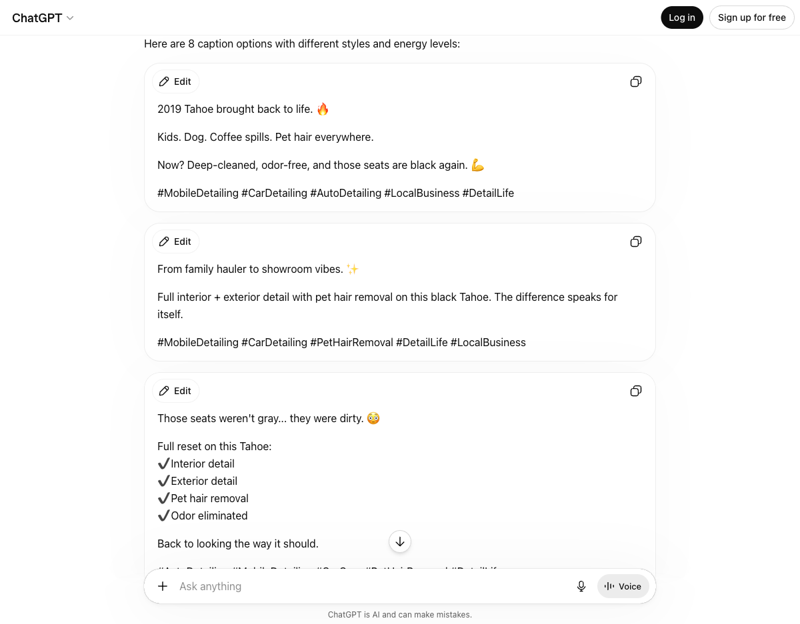
This is the prompt to learn first, because it solves the thing detailers hate most — writing captions. Feed ChatGPT the package and the car, get back a stack of ready-to-post captions:
You write social media captions for a mobile car detailing business.
Tone: confident, real, a little hype — not corporate. Short.

The job:
- Service: [e.g. full interior + exterior detail, pet hair removal, ceramic spray]
- Vehicle: [e.g. 2019 black Tahoe, was rough — kids, dog, coffee spills]
- The transformation: [e.g. seats went from gray to black, no more smell]

Give me 8 Instagram captions. Mix it up: a couple short punchy ones,
one that tells the before/after story, one with a soft CTA to book.
Add 5 relevant local + detailing hashtags at the end.
Do this once on a Sunday with three jobs’ worth of photos and you’ve got a week of content. Post it, geo-tag it, done. The photos are real — you took them. ChatGPT only wrote the words.
The “how much?” reply, the booking message, and the review reply
The instant quote reply. Save this and tweak it per inquiry:
Write a friendly, quick reply to a customer asking the price for
[service] on a [vehicle type]. Give a price range of [$X–$Y],
say what's included in one line, and ask one question to book
(their location and what day works). Keep it under 5 sentences,
sound like a real detailer texting back, not a bot.
The booking confirmation + reminder:
Write a short booking confirmation text for a mobile detail on [date/time]
at [location], service [X], price [$]. Friendly. Add a one-line note about
where to park / access to water if needed. Then write a separate
24-hour reminder text.
The review reply (do these the same day):
Write a warm, specific 2-sentence reply to this review. Mention the car
or service, sound human. Review: [paste it]
Four prompts. That’s the whole system. It runs the “front desk” so you can stay on the tools.
What this means for you
If you’re a solo mobile detailer: this is your unfair advantage. You can’t answer DMs with a buffer in your hand — but you can batch a week of captions Sunday night and keep three saved replies in your notes app to fire off between jobs. Reply speed is the one thing you can beat bigger shops on.
If you run a small shop with a couple of techs: put the four prompts on a shared doc so whoever’s at the desk sounds consistent and fast. The win is never leaving an inquiry sitting for two hours during the summer rush.
If you’re a weekend side-hustle detailer: captions and instant replies are how you look established before you are. A tight, consistent feed and a sub-five-minute reply make a one-truck operation read like a real business.
If you’re skeptical of “AI for detailing”: you’re right to be — most of what’s sold to this trade is overpriced automation. But there’s a difference between paying $300/month for an “AI agent” and pasting a free prompt to write captions faster. Start with the free version. If it saves you one Saturday evening of thumbing out replies, it earned its keep.
What you should never let AI do
This is the part that protects your reputation, so don’t skip it.
- Never let AI promise a result on a car it hasn’t seen. “Yes we can get that scratch out” or “your paint will look brand new” — sight unseen — is how you get a furious customer and a one-star review. AI doesn’t know the paint condition, the prior bodywork, or what’s under the swirl. Quote a range, inspect in person, then promise.
- Never post AI-generated “before/after” images. Detailing audiences are sharp and they will call out a faked transformation instantly — it torches trust faster than anything. Your real photos are your best marketing. Use AI for words, never for fake results.
- Never let a bot quote a firm price on a heavily soiled or damaged vehicle. Pet hair, mold, biohazard, oxidized paint — those need your eyes and your pricing, not a generic auto-reply.
- Never paste a customer’s address or payment info into ChatGPT. Keep prompts about the car and the service, not the person.
- Never send AI text without a read-through. A generic, robotic reply is worse than a slow human one in a relationship business. You’re the editor.
The bottom line
Detailing is one of the most physical, hands-on trades there is — AI is never going to clay a panel or shampoo a back seat. That’s exactly why the smart play is to let it take the office work that’s quietly costing you jobs: the slow replies, the empty social feed, the follow-ups you never send. Learn four prompts, win back your evenings, and stop losing the summer rush to whoever texts back first.
Want the full playbook — setting up ChatGPT from scratch, building your saved-reply library, and a content calendar that actually fills the schedule? Our Social Media Marketing with AI course covers the caption-and-content side, and Claude for Small Business handles the customer-communication system end to end.