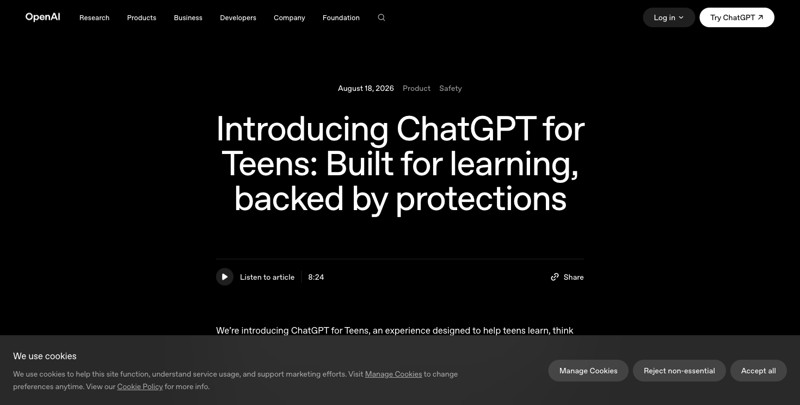
On August 18, 2026, OpenAI quietly flipped a switch that changed ChatGPT for millions of teenagers overnight — without a single one of them clicking “upgrade” or agreeing to anything. If the company’s system thinks you’re under 18, based on how you type, when you’re online, and how old your account is, you’re now in a different, locked-down version of ChatGPT. You didn’t ask for it. You might not even know it happened yet.
This is “ChatGPT for Teens,” and it’s the most significant change to how minors use AI chatbots since the technology went mainstream. It arrives after months of lawsuits accusing OpenAI’s previous safety systems of failing kids in crisis, and it fundamentally changes the deal: instead of asking users to prove their age, ChatGPT now guesses it, and acts on that guess by default. Here’s exactly what changed, how the guessing works, what a teen account can and can’t do now, and — the part most coverage is skipping — what parents still can’t see or control, even with this rolled out.
What Just Changed on August 18
OpenAI had already shipped pieces of this before. Parental controls arrived in September 2025, in the aftermath of a lawsuit alleging ChatGPT played a role in a teenager’s suicide. Age prediction — the system that estimates whether an account belongs to a minor — started rolling out in January 2026. What launched on August 18 is the product that finally stitches those pieces together into one default experience, plus a meaningfully harder set of behavioral restrictions than either piece had on its own.
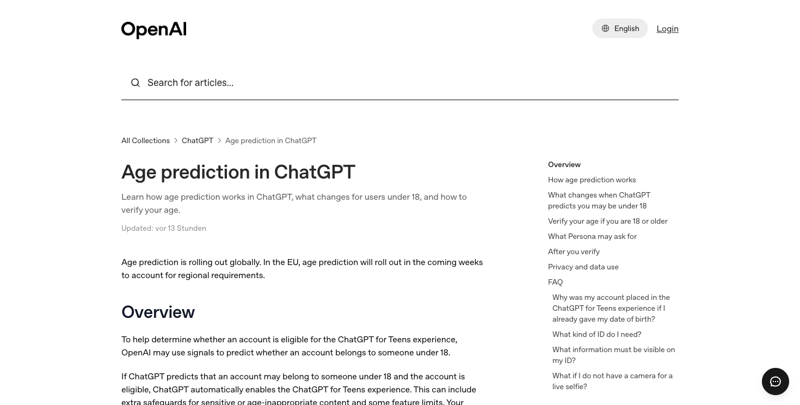
The core mechanic is auto-enrollment. Anyone who tells ChatGPT they’re between 13 and 17 gets the teen experience. So does anyone OpenAI’s system estimates is under 18, whether they said so or not. According to OpenAI’s own account of how this works, the age-prediction model looks at a mix of signals: how long the account has existed, what time of day it’s typically used, general usage patterns over time, and anything the user has stated about their age. Press coverage of the system (via TechCrunch’s January 2026 reporting on the age-prediction launch) has cited a figure of roughly 2,000 underlying signals feeding the model — a detail OpenAI’s own public documentation doesn’t enumerate, so treat that specific number as reported, not officially confirmed.
There’s no toggle to opt out and no birthdate field to lie past the way you might on a random website’s age gate. Lauren Jonas, OpenAI’s head of youth and families, put it plainly in coverage of the launch: “There’s no need for a teen to create a new account or change anything; if we predict you’re under 18, or you’ve told us so, this becomes your default experience.” If the system decides you’re probably a minor, you wake up with a different product.
What the teen experience actually restricts
Once an account is placed into ChatGPT for Teens, the differences aren’t cosmetic. Based on OpenAI’s official documentation and confirmed in multiple outlets covering the launch:
- No romantic or relational language. ChatGPT is explicitly barred from using romantic terms of endearment with teen accounts and is more strongly instructed not to imply it has feelings, consciousness, or emotions of its own — a direct response to concerns about teens forming unhealthy attachments to the chatbot.
- Content blocks around self-harm, suicide, eating disorders, and sexual or graphic content. These protections were already part of the September 2025 parental-controls update; the teen product makes them the default state rather than something a parent has to switch on.
- Homework-shortcut detection. The system is designed to notice when a teen is trying to get ChatGPT to just do an assignment for them, and redirects that request toward Study Mode instead of a straight answer.
- Study Mode on by default, along with “Study Hours” — a guided-learning posture built around quizzes, visualizations, and structured explanations rather than answer-dumping.
- More frequent break reminders and “you’re talking to AI” disclosures, aimed at both overuse and the blurring-the-line problem that shows up in a lot of the teen-AI-companion research.
- Eating-disorder-specific safety notifications were added as part of today’s update — a narrower, newer category than the general self-harm protections that already existed.
None of this is invisible tinkering. If you’re a teen (or you were one 20 minutes ago and got misclassified), the tone, the guardrails, and even what the model will and won’t say about itself are different from the adult product.
Parental controls: what a linked parent account can actually do
The parent side of this hasn’t fundamentally changed since September 2025, but it’s worth being precise about it, because the honest answer is “less than you’d expect.” A parent can link their account to a teen’s via an email or text invite. Once linked, they can:
- Set quiet hours — blocking ChatGPT access during set windows, like school hours or after bedtime
- Disable memory, voice mode, image generation, and visible chat history on the teen’s account
- Opt the teen’s conversations out of being used for model training
- Receive safety notifications, including the newly added eating-disorder alerts, when the system detects a high-risk conversation
That last one runs through limited human review — OpenAI’s documentation describes flagged conversations getting a human look before a notification goes to a parent, with the message itself redacted rather than the full transcript being handed over.
Here’s the part that matters most and gets glossed over in a lot of the initial coverage: a parent cannot read their teen’s chat history. The whole design is built around “smoke alarm, not dashboard” — you get told that something concerning happened, not what was said. Whether that’s the right tradeoff depends entirely on your family and your teen’s age, and there’s a real argument on both sides of it that we’ll get into in the decision section below.
What This Doesn’t Fix — the Honest Limits
No safety feature launched today is airtight, and pretending otherwise does families a disservice. Four limits are worth knowing before you decide how much to trust this.
1. Age prediction is a probability, not a fact. OpenAI has not published accuracy numbers for how often the system gets it right. One industry analysis of chatbot age-gating broadly (cited in Perplexity’s research summary of this space) found systems tend to be more accurate on explicit prompts — someone directly stating an age or intent — and less reliable at inferring age purely from behavior, especially for adults whose usage patterns happen to resemble a teen’s: new accounts, late-night use, students, non-native English speakers, or people who simply write in short, casual sentences.
2. Shared devices and shared adult use blur the signal badly. A parent who shares a laptop with their teen, a teacher who uses ChatGPT the same way their students do, or a young-looking-in-text 22-year-old grad student are all plausible false-positive candidates. There’s no public data yet on how often this happens in practice, because the system is one day old.
3. The appeal path exists but requires biometric data. If you’re an adult wrongly placed in teen mode, OpenAI’s documented fix is to verify your age through Persona, a third-party identity-verification service, typically via a selfie (with an ID check available in some countries). OpenAI says it receives only the verified age result back from Persona, not the photo or ID itself — but you’re still handing a third party a picture of your face to prove you’re old enough to talk to a chatbot without restrictions. Sameer Hinduja, co-director of the Cyberbullying Research Center, has raised exactly this concern in coverage of age-assurance systems broadly: the privacy tradeoff of biometric verification is real, even when the stated data-retention policy is narrow, and device-level or platform-level signals are generally preferable to asking users to submit ID.
4. A teen who wants to get around this has options nobody’s documented yet. Twenty-four hours into the rollout, there’s essentially no evidence of scaled teen workaround tactics circulating publicly — no viral “how to trick the age predictor” threads, no widely shared prompt tricks. That’s genuinely different from how kids have historically routed around age gates on platforms like Discord, where workaround culture formed almost immediately. It may mean the system is harder to game than expected, or it may just mean it’s too new for anyone to have found the gaps yet. Don’t mistake “no public workaround yet” for “unbeatable” — assume some teens will eventually find a soft spot, the same way they always have with every previous age gate.
What Real People Are Saying, 24 Hours In
The public reaction split roughly the way you’d expect a launch like this to split, and the loudest voices weren’t parents — they were teens themselves and industry watchers.
The most-engaged post covering the launch’s substance came from independent OpenAI tracker Tibor Blaho (257 likes, nearly 22,000 views), whose thread laid out the mechanics — auto-enroll, Study Mode, the Model Spec update on “relational interactions” — in more technical detail than most mainstream coverage attempted. CNN’s coverage (95 likes, 231,000 views) tied the launch directly to the lawsuits: “The move comes as OpenAI faces a string of lawsuits alleging that inappropriate conversations with ChatGPT contributed to the harm or deaths of young people.”
Reaction from people who’d actually be affected by this was more mixed and, in some threads, openly frustrated. One reply to the Blaho thread — from an account with 17 likes — read simply: “stupidest shit ever, get rid of this.” A more developed pushback, quoted in a separate thread, came from someone identifying as a “relatively recent former 17-year-old”: “I find it absolutely maddening when people treat 17-year-olds as barely human out of a misdirected desire for safety on the internet.” That tension — protecting genuinely vulnerable younger teens versus a blanket policy that also restricts a 17-year-old who’s a year from voting — is the central fault line in almost every piece of teen-safety tech, and this launch hasn’t resolved it any more than previous ones did.
On the “this is overdue, not novel” side, a widely echoed critique (surfaced across several tech-press pieces, not just social reaction) asked why these protections weren’t built in from the start, given ChatGPT scaled to hundreds of millions of weekly users years before a teen-specific product existed. It’s a fair question with an unsatisfying answer: safety features on consumer AI products have consistently arrived after adoption, not before it, across every major chatbot.
The most substantive skepticism came from a developer account (@stackzz) that reframed the whole launch around a single design risk: “The product has to decide who gets the restricted experience before the tutoring begins. That makes age estimation the real trust test. A wrong answer doesn’t just change a setting; it changes the AI experience around a student.” That’s the crux of it — every downstream feature (Study Mode, break reminders, content restrictions) depends on getting the age guess right first, and nobody outside OpenAI can currently audit how often that guess is wrong.
How This Compares to Google and Anthropic
If you’re wondering whether to worry about ChatGPT specifically or AI chatbots broadly, the honest answer is: this is currently a ChatGPT-specific product, not an industry standard yet.
Google/Gemini has its own age-assurance work underway — the company has published material on “age assurance measures for safer online kids and teens” and Gemini’s own under-18 experience — but as of this launch, Google hasn’t shipped anything with the same auto-enroll-by-behavioral-prediction mechanism OpenAI just deployed. Google’s approach so far leans more on account-type signals (a Google Workspace for Education account, a Family Link–managed account) than on inferring age from chat content and usage patterns the way ChatGPT’s system does.
Anthropic/Claude takes a different position entirely: Claude’s consumer terms of service currently require users to be 18 or older, full stop, with no teen-specific product tier. That’s a stricter policy on paper (no one under 18 is a permitted consumer user), though it also means Anthropic doesn’t have an equivalent system to catch teens who sign up anyway claiming to be adults — a gap ChatGPT’s age-prediction system is explicitly designed to close.
Neither comparison is a clean “Google is better” or “Claude is safer” verdict. They’re different tradeoffs: OpenAI is trying to build a permissive-but-restricted teen product; Anthropic is trying to keep teens off the adult product entirely (with limited ability to enforce that); Google is somewhere in between, leaning on account infrastructure it already controls through schools and Family Link. Watch this space — the Claude parental controls search term is already showing up as a related query on ChatGPT’s own parental-controls results, which is usually a sign competitors are about to be pulled into the same conversation.
What This Means for You
If you’re a parent of a 13–17-year-old who already uses ChatGPT: Assume they’re already in the teen experience, or will be within days as the system builds usage history. Your first action: send the linking invite from your own account (Settings → Parental Controls) and set quiet hours before you do anything else. That single step gets you the safety-notification pipeline even if you never look at anything else.
If you’re a parent of a tween approaching 13: The system may place them in teen mode even before they officially qualify, based on stated age or inferred signals — that’s not a bug, it’s the “estimates under 18” half of the rule. Don’t wait for a specific birthday to have the conversation about what ChatGPT is and isn’t for.
If you’re 18+ and got flagged as a teen by mistake: Go to Settings → Account and look for the age-verification flow (or use the direct link at chatgpt.com/verify_age). You’ll be asked to submit a selfie via Persona. It’s a few minutes of friction in exchange for removing the restrictions — a fair trade for most people, an uncomfortable one if you’re specifically uneasy about biometric data collection, which is a reasonable thing to be uneasy about.
If you’re a teacher or school administrator: This doesn’t change your students’ school-issued accounts if those run through a separate education agreement, but it will affect how students use ChatGPT on personal devices and personal accounts outside class. Worth a heads-up email to parents if your school has been recommending ChatGPT for homework help.
If you’re a teen reading this yourself: The honest version is that this system is trying to protect people younger and more vulnerable than you might be, at the cost of some friction for you specifically if you’re 16 or 17 and frustrated by being lumped in with a 13-year-old. That frustration is legitimate. It’s also not going away this week — the appeal path (age verification) exists, but it’s built for adults misclassified as teens, not for teens who want adult-mode access.
If you’re a mental-health professional or school counselor: The eating-disorder and self-harm notification pipeline is new enough that its real-world reliability is untested. Don’t treat “my patient’s parent didn’t get an alert” as evidence nothing concerning happened — treat it as evidence the system didn’t flag it, which is a different thing.
If you’re evaluating AI tools for your own household’s tech policy more broadly: This is a good moment to audit all the AI tools in your home, not just ChatGPT. Gemini, Claude, and any AI features baked into gaming platforms or social apps don’t have identical protections, and a teen locked out of ChatGPT’s romantic-language restrictions can simply open a different app that has none.
Edge Cases and Troubleshooting
“My 17-year-old got put in teen mode and it’s breaking their workflow for school.” Study Mode’s homework-shortcut detection is aggressive by design. If it’s genuinely interfering with legitimate research or writing help, the honest options right now are: have them lean into Study Mode’s guided format (it’s meant to still get them to the answer, just via more steps), or use a different tool for that specific task while keeping ChatGPT for lower-stakes use.
“I’m an adult with a new account and got flagged as a teen.” New-account status is one of the documented signals feeding the age-prediction model. This is a known false-positive pattern — verify your age via Persona rather than trying to “prove it” through behavior, since the system reportedly won’t re-run prediction once you’ve verified.
“My teen’s account isn’t showing the teen experience even though they’re 15.” Enrollment is rolling out globally in phases — full availability in some markets (Australia was cited as trailing to around September 8) lags the initial US/global push. If your teen isn’t in it yet, that’s likely a rollout-timing issue, not a system failure — but don’t assume it means they’re exempt long-term.
“Can I see exactly what triggered a safety notification?” No. The design intentionally shows you that something happened and a general category, not the underlying conversation. If you need more context, the documented path is a direct conversation with your teen, not the app.
“My teen shares a laptop with a sibling who’s an adult — will the adult get flagged too?” Plausible, based on how the signals work (time-of-day and usage-pattern overlap on a shared device). If this happens, the adult sibling would use the same Persona verification path.
“Does linking a parent account mean I can see who they’re talking to or what they searched?” No — linking gives you controls (quiet hours, feature toggles, safety notifications) and a monitoring pipeline for high-risk content specifically, not a general activity log.
“What happens to a teen’s existing chat history and memory when they get auto-enrolled?” OpenAI’s documentation doesn’t spell out a retroactive wipe; memory and chat history become things a linked parent can subsequently disable going forward, which implies existing history isn’t automatically deleted at enrollment — but this specific detail isn’t confirmed in OpenAI’s public materials as of launch day, so treat it as an open question rather than a settled fact.
“Is there a way to permanently prove I’m an adult so this never happens again?” Age verification via Persona is described as a one-time fix per account — once verified, OpenAI says age prediction isn’t re-run on that account. That’s the closest thing to a permanent fix currently offered.
Comparison: What Changed vs. What Was Already There
| Feature | Before Sept 2025 | Sept 2025 (Parental Controls) | Jan 2026 (Age Prediction) | Aug 18, 2026 (ChatGPT for Teens) |
|---|---|---|---|---|
| Age verification | None | Manual parent-set, opt-in | Behavioral estimate, opt-out via verification | Behavioral estimate + stated age, default for flagged accounts |
| Content restrictions for minors | None by default | Available if parent enabled controls | Same as Sept 2025 | Default-on for auto-enrolled accounts |
| Romantic/relational language limits | None | None | None | New — explicitly barred for teen accounts |
| Homework-shortcut detection | None | None | None | New — redirects to Study Mode |
| Eating-disorder safety alerts | None | Self-harm alerts only | Self-harm alerts only | New — eating-disorder-specific notifications added |
| Parent visibility into chats | None | None (notifications only) | Same | Same — still no transcript access |
| Enrollment trigger | N/A | Parent opts in | System estimate, applies restrictions | Auto-enroll: stated age 13–17 OR system estimate |
| Adult misclassification fix | N/A | N/A | Verify via Persona | Same — Persona selfie/ID verification |
Frequently Asked Questions
Is ChatGPT safe for my 14-year-old now? Safer than before, in the specific sense that content restrictions and break reminders are now the default rather than something a parent had to manually enable. It’s not a guarantee — age prediction is probabilistic, and no content filter is perfect. If you’re deciding whether to let a young teen use ChatGPT at all, link a parent account and set quiet hours as a baseline, regardless of what you decide about broader access.
How does ChatGPT know my kid is a teenager if they never told it their age? The system infers it from account signals — how long the account has existed, typical time-of-day usage, and general usage patterns — combined with anything explicitly stated. It’s a prediction, not a lookup against any official record.
Can I turn off the teen restrictions for my own kid if I think they’re unnecessary? Not directly. There’s no parent-side toggle to disable the teen experience for an account the system has classified as a minor’s; the linking controls affect specific features (quiet hours, memory, notifications) within that experience, not whether the experience applies at all.
What if my teen lies and says they’re 18? The system can still flag the account based on behavioral signals even if a false adult age was entered — that’s the entire point of layering prediction on top of self-reported age rather than trusting self-reported age alone.
Does this apply to ChatGPT Enterprise or Team accounts my teen might access through a job or internship? OpenAI’s documentation frames this around personal Free and paid personal accounts; workplace-managed accounts operate under separate admin policies and aren’t the focus of this launch.
Is there a kid-friendly version of ChatGPT for kids under 13? OpenAI’s terms have generally required users to be at least 13 (or the applicable age of digital consent in their country) for standalone accounts; this launch doesn’t introduce a distinct under-13 product.
What data does OpenAI actually get back from the Persona age-verification check? According to OpenAI’s public description, it receives the verified age result, not the selfie or ID document itself, which is retained by Persona under its own data policies.
Will my teen’s chats now be used to train ChatGPT’s models? Parents can opt a linked teen’s conversations out of model training as one of the available controls — it’s not automatic, so check that setting specifically if it matters to you.
Should I be more worried about this news, or less, than before Aug 18? Less, cautiously. The system closes a real gap (restrictions that used to require a parent to actively enable are now on by default for flagged accounts), while opening a new one (probabilistic age-guessing that hasn’t published accuracy data). Read it as “meaningfully better than yesterday, not a solved problem.”
The Bottom Line
ChatGPT for Teens is a genuine step forward from where things stood a week ago — restrictions that used to depend on a parent knowing to turn them on are now the default for any account the system suspects belongs to a minor. But “default-on” isn’t the same as “airtight,” and the honest read of this launch is that OpenAI has built a smoke alarm, not a dashboard: you’ll get told when something concerning happens, not shown what was actually said, and the entire system rests on an age-prediction model whose real-world accuracy nobody outside OpenAI can currently verify.
If you’re a parent, the single highest-value move today is linking your account and setting quiet hours — five minutes of setup that gets you the safety-notification pipeline regardless of how the rest of this evolves. If you’re trying to understand AI tools well enough to make these calls with confidence instead of guesswork, that’s exactly the gap our AI Fundamentals course is built to close — a plain-language foundation in how these systems actually work, not just what they’re marketed as doing.
Sources
- OpenAI — Introducing ChatGPT for Teens
- OpenAI — Our approach to age prediction
- OpenAI — Introducing parental controls
- OpenAI Help Center — Age prediction in ChatGPT
- Axios — OpenAI debuts ChatGPT for Teens
- CNN via X — ChatGPT for Teens launch coverage
- TechCrunch — OpenAI’s age prediction launch (January 2026)
- Reuters — Mother sues OpenAI alleging ChatGPT encouraged daughter’s suicide
- The Hill — OpenAI launches ChatGPT for Teens with safety tools
- Engadget — ChatGPT’s stricter teen mode starts rolling out
- Georgetown KGI — Technical assessment of online age-assurance systems
- MacRumors — OpenAI Announces ChatGPT for Teens
