A storm rolls through Thursday night. By 6 a.m. your phone has eleven voicemails, your inbox has four “is my tree going to fall on the house” emails, and your two crews are already booked solid for the day. You know exactly which of those eleven calls is the real emergency — the oak leaning over the kid’s bedroom. What you don’t have is the twenty minutes it takes to write everyone back, send three estimates, and still get to the job site by 7:30.
That gap — between the work you can do and the office work you can’t keep up with — is where tree service owners are quietly putting ChatGPT to work in 2026. Not on the dangerous part. On the typing.
What’s actually happening (and what’s just sales pitch)
If you’ve gotten a cold call this year from an “AI for tree service” company, you’ve heard the loud version: AI answering services for $2,500 a month, AI that “books jobs while you sleep,” AI estimating tools that price a removal from a satellite photo. Some of that is real and useful. A lot of it is software companies selling to a trade with cash and a labor problem.
Here’s the quieter, more honest version of what’s working — the part you can do today with a free or $20 ChatGPT account and zero new software:
- The Tree Care Industry Association now openly recommends ChatGPT, Claude, and Perplexity to its members for drafting estimates, follow-up emails, FAQs, job ads, SOPs, and safety-meeting agendas — with a human checking every word.
- One tree care firm profiled in TCI Magazine raised its lead-conversion rate 42% in two months mostly by replying to inbound leads faster.
- The reason this matters so much in this trade specifically: storms create a flood of leads at exactly the moment your crews are least available to answer the phone, and the company that replies first usually wins the job.
So the use case isn’t “let AI run the business.” It’s “stop losing the high-ticket storm job because the call went to voicemail and the estimate took two days.”
The 5-minute storm-damage update
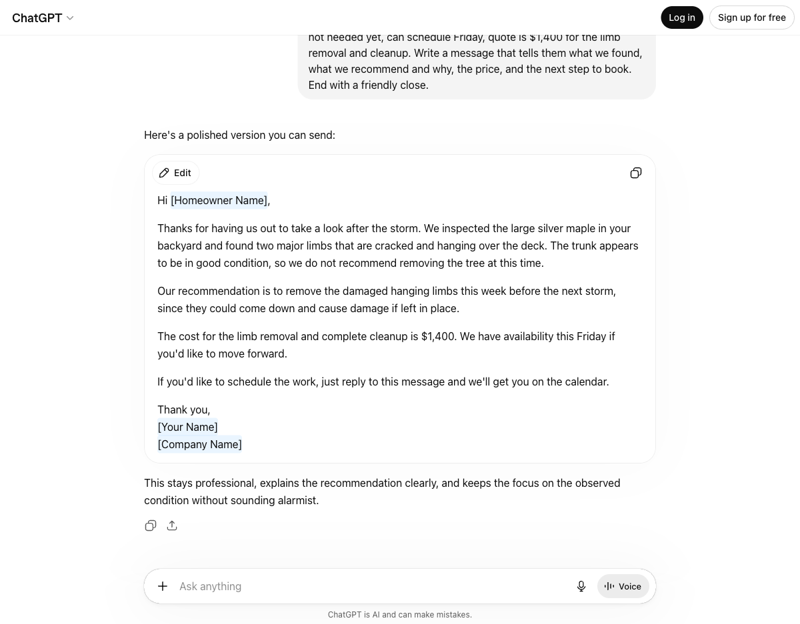
This is the one to learn first, because it’s the highest-value message you send all season. After a storm you need to tell a homeowner three things clearly: what you found, what it’ll cost, and what happens next. Done well it sounds professional and calm. Done in a hurry from your truck it sounds like a text from a stranger.
Open ChatGPT and paste this, filling in the brackets with whatever you’d say out loud:
You are helping a tree service owner write a clear, professional message
to a homeowner after a storm. Keep it calm, plain-English, and under 150 words.
No scare tactics, no jargon.

Here are my rough notes from the site visit:
[e.g. — big silver maple in back yard, two major limbs cracked and hanging
over the deck, trunk looks okay, needs the hanging limbs removed this week
before the next storm, full removal not needed yet, can schedule Friday,
quote is $1,400 for the limb removal and cleanup]

Write a message that: tells them what we found, what we recommend and why,
the price, and the next step to book. End with a friendly close.
You’ll get back something you can read, fix one detail in, and send. The whole point is that you already made every real decision — what’s wrong, what to do, what it costs. ChatGPT just turned your notes into a message a customer trusts. That’s the line, and we’ll come back to it.
Three more prompts that earn their keep
The plain-English estimate explainer. Customers don’t argue with a price they understand. Paste your line items and ask ChatGPT to explain why the dead oak by the driveway is a priority, in homeowner language:
Turn this estimate into a short, friendly explanation a homeowner will understand.
Explain why each item matters in plain English. Don't change any prices.
Estimate: [paste your line items and totals]
The same-day review reply. Reviews are your storm-season marketing. Don’t let them sit:
Write a warm, specific 2-3 sentence reply to this review. Mention the
service by name, sound like a real person, not a corporation.
Review: [paste the customer's review]
The “now hiring climber” post. Every tree company in America is short on crew, and the job ad is the bottleneck. Have ChatGPT write the post, then you add the pay range and the one detail that makes your shop different:
Write a short, no-BS job post for an experienced tree climber at a
[town] tree service. Mention safety culture and steady year-round work.
Friendly, direct, not corporate. Leave a blank for pay range.
Batch all four on a Sunday night and you’ve got a week of office work done in the time it takes to drink a coffee.
What this means for you
If you’re a solo arborist or a one-truck operation: this is the biggest unlock. You’re the estimator, the climber, the office, and the marketing department. The storm-update and estimate-explainer prompts buy back the nights you currently spend thumbing out replies. Start there.
If you run two or three crews: your problem is volume, not capability. The real win is speed of reply during the busy season — set up the four prompts above as saved templates so whoever’s at a phone can fire back a professional response in two minutes instead of “I’ll have the owner call you.”
If you’ve got an office manager: don’t replace them — make them faster. Their judgment on which job is urgent and which customer is difficult is worth keeping. Let AI handle the first draft so they spend their time on the calls that actually need a human.
If you’re skeptical of the whole thing: good. The margins in this trade are too thin for expensive toys. The test is simple — does it win you one storm job you’d have lost to voicemail? At $1,500–$2,000 for an emergency removal, it pays for a year of ChatGPT in a single Saturday.
What you should never let AI touch
This is the part the software salespeople skip, and it’s the most important paragraph on this page. There is real “AI for arborists” content out there pushing AI risk-assessment tools — software that looks at a photo and tells you whether a tree is safe. Don’t.
- Never let AI decide if a tree is safe, sound, or coming down. That’s a trained, certified judgment made standing under the tree, looking at root flare, cavity, lean, and storm trauma you cannot see in a photo. One owner online described AI confidently estimating a tree’s age — while a real arborist warned that cutting it wrong could finish off an oak already stressed by a tornado.
- Never let AI plan a rig or a cut. Drop zones, load on a limb, where the saw goes — that’s human, every time.
- Never let AI make the climb-safety call. Whether a climber goes up, in what conditions, with what gear, is a life-or-death decision, not a chatbot output.
- Never paste a customer’s personal details — address, phone, payment info — into ChatGPT. Keep prompts about the work, not the person.
- Never send AI text without reading it. It will occasionally invent a detail or get a price wrong. You’re the editor. Your name is on the truck.
The Tree Care Industry Association and ISA-credentialed arborists are consistent on this: AI drafts the communication; the human owns the risk. Keep that line bright and AI is a genuine help. Blur it and you’ve got a liability.
The bottom line
Tree work is one of the most AI-resistant trades there is — you cannot send a chatbot up a storm-damaged maple with a chainsaw. That’s exactly why the smart move is to let AI take the office work it’s actually good at (the typing, the follow-ups, the job ads) so you can spend more of your day on the billable, skilled, dangerous work only you can do. Learn the four prompts above and you’ve turned your slowest part of storm season — keeping up with customers — into a five-minute job.
If you want the full step-by-step — setting up ChatGPT from scratch, building your own saved prompt library, and the complete safety guardrail for the trades — our AI for Contractors: Winning More Bids course walks a non-technical crew lead through it from zero. Pair it with Claude for Small Business for the customer-communication side.
Sources
- TCI Magazine — Transforming Tree Care With AI: Practical Applications for Your Business
- NIP Group — 2026 Tree Care Industry Trends: What’s Next and How Brokers Can Prepare
- Omni AI — How AI Is Helping Tree Service Companies Book More Jobs in 2026
- Tree Care Industry Association (TCIA)
- International Society of Arboriculture (ISA) — Find an Arborist & credentialing
