Here’s the part of teaching music nobody auditions for. According to the Music Teachers National Association’s 2024 survey, an independent studio teacher works about 27.6 hours a week — and only 16.6 of those are actual lessons. The other eleven hours go to prep, recitals, bookkeeping, and the quiet evening grind of typing up what each student should practice and emailing parents about it. At a typical lesson rate, that’s tens of thousands of dollars a year you spend not teaching.
There’s a clean way to hand a chunk of those hours back, and it has nothing to do with replacing what you do. A teacher described it perfectly online recently: someone watched a coach turn his sloppy practice notes into a clean weekly plan for parents in two minutes with ChatGPT — and the point wasn’t that the tech coached anyone. It gave him back the night he’d have spent typing it up.
That’s the whole idea. Your ear runs every lesson. ChatGPT just writes up what your ear already heard. Let’s set it up — including the one rule that makes it work instead of backfire.
The admin tax (and why it costs you students, not just time)
The hours are bad enough. But the bigger problem is what doesn’t happen when you’re out of time: the parent never hears how their kid is doing.
There’s a well-documented “visibility gap” in music education — parents pull their children out of lessons not because they’re too busy, but because they can’t see progress. A child practices, improves slowly, and from the kitchen it all sounds the same. Meanwhile, the research is blunt about retention: parental involvement is one of the strongest predictors of whether a student keeps playing and enjoys it, and roughly half of all students quit by age 17. Summer is the danger zone — 40 to 50% of students who take an unmanaged “summer break” simply don’t come back in the fall.
A two-sentence weekly note — “Emma nailed her G major scale today and we started the Minuet; this week she’s polishing measures 5 through 8” — closes that gap. It’s the cheapest retention tool you have. It’s also the thing that never gets sent, because it’s 8:30pm and you’ve still got four more students to write up.
The 15-minute weekly batch
Here’s the move. Instead of writing each student up from scratch, you keep rough shorthand during or right after the lesson — the way you already do — and then ChatGPT turns the whole roster into polished notes in one pass.
Type something like this:
I’m a piano teacher. Turn my shorthand into a short, warm, personalized practice note for each student — written to the parent, encouraging, plain English, 3–4 sentences each. Use ONLY the details I give you; do not invent anything about their playing. Here are this week’s notes:
- Emma (age 9): G major scale clean, started Minuet 1, hesitated on the left-hand fingering in m.5–8. Practice hands separately, slow.
- Marcus (age 14): Wonderwall chord changes getting smoother, still rushing — needs metronome at 80.
- Sofia (age 7): Great ear, reading lags. Flashcards 5 min/day, review note values.
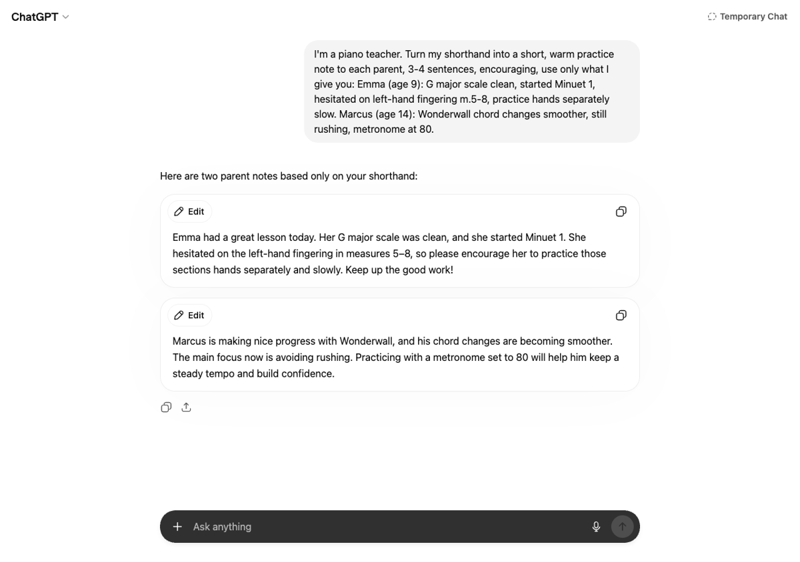
Out comes a warm, parent-ready note for each student. You skim, fix anything that’s off, and send. What used to be an hour is fifteen minutes. (Our differentiated content skill is built for exactly this per-student tailoring, and the email tone adjuster will soften or sharpen any note to match how you talk to a particular family.)
The one rule that makes this work: feed it the specific thing your ear caught. This isn’t optional polish — it’s the difference between a note that helps and one that doesn’t. The research on practice is clear that generic instructions (“practice 20 minutes”) don’t improve playing, while targeted ones (“measures 5–8, hands separately, that left-hand fingering you hesitated on”) do. And here’s the kicker: ChatGPT can’t generate that detail. It doesn’t know Emma hesitated on the F# major scale on Tuesday. Only you do. The AI formats your diagnosis; it cannot make the diagnosis. That limitation is exactly why the result still sounds like you and still actually helps.
Use the time you get back to keep students enrolled
This is the part to run before fall. The optimal re-enrollment window is late August through October, and the students most at risk are the ones who drifted over summer. Take the hours the weekly workflow frees up and point them at the visibility gap: a short, genuine progress note to every family before sign-up season — what their kid accomplished this year, what’s next, why continuing matters. The parent message skill drafts these in your voice in minutes. It’s the single highest-leverage thing you can do to keep your roster full, and now you actually have time to do it.
The line you don’t cross
This matters more in music than almost anywhere, so be clear about it.
ChatGPT writes the admin. It never teaches the music.
- Never trust it for the actual content. There’s a well-known story of a guitar teacher who kept pulling chords from ChatGPT and couldn’t figure out why they were wrong. The chatbot confidently makes up music theory, fingerings, and chords. Your training is the source of truth — always.
- The paid apps are student-side supplements, not your replacement. ROLI’s AI Music Coach is real, but it needs a $299 controller plus a $10–15 monthly subscription, and even ROLI positions it as a self-learner’s entry path, not a teacher replacement. Yousician, Simply Piano, and the rest are the same — paid tools a beginner might use between lessons. None of them can hear a student’s tone, watch their hand position, or notice they’re frustrated today. You can.
- The human is the point. As one teacher put it: the AI is for teaching the busywork; the human is for inspiring. Students keep going because someone real sees them. No app does that.
What this means for you
If you’re a solo piano or guitar teacher: this is your office assistant for free. Keep your shorthand, batch it once a week, and reclaim your evenings. The notes also quietly make you look more professional than the studio down the road.
If you run a multi-instrument studio: standardize the workflow and the parent-update template across your teachers. Consistent, frequent communication is what separates studios that grow from studios that churn.
If you’re building a roster: start the weekly-note habit on day one. The teachers parents rave about aren’t necessarily the best players — they’re the ones who keep families in the loop.
If you’re worried about the AI apps: don’t be, but don’t ignore them either. Know what they cost and what they can’t do, so when a parent asks “should we just get the app?” you can answer honestly — they’re practice supplements, and they can’t replace the person who actually teaches their child.
What this won’t do for you
- It won’t teach. It can’t hear, can’t watch hands, can’t motivate a discouraged kid. That’s all you.
- It can’t be trusted for music content. Chords, theory, fingerings — verify everything against your own training. It fabricates confidently.
- It can’t write a note without your input. Generic notes don’t help students; the specific detail comes from your ear, every time.
- It won’t fix a thin roster by itself. It frees up time and improves your communication — you still teach great lessons and build the relationships.
- It won’t send itself. You review every note before it reaches a parent. Always read first.
The bottom line
The teachers whose studios stay full year after year aren’t the ones with the fanciest gear. They’re the ones whose families feel seen and informed. That used to cost you your evenings. Now it costs fifteen minutes and a prompt — for the writing. The teaching, the ear, the encouragement, the judgment about what each student needs next: all of it stays exactly where it belongs.
If you want the broader playbook, our Teaching with AI course walks educators through the admin-saving workflows in plain English, and Tutoring with AI covers the one-on-one, between-session communication that keeps students enrolled — the same muscle that runs a private music studio.
Save the evenings. Keep the ear.
Sources
- MTNA 2024 Member Survey Summary (PDF)
- How music teachers are using AI tools — Practice Space
- The visibility gap: the retention problem killing music schools — Dave Simons Music
- Win back summer drops: fall re-enrollment — Ensemble Schools
- Parental involvement predicts enjoyment and progress — ERIC (Royal Conservatory study)
- The best AI tools for music teachers in 2026 — Pract.is
- Introducing AI Music Coach — ROLI
