Let’s say the awkward part first, because if we don’t, you’ll close this tab: this is not about AI making tattoos. Your art is yours, drawn by your hand, full stop. AI-generated “designs” deserve every bit of the heat they get — clients are right to feel like a piece run through a model came back contaminated, and “No AI” has become a real badge of trust for a reason. None of that is what this is about.
This is about the thing that’s quietly losing you clients, and it isn’t your art. It’s the DMs. The most-shared post in the whole tattoo conversation online right now isn’t about a bad tattoo — it’s a client with 2,700 likes saying she backed out twice because the artist wouldn’t answer messages after she’d paid the deposit: “if you can’t even open an Instagram DM after the deposit’s been paid, why would I let you play on my skin?” That’s the real problem. The admin — the intake questions, the deposit confirmations, the aftercare sheet you re-type at midnight — eats eight to twelve hours of your week and burns you out, and the burnout is what reads as “this artist doesn’t care.”
So here’s the deal. AI for the paperwork. Your hand for the art. Never the other way around. Here’s exactly how to set it up.
The line, drawn clearly
Everything below uses ChatGPT for words you’d write anyway — an aftercare sheet, a booking message, a deposit confirmation. It never touches a design, a stencil, or a reference. The community’s instinct is correct: AI images are trained on other artists’ work, they ignore line weight and how a piece ages, and a client who brings you an AI “design” is handing you something that’ll blur the second it heals. That fight isn’t yours to lose by accident. Keep AI on your side of the counter, not on the skin.
Done right, this actually strengthens the “I don’t use AI for art” position — because now you can say it cleanly: AI helps me answer you faster; it has never drawn a thing.
Why the aftercare sheet first
Start here because it’s the highest-leverage one, and because in a lot of places it’s not optional. Health departments in states like Texas, Michigan, and cities like New York legally require you to give every client written aftercare instructions — and often to document that they received them. You’re already supposed to be handing this out. Most artists are either re-typing it every time or working off a sheet they copied from someone years ago.
And those copied sheets are a mess. A peer-reviewed study that analyzed 700 American tattoo aftercare instructions found “tremendous” variation — sheets that contradicted each other, skipped basic hygiene, or never told the client when to actually see a doctor. That inconsistency is exactly why you write yours once, carefully, from a real source — and why you never let a chatbot freelance the medical parts.
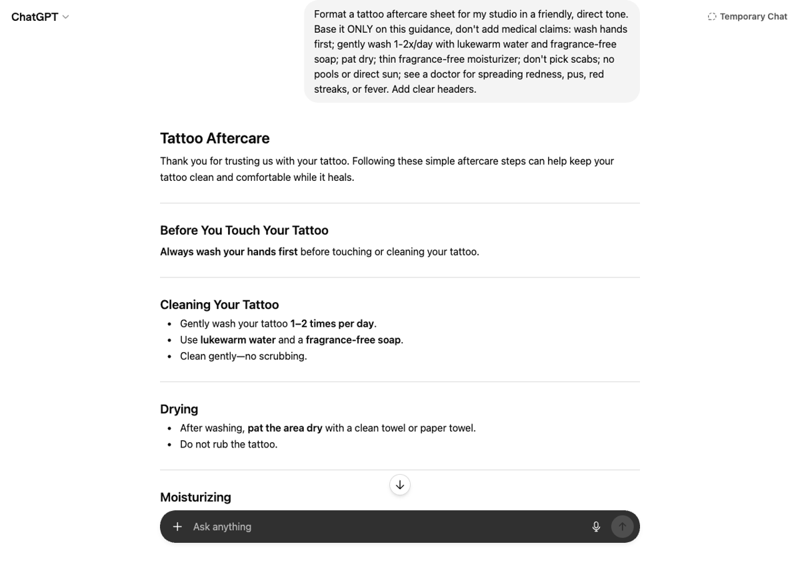
Here’s the prompt. The trick is you give it the real medical content and your studio’s voice, and you forbid it from inventing anything:
Help me format a tattoo aftercare sheet for my studio, [studio name]. Here is the medical guidance I want it based on — do NOT add, change, or invent any medical claims, timelines, or product recommendations beyond what I give you: [paste the do’s and don’ts from a reputable source — see below]. My studio’s tone is [friendly and direct / calm and clinical / etc.]. Lay it out clearly with short headers a nervous client can follow, end with the infection warning signs and “see a doctor, not me, if you notice these,” and keep my voice throughout.
You feed it the facts. It does the formatting and the tone. You read every line before it gets printed.
Where the medical content comes from (not ChatGPT)
This is the non-negotiable. The healing advice in your sheet should come from a real authority, not a model’s guess. The dermatology consensus is consistent on the basics: wash your hands first; gently wash the tattoo once or twice a day with lukewarm water and a fragrance-free soap; pat dry; apply a thin layer of a bland, fragrance-free moisturizer; don’t pick or scratch scabs; keep it out of pools, baths, and direct sun; and once it’s healed, use SPF 30+ on it. Surface healing runs roughly two to four weeks.
The part you must get exactly right is the infection section: spreading redness, increasing pain or heat, thick yellow or green pus, red streaks running out from the tattoo, fever — those mean see a doctor, and your sheet should say so plainly.
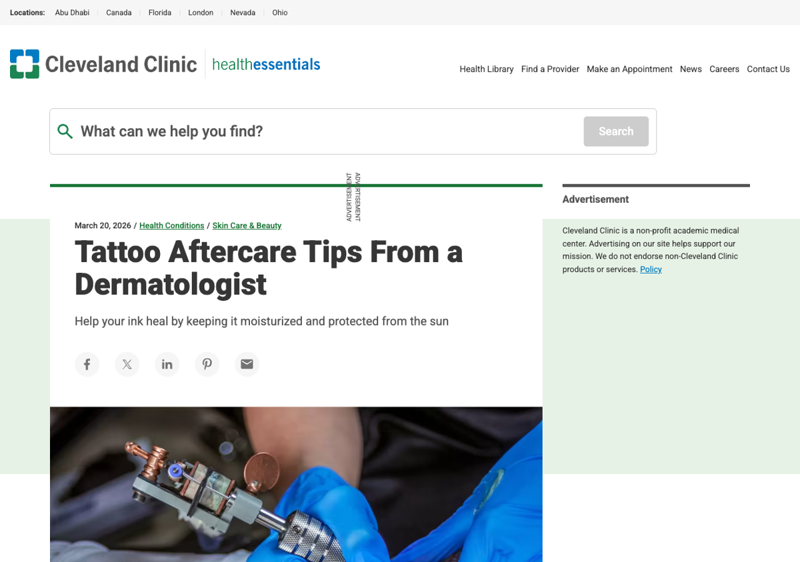
Pull your facts from a source like the American Academy of Dermatology, Cleveland Clinic, or — best of all — the exact language your state or city health department already requires. Paste that into ChatGPT. The chatbot’s job is to make it sound like you and lay it out well, never to decide what’s medically true.
The other two: intake and deposits
Once the aftercare sheet’s done, the same move handles the rest of the booking grind.
The consultation intake. Ask ChatGPT to turn your booking questions into a clean intake message: placement, size, budget range, reference vibe (their own ideas, not AI ones), plus the health screening — allergies, medications, pregnancy, skin conditions, whether they’re 18 with ID. Our appointment booking skill maps to this directly. One caution: a consent form has legal teeth that vary by state, so have a lawyer check the actual waiver language — AI can draft the plain-English skeleton, but a human signs off on the liability part.
The deposit and confirmation. This is the one that fixes the @miroreoo problem. A warm, clear, fast message: deposit received, here’s your date and time, here’s the cancellation policy, here’s what to do the night before. No-shows quietly cost some studios five figures a year, and the studios that confirm clearly and reply quickly cut them dramatically. You write the template once with the professional email writer, then it’s a 30-second copy-paste instead of a DM you keep meaning to send.
The point of all three: when a client messages you, you can answer like a person who has their act together — in two minutes, between sessions — instead of letting it sit until they assume you don’t care.
What this means for you
If you’re a solo artist drowning in DMs: this is the whole game. You’re not adding a robot to your studio; you’re writing three messages once so you never write them again. The fast reply is the marketing.
If you run a small studio: standardize it. One aftercare sheet, one intake, one deposit message in the studio’s voice, used by everyone. Clients get a consistent experience and you stop re-explaining policy.
If you’re newer / apprenticing: build these now. The artists who lose clients aren’t usually the worst tattooers — they’re the ones who vanish between the deposit and the appointment. Don’t be that. Set up the comms before you have a backlog to bury you.
If no-shows are your problem: lead with the deposit-and-confirmation message and a clear, kind cancellation policy. Most no-shows are confusion and silence, not malice. Close that gap and the calendar steadies.
What this won’t do for you
- It will never make your art. That’s the whole point. No designs, no stencils, no “touching up” a client’s piece through a model. Your hand only.
- It can’t decide what’s medically true. Every healing claim comes from a real authority and your own judgment. ChatGPT formats; it does not diagnose.
- It won’t clear your consent waiver legally. Get a lawyer to check the binding parts. Laws vary by state and country.
- It can’t replace your read on a client. The gut feeling about whether a piece, a placement, or a person is right — that’s yours.
- It won’t reply on its own (unless you wire up automation). The free version writes the templates; you still hit send, or you pay for booking software that does.
The bottom line
The artists who keep their chairs full aren’t the ones with the flashiest tools. They’re the ones who answer the message. For years that meant choosing between staying on the machine and staying on top of your inbox. It doesn’t anymore — you can write the aftercare sheet, the intake, and the deposit message once, in your own voice, and get the hours back for the only thing that was ever actually the job.
AI for the paperwork. Your hand for the art. If you want the full back-office workflow built out — the same admin-yes, craft-no approach that powers our estheticians and dog groomers courses — those walk a non-technical pro through it step by step.
Answer the DM. Keep the art yours.
Sources
- Tattoo aftercare — Cleveland Clinic
- Tattoos: 7 unexpected skin reactions and what to do about them — American Academy of Dermatology
- Tattoo aftercare guidance — European Academy of Dermatology & Venereology (PDF)
- An analysis of 700 American tattoo aftercare instructions — PubMed
- Texas Administrative Code §229.408 — required tattoo care instructions
- Minimal aftercare instructions for tattoo — Michigan MDHHS (PDF)
- BBC — How AI is changing the tattoo industry
