The math is genuinely scary if you’re an independent tutor. A year of Khanmigo costs about $44 — and one subscription covers up to ten kids. A single hour with a human tutor runs $25 to $80. So a parent can buy a full year of AI tutoring for less than one hour with you. It’s “the summer of the AI tutor,” and 95% of students now use AI for schoolwork, up from 66% just two years ago.
Here’s the part that should actually calm you down: that $44 app isn’t coming for you. It’s coming for the after-school drilling that wealthy families used to pay tutors for. If your whole value is explaining the quadratic formula one more time, yes — you’re exposed. But if you’re the person a struggling kid trusts, the one who notices when they shut down and knows how to pull them back — no app at $44 or $4,400 does that. This post is how to use ChatGPT to make the first part faster so you can sell the second part harder.
What’s actually happening to tutoring
The threat is real but specific. Research is consistent on this in 2026: AI tutors deliver real learning gains, but the best outcomes come from a “human-in-the-loop” model where a tutor uses AI to scale practice and feedback — not from leaving a kid alone with a chatbot. Brookings, Bloom’s famous “two-sigma” tutoring research, and the actual usage data all point the same way.
The honest framing for your business: a pure explainer is very vulnerable. A coach, diagnostician, and motivator is not. Your job in 2026 isn’t to out-explain the AI — it’s to do everything the AI can’t, and to use the AI to buy back the prep hours you currently spend making worksheets at 10 p.m.
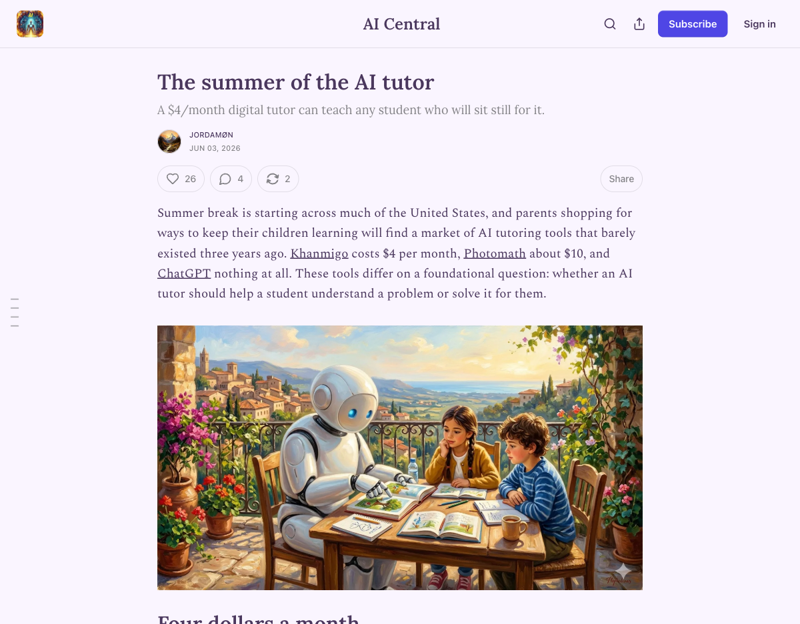
Four ways to prep faster with ChatGPT
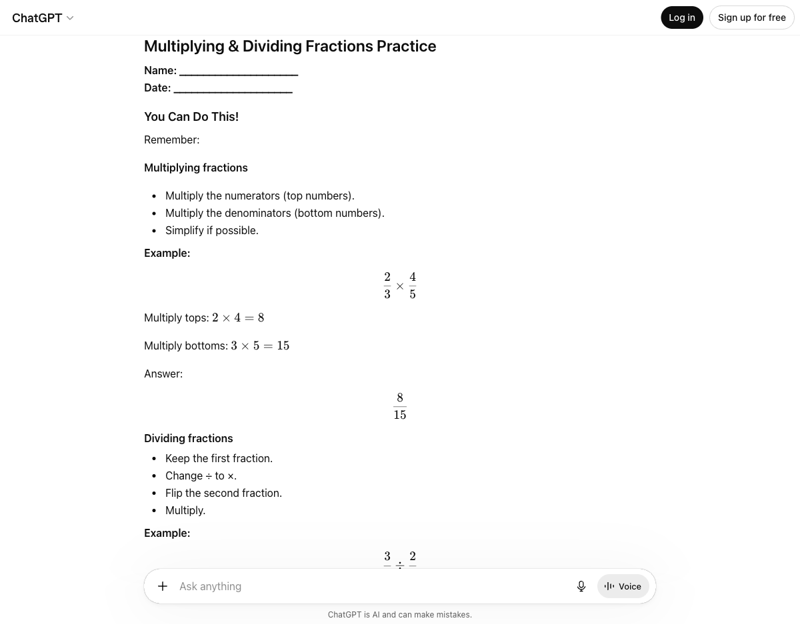
1. Custom worksheets in two minutes. Stop hunting PDFs. Describe the student and get tailored practice:
Create a practice worksheet for a 7th grader who understands basic
fractions but struggles with multiplying and dividing them. 8 problems,
increasing difficulty, with a short worked example at the top and an
answer key at the end. Keep the wording simple and encouraging.
2. A session plan from your messy notes. Paste what you scribbled last week and get a structured next session:
Here are my notes from last session: [paste]. Build a 45-minute
1-on-1 session plan for next time: a quick warm-up, the main focus,
a check-for-understanding, and one confidence-building win at the end.
3. Parent progress updates that take 30 seconds. This is the one that wins referrals — parents pay for tutors who communicate:
Write a warm, specific weekly progress update to a parent. Student: [name].
This week we worked on [topic]. Wins: [x]. Still working on: [y].
One thing to practice at home: [z]. Friendly, 5-6 sentences, no jargon.
4. A diagnostic you actually run. Use AI to design a quick check, then deliver it yourself and read the kid live:
Give me 6 short diagnostic questions to find exactly where a student's
understanding of [topic] breaks down, from easiest to hardest, with a
note on what a wrong answer to each one tells me.
That last one is the whole strategy in miniature: AI builds the tool, you run it and interpret it. The interpreting is the job.
What this means for you
If you’re a subject tutor (math, science, writing): lean all the way into prep automation. Worksheets, practice sets, and parent updates are where AI buys you the most time — reinvest it into more students or deeper sessions.
If you do test prep (SAT, etc.): AI is excellent for generating endless practice items and drills, but your edge is strategy, pacing, and managing test anxiety — exactly the socio-emotional stuff AI is weakest at. Sell that.
If you’re a language tutor: cheap AI conversation apps are real competition for raw practice. Position yourself on what they can’t do — correcting in context, cultural nuance, accountability, and a human who notices when a student is faking confidence.
If you support students with learning differences or anxiety: this is the most AI-proof tutoring there is. Reading non-verbal cues, adjusting in real time, building a kid’s identity as a learner over months — name that explicitly to parents. It’s the opposite of a $44 app.
What you should never do — and what AI can’t
The safeguarding line first, because it matters most:
- Never put a child alone with a general chatbot as their “tutor.” ChatGPT isn’t built with the safety guardrails of education-specific tools. Use it for your prep, behind the scenes — not as an unsupervised tutor for a young student.
- Never paste a student’s full name, school, or personal details into ChatGPT. Use a first name or initials in your prompts. Keep their data yours.
- Never hand over a worksheet without checking it. AI makes math errors and invents facts. You’re the editor — a wrong answer key is worse than no worksheet.
And the things AI simply can’t do, which are now your core product:
- Read the room. Body language, tone, the slumped-shoulder “I don’t get it but I won’t say so” — AI misses all of it.
- Adapt live. A great tutor changes course mid-sentence on a subtle signal. AI follows a script.
- Know the context. The teacher’s quirks, the family situation, the kid’s anxiety triggers — that local knowledge shapes everything and lives only in your head.
- Mentor over time. Building executive function, motivation, and a learner’s identity over months is the two-sigma magic. AI supplements it; it doesn’t replace it.
The bottom line
The $44 AI tutor is real, and it will absolutely eat the market for tutors whose only offer is explanation-on-demand. It will not touch the tutor who diagnoses, motivates, and earns a family’s trust. So use ChatGPT to win back your prep time — worksheets, plans, parent updates, diagnostics — and pour that time into the human work no app can do. That’s not competing with AI. That’s using it to become the kind of tutor no one cancels.
Want the full system — the prompts, the parent-communication templates, and how to position yourself against AI apps without sounding defensive? Our Tutoring with AI course is built exactly for the independent tutor figuring this out right now. Start with AI Fundamentals if you’re brand new to ChatGPT.