If your free ChatGPT suddenly seems to remember that you’re vegetarian, or that you’re studying for the CPA exam, you didn’t imagine it. On June 9, OpenAI quietly amended its GPT-5.5 Instant announcement with one paragraph: personalization is “now rolling out to ChatGPT Go & Free.” No keynote, no blog post of its own — just the biggest upgrade the free tier has gotten in a year, slipped in as an update note.
For the roughly nine in ten ChatGPT users who’ve never paid a cent, here’s what actually changed, what’s still locked behind the $20 plan, and the one trade-off OpenAI would rather you not think too hard about.
What just changed
Two upgrades landed on free accounts in the past five weeks, and they compound.
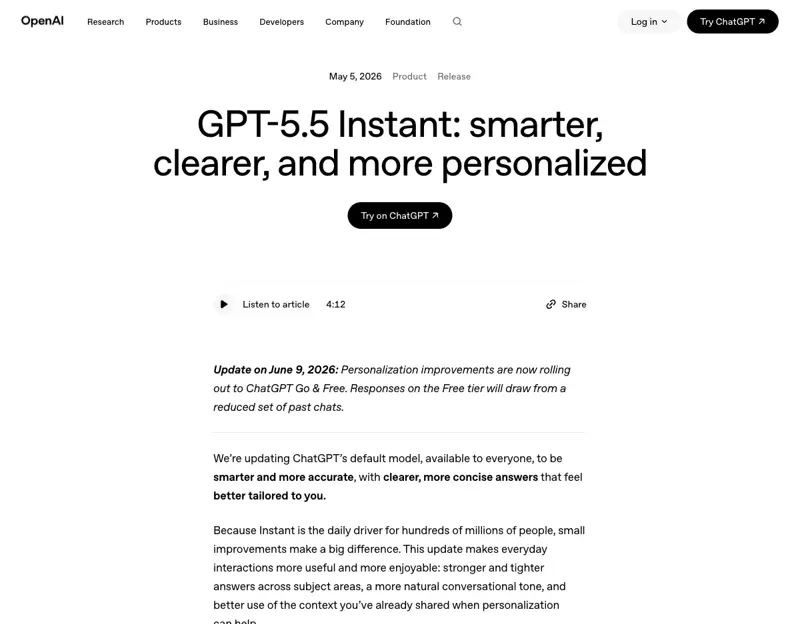
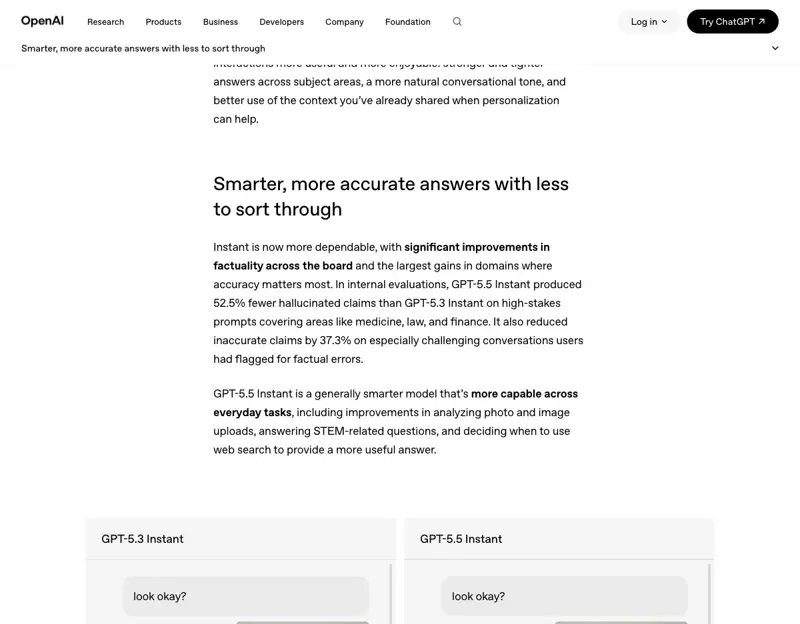
First, the brain. On May 5, OpenAI swapped ChatGPT’s default model to GPT-5.5 Instant — for everyone at once, free included. That’s unusual; free tiers normally get the hand-me-down model. By OpenAI’s internal testing, the new default makes 52.5% fewer hallucinated claims on high-stakes topics like medicine, law, and finance, and gives answers about 30% shorter. (Worth holding lightly: those are OpenAI’s own evaluations, not independent benchmarks.)
Second, the memory. On June 9, the personalization built on OpenAI’s “dreaming” memory system — the background process that reads your past chats and quietly builds an understanding of you — started reaching Free and Go accounts. We explained how dreaming works when it launched for paid users; the short version is that ChatGPT now consolidates what it learns about you the way a brain consolidates memories during sleep.
Why did free users suddenly get a feature this expensive to run? OpenAI said it plainly: engineering work “reduced the compute required to serve dreaming to Free users by approximately 5x.” The accountants signed off, so you get a memory.
What free accounts actually get (and don’t)
Three things arrived for free users:
- Past-chat personalization. ChatGPT references your previous conversations, so you stop re-explaining yourself in every new chat.
- Memory Sources. Tap the small book icon under a response to see exactly what context shaped it — which saved memory, which past chat — and delete or correct anything that’s wrong or stale. This transparency panel is honestly the best part of the rollout, and it’s on every plan.
- Saved memories. The explicit “remember that I…” notes, now with the improved system underneath.
What stays paid — and this is the line OpenAI drew carefully:
| Feature | Free | Plus ($20/mo) |
|---|---|---|
| Past-chat personalization | ✅ Reduced set of recent chats | ✅ Full multi-year synthesis |
| Memory capacity | Standard | Doubled |
| Memory summary page (full dreaming profile) | Rolling out gradually | ✅ Full |
| Files in memory (library) | ❌ (500 MB storage) | ✅ (20 GB) |
| Gmail integration | ❌ | ✅ (outside EU/UK) |
| Ads | Yes | No |
The phrase doing the heavy lifting is “a reduced set of past chats.” Free ChatGPT will remember the recent you; Plus remembers the whole you. OpenAI describes the free version as “short-term continuity” versus the paid tiers’ “longer-term understanding.” That’s a real difference, not marketing fog — and it’s clearly designed to make the upgrade feel natural once you’ve gotten used to being remembered at all.
The 2-minute control check
Whether you find this delightful or unsettling, take two minutes today:
- See what it knows: Settings → Memory. Free accounts get a manageable list; you can delete any item (⋯ → Delete) or everything at once.
- Check what shaped an answer: tap the book icon under any personalized response. Mark sources irrelevant or delete them right there.
- Want one conversation off the record? Use Temporary Chat (the icon at the top right of a new chat). It doesn’t read your memories, doesn’t create new ones, and doesn’t enter your history.
- Want none of it? Settings → Memory → toggle off. Turning off saved memories also turns off chat-history reference.
- The ads angle: Settings → Ad controls lets you turn off ad personalization (you’ll still see contextual ads) and clear your ad data.
What this means for you
If you use free ChatGPT casually: This is all upside with one homework item. The answers got measurably better and the re-explaining tax is gone. Do the 2-minute control check once, then enjoy it.
If you’ve been on the fence about Plus: Wait a month. The honest test is whether “short-term continuity” is enough for how you use it. If you keep noticing ChatGPT forgot something from March, that’s the gap Plus closes — and now you’ll know you’re paying for the difference, not the idea.
If you’re on Go ($8/month): You get the same memory sources as Free with 10× the messages — but also the same ads. Go’s value question just got sharper: you’re paying to remove the message limit, not the ads or the memory cap.
If you’re privacy-cautious: The combination to think about isn’t memory or ads — it’s memory and ads. Ad targeting on free accounts can draw on past chats and memories when personalization is on. Turning off ad personalization (step 5 above) breaks that link while keeping the useful memory. That’s the setting that matters most.
If you’re in the EU: Both the ads and the memory features arrive on a different schedule — ads require explicit opt-in consent under GDPR, and some memory features (like Gmail integration) don’t ship in the EEA at all. Your free tier is, for once, the more private one by default.
What this can’t fix
You might not have it yet. The rollout is staged “over the coming weeks.” If your free account still has no memory, that’s the queue, not a setting you missed.
The memory has edges. A reduced window means free ChatGPT can confidently “remember” a stale version of you — the job you left, the diet you quit. The fix is the book icon: when a personalized answer feels off, check its sources and prune. As one skeptic on X put it after the rollout: the failure mode isn’t forgetting, it’s “quietly settling on a wrong assumption about you and then acting on it.”
The accuracy numbers are OpenAI grading OpenAI. A 52.5% hallucination reduction is meaningful if it holds, but independent testing hasn’t confirmed it yet. The new model still makes things up — less often is not never.
Ads now know you better. The Network Advertising Initiative flagged the memory-plus-ads combination within a day of the rollout. OpenAI’s rules are real (no ads on sensitive topics, conversations not shared with advertisers) — but a behavioral profile that improves ad targeting is the business model, and you’re opted in by default.
It’s still not Plus. If your work depends on ChatGPT holding long-running project context, the free tier’s short window will frustrate you on schedule. That’s by design.
The bottom line
Free ChatGPT crossed a line this week: from a very good answer machine to something that knows who’s asking. Take the upgrade — it’s genuinely the most useful thing the free tier has ever gotten — but take the two minutes of settings with it, because a tool that remembers you should remember what you choose.
If you want to actually drive the new model well — prompts that use the memory instead of fighting it — our GPT-5.4+ for ChatGPT Users course covers the daily-driver skills, free tier included.
Sources
- OpenAI — GPT-5.5 Instant: smarter, clearer, and more personalized (with June 9 update)
- OpenAI — Memory and new controls for ChatGPT
- OpenAI Help Center — ChatGPT release notes
- The Decoder — ChatGPT update rolls out GPT-5.5 Instant
- Implicator.ai — OpenAI expands ChatGPT memory to free users after 5× compute cut
- Network Advertising Initiative — analysis of ChatGPT ads and memory, June 10, 2026
- Axios — OpenAI updates ChatGPT Instant with GPT-5.5
